

Have you ever watched the Federal Reserve talk about interest rates and wondered, “Why is my stock moving because of this?” I did. I was investing in Korean and U.S. companies, yet every inflation report and rate announcement seemed able to shake both markets at once. At first, the connection felt almost unfair. The company had not suddenly changed, so why was the price falling?
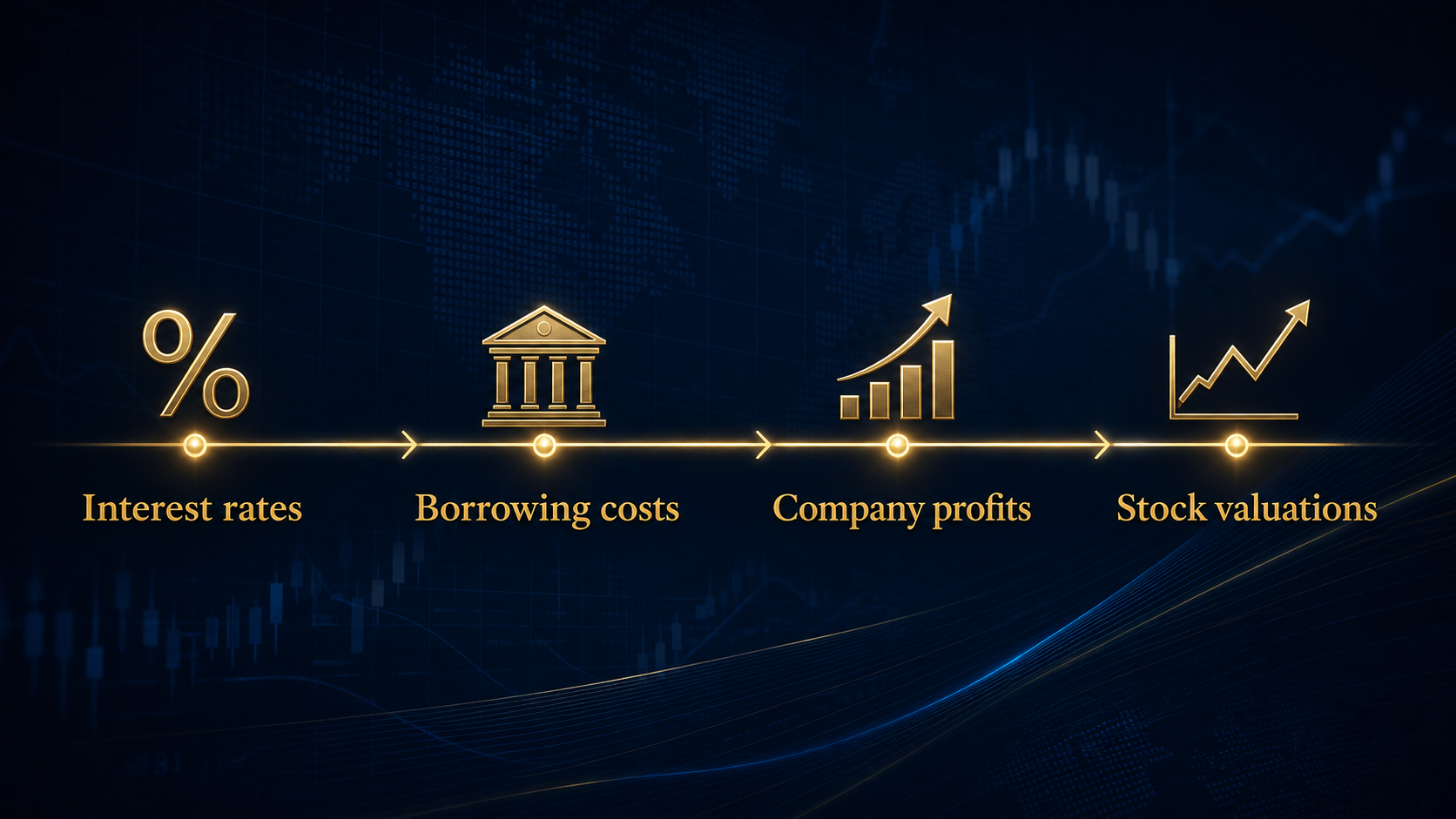
The short answer is that interest rates change the price of money. They affect borrowing costs, bond yields, company valuations, currency flows, and how much risk investors are willing to take. Inflation matters because central banks often use interest rates to slow rising prices. Once I understood that chain, the market’s reaction stopped looking completely random.
This does not mean every stock must fall when rates rise or rally when rates fall. Earnings, valuation, debt, industry conditions, and investor expectations still matter. It means inflation and interest rates change the background against which all of those pieces are judged.
Let’s unpack that relationship in plain English, starting with what inflation and interest rates actually mean and ending with what a long-term investor can realistically do.
Educational Disclaimer: This article is for educational purposes only and is not personal financial advice. Investing involves risk, including the possible loss of principal.
Key Takeaways
- Inflation reduces the purchasing power of money over time.
- Higher interest rates can pressure stock valuations, especially growth stocks.
- ETFs are affected by the stocks, bonds, or assets they hold.
- Index ETFs can still be useful for long-term investors, but they are not risk-free.
- Dollar-cost averaging can help investors stay disciplined during uncertain markets.
- Long-term investors should focus on diversification, costs, quality, and time horizon.
What Is Inflation?
Inflation means prices are rising across the economy. When inflation increases, the same amount of money buys fewer goods and services than before. For example, if food, rent, energy, transportation, and healthcare costs rise, households feel pressure even if their income stays the same.
For investors, inflation matters because it affects real returns. A portfolio may earn a positive return on paper, but if inflation is high, the investor’s real purchasing power may grow much less than expected. This is why simply holding cash can become risky over long periods.
Inflation can also influence company profits. Some businesses can raise prices and protect margins. Others may struggle because their costs rise faster than their revenue. This difference is one reason inflation does not affect every stock in the same way.

What Are Interest Rates?
Interest rates represent the cost of borrowing money and the reward for saving or lending money. Central banks, such as the Federal Reserve in the United States, use monetary policy to influence short-term interest rates and broader financial conditions.
When inflation is too high, central banks may raise interest rates to slow borrowing, reduce demand, and bring inflation closer to target. When the economy is weak, they may lower rates to encourage borrowing, investment, and spending.
This matters for investors because interest rates affect the discount rate used to value future cash flows. In simple terms, when interest rates rise, future profits become less valuable today. That can put pressure on stock prices, especially for companies expected to earn much of their profit far in the future.
For beginners looking to build a long-term portfolio, understanding index ETF investing can help you apply these economic concepts in a simple and diversified investment strategy.
How Inflation Affects Stocks
Inflation affects stocks through costs, consumer demand, profit margins, and investor expectations. If a company can raise prices without losing customers, inflation may be manageable. If a company faces rising wages, materials, shipping, or financing costs but cannot raise prices, profit margins may shrink.
Some sectors may handle inflation better than others. Companies with strong brands, essential products, pricing power, and healthy balance sheets may be more resilient. Businesses with weak margins, heavy debt, or low pricing power may face more pressure.
This is why inflation does not automatically mean all stocks will fall. The effect depends on the type of company, the strength of demand, the level of debt, and how investors expect the Federal Reserve to respond.
If you are new to the stock market, start with our guide on what a stock is and how stocks work. Understanding the basic structure of stock ownership makes it easier to understand why macroeconomic changes affect prices.
How Interest Rates Affect the Stock Market
Interest rates affect the stock market in several ways. First, higher rates increase borrowing costs. Companies that depend on debt may have to pay more interest, which can reduce profits. Second, higher rates can slow consumer spending because mortgages, credit cards, auto loans, and business loans become more expensive.
Third, higher rates make safer assets more attractive. If cash and bonds offer higher yields, some investors may demand lower stock prices before taking equity risk. This can reduce the valuation investors are willing to pay for stocks.
Growth stocks are often more sensitive to rising rates because their valuations depend heavily on future earnings. Value stocks, dividend stocks, and profitable companies with strong cash flow may sometimes hold up better, although they can still decline during broad market sell-offs.
| Market Factor | When Rates Rise | Possible Investor Reaction |
|---|---|---|
| Growth Stocks | Future earnings are discounted more heavily | Valuations may fall |
| Dividend Stocks | Compete with higher bond yields | Investors may demand better yields |
| Bonds | New bonds may offer higher income | Income investors may shift allocation |
| Cash | Savings yields may improve | Cash becomes less unattractive |
| Borrowers | Debt costs rise | Highly leveraged companies may struggle |
How Inflation and Interest Rates Affect ETFs
ETFs are not separate from the market. An ETF is affected by the assets it owns. A stock ETF moves based on the stocks inside the fund. A bond ETF is affected by interest rates, credit risk, and bond prices. A sector ETF may be more exposed to one part of the economy.
For example, a broad index ETF may hold technology, healthcare, financial, consumer, industrial, and energy companies. Inflation and interest rates may affect each sector differently. This is one reason broad ETFs can reduce company-specific risk, but they still cannot eliminate market risk.
If you are still learning ETF basics, read our full guide on what an ETF is and how it works. For investors who prefer passive investing, our article on index ETFs explains how broad-market funds can support long-term wealth building.
ETF costs also matter. During low-return or volatile periods, high fees can quietly reduce long-term results. Our guide to ETF expense ratios explains why costs should be part of every fund comparison.
Why Higher Rates Can Pressure Stock Valuations
Stock prices are partly based on expectations about future earnings. When interest rates are low, investors may be willing to pay more for future growth because alternatives such as cash and bonds offer lower returns. When rates rise, that calculation changes.
Higher rates can make investors more selective. Instead of buying any company with a strong growth story, they may focus on businesses with real profits, durable cash flow, strong balance sheets, and reasonable valuations.
This does not mean long-term investors should automatically sell stocks when rates rise. It means investors should understand that valuation risk becomes more important. Paying too much for weak or speculative companies can be dangerous when money is no longer cheap.
Why Dollar-Cost Averaging Can Still Work
Inflation and interest rates can create market volatility. Prices may fall after inflation reports, Federal Reserve meetings, earnings warnings, or recession fears. For long-term investors, one practical response is dollar-cost averaging.
Dollar-cost averaging means investing a fixed amount of money on a regular schedule. Instead of trying to guess the perfect entry point, investors build positions gradually. When prices are lower, the same contribution buys more shares. When prices are higher, it buys fewer shares.
This strategy does not guarantee profit or prevent losses. However, it can reduce emotional decision-making and help investors stay consistent. If you want a deeper explanation, read our beginner guide on what dollar-cost averaging is.
Practical Tips for Long-Term Investors
Long-term investors do not need to predict every inflation report or interest rate decision. A more practical approach is to build a portfolio that can survive different environments. That means focusing on diversification, reasonable costs, quality assets, and a time horizon long enough to handle volatility.
- Do not panic after one inflation report. Markets often react quickly, but long-term strategy should not depend on one data point.
- Understand what your ETF owns. A technology ETF, dividend ETF, bond ETF, and broad index ETF can behave very differently.
- Watch costs. Expense ratios matter more over long periods than many beginners realize.
- Keep cash needs separate. Money needed soon should not depend on short-term stock market performance.
- Use diversification. A portfolio built around only one sector or one theme can be fragile.
- Think in real returns. Inflation-adjusted purchasing power matters more than nominal returns.
Common Mistakes Beginners Make
The first mistake is assuming that inflation always destroys stocks. The reality is more complex. Some companies can pass higher costs to customers, while others cannot. Some sectors may benefit from certain inflationary conditions, while others suffer.
The second mistake is assuming that ETFs are automatically safe. ETFs can be diversified, but they still carry market risk. A concentrated sector ETF can be much riskier than a broad-market index ETF.
The third mistake is trying to time every Federal Reserve decision. Interest rate expectations can change quickly. By the time a beginner reacts, the market may have already priced in much of the news.
Frequently Asked Questions
Does inflation always hurt stocks?
No. Inflation can hurt some stocks more than others. Companies with strong pricing power may handle inflation better, while companies with weak margins or high debt may struggle.
Are ETFs good during inflation?
ETFs can be useful during inflation if they fit the investor’s goals and risk tolerance. Broad index ETFs provide diversification, but they can still fall when the overall market declines.
Do higher interest rates always make stocks fall?
No. Higher rates can pressure valuations, but stock prices also depend on earnings, economic growth, investor expectations, and company quality. The effect is not automatic or identical across all sectors.
Should beginners invest when interest rates are high?
Beginners should avoid making decisions based only on interest rates. A disciplined plan, diversified assets, reasonable costs, and a long-term horizon are more important than trying to predict the perfect macro environment.
How do inflation and interest rates affect index ETFs?
Index ETFs are affected by the companies or assets inside the index. Inflation can affect company costs and consumer demand, while interest rates can affect valuations and investor risk appetite.
Final Thoughts
I still get frustrated when a rate headline pushes down companies whose long-term business outlook I believe in. Understanding the reason does not make a red portfolio pleasant. It does stop me from treating every market move as proof that the company itself is broken.
When inflation or the Fed dominates the news, ask three questions: Has the company’s business changed? Is its debt or valuation especially sensitive to rates? Has my original reason for owning it changed? Those questions are more useful than reacting to the first frightening headline.
Rates will rise, fall, and surprise us again. A long-term plan should be able to live through more than one interest-rate cycle. That is the part I try to remember when the market starts shaking and every headline suddenly feels urgent.