
What Is a Stock? Complete Beginner’s Guide
What Is a Stock? Quick Comparison
| Investment | What You Own | Main Risk |
|---|---|---|
| Stock | A share of one company | Company and market risk |
| ETF | A basket of investments | Fund and market risk |
| Bond | A debt investment | Credit and interest-rate risk |
Learning how the stock market and interest rates works begins with one simple question: what is a stock? A stock represents ownership in a company. When you buy a share of stock, you are buying a small piece of that business. If the company grows, earns more money, and becomes more valuable over time, your stock may increase in value. If the company struggles, your stock may fall. This guide explains what is a stock in plain English, how stocks work, why companies issue shares, how investors make money, and what risks beginners should understand before investing.
Educational Disclaimer: This article is for educational purposes only and is not personal financial advice. Investing involves risk, including the possible loss of principal.
Key Takeaways
- A stock is a small ownership share in a company.
- Companies issue stock to raise money for growth, operations, debt repayment, or expansion.
- Investors can make money from stocks through price appreciation and, in some cases, dividends.
- Stock prices move because of company performance, investor expectations, interest rates, economic conditions, and market sentiment.
- Stocks can build long-term wealth, but they also carry real risk.
What Is a Stock?

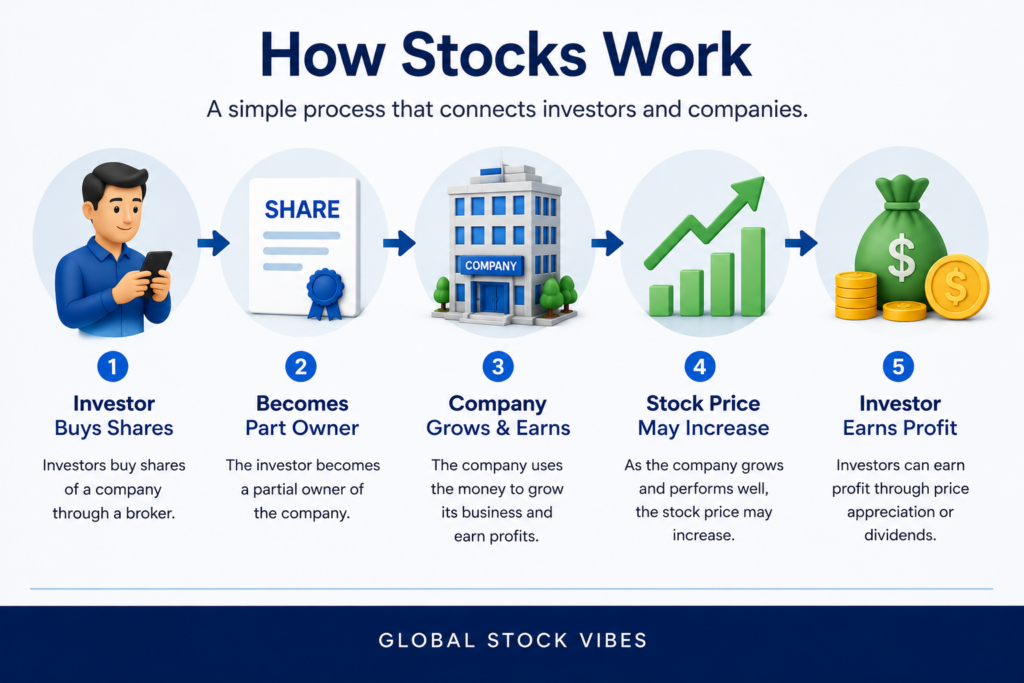
A stock is a financial security that represents partial ownership in a company. If a company has one million shares outstanding and you own one share, you own a very small fraction of that company. That does not mean you can walk into the company’s office and take a chair or decide how employees work. It means you have a financial ownership interest in the business.
This is the simplest way to understand what is a stock: a stock is not just a ticker symbol moving up and down on a screen. It is a claim on a real business. Behind every stock, there is a company with products, customers, employees, costs, revenue, profits, debt, competitors, and future expectations.
For example, when investors buy shares of a large public company, they are not buying a random price chart. They are buying ownership in a business that may sell products, provide services, generate cash flow, and try to grow over time. The value of the stock depends partly on what the company is worth today and partly on what investors believe it may be worth in the future.
Why Do Companies Issue Stock?
Companies issue stock to raise capital. Capital is money a business can use to grow, build factories, hire employees, develop products, repay debt, acquire other companies, or expand into new markets. Instead of borrowing all the money from banks or bond investors, a company may sell ownership shares to public investors.
When a private company decides to sell shares to the public for the first time, that process is called an initial public offering, or IPO. After the IPO, the company’s shares can usually be traded on a stock exchange, such as the New York Stock Exchange or Nasdaq.
For the company, issuing stock can provide access to large amounts of funding. For investors, buying stock creates an opportunity to participate in the company’s future growth. This connection between business funding and investor ownership is central to understanding what is a stock and why the stock market exists.
How Do Stocks Work?
Stocks trade in markets where buyers and sellers agree on prices. If more investors want to buy a stock than sell it, the price may rise. If more investors want to sell than buy, the price may fall. Prices can move quickly because investors constantly react to new information.
Stock prices may change because of company earnings, product launches, leadership changes, interest rates, inflation reports, global events, industry trends, and investor psychology. Sometimes the price movement is based on real business improvement. Sometimes it reflects fear, excitement, or short-term speculation.
When you buy a stock through a brokerage account, you usually buy it from another investor who is selling. The company itself does not receive your money in most normal secondary market trades. The company receives money when it issues new shares, but after that, shares are usually traded between investors.
This is an important point for beginners. The stock market is not only about companies raising money. It is also a marketplace where investors buy and sell ownership claims based on changing expectations.
What Is a Share of Stock?
A share is one unit of ownership in a company. People often use the words “stock” and “share” together, but they are slightly different. “Stock” usually refers to ownership in a company in general, while “share” refers to a specific unit of that ownership.
For example, you might say, “I own stock in a company,” or “I own 10 shares of that company.” Both statements are related, but one describes the investment category and the other describes the number of ownership units.
Understanding this distinction helps answer what is a stock more clearly. A stock is the ownership interest. A share is the measurable piece of that ownership.
How Investors Make Money From Stocks
Investors generally make money from stocks in two main ways: capital appreciation and dividends.
1. Capital Appreciation
Capital appreciation happens when the stock price rises above the price you paid. If you buy a stock at $50 and later sell it at $70, the $20 difference is a capital gain before taxes and trading costs. This is the most common way people think about making money from stocks.
However, capital appreciation is never guaranteed. A stock bought at $50 can also fall to $40, $30, or even lower. The market does not owe investors a profit. Stock prices depend on business results, valuation, investor demand, and broader economic conditions.
2. Dividends
Some companies pay dividends. A dividend is a cash payment made to shareholders, usually from company profits. Not all companies pay dividends. Younger or fast-growing companies may reinvest profits into expansion instead of distributing cash to shareholders.
Dividend-paying stocks can be attractive to investors who want regular income, but a dividend is not guaranteed. Companies can reduce, suspend, or eliminate dividends if business conditions weaken.
If you want to understand how funds hold many stocks at once, read our guide on what an ETF is and how it works. ETFs can make it easier for beginners to invest in a diversified basket of stocks instead of choosing individual companies one by one.
Common Stock vs. Preferred Stock
Most beginners are talking about common stock when they ask what is a stock. Common stock represents basic ownership in a company. Common shareholders may have voting rights and may benefit if the company grows and the stock price rises.
Preferred stock is different. Preferred shareholders usually have a higher claim on dividends than common shareholders, but they often have limited voting rights. Preferred stock can behave more like a hybrid between a stock and a bond, depending on the terms.
For most beginner investors, common stock is the main type to understand first. It is the type most often discussed in financial news, brokerage apps, and long-term investing guides.
Benefits of Investing in Stocks

Stocks have historically provided some of the highest long-term returns among major asset classes, although past performance never guarantees future results. Investing in stocks allows individuals to participate in the growth of businesses around the world.
One advantage of stock investing is compound growth. Investors who reinvest dividends and remain invested for many years may benefit from compounding, where investment gains themselves begin generating additional gains. Time in the market has historically been more important than trying to perfectly predict short-term price movements.
Another advantage is accessibility. Modern brokerage platforms allow investors to buy stocks with relatively low costs, and many brokers now offer fractional shares, making it possible to begin investing with small amounts of money.
Risks of Investing in Stocks
Although stocks offer long-term growth potential, they also involve risk. Prices can rise rapidly, but they can also fall significantly during market corrections, recessions, or company-specific problems.
Investors sometimes experience emotional reactions when markets become volatile. Fear may encourage selling after prices have already fallen, while excitement may encourage buying after prices have already risen. Successful long-term investing often requires discipline, patience, and a willingness to ignore short-term market noise.
Understanding what is a stock also means understanding that ownership does not guarantee profit. Every investment carries uncertainty, and even successful companies experience difficult periods.
Should Beginners Buy Individual Stocks or ETFs?
Many beginners wonder whether they should buy individual stocks or invest in ETFs. The answer depends on their goals, experience, and willingness to research companies.
Buying individual stocks allows investors to focus on specific businesses they believe will grow over time. However, concentrating too much money in only a few companies increases investment risk.
ETFs offer immediate diversification by holding many different companies in a single investment. Instead of relying on one business, investors gain exposure to an entire group of companies. For many beginners, broad-market ETFs can provide a simpler way to begin investing while reducing company-specific risk.
If you are new to ETFs, our guide explaining what dollar-cost averaging is is an excellent place to continue learning.
You may also find our comparison of Index Funds vs. ETFs helpful when deciding which investment vehicle best matches your long-term strategy.
Frequently Asked Questions
What is a stock in simple terms?
A stock represents partial ownership in a company. When you buy a share of stock, you become one of the company’s shareholders and may benefit if the business grows over time.
Why do stock prices change every day?
Stock prices change because buyers and sellers continuously react to new information about companies, the economy, interest rates, earnings reports, and investor expectations.
Can I lose money investing in stocks?
Yes. Stock prices can fall for many reasons, including poor company performance, economic slowdowns, or changes in investor sentiment. Diversification and long-term investing may help reduce risk, but they cannot eliminate it.
Are stocks better than ETFs?
Neither is universally better. Individual stocks may offer higher return potential but also higher risk. ETFs provide diversification and may be easier for many beginner investors.
Final Thoughts
Understanding what is a stock is one of the most important first steps toward becoming a successful investor. A stock is much more than a symbol on a trading screen—it represents ownership in a real business with employees, products, customers, profits, and long-term growth potential.
Before buying any investment, take time to understand how the company makes money, what risks it faces, and how the investment fits into your financial goals. Long-term investing is rarely about finding one perfect stock. Instead, it is about consistently making informed decisions, staying diversified, controlling costs, and allowing time for compounding to work.
Sources
New York Stock Exchange (NYSE)
U.S. Securities and Exchange Commission (SEC) – Investor.gov