
Why holding cash fails to beat inflation is simple: cash may feel stable, but rising prices can reduce what that money can buy. Holding cash and inflation are connected because cash may feel safe while still losing purchasing power when prices rise. Holding cash may feel like the safest financial decision, especially when markets are volatile. Cash does not move up and down like stocks, and a bank balance can feel stable. But over the long term, cash often fails to keep up with inflation and interest rates. As prices rise, the same amount of money buys less than it did before.
This does not mean cash is useless. Everyone needs cash for emergencies, short-term bills, and planned expenses. The problem begins when too much money stays in cash for too long. This guide explains why holding cash can reduce purchasing power, how inflation affects savings, and how long-term investors can think about cash, ETFs, bonds, and productive assets more clearly.
This article is for educational purposes only and does not constitute personal financial advice.

I understand why people hold too much cash. I have roughly $20,000—about ₩30 million—set aside while deciding how to build a dividend portfolio. Even during a market correction, part of me worries that strong stocks will suddenly run higher before I buy. Then another part says, “Wait. What if they fall again?”
Cash removes the daily price swings, but it creates a quieter risk. The balance may look unchanged while groceries, housing, travel, and everything else become more expensive. Nothing dramatic happens on the screen, so the loss of buying power is easy to ignore.
The answer is not to invest every dollar. Cash has a job: emergencies, near-term spending, and flexibility. The real mistake is holding money without deciding what job it has or how long it should remain there.
Why Holding Cash Fails to Beat Inflation: Key Takeaways
Cash feels safe because the number in your bank account usually does not fall. If you deposit $10,000, you still see $10,000 before spending, fees, or withdrawals. That stability can be comforting during stock market corrections, recessions, or periods of economic uncertainty.
Cash also gives flexibility. It can pay for emergencies, cover job loss, fund repairs, or help you avoid selling investments at a bad time. A healthy emergency fund is a practical part of personal finance, not a mistake.
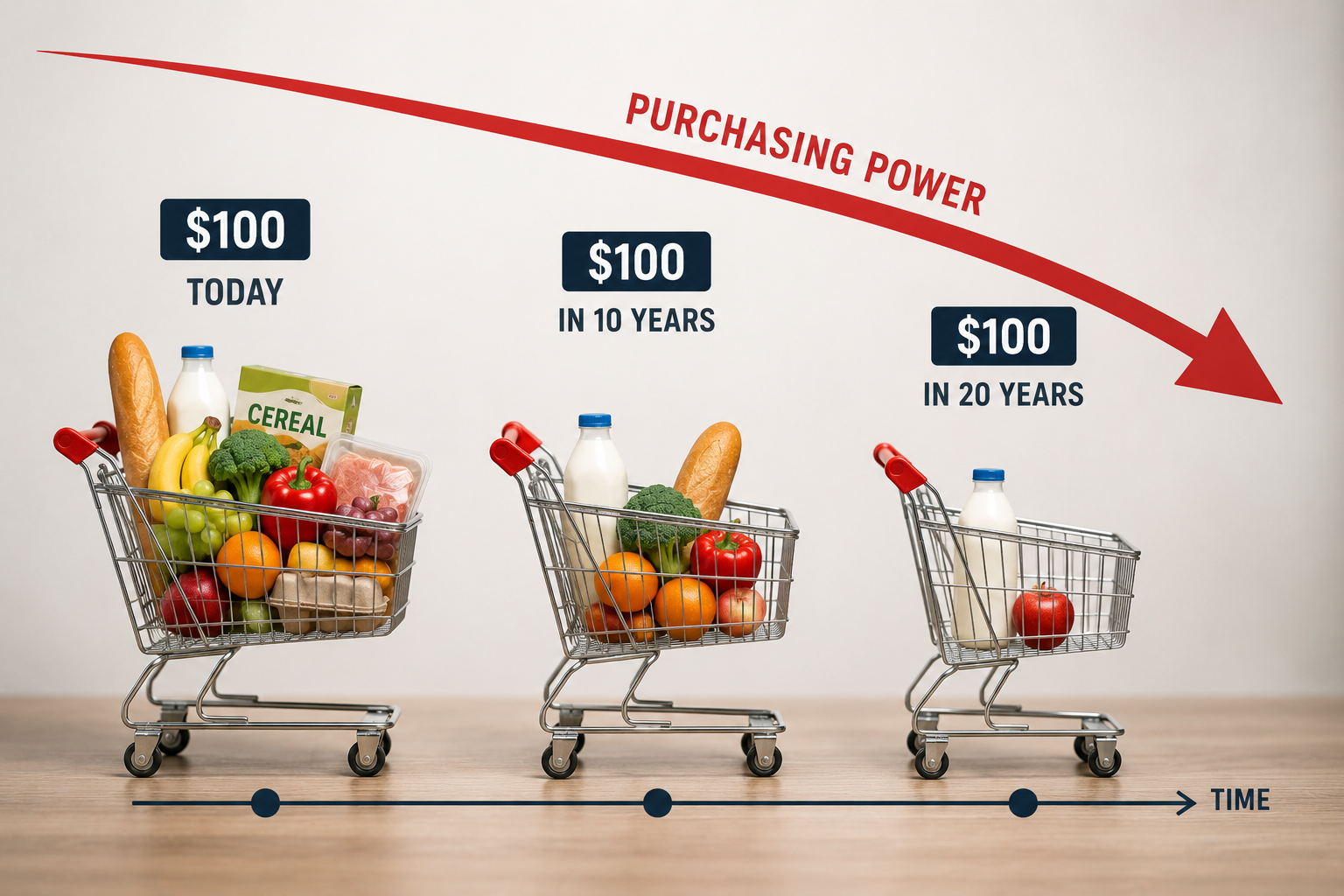
The danger is confusing short-term safety with long-term protection. Cash can protect you from market volatility, but it does not fully protect you from inflation. A dollar may stay a dollar, but the amount of goods and services that dollar can buy may decline over time.
How Inflation Reduces Purchasing Power
Inflation means prices rise across the economy. When food, housing, energy, healthcare, education, and services become more expensive, your cash must stretch further. If your savings account earns less than the inflation rate, your real return is negative.
For example, if cash earns 3% interest but prices rise by 5%, your account balance may grow in nominal terms, but your purchasing power still falls. You have more dollars, but each dollar is worth less in real-world spending terms.
This is why inflation is sometimes described as a hidden tax on idle money. You may not see a line item called “inflation loss” on your bank statement, but the effect appears when the same groceries, rent, insurance, or travel cost more than before.
For official inflation data, investors can review the U.S. Bureau of Labor Statistics Consumer Price Index reports. CPI is not perfect for every household, but it is one of the most widely followed measures of consumer price inflation.
The Difference Between Nominal Return and Real Return
To understand why holding cash can fail over time, investors need to understand the difference between nominal return and real return.
- Nominal return is the return you see before adjusting for inflation.
- Real return is the return after subtracting inflation.
If a savings account pays 4% and inflation is 2%, the real return is positive. If a savings account pays 2% and inflation is 5%, the real return is negative. This simple calculation matters because wealth is not only about the number of dollars you own. It is about what those dollars can buy.
Long-term investors should think in real returns. A portfolio that grows slowly but beats inflation can increase purchasing power. A cash balance that looks stable but loses to inflation can quietly weaken financial security.
When Cash Is Useful
Cash is not bad. In fact, cash has several important roles in a conservative financial plan. The problem is not having cash. The problem is treating cash as a long-term wealth-building asset.
Cash is useful for an emergency fund. Many households keep several months of expenses in cash or cash-like accounts. This can reduce stress and prevent forced selling during market downturns.
Cash is also useful for short-term goals. If you plan to use money within the next one to three years, keeping it in cash, money market funds, certificates of deposit, or short-term Treasury bills may be more appropriate than exposing it to stock market volatility.
Cash can also create opportunity. When markets fall sharply, investors with available cash may be able to buy quality assets at better prices. The key is having a purpose for cash instead of letting it sit indefinitely without a plan.
When Holding Cash Becomes a Problem
Holding cash becomes a problem when the balance is much larger than your emergency needs and short-term goals. At that point, cash may no longer be serving as protection. It may be acting as a drag on long-term wealth.
Large cash balances can feel conservative, but they may expose investors to inflation risk. The risk is not that the cash disappears overnight. The risk is that it gradually buys less over many years.
This is especially important for retirement planning. A person who keeps too much money in cash for decades may avoid market volatility, but they may also miss the compounding power of productive assets. Over long periods, that opportunity cost can be substantial.
The Federal Reserve often discusses financial conditions, inflation, interest rates, and household balance sheets in its public reports and data releases. These topics matter because cash returns, inflation expectations, and interest-rate policy are connected.
Cash vs Inflation: Simple Comparison
| Asset Type | Main Strength | Main Risk | Best Use |
|---|---|---|---|
| Cash | Stability and liquidity | Loses purchasing power when inflation is higher than interest earned | Emergency funds and short-term spending |
| High-yield savings | Better yield than ordinary checking accounts | Rates can change and may still trail inflation | Short-term savings and cash reserves |
| Short-term bonds | Income and relatively lower volatility | Interest-rate risk and reinvestment risk | Conservative income and near-term goals |
| Broad stock ETFs | Long-term growth potential | Market volatility and possible losses | Long-term wealth building |
| Dividend or quality stocks | Potential income and pricing power | Company-specific risk and valuation risk | Long-term investors who understand equity risk |
This comparison does not mean one asset is always better than another. It means each asset has a job. Cash is strong for liquidity. Equities are stronger for long-term growth potential. Bonds may provide income and stability. A good portfolio usually combines different tools instead of relying on only one.
How Productive Assets Can Help Beat Inflation
Productive assets are assets that can generate income, earnings, rent, dividends, or cash flow. Stocks represent ownership in businesses. Bonds represent lending to governments or companies. Real estate may generate rental income. These assets can fluctuate, but they also have the potential to grow over time.
Businesses with strong pricing power may be better positioned during inflationary periods. If a company can raise prices without losing too many customers, it may protect profit margins better than a weaker competitor. This is one reason investors care about economic moats.
For a deeper explanation of moats and how capital moves toward stronger companies, read Global Capital Flows & Economic Moats Explained.
Index funds and ETFs can also help investors access productive assets without picking individual stocks. A broad-market ETF may hold hundreds or thousands of companies, which can reduce single-company risk while still giving exposure to long-term market growth.
If you are new to ETFs, start with What Is an ETF and How It Works Explained. To compare ETFs with traditional index funds, see Index Funds vs ETFs: Which Investment Is Better for You?.

A Practical Cash Strategy for Long-Term Investors
A practical strategy does not require putting every dollar into the market. A conservative investor can still keep cash while reducing the risk of long-term purchasing-power loss.
- Keep an emergency fund. Cash should first protect your household from unexpected expenses.
- Separate short-term money from long-term money. Money needed soon should not be treated the same as retirement money.
- Use higher-yield cash options when appropriate. Savings accounts, money market funds, CDs, or Treasury bills may offer better yields than ordinary checking accounts.
- Invest long-term money gradually. Dollar-cost averaging can reduce the pressure of trying to time the market.
- Watch fees. Lower costs can help more of your return stay in your portfolio. For details, read our guide to ETF expense ratios.
The exact mix depends on personal needs, age, income stability, debt, risk tolerance, and goals. A household with uncertain income may need more cash than a household with stable income and low expenses. A retiree may think differently from a young investor with decades to compound.
Common Mistakes Investors Make with Cash
The first mistake is keeping too much cash because of fear. Market declines are uncomfortable, but avoiding all volatility can create a different risk: falling behind inflation.
The second mistake is chasing yield without understanding risk. Some products look like cash but carry credit risk, liquidity risk, or price volatility. Investors should understand where their money is held and how quickly it can be accessed.
The third mistake is waiting for the perfect time to invest. Markets rarely offer perfect clarity. A gradual investing plan can be more realistic than trying to identify the exact bottom or the perfect entry point.
The fourth mistake is ignoring taxes. Interest income, dividends, and capital gains may be taxed differently depending on the account and country. Tax rules change, so investors should review their own situation or consult a qualified professional.
External References
For official background on inflation and monetary conditions, see the U.S. Bureau of Labor Statistics Consumer Price Index, the Federal Reserve monetary policy resources, and the Investor.gov explanation of inflation.
FAQ
Why does holding cash lose value over time?
Holding cash can lose value when inflation rises faster than the interest earned on cash. The account balance may look stable, but purchasing power can decline.
Is holding cash always bad?
No. Cash is useful for emergency funds, short-term goals, and liquidity. The problem is holding too much cash for long-term wealth building.
How much cash should investors keep?
There is no single number for everyone. Many people keep several months of expenses in cash, but the right amount depends on income stability, expenses, debt, and personal risk tolerance.
What assets can help fight inflation?
Broad stock ETFs, quality companies, inflation-linked bonds, short-term bonds, and some real assets may help, depending on the investor’s goals and risk tolerance.
Can ETFs help protect against inflation?
ETFs can provide exposure to stocks, bonds, commodities, or inflation-related assets. They do not eliminate risk, but broad ETFs can help investors build diversified long-term portfolios.
Final Thoughts
Holding cash can feel safe, but safety depends on the purpose of the money. Cash is useful for emergencies and short-term needs. It is less effective as a long-term wealth engine because inflation can reduce purchasing power over time.
The goal is not to avoid cash completely. The goal is to use cash intentionally. Keep enough for stability, then consider whether long-term money should be allocated to assets that have a better chance of outpacing inflation.
A disciplined portfolio can combine cash, bonds, ETFs, and quality businesses in a way that fits your risk tolerance. For more beginner-friendly investing guides, visit the dollar-cost averaging guide.