

401(k) contribution limits 2026 tell workers how much they can defer from pay into a workplace retirement plan during the 2026 tax year. For 2026, the employee elective deferral limit for most 401(k) plans is $24,500, with an additional $8,000 catch-up contribution for many workers age 50 or older.
The limit sounds like one number, but a real 401(k) plan can involve several moving parts: employee contributions, employer matching contributions, Roth 401(k) contributions, catch-up rules, compensation limits, and plan-specific rules. This guide explains the 2026 limits in plain English so beginners can understand what the numbers mean before choosing a contribution rate.
Educational disclaimer: This article is for general education only and is not personal tax, legal, retirement, or investment advice. 401(k) rules can depend on your employer plan, compensation, age, tax situation, and plan documents. Check official sources or a qualified professional for your own situation.
Key Takeaways
- The 2026 employee contribution limit for most 401(k) plans is $24,500.
- The 2026 catch-up contribution for many workers age 50 or older is $8,000, making the age 50+ employee total $32,500.
- Workers age 60, 61, 62, or 63 may have a higher catch-up limit of $11,250 for 2026 if their plan allows it.
- Traditional and Roth 401(k) contributions generally share the same employee deferral limit.
- Employer contributions are separate from your employee deferral, but the plan still has overall annual addition limits.
401(k) Contribution Limits 2026: The Main Numbers
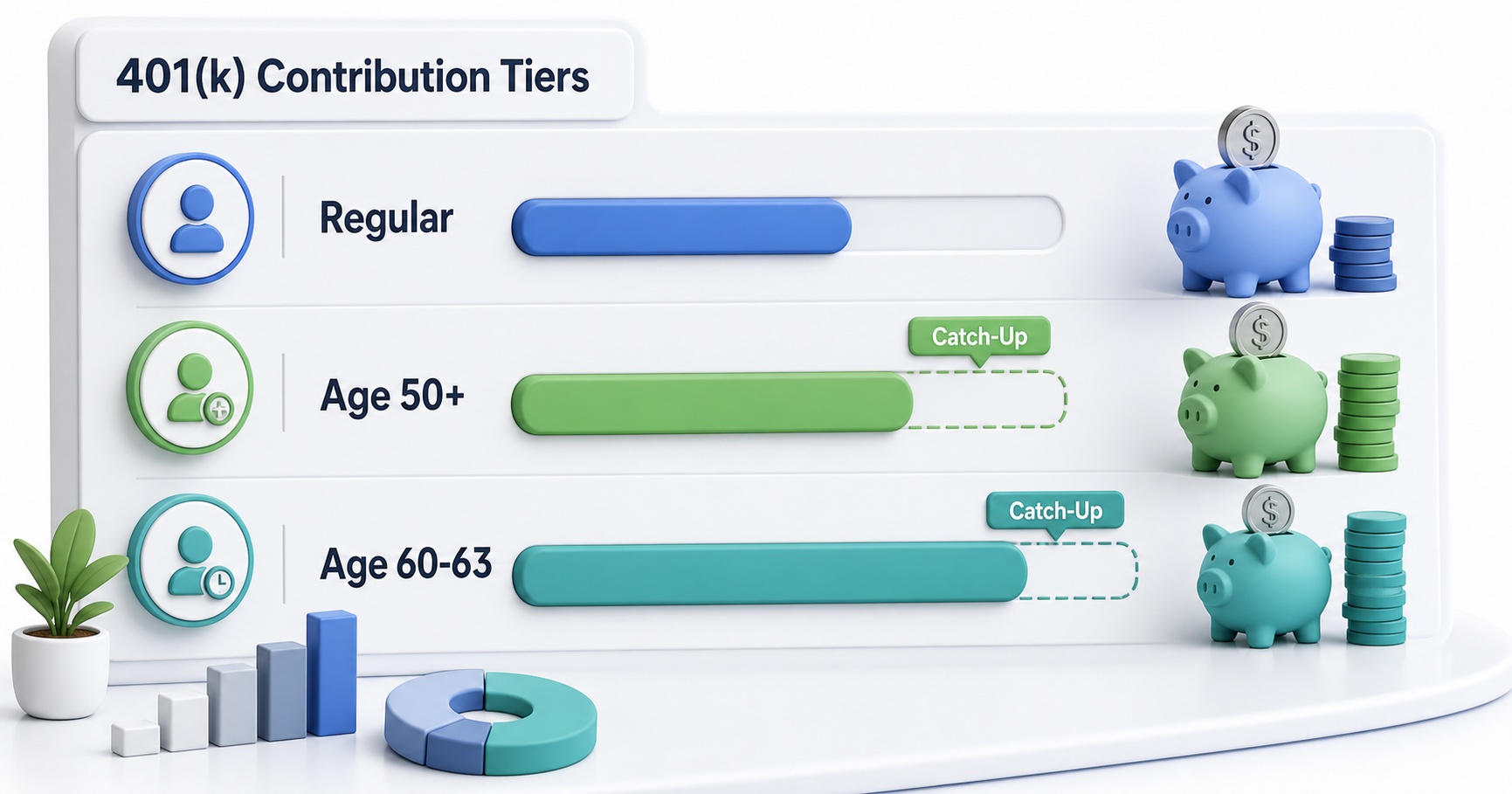
401(k) contribution limits 2026 begin with the employee elective deferral limit. The IRS announced that employees can contribute up to $24,500 to most 401(k) plans in 2026. This is the amount an employee may defer from pay into the plan, subject to plan rules and compensation.
If you are age 50 or older by the end of 2026, you may also be eligible for a catch-up contribution. For many 401(k), 403(b), governmental 457 plans, and the federal Thrift Savings Plan, the standard age 50+ catch-up contribution is $8,000 for 2026. That can bring the employee total to $32,500.
There is also a special SECURE 2.0 catch-up rule for some workers age 60 through 63. For 2026, the higher catch-up contribution limit remains $11,250 instead of the standard $8,000. Whether this applies in practice can depend on your age and whether your plan supports the rule.
| Worker Situation | 2026 Employee Contribution Limit | Beginner Note |
|---|---|---|
| Under age 50 | $24,500 | Main employee deferral limit |
| Age 50 or older | $32,500 | $24,500 plus $8,000 catch-up |
| Age 60 to 63 | Up to $35,750 | $24,500 plus $11,250 higher catch-up if eligible |
These employee limits are different from the IRA limits discussed in our guide to Roth IRA contribution limits 2026. A 401(k) is a workplace plan, while an IRA is an individual retirement account. The rules, limits, and investment menus are not the same.
How Catch-Up Contributions Work in 2026
401(k) contribution limits 2026 are especially important for older workers because catch-up contributions can materially raise the amount allowed. A catch-up contribution is extra room for workers who are close enough to retirement age that Congress allows additional saving capacity.
For a simple example, imagine a 52-year-old worker whose plan allows catch-up contributions. If the worker can afford it and the plan permits it, the employee could contribute the regular $24,500 plus the $8,000 catch-up, for a total of $32,500 in employee deferrals for 2026.
Now imagine a 61-year-old worker in an eligible plan. The higher catch-up amount may be $11,250 instead of $8,000. That could bring the employee deferral total to $35,750 for 2026. This special rule is easy to overlook because it applies only to a narrow age range.
Catch-up contributions do not eliminate investment risk. Money inside the 401(k) still depends on the investments chosen, market performance, fees, and the length of time before retirement. But for eligible workers with room in their budget, catch-up contributions can increase the amount going into a tax-advantaged account.
Traditional 401(k) vs Roth 401(k) Limits
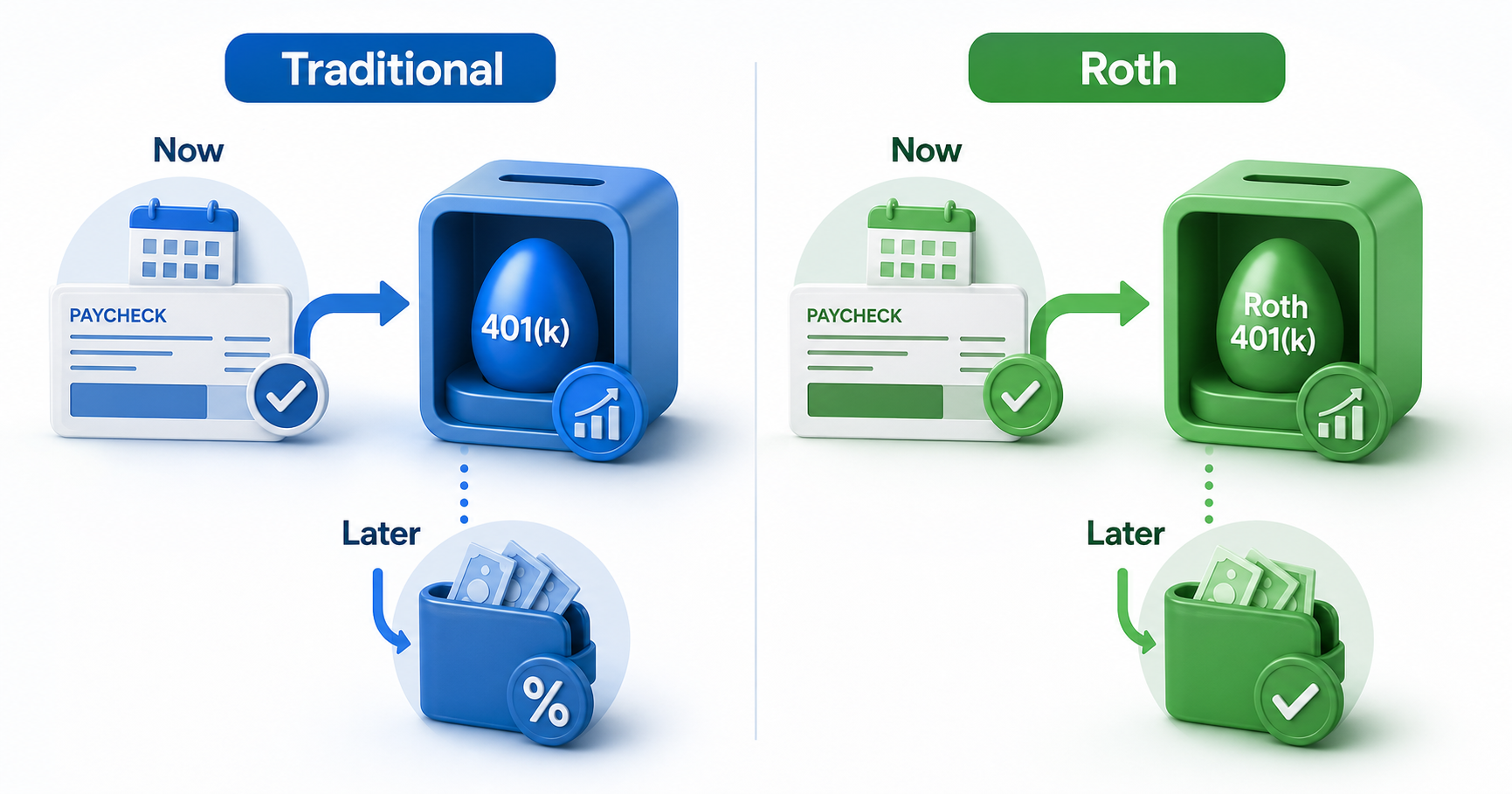
The 2026 employee deferral limit generally applies across traditional 401(k) and Roth 401(k) employee contributions combined. It is not a separate $24,500 limit for traditional contributions and another $24,500 limit for Roth contributions.
The difference is tax timing. Traditional 401(k) contributions are usually made before income tax, which can reduce taxable income now. Roth 401(k) contributions are made after tax, but qualified withdrawals may be tax-free later under the rules.
| Feature | Traditional 401(k) | Roth 401(k) |
|---|---|---|
| Tax timing | Possible tax break now | Possible tax-free qualified withdrawals later |
| Uses employee limit? | Yes | Yes |
| Can be combined? | Often yes, if plan allows | Often yes, if plan allows |
| Main decision | Tax rate now vs later | Tax rate now vs later |
For example, a worker under age 50 might contribute $14,500 to a traditional 401(k) and $10,000 to a Roth 401(k), reaching the $24,500 employee limit. The exact split is a planning decision, not a universal rule.
If you are still learning the account basics, start with our guide to what a 401(k) is. If you are comparing Roth accounts more broadly, the guide to what a Roth IRA is explains the individual-account version.
Do Employer Matching Contributions Count Toward Your Limit?
Employer matching contributions usually do not count against your $24,500 employee deferral limit. That is good news for workers with a match. If you contribute from your paycheck and your employer adds a match, the employer contribution is generally separate from your employee deferral limit.
However, employer contributions are not unlimited. 401(k) plans also have overall annual addition limits that can include employee contributions, employer contributions, and certain other amounts. These rules can become more relevant for high earners, business owners, or people with very generous employer contributions.
For many beginners, the first practical question is simpler: does the employer offer a match, and how much do you need to contribute to receive the full match? If your budget allows, contributing enough to capture the full match is often a useful starting goal because it increases the amount going into your retirement account.
Matching formulas vary. One employer may match 50% of contributions up to 6% of pay. Another may match dollar-for-dollar up to a smaller percentage. Some plans also use vesting schedules, which determine how much of the employer money you keep if you leave the company.
Monthly and Paycheck Examples for 2026
401(k) contribution limits 2026 can feel large when viewed as annual numbers. Breaking them into monthly or paycheck amounts makes them easier to understand. The exact amount depends on how often you are paid and whether your plan lets you adjust contributions by dollar amount or percentage.
| 2026 Goal | Monthly Amount | Approximate Amount Over 26 Paychecks |
|---|---|---|
| $24,500 regular employee limit | About $2,041.67 | About $942.31 |
| $32,500 age 50+ total | About $2,708.33 | $1,250.00 |
| $35,750 age 60-63 potential total | About $2,979.17 | About $1,375.00 |
Most workers do not need to max out a 401(k) to make progress. A beginner might start with the employer match, then increase the contribution rate by one percentage point over time. Automatic payroll contributions can also support dollar-cost averaging because money is invested on a regular schedule.
Regular contributions also give long-term compounding more time to work. If the concept is new, our article on compound interest explains why time and reinvestment can matter so much, even though market returns are never guaranteed.
How to Decide How Much to Contribute
The best contribution amount is not always the maximum. It depends on your income, debts, emergency savings, employer match, tax situation, time horizon, and other goals. A high contribution rate is not helpful if it forces you into credit card debt or leaves you without cash for near-term needs.
A practical order for many beginners is to first understand the employer match, then check the budget, then choose an investment mix that fits the time horizon. If the plan offers a target-date fund, broad stock fund, bond fund, or stable value option, each choice has a different role and risk profile.
Your contribution decision should also connect to asset allocation. A young worker may hold more stock exposure because retirement is decades away. A worker closer to retirement may want a more balanced mix. Our guide to asset allocation explains how stocks, bonds, and cash can work together.
Fees matter too. A 401(k) plan may include fund expense ratios, administrative costs, or other plan-level fees. If you are comparing funds, the explanation of expense ratios can help you understand how ongoing fund costs reduce returns over time.
Common 401(k) Contribution Mistakes

The first mistake is confusing the employee limit with the total plan limit. Your employee deferral limit is the amount you put in from pay. Employer contributions are usually separate, but total annual additions have their own rules.
The second mistake is assuming Roth and traditional 401(k) limits are separate. They generally share the same employee deferral limit. Splitting contributions between both can be useful, but the combined total still matters.
The third mistake is missing the employer match. If your employer offers a match and you can afford the contribution, missing the match may mean leaving part of your compensation unused. The match is not a guarantee of investment profit, but it is extra money entering the plan.
The fourth mistake is maxing out too early without checking payroll timing. Some plans stop employee contributions once you hit the limit. If your employer match is calculated per paycheck and your plan does not offer a true-up feature, maxing out early could affect how much match you receive. Plan rules vary, so this is worth checking.
The fifth mistake is focusing only on the limit instead of the plan. The contribution amount matters, but the investment menu, fees, risk level, and review habit also matter. A large contribution into an unsuitable investment mix can still create problems.
Frequently Asked Questions About 401(k) Contribution Limits 2026
What are the 401(k) contribution limits 2026?
The 2026 employee contribution limit for most 401(k) plans is $24,500. Many workers age 50 or older may contribute an additional $8,000 catch-up amount, for a total of $32,500.
What is the 2026 401(k) catch-up limit?
For many workers age 50 or older, the 2026 catch-up contribution limit is $8,000. Workers age 60 through 63 may have a higher catch-up contribution limit of $11,250 if eligible and if the plan supports it.
Does my employer match count against my 401(k) contribution limit?
Employer matching contributions generally do not count against your employee deferral limit. They may count toward broader annual addition limits that apply to the plan.
Can I contribute to a 401(k) and a Roth IRA in 2026?
Yes, if you are eligible for both. A 401(k) and a Roth IRA have separate rules and separate limits. Roth IRA eligibility also depends on income and filing status.
Should beginners max out a 401(k)?
Not always. Maxing out can be useful for some savers, but beginners should also consider emergency savings, high-interest debt, employer match, budget stability, and investment choices.
Final Thoughts
401(k) contribution limits 2026 give workers a clear planning number: $24,500 for regular employee deferrals, with additional catch-up room for older workers. But the limit is only one part of the decision. Your employer match, Roth vs traditional choice, investment menu, fees, and budget all affect how useful the plan is.
For beginners, the strongest starting point is simple: understand the match, choose a sustainable contribution rate, know the current limits, and review your investment mix. A 401(k) can be a powerful retirement tool, but it works best when the contribution amount fits the rest of your financial life.