
Do you ever look at cash waiting in your account and think, “Should I buy now, or will the market fall again?” I do. I currently have a meaningful amount of cash that I am considering putting mostly into dividend stocks. At the same time, I already own growth companies, semiconductor stocks, and ETFs that I plan to keep for years.
The difficult part is not finding one more ticker. It is deciding what each part of the money is supposed to do. Growth holdings may build future value. Dividend holdings may support my goal of eventually reaching about $1,000 in monthly dividend income. Cash gives me flexibility, even though holding too much of it for too long has a cost.
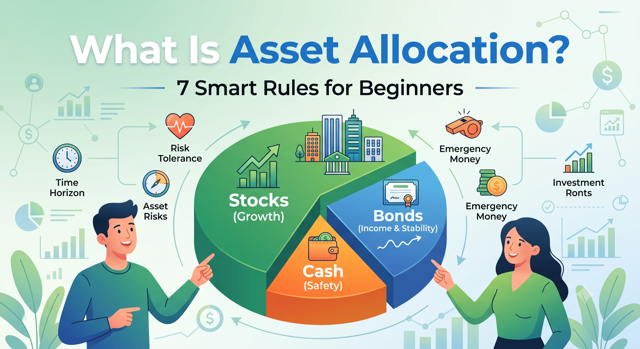
Asset allocation is simply the way you divide a portfolio among major roles such as growth, income, and short-term safety—usually through stocks, bonds, and cash. A portfolio can contain excellent investments and still feel wrong if too much money is assigned to one job. This guide explains how beginners can build a mix they understand without copying somebody else’s percentages.
Key Takeaways
- Asset allocation means dividing your portfolio among asset classes such as stocks, bonds, and cash.
- Your allocation can affect risk, return potential, volatility, and how your portfolio reacts to market changes.
- There is no perfect allocation for everyone. Time horizon, risk tolerance, goals, and financial situation all matter.
- Asset allocation is different from diversification, but the two work together.
- Beginners can often start with simple broad-market funds instead of trying to pick many individual investments.
What Is Asset Allocation and Why Does It Matter?
What is asset allocation in plain English? It is the basic recipe of your portfolio. If your money is the meal, asset allocation is how much of the recipe comes from stocks, bonds, cash, and other assets.
Investor.gov defines asset allocation as dividing investments among different categories such as stocks, bonds, and cash. The right mix depends largely on your time horizon and your ability to tolerate risk. That is why asset allocation is personal rather than universal.
Stocks usually provide more long-term growth potential, but they can rise and fall sharply. Bonds are generally used to add income and reduce volatility, although they also carry risk. Cash is more stable in the short term, but it may lose purchasing power over time if inflation is higher than the interest earned.
This matters because two investors can own the same type of account and have completely different outcomes. For example, two workers may both use a 401(k), but one may hold mostly stock funds while the other holds mostly cash or bond funds. Their long-term results and short-term stress levels may be very different.
Asset allocation also affects how you respond emotionally. A portfolio that is too aggressive may cause panic selling during a market downturn. A portfolio that is too conservative may feel safe but fail to grow enough for long-term goals. A useful allocation balances what you need from the portfolio with what you can actually stick with.
The 3 Main Parts of Asset Allocation
Most beginner portfolios start with three core asset classes: stocks, bonds, and cash. More advanced investors may add real estate, commodities, or alternative investments, but those are not necessary for understanding the basics.

| Asset Class | Main Role | Common Risk | Beginner Example |
|---|---|---|---|
| Stocks | Growth potential | Market volatility | Stock index fund or ETF |
| Bonds | Income and stability | Interest rate and credit risk | Bond fund |
| Cash | Short-term safety and liquidity | Inflation risk | Savings, money market, cash reserve |
Stocks represent ownership in companies. If you are still learning the basic building blocks of investing, start with our guide to what a stock is. Stocks can help a portfolio grow, but their prices can move quickly.
Many beginners get stock exposure through funds instead of individual companies. An index fund can hold many stocks at once and track a market benchmark. An ETF can also provide broad exposure, and our guide to how ETFs work explains that structure in more detail.
Bonds are loans made to governments, municipalities, or companies. They are often used to reduce portfolio swings, but they are not risk-free. Bond prices can fall when interest rates rise, and some bonds carry default risk.
Cash can be useful for emergencies, upcoming expenses, or reducing short-term volatility. But too much cash can slow long-term growth. That is especially important for younger investors with decades until retirement.
Asset Allocation vs Diversification
Asset allocation and diversification are related, but they are not the same thing.
Asset allocation is the big-picture decision. It answers: how much of the portfolio should be in stocks, bonds, cash, or other categories?
Diversification is what happens inside those categories. It answers: within the stock portion, are you spread across many companies, sectors, and markets, or are you concentrated in only a few positions?
| Concept | Main Question | Example |
|---|---|---|
| Asset Allocation | How should the portfolio be divided among asset classes? | 70% stocks, 25% bonds, 5% cash |
| Diversification | How spread out are the investments inside each asset class? | Using a broad stock index fund instead of one company |
FINRA explains that asset allocation is usually expressed as the percentage of your portfolio invested in different asset classes, such as stocks, bonds, and cash. Diversification then helps spread risk within those areas.
For example, owning one technology stock is not the same as owning a broad market fund. A fund tracking the S&P 500 spreads money across many large U.S. companies. That does not eliminate market risk, but it reduces the risk that one company alone drives the entire portfolio.
A beginner investor can think of it this way: asset allocation chooses the rooms in the house, while diversification chooses how many pieces of furniture are in each room. You usually need both for a more balanced setup.
7 Smart Rules for Beginner Investors
What is asset allocation supposed to help you do? It helps create a portfolio that matches your goals instead of your emotions. These seven rules can help beginners avoid common mistakes.
1. Start with your time horizon
Time horizon means when you expect to need the money. Money needed next year should usually be handled differently from money intended for retirement 30 years from now.

A long time horizon may allow more stock exposure because the investor has more time to ride out market declines. A short time horizon usually calls for more caution because there may not be enough time to recover from a major downturn.
2. Know your risk tolerance
Risk tolerance is not just what you say when markets are calm. It is how you may feel when your portfolio is down 20%, 30%, or more. If an allocation causes you to panic, it may be too aggressive even if it looks good on paper.
3. Separate emergency money from investment money
Emergency savings should not depend on market performance. If you might need cash for job loss, medical bills, car repairs, or rent, that money usually belongs outside a volatile investment portfolio.
4. Use broad funds when you are still learning
Beginners often do not need a complicated portfolio. Broad index funds, target-date funds, or diversified ETFs can provide exposure without requiring constant research. Costs still matter, so it is useful to understand expense ratios before choosing funds.
5. Avoid copying someone else’s allocation blindly
A 25-year-old worker, a 45-year-old parent, and a 65-year-old retiree may all need different allocations. Income stability, debt, family needs, pension access, Social Security expectations, and investing experience can all change the right mix.
6. Rebalance occasionally
Over time, market movement can pull your portfolio away from the original target. If stocks rise a lot, a 70% stock allocation may become 80%. Rebalancing means adjusting the portfolio back toward the target mix.

7. Keep the plan simple enough to follow
A perfect-looking allocation is useless if you cannot maintain it. A simple plan that you understand and follow for years is often better than a complex plan you abandon after one bad market month.
Asset Allocation Examples by Investor Type
There is no single correct portfolio, but examples can help explain how different investors might think. These are educational examples only, not personal recommendations.
| Investor Type | Possible Priority | Example Allocation |
|---|---|---|
| Young long-term investor | Growth | 85% stocks, 10% bonds, 5% cash |
| Mid-career investor | Growth with some stability | 70% stocks, 25% bonds, 5% cash |
| Near-retirement investor | Balance and income | 50% stocks, 40% bonds, 10% cash |
| Short-term saver | Capital preservation | Mostly cash or short-term fixed income |
These examples are not rules. They simply show how asset allocation can shift as goals and time horizons change. Age, time horizon, goals, risk tolerance, and financial situation can all influence retirement allocation choices.
Retirement accounts make this especially important. A Roth IRA may be opened by an individual, while a workplace plan like a 401(k) comes through an employer. If you recently read our guide to what a Roth IRA is, asset allocation is the next question: once money goes into the account, how should it be invested?
The same question applies to a 401(k). Choosing the contribution amount is only one step. The investments inside the account determine whether the money sits in cash, a target-date fund, a stock fund, a bond fund, or another option.
How Asset Allocation Works in a 401(k) or Roth IRA
What is asset allocation inside a retirement account? It is the mix of investments you choose within that account. The account gives the tax structure. The allocation determines how the money is invested.
For example, a 401(k) might offer several target-date funds, an S&P 500 fund, an international stock fund, a bond fund, and a stable value fund. A Roth IRA at a brokerage may offer a wider menu of ETFs, mutual funds, stocks, and bonds.
A target-date fund is one simple solution because it automatically changes its allocation over time. The fund typically starts more stock-heavy for younger investors and becomes more conservative as the target retirement year approaches. That can be useful for someone who wants a hands-off approach.
Another approach is building your own mix using broad funds. For example, an investor might combine a U.S. stock index fund, an international stock fund, and a bond fund. This requires more maintenance, but it can offer more control over costs and allocation.
Some investors pair asset allocation with dollar-cost averaging. Automatic contributions can buy into the same allocation over time, reducing the pressure to find the perfect entry point. Over long periods, steady investing and compounding can work together. If that concept is new, review our guide to compound interest.
Common Asset Allocation Mistakes
The first mistake is taking too much risk without realizing it. A portfolio that is nearly all stocks may be reasonable for some long-term investors, but it can also be emotionally difficult during a bear market.
The second mistake is taking too little risk. A young investor with a retirement goal decades away may hurt long-term growth by holding too much cash. Safety matters, but so does keeping up with inflation and future spending needs.
The third mistake is confusing a popular investment with a complete portfolio. Buying one fund, stock, or ETF does not automatically mean the portfolio is balanced. The total mix matters more than the popularity of one holding.
The fourth mistake is ignoring fees. Two funds may look similar but have different expense ratios. Over decades, lower costs can make a meaningful difference. Fees should not be the only factor, but they should not be ignored.
The fifth mistake is never reviewing the allocation. You do not need to check your portfolio daily, but occasional reviews help ensure your portfolio still matches your goals. Major life events, new jobs, retirement timeline changes, or large market moves can all make a review useful.
Frequently Asked Questions About Asset Allocation
What is asset allocation in simple terms?
What is asset allocation? It is the way you divide your portfolio among assets such as stocks, bonds, and cash. The goal is to create a mix that fits your time horizon, risk tolerance, and financial goals.
What is a good asset allocation for beginners?
A good beginner allocation is one the investor understands and can stick with. Some beginners use target-date funds, while others build a simple mix of stock and bond funds. The right answer depends on age, goals, risk tolerance, and when the money will be needed.
Is asset allocation more important than picking stocks?
For many long-term investors, asset allocation can matter more than individual stock picking because it determines the overall risk and return profile of the portfolio. Individual investments still matter, but the broad mix often drives the experience.
How often should I change my asset allocation?
You do not need to change it constantly. Many investors review their allocation once or twice a year or after major life changes. Frequent changes based on emotion can create unnecessary mistakes.
Does asset allocation guarantee profits?
No. Asset allocation can help manage risk and organize a portfolio, but it does not guarantee returns or prevent losses. All investing involves risk, including the possible loss of principal.
Investors who prefer not to maintain the allocation themselves can examine target date funds. These funds combine asset allocation and automatic changes over time, but their glide paths, fees, and risk levels still require review.
Final Thoughts
I do not think one perfect percentage is waiting to be discovered. My own mix changes as my cash balance, dividend goal, family needs, and confidence in particular companies change. What matters is that I can explain why each part is there.
Look at your portfolio and try three labels: growth, income, and safety. Where does each holding belong? Is one label taking almost all the money? If the answer makes you uncomfortable, that feeling may be more useful than copying a model portfolio from someone whose life is nothing like yours.
This article is for educational purposes only and is not personal financial advice. Consider your own situation, goals, and risk tolerance before making investment decisions.