
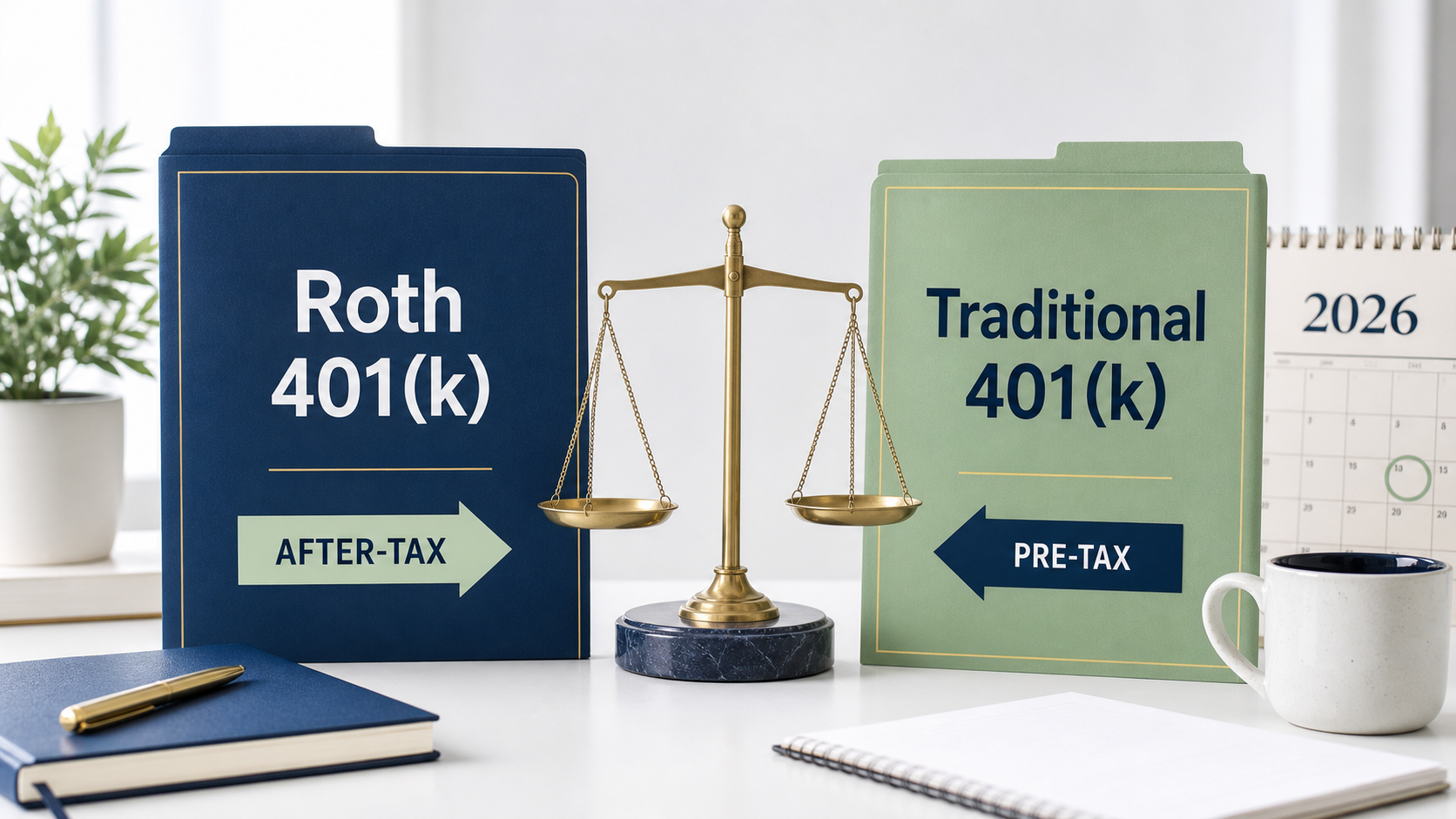
Roth 401(k) vs Traditional 401(k) is a choice between paying income tax now or deferring tax until retirement. A Roth 401(k) uses after-tax employee contributions, while a traditional 401(k) generally uses pre-tax employee contributions that may reduce taxable income today.
The beginner question is not which account is always better. The better question is whether today’s tax break or tomorrow’s tax-free qualified withdrawal treatment is more useful for your situation, income, and retirement plan.
Educational disclaimer: This article is for general education only and is not personal tax, legal, retirement, or investment advice. 401(k) rules can depend on your employer plan, income, tax rate, age, state taxes, and future law changes. Check official IRS guidance or a qualified professional for your own situation.
Key Takeaways
- A traditional 401(k) usually lowers taxable income now, but withdrawals are generally taxed later.
- A Roth 401(k) does not provide the same upfront tax break, but qualified withdrawals may be tax-free later.
- Both options share the same employee elective deferral limit when they are inside the same 401(k) plan.
- Your employer match may be calculated using your contributions, but matching contributions have plan-specific treatment and should be reviewed carefully.
- The best choice depends on tax rate today, expected tax rate later, employer plan quality, cash flow, and retirement time horizon.
Roth 401(k) vs Traditional 401(k): The Core Difference
The core difference in Roth 401(k) vs Traditional 401(k) is tax timing. A traditional 401(k) generally lets you defer income tax on employee contributions today. The money then grows inside the plan, and withdrawals are generally taxed as income later.
A Roth 401(k), also called a designated Roth account in IRS materials, works in the opposite tax direction. You contribute after-tax dollars, so you do not get the same current-year tax reduction. If the withdrawal is qualified, the distribution can be excluded from gross income under IRS rules.
Both choices can be useful. The traditional option may help someone who needs a tax break now or expects a lower tax rate in retirement. The Roth option may help someone who can afford the current tax cost and expects tax-free qualified withdrawals to be more valuable later.
If you need the account foundation first, read our beginner guide to what a 401(k) is. This article focuses specifically on choosing between the two tax treatments inside a workplace plan.
How Traditional 401(k) Contributions Work
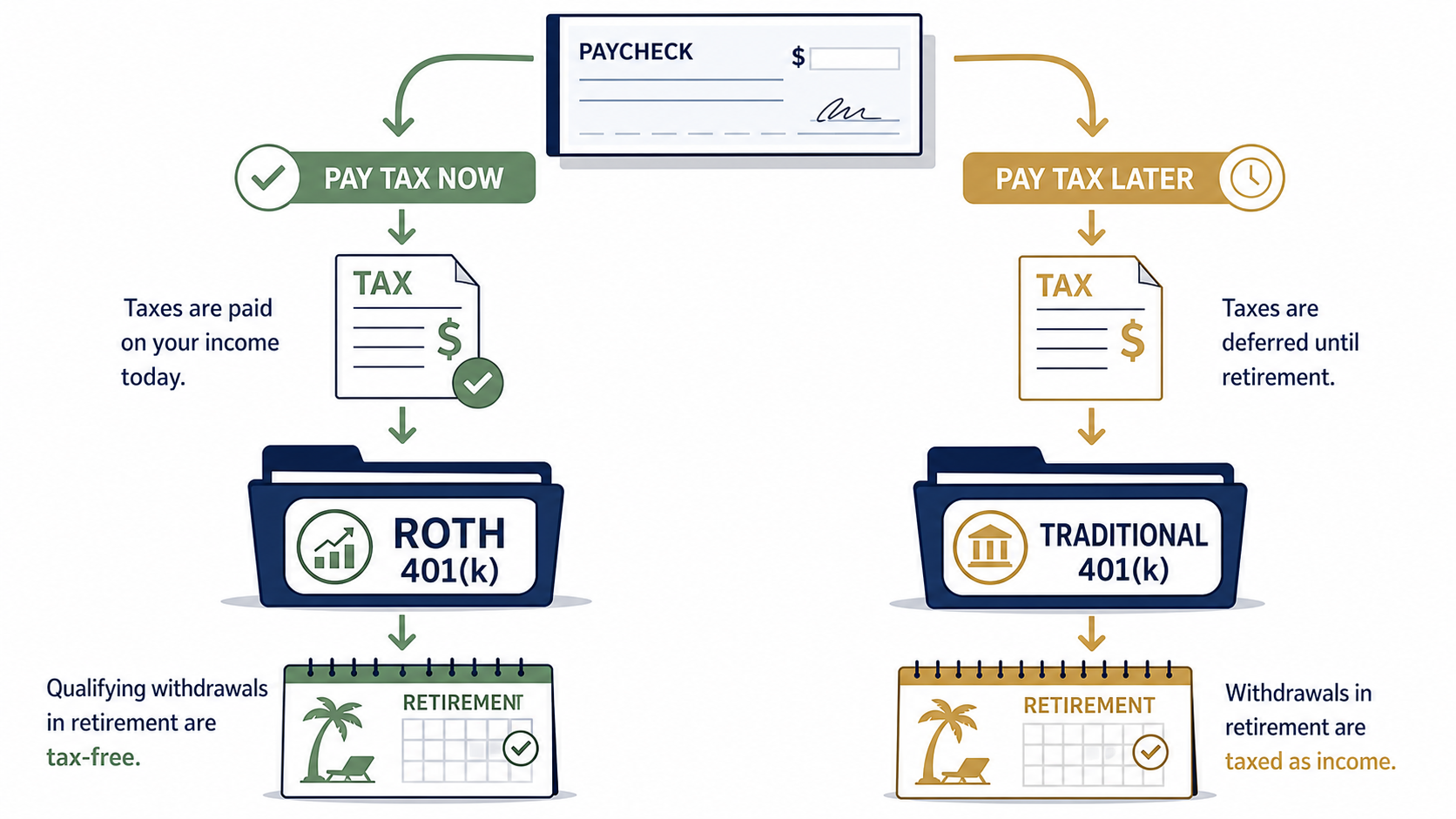
A traditional 401(k) contribution is often described as pre-tax because it generally reduces taxable income in the year of contribution. If a worker earns wages and contributes to a traditional 401(k), that contribution may lower current taxable income for federal income tax purposes.
The trade-off is that the tax bill is delayed, not erased. When money comes out of the traditional 401(k), distributions are generally taxed as ordinary income. That can be fine if your tax rate is lower in retirement, but it can be less attractive if your future tax rate is higher than expected.
Traditional 401(k) contributions can also help with current cash flow. Because they may reduce taxes now, the after-tax paycheck impact can feel smaller than contributing the same dollar amount to a Roth 401(k). This is one reason traditional contributions remain popular among workers in higher current tax brackets.
How Roth 401(k) Contributions Work
A Roth 401(k) contribution is an after-tax salary deferral. The contribution is included in current gross income, so it does not reduce taxable income the way a traditional 401(k) contribution generally can.
The benefit is on the withdrawal side. The IRS explains that qualified distributions from a designated Roth account are excluded from gross income when the required conditions are met. Those conditions include a five-year rule and a qualifying event such as reaching the applicable age, disability, or death.
A Roth 401(k) may appeal to younger workers, people in lower current tax brackets, or workers who expect tax rates to be higher later. It can also appeal to investors who value tax diversification, meaning they want some retirement money in pre-tax accounts and some in after-tax Roth accounts.
For a broader Roth account comparison, see our guide to Roth 401(k) vs Roth IRA. A Roth 401(k) is still a workplace plan account, while a Roth IRA is an individual account with separate rules.
Contribution Limits and Employer Match
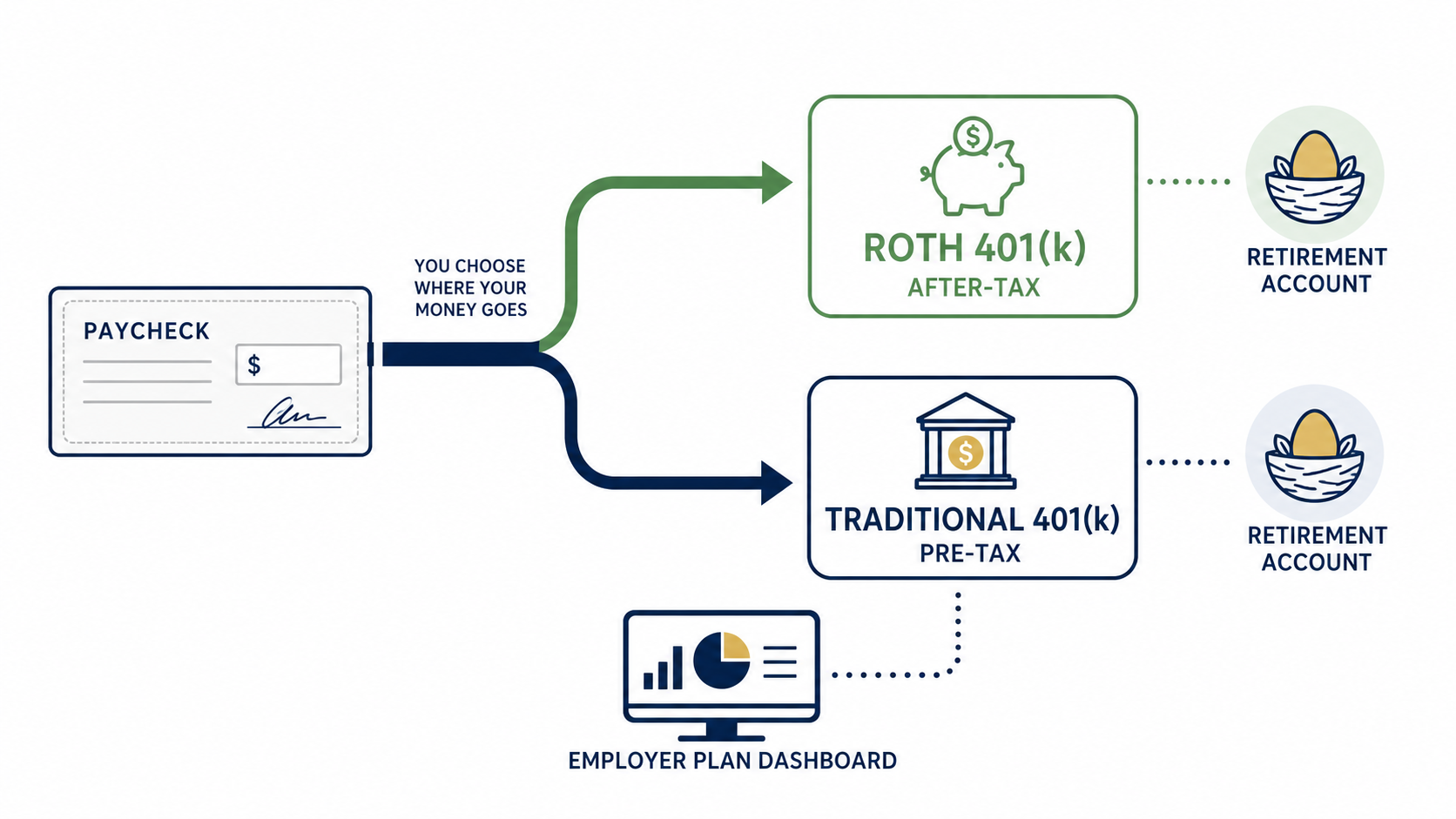
Roth 401(k) vs Traditional 401(k) does not create two separate employee contribution limits inside the same 401(k) plan. The combined amount of pre-tax elective deferrals and designated Roth contributions is limited by the annual employee deferral limit.
For 2026, the IRS announced that the 401(k) employee contribution limit is $24,500. Additional catch-up rules may apply for eligible older workers. If you split contributions between Roth and traditional, the total still counts toward the same employee deferral limit.
| Feature | Roth 401(k) | Traditional 401(k) |
|---|---|---|
| Contribution tax timing | After-tax | Generally pre-tax |
| Current taxable income | Usually not reduced by the contribution | Generally reduced by the contribution |
| Qualified retirement withdrawals | May be tax-free when rules are met | Generally taxed as income |
| Employee contribution limit | Shared with traditional 401(k) deferrals | Shared with Roth 401(k) deferrals |
Employer matching contributions add another layer. IRS guidance says employers may take designated Roth deferrals into account when calculating a match, but plan rules determine the details. Beginners should read the plan documents or ask the plan administrator how employer contributions are treated.
For the current annual numbers, use our full guide to 401(k) contribution limits 2026. Limits change over time, so this comparison should be updated when IRS limits change.
Which Is Better If Your Tax Rate Changes?
The Roth 401(k) vs Traditional 401(k) decision often comes down to tax-rate expectations. If your tax rate is higher today than it will be in retirement, a traditional 401(k) may be attractive because the current tax deduction can be valuable.
If your tax rate is lower today than it may be later, a Roth 401(k) may be attractive because paying tax now could be less expensive than paying tax on withdrawals later. This is why Roth contributions are often discussed for younger workers, early-career professionals, and people with temporarily low income.
The hard part is that nobody knows future tax rates with certainty. Your own income may change. Tax law may change. State taxes may change. Retirement spending may be higher or lower than expected. Because of that uncertainty, some investors use both Roth and traditional contributions over time.
Cash Flow, Paycheck Impact, and Behavior
Taxes are not the only issue. Cash flow matters too. A traditional 401(k) contribution may feel easier on a paycheck because the current tax reduction can offset part of the contribution. A Roth 401(k) contribution may feel more expensive because taxes are paid upfront.
That paycheck difference can affect behavior. If Roth contributions cause someone to save much less, the theoretical tax benefit may not matter as much. If traditional contributions help someone save consistently and capture an employer match, that can be very valuable.
On the other hand, Roth contributions can help build a pool of retirement money that may be more tax-flexible later. That can matter for retirees who want to manage taxable income, healthcare-related thresholds, or other planning issues. This is a reason some long-term savers value tax diversification.
When a Traditional 401(k) May Fit Better
A traditional 401(k) may fit better when you are in a high current tax bracket and expect a lower tax bracket in retirement. It may also fit when current cash flow is tight and the upfront tax deduction helps you contribute more consistently.
Traditional contributions can be especially useful for workers who are near peak earning years. If income is high now but retirement spending is expected to be more moderate, deferring tax may be a reasonable strategy.
This does not mean the traditional option is always best for high earners. Future tax rates, required distributions, state taxes, and retirement income sources can change the outcome. But the current tax break is the main reason many workers choose traditional 401(k) contributions.
When a Roth 401(k) May Fit Better
A Roth 401(k) may fit better when your current tax rate is relatively low, you expect higher taxable income later, or you want more tax diversification in retirement. It may also appeal if you value the possibility of qualified tax-free withdrawals and can afford the upfront tax cost.
Roth contributions can be useful for younger workers because early-career income may be lower than future earnings. Paying tax at a lower current rate can make sense if future income and tax rates rise.
A Roth 401(k) may also fit workers who cannot make direct Roth IRA contributions because of income limits but still have access to a designated Roth option through an employer plan. For more on Roth IRA eligibility, see our guide to Roth IRA contribution limits 2026.
Can You Split Contributions Between Both?
Many employer plans allow workers to split contributions between Roth and traditional 401(k) options, although the exact plan rules matter. Splitting can be a practical middle path when you are uncertain about future tax rates.
For example, a worker might contribute part of each paycheck to the traditional side for a current tax benefit and part to the Roth side for future tax flexibility. The combined employee deferrals still must stay within the annual limit.
This blended approach can also reduce regret. If future tax rates are higher, the Roth side may help. If future tax rates are lower, the traditional side may help. The trade-off is that you give up the chance to fully optimize around one tax outcome.
Beginner Checklist Before Choosing
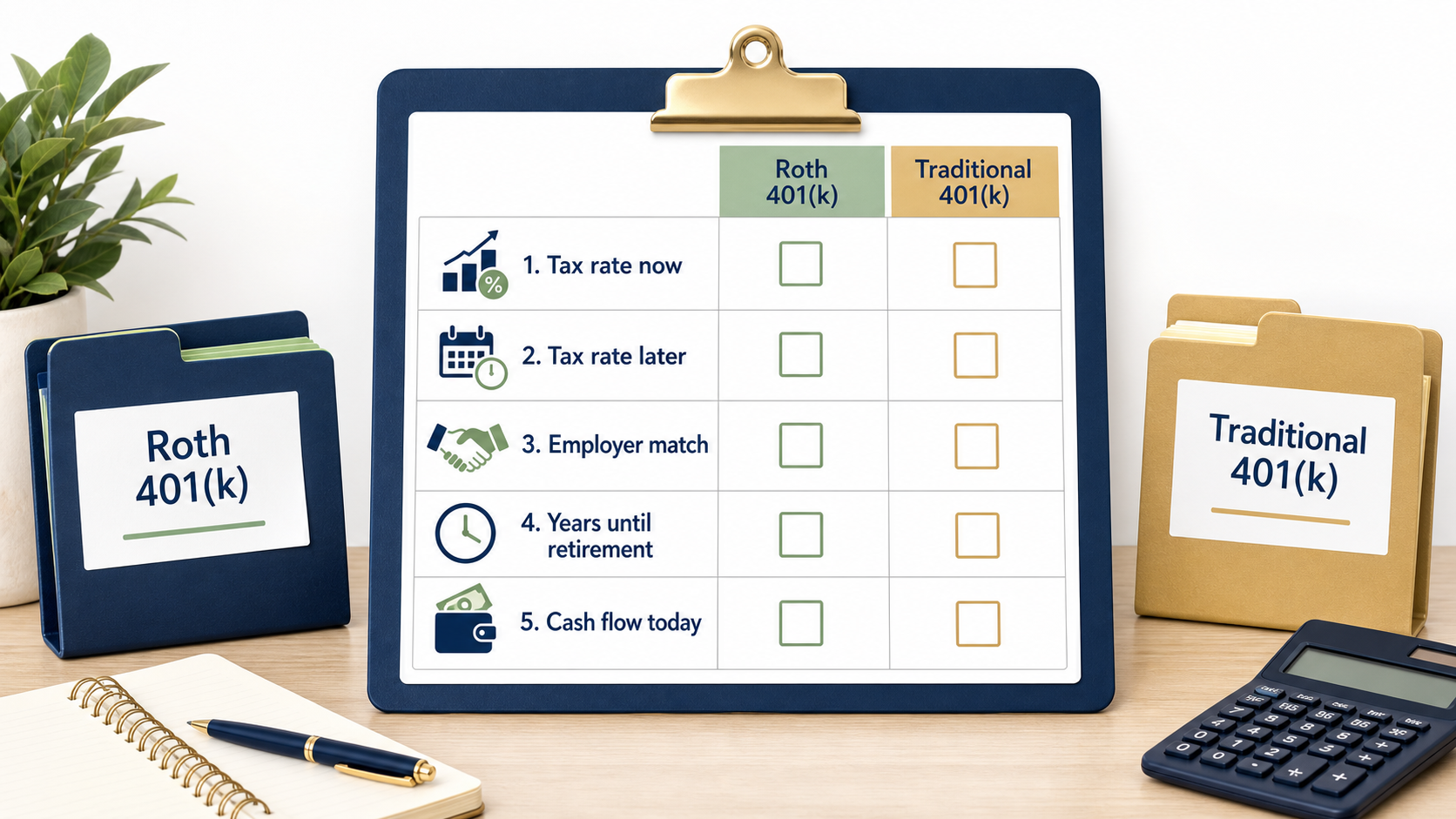
Use this checklist before choosing between Roth 401(k) vs Traditional 401(k). The goal is not to predict the future perfectly. The goal is to avoid making the choice based on one factor only.
- Compare your current tax bracket with your expected retirement tax bracket.
- Check whether your employer offers both Roth and traditional 401(k) options.
- Understand how the employer match works in your plan.
- Estimate the paycheck impact of Roth versus traditional contributions.
- Review investment options and fees inside the plan.
- Consider whether you already have Roth IRA, traditional IRA, or taxable brokerage assets.
- Decide whether tax diversification is worth splitting contributions.
Account choice is only one layer. Your investments still need to match your goals and risk tolerance. Our beginner guide to asset allocation explains how the mix of stocks, bonds, and cash can shape long-term outcomes.
Frequently Asked Questions About Roth 401(k) vs Traditional 401(k)
Is Roth 401(k) better than Traditional 401(k)?
Not always. A Roth 401(k) may be better if your current tax rate is low or you want future tax-free qualified withdrawals. A traditional 401(k) may be better if your current tax rate is high and the upfront tax deduction is valuable.
Can I contribute to both Roth and Traditional 401(k)?
Many plans allow both Roth and traditional contributions, but the combined employee deferrals must stay within the annual 401(k) limit. Check your specific employer plan rules.
Does the employer match go into Roth 401(k)?
Plan rules matter. IRS guidance says employers may consider designated Roth deferrals when calculating matching contributions, but employer contributions have specific treatment and should be reviewed in the plan documents.
Does a Roth 401(k) lower taxable income?
Generally no. Roth 401(k) employee contributions are after-tax, so they do not provide the same current taxable income reduction as traditional 401(k) contributions.
Should young workers choose Roth 401(k)?
Some younger workers may prefer Roth contributions if their current tax rate is relatively low and they expect higher income later. But the best choice still depends on cash flow, employer match, plan quality, and tax expectations.
Final Thoughts
Roth 401(k) vs Traditional 401(k) is a tax-timing decision. Traditional contributions can help now by generally reducing taxable income, while Roth contributions may help later through qualified tax-free withdrawals.
The practical choice depends on today’s tax rate, expected future tax rate, employer match, paycheck impact, plan quality, and the value of tax diversification. If you are unsure, splitting contributions may be worth exploring if your employer plan allows it.