
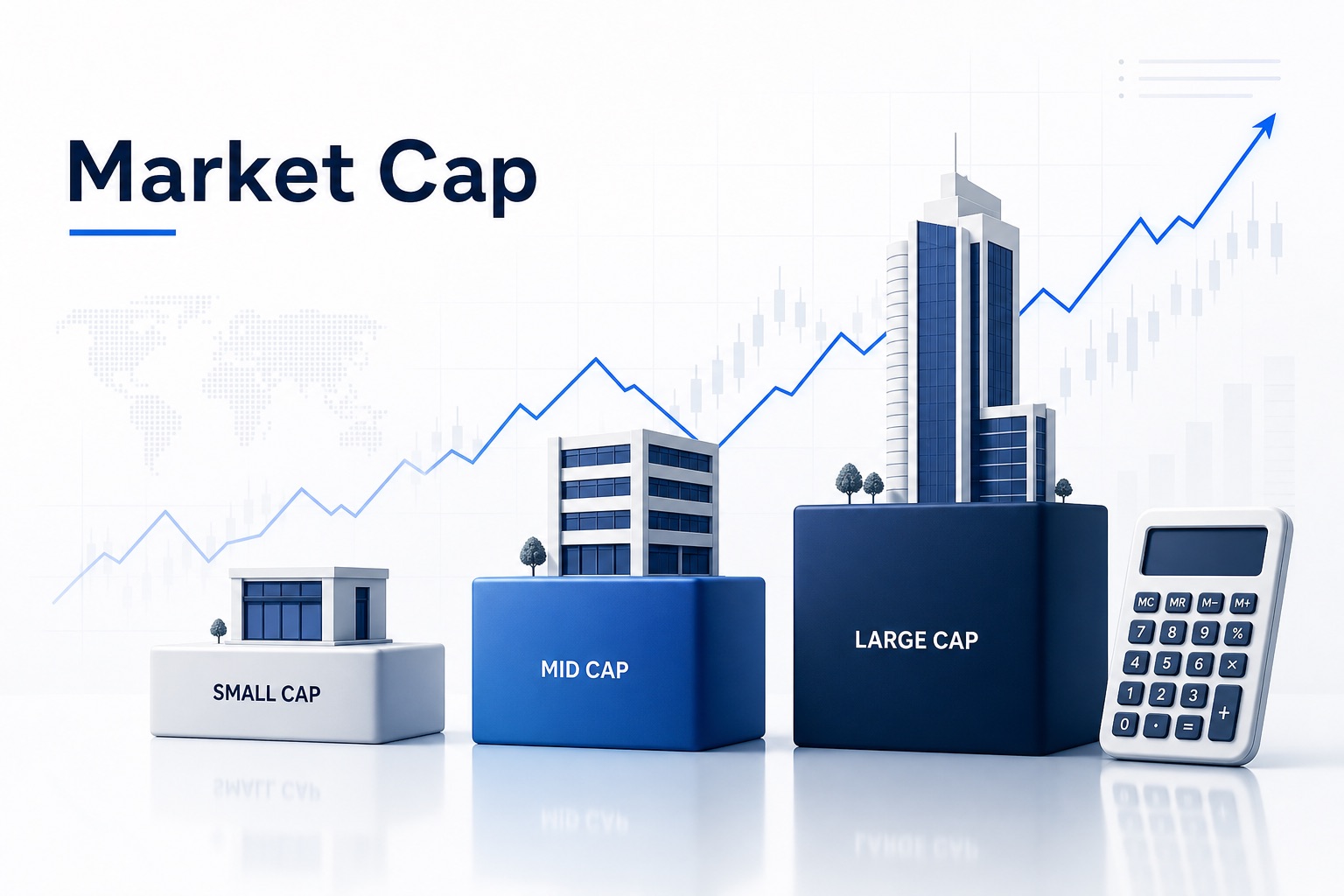
What is market capitalization? Market capitalization, often called market cap, is the total stock market value of a public company. It shows how much investors currently value the company based on its share price and the number of shares outstanding.
If you are learning how to compare stocks, market capitalization is one of the first concepts to understand. It helps investors quickly separate giant global companies from smaller, younger, and often more volatile businesses.
Educational Disclaimer: This article is for educational purposes only and is not personal financial advice. Investing involves risk, and you should always do your own research before making financial decisions.
Key Takeaways
- Market capitalization is the total market value of a company’s outstanding shares.
- The formula is simple: share price multiplied by shares outstanding.
- A high share price does not automatically mean a company is larger or more expensive.
- Large-cap stocks are usually more established, while small-cap stocks often carry higher volatility and different growth risks.
- Market cap helps investors understand index funds, ETFs, portfolio concentration, and stock market risk.
- Market cap is useful, but it should not be the only factor in an investment decision.
What Is Market Capitalization in Simple Terms?
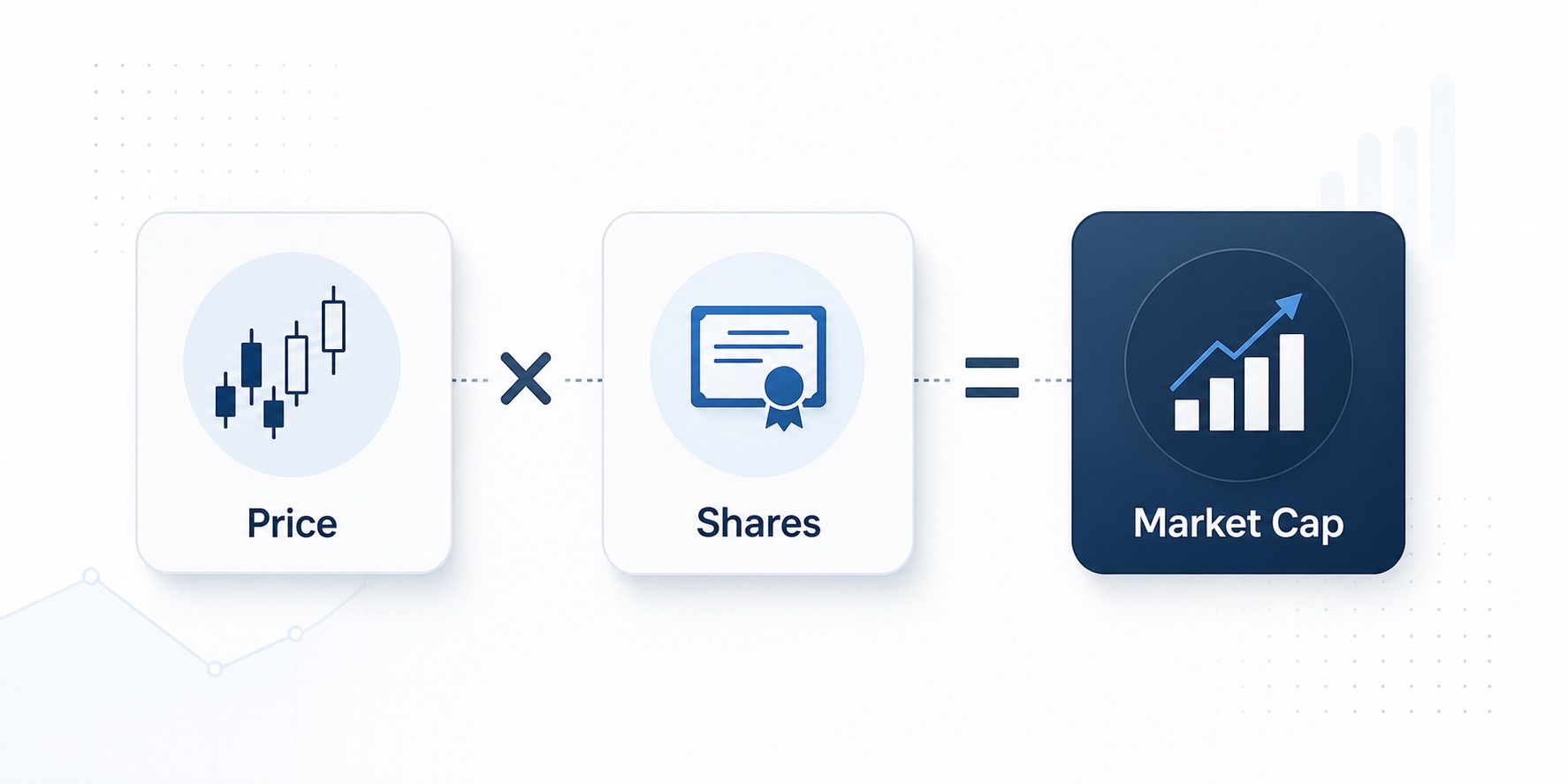
Market capitalization is the value the stock market places on a company’s equity. It is calculated by taking the current stock price and multiplying it by the total number of shares outstanding.
Here is the basic formula:
Market Capitalization = Share Price × Shares Outstanding
For example, if a company has 1 billion shares outstanding and each share trades at $50, the company’s market capitalization is $50 billion.
This number changes whenever the stock price changes. If investors become more optimistic and the stock price rises, the market cap rises. If the stock price falls, the market cap falls too.
Market capitalization is not the same as cash in the bank. It is also not the same as revenue, profit, or book value. It is the current market value of the company’s common equity.
If you are still learning the basics of stock ownership, our guide on what a stock is and how stocks work is a helpful place to start.
Why Market Capitalization Matters
Market capitalization matters because company size affects risk, expectations, liquidity, and investor behavior. A trillion-dollar company and a $500 million company may both trade on the stock market, but they usually behave very differently.
Large companies often have established products, global customers, deeper financial resources, and easier access to capital. They may still decline sharply, but their businesses are usually more mature.
Smaller companies may have more room to grow. However, they can also be more sensitive to competition, interest rates, funding conditions, and economic slowdowns.
Market cap also affects how much influence a company has inside major stock indexes. In many market-cap-weighted indexes, the biggest companies carry the most weight.
This matters for ETF investors because a fund can own hundreds of stocks but still be heavily influenced by a small number of mega-cap companies. If you are new to funds, read our guide on what an ETF is and how it works.
Market Cap vs Stock Price
One of the biggest beginner mistakes is judging a company only by its stock price. A $500 stock is not automatically more expensive than a $50 stock.
The number of shares outstanding matters. A company with a lower share price can still have a much higher market capitalization if it has many more shares in the market.
| Company | Share Price | Shares Outstanding | Market Capitalization |
|---|---|---|---|
| Company A | $500 | 10 million | $5 billion |
| Company B | $50 | 500 million | $25 billion |
In this example, Company A has the higher stock price, but Company B is five times larger by market capitalization.
This is why investors should avoid saying a stock is “cheap” just because the share price is low. A stock split can lower the price of each share without making the company itself cheaper. A low share price can still represent an expensive company if the market value is high compared with earnings, sales, or cash flow.
Large-Cap, Mid-Cap, and Small-Cap Stocks
Investors often group companies by market capitalization. The exact dollar ranges can change over time, but the basic categories help investors understand company size and risk.

| Category | Common Size Range | Typical Profile | Investor Consideration |
|---|---|---|---|
| Mega-Cap | Often $200 billion or more | Global market leaders with major index influence | Can dominate ETF and index fund performance |
| Large-Cap | About $10 billion or more | Established companies with stronger liquidity | Often more stable, but not risk-free |
| Mid-Cap | About $2 billion to $10 billion | Companies between early growth and maturity | May offer balance between growth and stability |
| Small-Cap | About $300 million to $2 billion | Smaller businesses with more room to expand | Often more volatile and sensitive to economic stress |
Large-cap stocks can still be risky if expectations are too high. Small-cap stocks can still be strong businesses if they have durable advantages and healthy finances.
The category is a starting point, not a final judgment. Investors still need to study profitability, debt, valuation, competition, and long-term business quality.
How Market Cap Affects Index Funds and ETFs
Market capitalization is especially important for index investors. Many popular indexes are market-cap weighted, which means larger companies receive a bigger position inside the index.
This structure can be useful because successful companies naturally become larger parts of the index. Investors do not need to manually decide which winners deserve more weight.
However, market-cap weighting can also create concentration. If a few mega-cap stocks become extremely large, a broad index may become more dependent on those companies than investors realize.
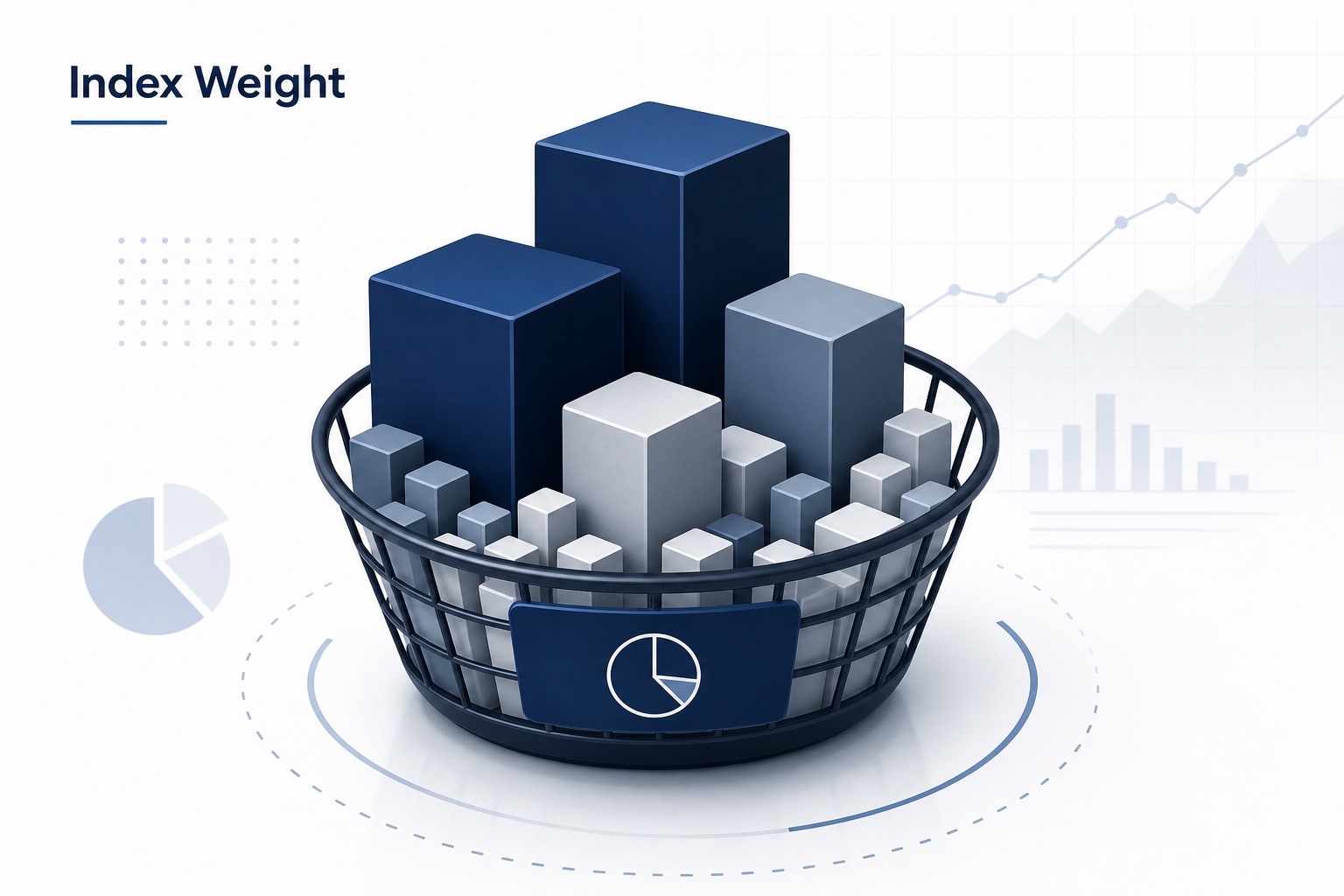
This is one reason investors should look under the hood before buying a fund. A fund may own many stocks, but its top holdings can still drive a large share of performance.
For a deeper look at fund structure, read our comparison of index funds vs ETFs. It explains how these investment vehicles differ in trading, costs, and flexibility.
Costs also matter over long periods. Our guide to ETF expense ratios explains why even small fund fees can affect long-term results.
Market Cap and Portfolio Risk
Market cap can help investors understand portfolio risk. A portfolio filled with only small-cap stocks may behave very differently from one built around large-cap index funds.
Large-cap companies often have stronger access to credit, broader customer bases, and more diversified revenue streams. That can help during difficult markets, although it does not remove risk.
Small-cap companies may grow faster, but they may also face more pressure when borrowing costs rise or investors become defensive. This is why interest rates and inflation can matter for stock valuations.
If you want to understand that connection better, our guide on inflation and interest rates explains how macro conditions can affect stocks and ETFs.
Market cap can also help investors avoid accidental concentration. If most of your portfolio depends on a few mega-cap companies, your results may be less diversified than they appear.
Market Cap vs Business Quality
Market capitalization tells you company size, but it does not tell you whether the business is high quality. A large company can have weak growth, high debt, or declining competitive advantages.
A smaller company can sometimes have excellent products, strong margins, and a long runway for growth. The challenge is that smaller companies often have less room for mistakes.
Investors should ask several questions beyond market cap. Is the company profitable? Does it have pricing power? Is debt manageable? Are customers loyal? Can competitors easily copy the business?
These questions matter because money often flows toward companies with durable advantages. Our article on global capital flows and economic moats explains why strong businesses can attract long-term investor attention.
Market cap gives you the size of the company. Business quality helps you understand whether that size is supported by real fundamentals.
Common Market Capitalization Mistakes
The first mistake is assuming that bigger always means safer. Large companies can still fall if earnings disappoint, valuations become stretched, or competition intensifies.
The second mistake is assuming that small companies are automatically better opportunities. Small-cap stocks may grow faster, but they can also be more volatile and less financially stable.
The third mistake is ignoring valuation. Market cap tells you what investors are paying for the company today. It does not tell you whether that price is reasonable.
The fourth mistake is buying all at once without a plan. For long-term investors, dollar-cost averaging can help reduce the stress of trying to pick the perfect entry point.
The best approach is simple. Use market capitalization to understand company size, then combine it with valuation, financial strength, business quality, and your personal risk tolerance.
Frequently Asked Questions
What is market capitalization?
Market capitalization is the total stock market value of a company’s outstanding shares. It is calculated by multiplying the current share price by the number of shares outstanding.
Why is market capitalization important?
Market capitalization helps investors understand company size, compare stocks, evaluate portfolio exposure, and see how large companies influence indexes and ETFs.
Is market cap the same as company value?
No. Market cap measures the value of common equity. It does not fully account for debt, cash, preferred stock, or other parts of a company’s capital structure.
Is a large-cap stock always safer?
No. Large-cap stocks are often more established, but they can still decline because of weak earnings, high valuations, competition, or changing market conditions.
How does market capitalization affect ETFs?
Many ETFs track market-cap-weighted indexes. This means larger companies can have more influence on fund performance than smaller companies inside the same index.
Final Thoughts
What is market capitalization? At its core, it is a simple way to measure how much the stock market values a company’s equity at a given moment.
For beginner investors, market cap is useful because it turns company size into a number that is easy to compare. It can help you understand whether a stock is a global giant, a mid-sized business, or a smaller company with higher uncertainty.
Still, market capitalization is only one piece of the investing puzzle. It should be used alongside valuation, business quality, financial strength, and long-term strategy.
When used correctly, market cap can help investors build clearer portfolios, understand index exposure, and make more disciplined decisions in changing market conditions.