

What is portfolio rebalancing? Portfolio rebalancing is the process of bringing your investments back to your target mix after market movement causes stocks, bonds, cash, or other assets to drift away from your plan.
For beginner investors, this matters because a portfolio can slowly become riskier or more conservative than intended without you noticing. If stocks rise much faster than bonds, a 60% stock portfolio can quietly become 70% stocks. If stocks fall sharply, the same portfolio may become too conservative for long-term growth.
The goal is not to predict the market. The goal is to keep your portfolio aligned with your time horizon, risk tolerance, and financial goals.
Key Takeaways
- Portfolio rebalancing means adjusting your investments back to your target asset allocation.
- It helps control risk after market gains, losses, deposits, or withdrawals change your portfolio mix.
- Common methods include adding new money, selling overweight assets, or reviewing on a fixed schedule.
- Rebalancing too often can create unnecessary costs, taxes, and emotional decisions.
- A simple written rule can make long-term investing calmer and more consistent.
What Is Portfolio Rebalancing in Simple Terms?
What is portfolio rebalancing in plain English? It is portfolio maintenance. You first decide what mix of investments fits your plan, then you occasionally adjust the account when that mix gets too far away from the target.
Imagine you start with 60% stocks and 40% bonds. After a strong stock market year, stocks may grow to 70% of your portfolio while bonds shrink to 30%. You did not choose a 70/30 portfolio, but market movement created one for you. Rebalancing brings the account back toward 60/40.
This connects directly to asset allocation. Asset allocation is the plan. Rebalancing is the follow-up habit that helps keep the plan from drifting.
The SEC’s Investor.gov defines rebalancing as bringing a portfolio back to its original asset allocation mix because some investments grow faster than others over time. That is the heart of the concept: markets move, your percentages change, and your risk level changes with them.
Why Portfolio Rebalancing Matters

Portfolio rebalancing matters because risk changes even when you do nothing. A portfolio is not frozen after you buy your first funds. Stocks, bonds, cash, and other assets move at different speeds, so your mix can drift away from the level of risk you originally accepted.
For example, a young investor using a 401(k) may choose a growth-heavy portfolio because retirement is decades away. If stocks surge for several years, that account may become even more aggressive. That can feel good during a bull market, but it may feel painful during the next downturn.
The opposite can also happen. After a stock market decline, a portfolio may become too conservative if the investor avoids adding to stocks. Over time, that can reduce growth potential and make it harder for compound interest to work as powerfully as it could.
Rebalancing also helps reduce emotional investing. Without a rule, many people buy more of what recently went up and avoid what recently went down. A rebalancing plan can gently push you to do the opposite: trim what became too large and add to what became too small.
What is portfolio rebalancing useful for during volatile markets? It gives you a rule before emotions take over. When headlines are loud, investors often feel pressure to make a dramatic move. A rebalancing rule keeps the decision focused on your target allocation instead of the news cycle.
That does not mean rebalancing removes uncertainty. It simply gives you a repeatable process. If your portfolio is still close to target, you may do nothing. If it has drifted too far, you make a measured adjustment instead of guessing where markets go next.
How Portfolio Rebalancing Works
The first step is choosing a target allocation. This may be 80% stocks and 20% bonds, 60% stocks and 40% bonds, or another mix that fits your goals. The right mix depends on your age, timeline, income stability, risk tolerance, and whether the account is meant for retirement, a future home, education, or general wealth building.
The second step is checking your current allocation. If your target is 60/40 and your actual mix is 63/37, you may decide that is close enough. If it becomes 70/30, you may decide it is time to act.
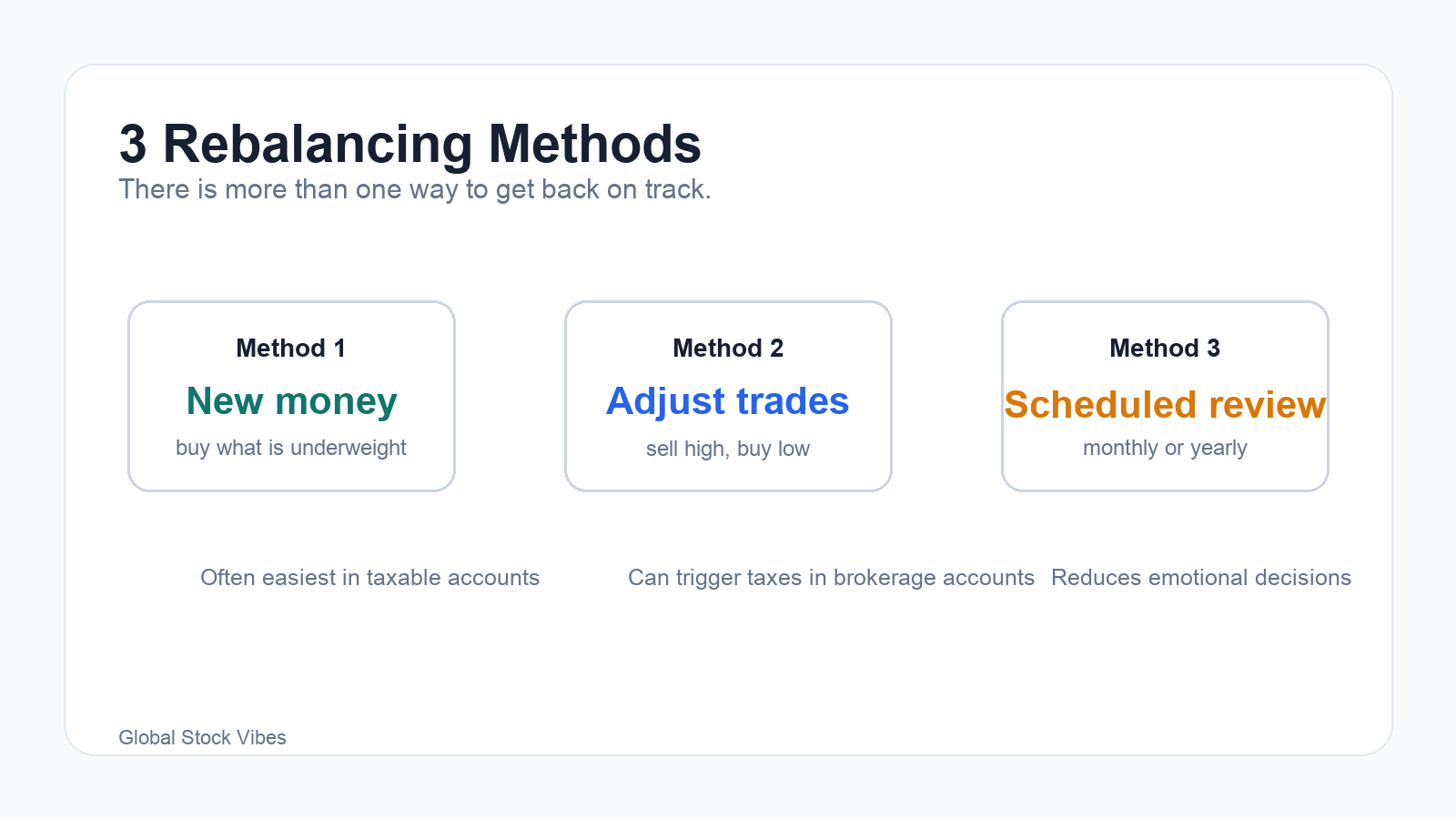
The third step is choosing how to rebalance. Some investors use new contributions. If stocks are below target, they direct new money toward stock funds. If bonds are below target, they direct new money toward bond funds. This can be tax-friendly because it may avoid selling investments.
Other investors sell a portion of the overweight asset and buy the underweight asset. That can work well inside tax-advantaged accounts such as 401(k)s and IRAs, where trades may not create immediate taxable events. In a regular taxable brokerage account, selling investments may create capital gains taxes, so the tax impact deserves extra care.
Many beginner investors use broad funds for this process. An index fund can make rebalancing easier because one fund may represent a whole market segment rather than a single company. ETFs can serve a similar role, and our guide to how ETFs work explains that structure in more detail.
For retirement accounts, rebalancing can also work differently from a regular brokerage account. Inside many 401(k) plans, you may be able to change future contributions separately from the investments you already own. That means you can send new paycheck contributions toward the underweight fund without selling anything right away.
Inside an IRA, you may have more investment choices, but the same principle applies. The account type does not choose the risk level for you. Your asset allocation does that, and rebalancing helps keep the account from drifting away from the plan.
In a taxable brokerage account, the process needs more caution. Selling appreciated investments can create taxable gains. In that case, many investors prefer to rebalance with dividends, interest, or new contributions first, then consider selling only when the drift is large enough to justify the tradeoff.
When Should You Rebalance a Portfolio?
There is no perfect schedule for every investor. The best rebalancing rule is usually one you can follow consistently without turning investing into a daily guessing game.
One common approach is calendar-based rebalancing. You review your portfolio once or twice a year and adjust if needed. This is simple, predictable, and easy for beginners to understand. It also reduces the temptation to react to every market headline.
Another approach is threshold-based rebalancing. Instead of checking only by calendar, you rebalance when an asset class moves too far from target. For example, if your stock target is 60%, you might rebalance only when stocks move above 65% or below 55%.
Some investors combine both. They review on a schedule, but only trade if the portfolio is meaningfully off target. This can reduce unnecessary trading while still keeping risk under control.
Dollar-cost averaging can also help. If you invest every paycheck or every month, you may be able to direct new contributions toward underweight assets instead of selling existing holdings. That is one practical way to connect rebalancing with dollar-cost averaging.
| Method | How It Works | Beginner Benefit |
|---|---|---|
| Calendar review | Check once or twice a year | Simple and predictable |
| Threshold rule | Act only when the mix drifts too far | Avoids unnecessary trades |
| New contributions | Send new money to underweight assets | May reduce tax impact |
| Target-date fund | Fund adjusts automatically over time | Very hands-off |
Portfolio Rebalancing Example
Here is a simple example. Suppose Mia has $10,000 invested with a target of 60% stocks and 40% bonds. That means $6,000 in stock funds and $4,000 in bond funds.
After a strong year for stocks, her account grows to $12,000. Her stock funds are now worth $8,400 and her bond funds are worth $3,600. Her actual allocation is 70% stocks and 30% bonds.
If Mia wants to return to 60/40, the target on a $12,000 portfolio is $7,200 in stocks and $4,800 in bonds. She could sell $1,200 of stock funds and buy $1,200 of bond funds. Or, if she is still adding money, she could direct future contributions to bonds until the portfolio gets closer to target.
This example is not a recommendation to use 60/40. It simply shows how the math works. A different investor may want a more aggressive or conservative allocation. Someone using a Roth IRA for long-term retirement may choose a different mix from someone investing for a shorter-term goal.
The same idea works with more detailed portfolios. If you own U.S. stocks, international stocks, bonds, and cash, you can compare each category with its target. You do not need to make it complicated. The point is to maintain a plan, not to chase perfect percentages every day.
Common Rebalancing Mistakes
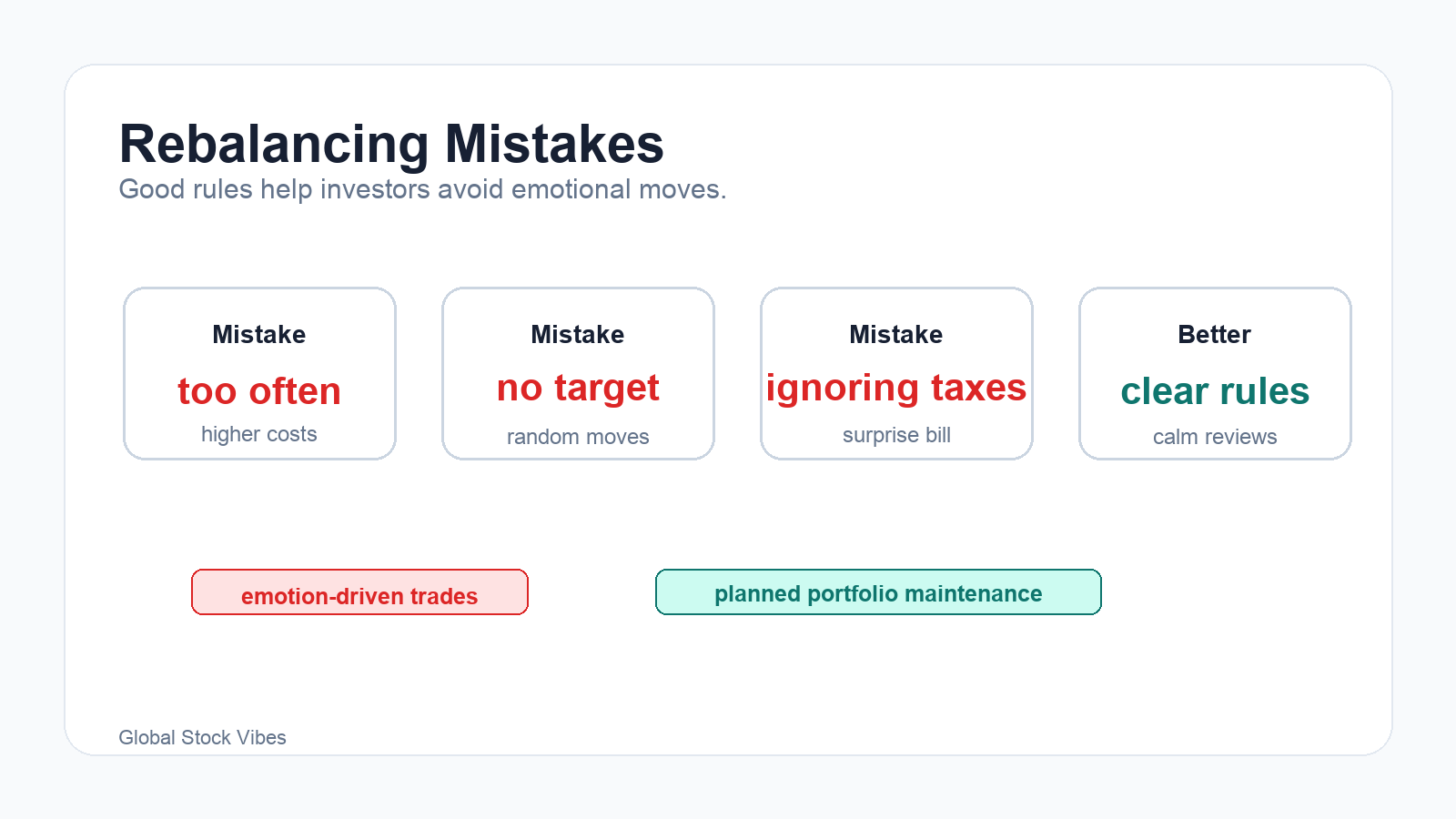
The first mistake is rebalancing too often. Small market moves are normal. If you trade every time your portfolio drifts by one percentage point, you may create extra costs, taxable events, and stress without improving the plan.
The second mistake is rebalancing without a target. You cannot rebalance back to a plan if you never created one. Before asking what is portfolio rebalancing for your account, ask what mix of assets you are trying to maintain.
The third mistake is ignoring fees and taxes. Fund expenses matter over long periods, and frequent trades in taxable accounts can create tax consequences. Fund costs are also worth watching because small percentages can add up over time.
The fourth mistake is using rebalancing as a market-timing tool. Rebalancing is not about guessing whether the S&P 500 will rise or fall next month. It is about keeping your risk level aligned with your plan.
The fifth mistake is forgetting that your life changes. A portfolio that made sense at age 25 may not fit at age 55. Rebalancing keeps your current mix close to your chosen target, but you may still need to update the target itself when your goals, income, family situation, or retirement timeline changes.
A helpful beginner rule is to write the trigger down before you need it. For example: “I will review my portfolio every January and rebalance only if any major asset class is more than five percentage points from target.” The exact numbers can vary, but the written rule matters because it prevents every market dip from becoming a new decision.
What is portfolio rebalancing not meant to do? It is not meant to make every investment equal, force daily trading, or guarantee higher returns. It is a discipline for keeping risk intentional. That is why it pairs well with long-term funds, retirement accounts, and simple investing habits.
Frequently Asked Questions About Portfolio Rebalancing
Is portfolio rebalancing good for beginners?
Yes, portfolio rebalancing can be helpful for beginners because it creates a simple rule for keeping investment risk aligned with a plan. It is most useful after you already know your target asset allocation.
How often should I rebalance my portfolio?
Many investors review once or twice a year, while others use a threshold rule such as rebalancing when an asset class is more than five percentage points away from target. The right rule depends on account type, costs, taxes, and personal preference.
Can rebalancing lose money?
Yes. Rebalancing does not guarantee profit or prevent losses. It may involve selling an asset that continues to rise or buying an asset that continues to fall. Its main purpose is risk control, not return prediction.
Should I rebalance in a 401(k) or IRA?
Tax-advantaged accounts can be convenient places to rebalance because trades inside the account may not create immediate taxable events. Still, investors should check plan rules, fund choices, fees, and their own financial situation.
What is the easiest way to rebalance?
The easiest way is often to use new contributions to buy whichever asset class is below target. Another simple option is a target-date fund, which handles allocation changes inside one fund.
Final Thoughts
What is portfolio rebalancing really about? It is about staying honest with your original investment plan. Markets move, winners grow, laggards shrink, and your portfolio can slowly become something different from what you intended.
A good rebalancing rule does not need to be complicated. Choose a target allocation, review it on a reasonable schedule, avoid unnecessary trades, and pay attention to taxes and fees. For long-term investors, that kind of calm maintenance can be more useful than reacting to every market move.