
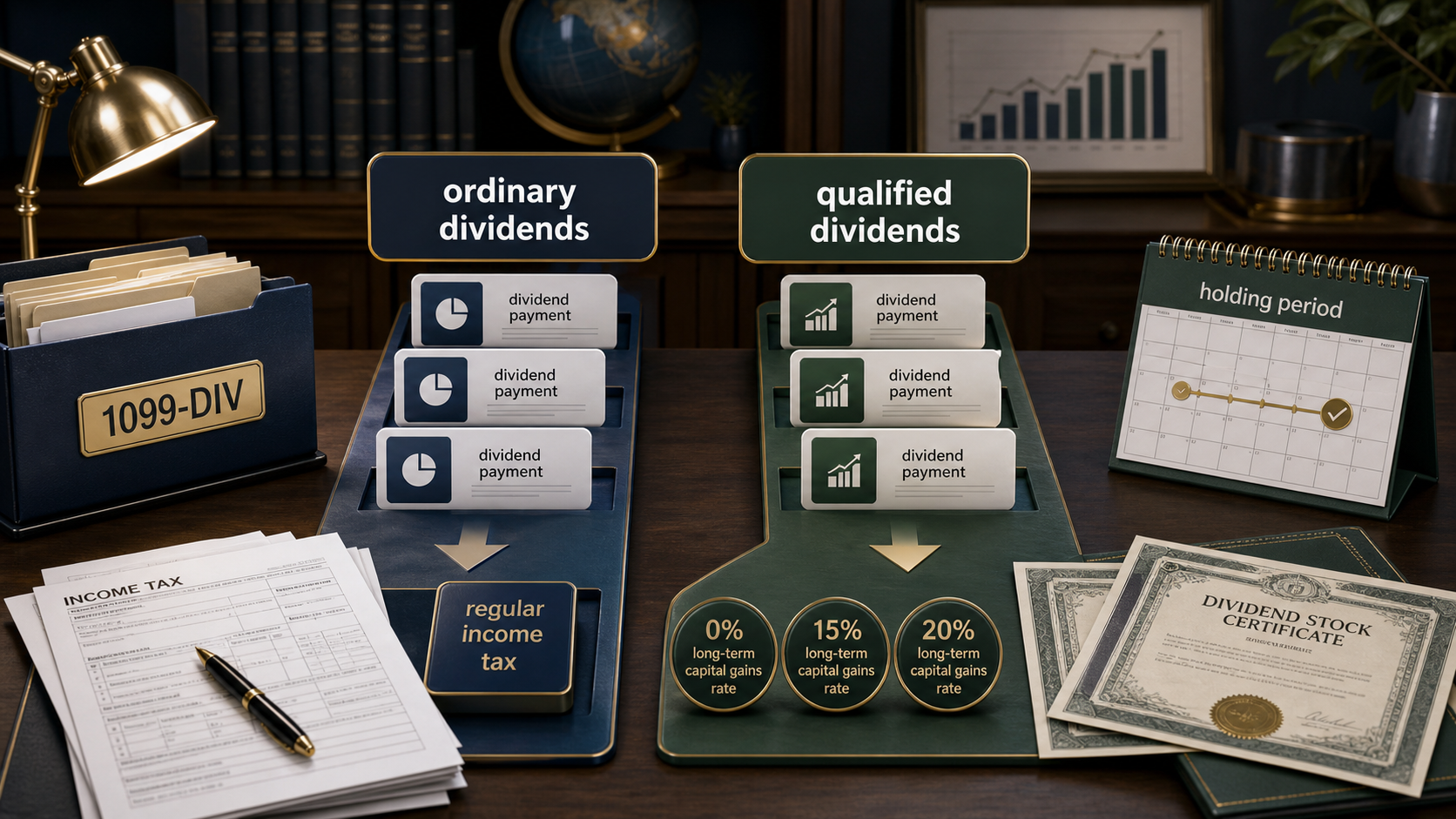
Qualified dividends are dividends that meet IRS rules and may be taxed at lower long-term capital gains tax rates instead of ordinary income tax rates. For beginner investors, the key idea is simple: not every dividend gets the same tax treatment.
A dividend can look like income in your brokerage account, but the tax category behind it matters. Some payments are ordinary dividends. Others receive qualified treatment. Some may be nonqualified because of the company type, holding period, or fund structure.
Educational disclaimer: This article is for general education only and is not personal tax, legal, investment, or financial advice. Dividend tax treatment depends on current law, taxable income, filing status, holding period, account type, and the security involved. Consider a qualified tax professional before making tax-sensitive investing decisions.
Key Takeaways
- Some qualifying dividend income may receive lower long-term capital gains tax treatment.
- Ordinary dividends are generally taxed as ordinary income unless they qualify for special treatment.
- Holding period rules are one of the biggest reasons a dividend may fail to qualify.
- Form 1099-DIV usually separates total ordinary dividends from the qualified portion.
- Dividend tax treatment matters most in taxable brokerage accounts, not inside many retirement accounts.
Qualified Dividends: The Basic Definition
Qualified dividends are dividends that satisfy specific tax rules. When a payment qualifies, it may be taxed at long-term capital gains rates rather than ordinary income rates. That can reduce tax drag for investors who hold dividend-paying stocks or funds in taxable accounts.
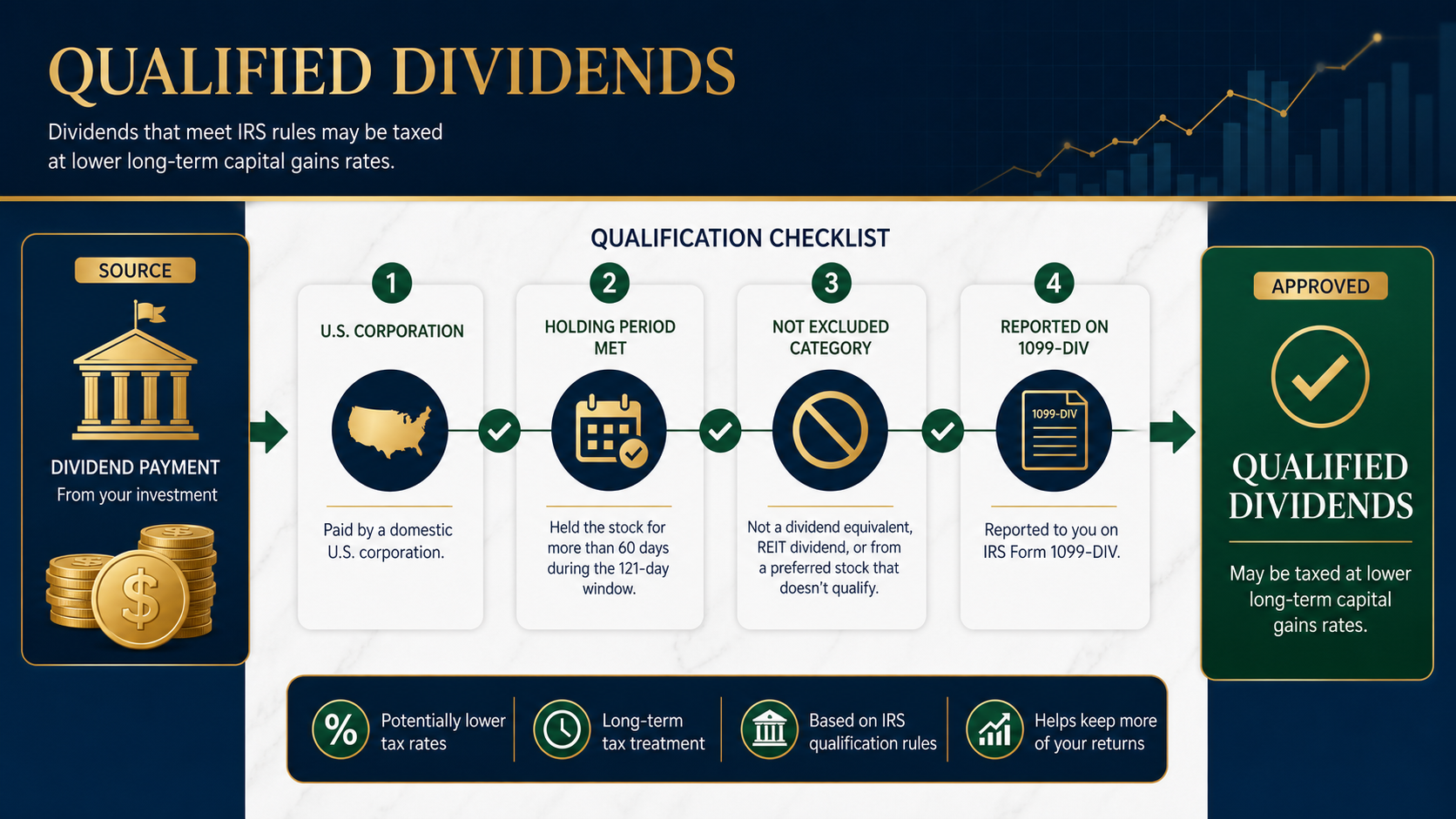
This does not mean every dividend from a familiar company automatically qualifies. The payer must generally be an eligible U.S. corporation or qualified foreign corporation, the dividend must not fall into an excluded category, and the investor must meet the required holding period.
For readers still building the foundation, GSV’s guide to dividend stocks explains where dividends come from, while the guide to dividend yield explains how investors compare dividend payments to stock price.
Qualified Dividends vs Ordinary Dividends
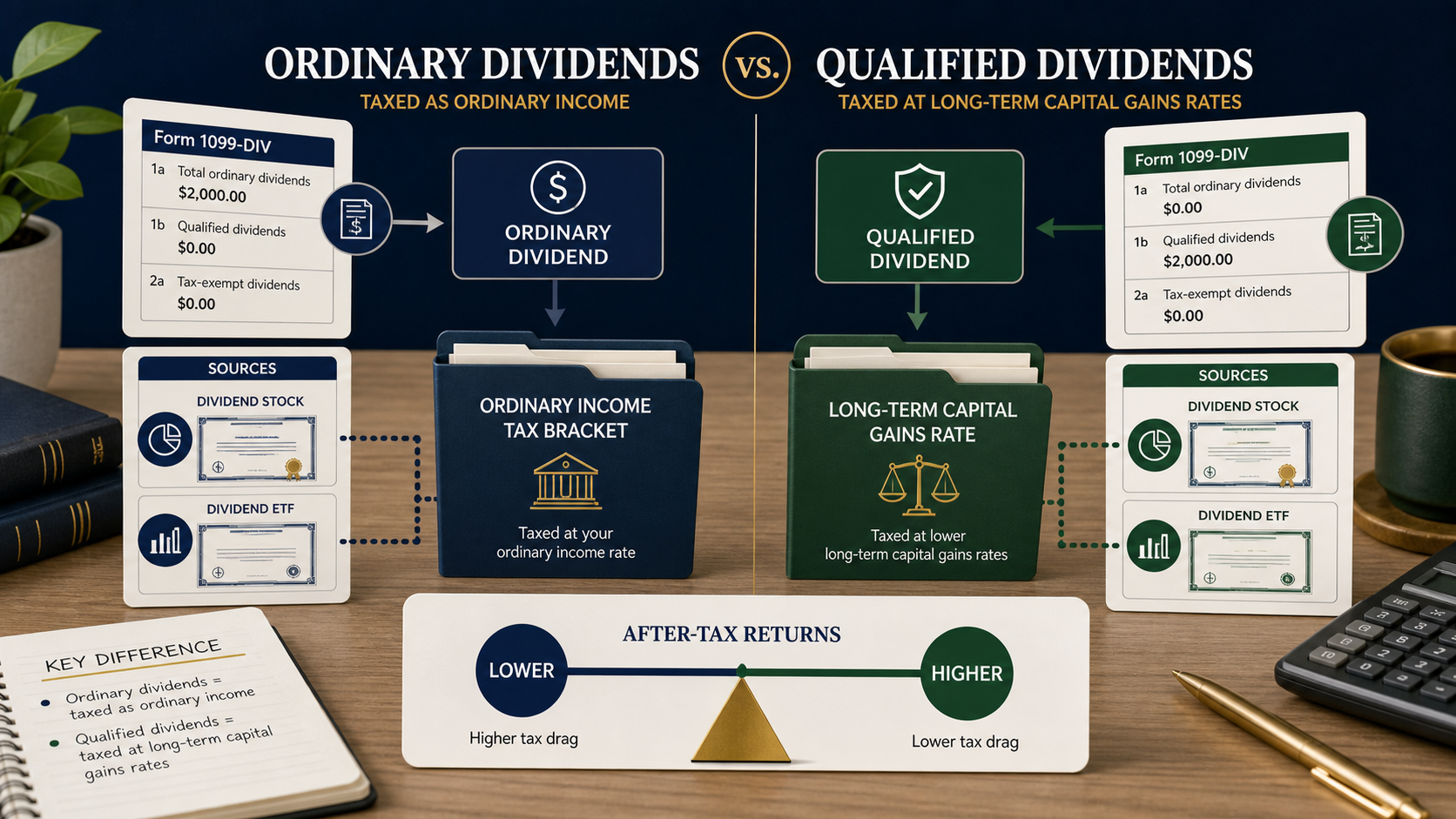
Ordinary dividends are the broad category. They are reported as dividend income and are generally taxed as ordinary income unless they qualify for lower tax treatment. The qualified portion is a subset of ordinary dividends that meets extra requirements.
Form 1099-DIV reflects this distinction. Box 1a generally reports total ordinary dividends. Box 1b generally reports the portion that may qualify for lower tax treatment. Box 1b is usually part of Box 1a, not an additional amount on top of it.
The tax difference can be meaningful. Ordinary income tax rates may be higher than long-term capital gains rates for many investors. Eligible dividend income may be taxed at 0%, 15%, or 20% long-term capital gains rates depending on taxable income and filing status, though exceptions and additional taxes can apply.
How the Holding Period Rule Works
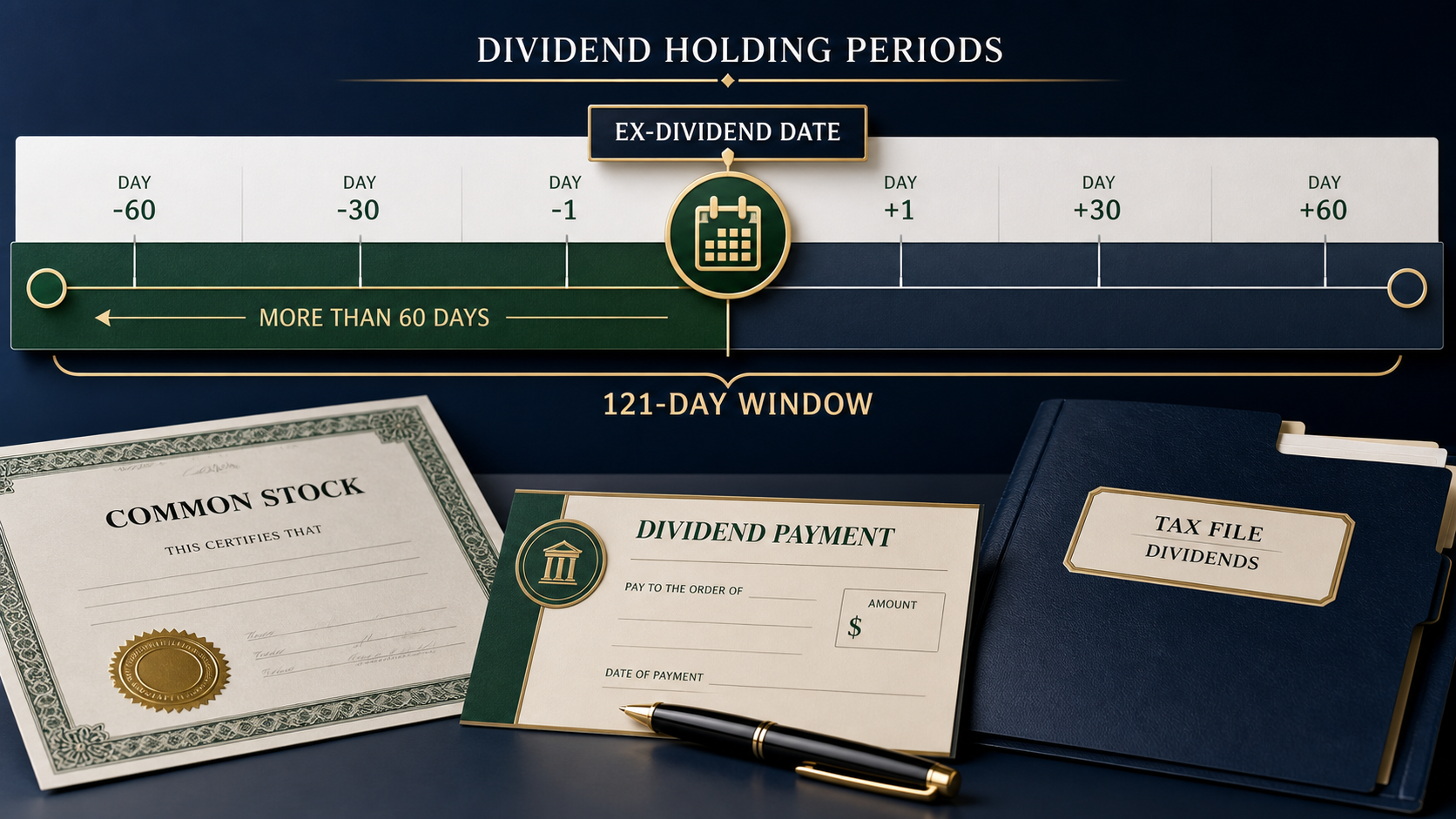
The holding period rule is one of the most important requirements. For many common stock dividends, IRS Publication 550 explains that you generally must have held the stock for more than 60 days during the 121-day period that begins 60 days before the ex-dividend date.
The ex-dividend date is important because it determines who is entitled to the upcoming dividend. Buying right before a dividend is paid does not automatically create qualified dividend treatment. The holding period test is designed to prevent investors from briefly buying a stock just to capture the dividend and still receive favorable tax treatment.
Preferred stock can have different holding period rules in some cases, especially when dividends are tied to longer periods. Because the details can be technical, beginners should rely on tax forms, official IRS guidance, and professional help when the amounts are significant.
Why Qualified Dividends Matter in Taxable Accounts
The tax category matters most in taxable accounts because taxable accounts expose dividends, interest, capital gains, and fund distributions to annual tax reporting. If you hold dividend-paying investments in a brokerage account, the category can affect after-tax returns.
Inside many retirement accounts, the annual tax treatment of dividends may not work the same way. A dividend paid inside a traditional IRA or 401(k) generally does not usually create a current-year taxable dividend entry the way a taxable account dividend can. Roth accounts have their own qualified withdrawal rules.
This is why dividend tax treatment connects naturally with asset location. Investors who own dividend-heavy assets may think about which accounts hold them, although tax placement should not override a sensible portfolio plan.
How Funds Handle Qualified Dividends
Dividend tax treatment can also show up in ETFs and mutual funds. A fund may receive dividends from its underlying holdings and then distribute income to shareholders. Some of that income may qualify for lower rates, while other amounts may be ordinary income, capital gain distributions, or another category.
A dividend ETF may produce qualified dividend income if its holdings and holding periods satisfy the requirements, but investors should not assume every distribution is qualified. Fund tax reporting can depend on what the fund owns, how long it holds securities, and the type of income received.
Costs also matter. A tax-efficient dividend fund with an unnecessarily high expense ratio can still drag on returns. If you use ETFs, review the ETF expense ratio alongside yield, diversification, and tax treatment.
A Simple Qualified Dividend Example
Imagine an investor receives $1,000 of dividends in a taxable brokerage account. The Form 1099-DIV shows $1,000 in total ordinary dividends and $800 in Box 1b. That means $800 may be eligible for long-term capital gains tax rates, while the remaining $200 may be taxed as ordinary income.
The exact tax owed depends on the investor’s taxable income, filing status, deductions, and other tax items. The investor should not simply multiply the dividend by one rate without checking the full tax return.
The same investor may also have realized gains or losses from selling investments. That is where capital gains tax and tax loss harvesting become part of the broader taxable-account picture.
Common Mistakes With Qualified Dividends
The first mistake is assuming high yield means better after-tax income. A high dividend yield can be attractive, but the dividend may not be qualified, the stock may be risky, or the price may be falling for a reason.
The second mistake is ignoring the holding period. If you buy a stock shortly before the ex-dividend date and sell soon after, the dividend may not qualify even if the company itself often pays dividends that receive favorable treatment.
The third mistake is confusing Box 1a and Box 1b on Form 1099-DIV. Box 1a is the total ordinary dividend amount. Box 1b is the portion that may be qualified. Treating them as separate additive amounts can lead to confusion.
The fourth mistake is letting taxes drive the whole investment decision. Lower tax treatment can help, but dividend quality, diversification, valuation, account type, and risk still matter. Taxes are one input, not the whole strategy.
Beginner Checklist Before Chasing Dividend Tax Benefits
- Confirm whether the investment is held in a taxable account or retirement account.
- Review Form 1099-DIV after year-end instead of guessing the tax category.
- Check whether the dividend is from an eligible payer.
- Understand the holding period around the ex-dividend date.
- Compare yield with business risk and portfolio diversification.
- Look at fund costs, turnover, and distribution history.
- Consider whether the asset belongs in taxable or tax-advantaged accounts.
- Ask a tax professional when dividend income is large or tax rules are unclear.
This checklist keeps the tax benefit in context. Favorable treatment can help, but a dividend strategy still needs a durable investment reason behind it.
Final Thoughts
Qualified dividends can make dividend investing more tax-efficient in taxable accounts, but favorable treatment is not automatic and it is not a reason to chase yield blindly. The payer, holding period, account type, and tax form reporting all matter.
For beginners, the practical takeaway is to understand the difference between ordinary dividends and the qualified portion, keep good records, and build the portfolio around sound investing principles first. Tax treatment should support the plan, not replace it.
Frequently Asked Questions About Qualified Dividends
What are qualified dividends?
They are dividends that meet IRS rules and may be taxed at lower long-term capital gains tax rates instead of ordinary income tax rates.
Are qualified dividends tax-free?
No, not automatically. Some taxpayers may owe 0% federal tax on qualified dividend income depending on taxable income and filing status, but others may owe 15%, 20%, or additional taxes.
Where do qualified dividends appear on Form 1099-DIV?
They generally appear in Box 1b of Form 1099-DIV. Total ordinary dividends generally appear in Box 1a.
Do ETFs pay qualified dividends?
Some ETF distributions may include dividend income that qualifies, but not all fund income does. The answer depends on the underlying holdings, holding periods, and fund tax reporting.
Do qualified dividends matter in an IRA?
Qualified dividend treatment usually matters most in taxable accounts. Inside many IRAs and 401(k)s, annual dividends generally do not create the same current-year taxable dividend reporting.
Continue Learning
Ready for the next step? Explore these related investing guides.