
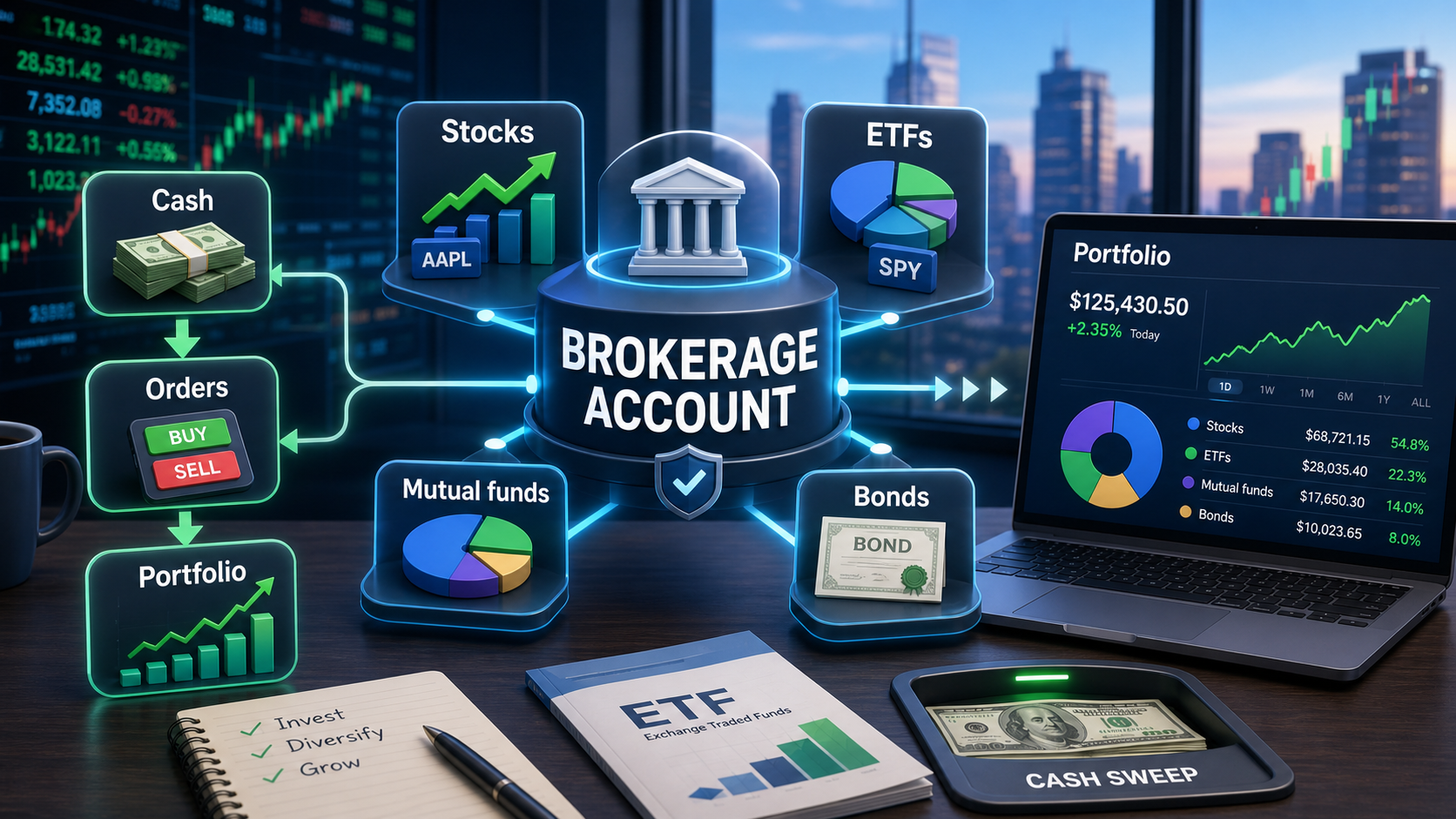
What is a brokerage account? It is an account that lets you buy, sell, and hold investments such as stocks, ETFs, mutual funds, bonds, and cash products. Think of it as the doorway to the investment market—not an investment by itself.
The account is opened with a brokerage firm, sometimes called a broker-dealer. You deposit money, choose investments, place orders, and track your holdings through the broker’s platform. A brokerage account can be powerful, but it also comes with market risk, tax rules, fees, and security choices beginners should understand before putting real money to work.
Brokerage Account Key Takeaways
- A brokerage account is a flexible investment account used to buy and hold securities.
- It can hold stocks, ETFs, mutual funds, bonds, Treasury bills, and cash sweep options depending on the broker.
- Taxable brokerage accounts do not have the same tax advantages as IRAs or 401k plans.
- You can usually access money more flexibly than in retirement accounts, but investments can lose value.
- Before opening one, compare fees, investment choices, cash sweep terms, security features, and research tools.
How a Brokerage Account Works
A brokerage account works as the connection between your money and the investment markets. After opening the account, you transfer cash from a bank account. Once the cash settles, you can place an order to buy an investment. The broker sends that order to be executed, and the purchased investment appears in your portfolio.
The broker does not make an investment safe just because the account is easy to use. If you buy a stock, your result depends on that company’s performance and market valuation. If you buy an ETF or mutual fund, your result depends on the assets inside the fund. If you leave money in cash, your return depends on the broker’s cash sweep option or money market choice.
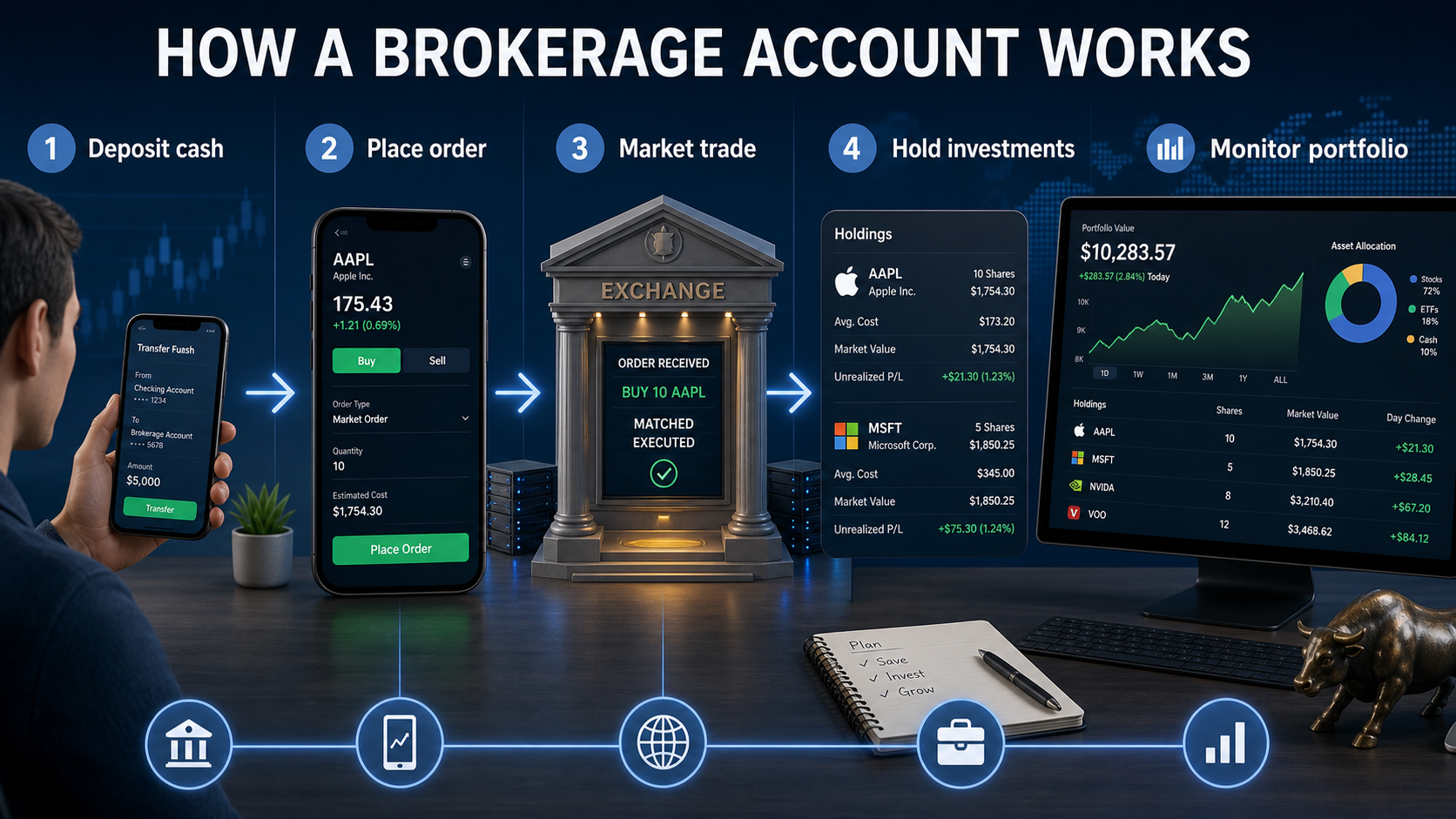
For a beginner, the account mechanics are usually simpler than the investing decisions. Opening the account can take minutes. Building a sensible portfolio can take more thought. That is why it helps to understand the difference between individual stocks, diversified funds, bonds, and cash before placing your first trade.
What Opening My First Account Taught Me
I started investing with a modest amount of savings and almost no market knowledge. I even joined a stock recommendation chat room and came close to putting money into questionable small companies because someone else sounded confident. Looking back, opening the brokerage account was the easy part. Learning whom not to trust was much harder.
Little by little, I built my own rules. I moved toward established companies I understood and stopped treating every exciting recommendation as an opportunity. Fractional shares helped because some U.S. stocks felt far too expensive when I was starting. Being able to buy a small piece meant I could begin with a few dollars, keep adding regularly, and learn without waiting until I had a large lump sum.
Those small purchases eventually grew into a much larger portfolio. I now encourage my daughter to invest small amounts through her own account, and we sometimes talk about the companies we own. That progress did not come from finding a magical brokerage app. It came from using the account consistently and becoming more careful about what went inside it.
Have you been waiting because your starting amount feels too small? A brokerage account may lower the practical barrier, especially when fractional shares are available. But start slowly. Experience can help you recognize opportunities later, while one rushed decision can teach a much more expensive lesson.
What You Can Hold in a Brokerage Account
Most modern brokerage accounts can hold many types of investments. The available menu depends on the firm, but common choices include individual stocks, ETFs, mutual funds, bonds, options, Treasury securities, certificates of deposit, and cash sweep products. Some brokers also offer fractional shares, automated portfolios, or margin borrowing.
Individual stocks represent ownership in a public company. If you are new to that idea, start with GSV’s guide to what a stock is. Stocks can offer growth, but they can also be volatile because one company can disappoint investors, miss earnings expectations, or trade at an expensive valuation.
ETFs and mutual funds pool many securities into one investment. A broad ETF can make diversification easier than buying single stocks one by one. If you are comparing fund wrappers, read what an ETF is and how a mutual fund works before choosing.
A brokerage account can also hold cash-like investments. For example, you may keep uninvested cash in a sweep program, a money market fund, Treasury bills, or another short-term product. These tools can be useful while waiting to invest, but they are not the same as long-term growth investments. GSV’s money market fund guide explains that distinction in more detail.
Brokerage Account vs Retirement Account
A taxable brokerage account is different from an IRA or 401k. The biggest difference is tax treatment. A regular taxable account usually gives you flexible access to money, but dividends, interest, and realized capital gains can create taxes along the way. Retirement accounts may offer tax advantages, but they usually come with contribution limits and withdrawal rules.
| Feature | Taxable Brokerage Account | Retirement Account |
|---|---|---|
| Main purpose | Flexible investing and wealth building | Retirement saving |
| Tax treatment | Taxes may apply each year | Tax advantages depend on account type |
| Contribution limits | No standard annual IRS contribution cap | IRS limits usually apply |
| Withdrawals | Usually flexible | Rules and penalties may apply |
| Best fit | Goals before or beyond retirement | Long-term retirement savings |
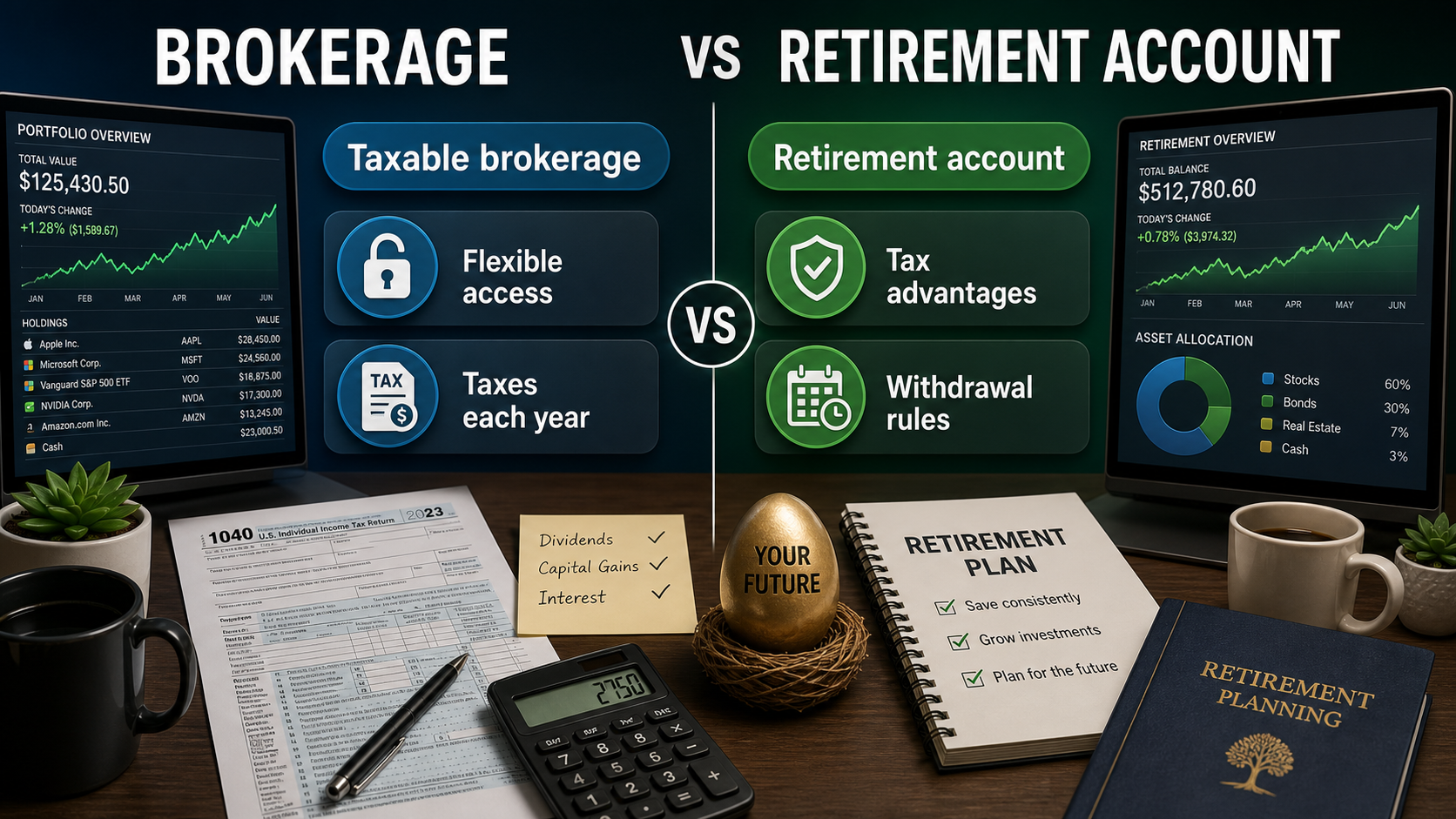
For example, a traditional IRA can offer tax-deferred growth, while a Roth IRA can offer tax-free qualified withdrawals when rules are met. A taxable account does not usually provide those retirement tax benefits. Its strength is flexibility. You can invest for a house down payment, early retirement bridge, future business purchase, or general long-term wealth without locking every dollar inside retirement rules.
Cash, Margin, and Account Types
Many beginners should start with a cash account. In a cash account, you buy securities using settled cash. It is straightforward and avoids borrowing. A margin account lets you borrow from the broker using eligible securities as collateral. Margin can increase buying power, but it also increases risk and can lead to forced selling if your account value falls.
Some brokers also offer joint accounts, custodial accounts, trust accounts, and business accounts. The right account title affects ownership, taxes, transfer rules, and estate planning. For a first investing account, many individuals start with a simple taxable individual brokerage account unless they have a specific reason to choose another structure.
Cash sweep programs deserve attention. Uninvested cash may earn interest, move into a bank sweep program, or sit in a low-yield default option. During higher-rate environments, this detail matters. If your cash is meant for emergencies rather than investing, compare it with a high-yield savings account before assuming the broker’s default cash option is best.
Taxes in a Brokerage Account
A taxable brokerage account can create several types of taxable income. Dividends may be taxable. Bond interest may be taxable. Selling an investment for more than you paid can create a capital gain. Selling for less can create a capital loss, which may have tax uses under IRS rules.
The holding period matters. Long-term capital gains may be taxed differently from short-term gains. Fund distributions can also surprise beginners. A mutual fund or ETF may distribute dividends or capital gains even if you did not sell shares yourself. Tax rules are one reason many investors place high-turnover or income-heavy strategies carefully across taxable and retirement accounts.
This does not mean taxable brokerage accounts are bad. It means tax awareness matters. A simple diversified portfolio held for a long time may be more tax-efficient than frequent trading. If you are investing gradually, dollar-cost averaging can help create a steady process without trying to guess perfect entry points.
What to Check Before Opening a Brokerage Account
Before opening a brokerage account, compare the basics. Look at trading commissions, fund fees, account fees, transfer fees, margin rates, and options contract fees if those apply. Many brokers advertise zero-dollar stock and ETF trades, but that does not mean every cost is zero.
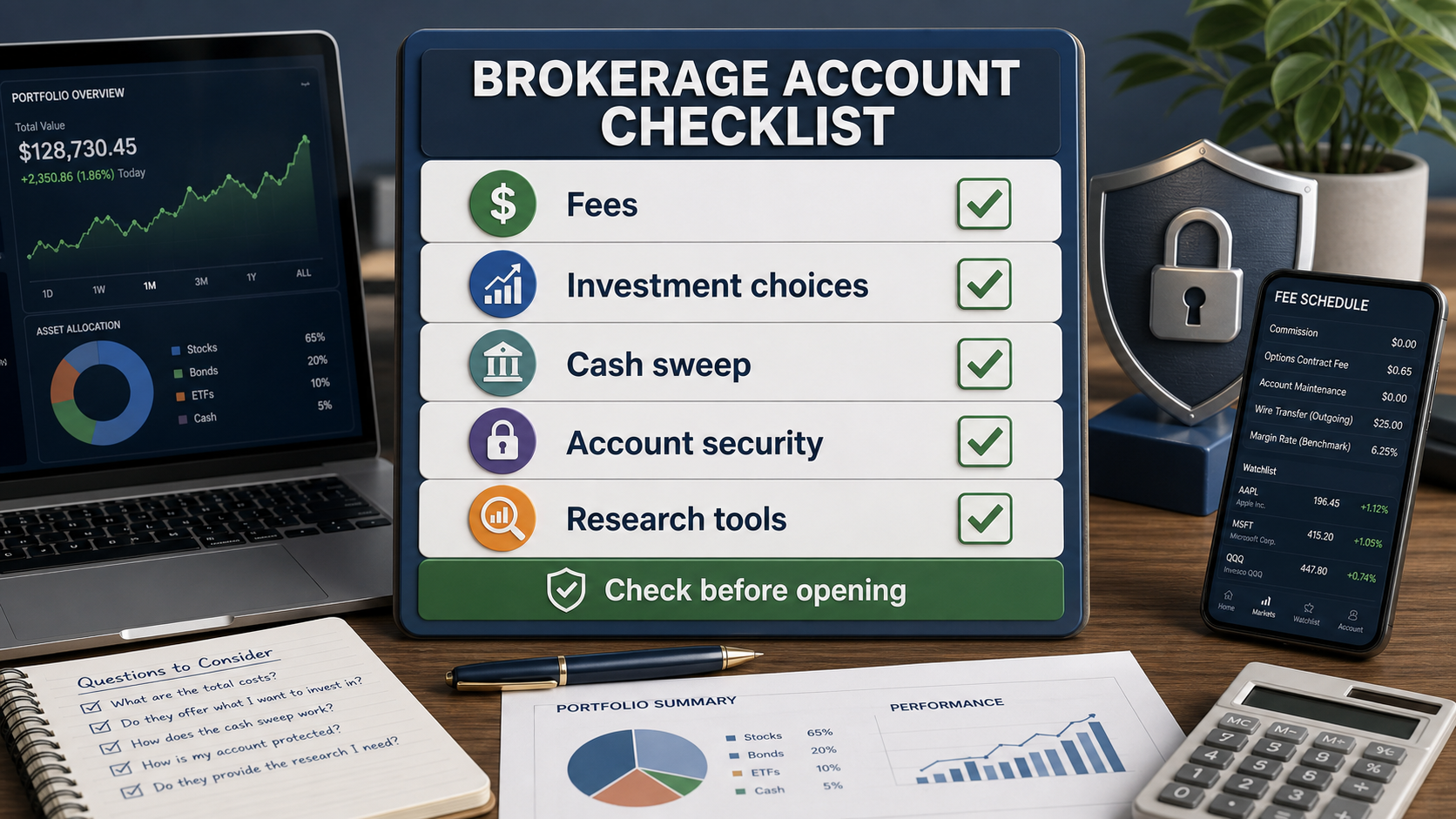
Next, check investment access. Does the broker offer the ETFs, mutual funds, bonds, Treasury securities, or cash products you want? Does it support fractional shares if your budget is small? Are research tools beginner-friendly? Does the app make risky trading too easy, or does it help you make thoughtful decisions?
Security also matters. Use strong passwords, two-factor authentication, and a broker with clear account protection policies. FINRA’s BrokerCheck can help investors research brokerage firms and financial professionals. SIPC protection may apply if a member brokerage firm fails and customer securities are missing, but it does not protect against market losses.
Common Beginner Mistakes
The first mistake is opening the account before having a plan. A brokerage account is only a tool. Without a plan, it can turn into a place for random trades, hype chasing, or panic selling. A simple plan should include your goal, time horizon, risk tolerance, contribution schedule, and target asset mix. GSV’s asset allocation guide can help with that foundation.
The second mistake is treating a brokerage account like a bank account. Investments are not deposits. Stocks and funds can fall. Bond prices can move. Cash sweep terms can change. If the money is for rent, emergency savings, or a near-term bill, it may not belong in volatile investments.
The third mistake is trading too often. Frequent trading can create taxes, costs, stress, and bad habits. For many beginners, a boring portfolio of diversified funds held consistently is more practical than trying to outsmart every market move. Understanding the S&P 500 can be a useful starting point for learning how broad market exposure works.
FAQ About Brokerage Accounts
Is a brokerage account safe?
A brokerage account can be held at a regulated firm, but investments inside it can lose value. SIPC protection is not the same as FDIC insurance and does not protect against normal market losses.
Do I need a brokerage account to buy stocks?
Most individual investors use a brokerage account to buy publicly traded stocks, ETFs, mutual funds, bonds, and other securities. Some employer plans or direct purchase programs work differently, but a broker is the common route.
Is a brokerage account taxable?
A regular taxable account can create taxes from dividends, interest, and realized capital gains. Retirement accounts have different tax rules.
How much money do I need to open a brokerage account?
Some brokers have no account minimum, while others require a minimum deposit. Even if the account minimum is low, you should only invest money that fits your budget and risk tolerance.
Can I lose money in a brokerage account?
Yes. If the investments you buy fall in value, your account can lose money. The account gives access to markets; it does not guarantee returns.
Final Thoughts on Brokerage Accounts
Opening a brokerage account can take only a few minutes. Learning what deserves a place inside it takes much longer. I made mistakes, trusted voices I should not have trusted, and slowly built rules that fit me better.
If your starting amount feels too small, remember that fractional shares can let you begin with a modest purchase. What matters is not looking wealthy on day one. It is learning how orders work, choosing businesses or funds you understand, and continuing carefully enough to stay in the market.
The account is only the container. Before opening one, compare costs, security, cash sweep options, investment choices, and whether the platform helps you invest calmly instead of pushing you toward constant reaction. Then start small enough that your first lessons do not have to become your most expensive ones.