
A dividend ETF is an exchange-traded fund that owns a basket of dividend-paying stocks. Instead of choosing one company for its dividend, investors buy shares of a fund that spreads money across many companies selected by a dividend strategy.
The appeal is easy to understand. A dividend ETF can offer income potential, diversification, and simple access through a brokerage account. But it can still lose value, the income can change, and a high yield is not always a sign of quality.
This beginner guide explains how a dividend ETF works, how it differs from dividend stocks and index ETFs, what risks to watch, and how to decide whether this type of fund fits your investing plan.
Key Takeaways
- A dividend ETF owns a group of dividend-paying stocks inside one tradable fund.
- The fund may focus on high yield, dividend growth, dividend quality, or a mix of factors.
- Dividend ETFs can simplify income investing, but dividends are not guaranteed.
- Expense ratios, sector concentration, tax treatment, and payout sustainability matter.
- A dividend ETF should fit your portfolio strategy, not replace a complete investing plan.
What Is a Dividend ETF?
A dividend ETF is a fund that trades on an exchange and focuses on stocks that pay dividends. Some dividend ETFs seek higher current income. Others focus on companies with a history of raising dividends. Some combine yield, quality, profitability, and valuation screens.
The ETF part matters. As GSV explains in its guide to how ETFs work, an ETF gives investors shares of a pooled portfolio. That structure can make it easier to buy diversified exposure without researching every holding one by one.
The dividend part also matters. GSV’s beginner guide to dividend stocks explains that dividends are payments some companies make to shareholders. A dividend ETF collects exposure to many such companies inside one fund.
That does not make the fund safe by default. The underlying companies are still stocks. Their prices can fall, dividends can be reduced, and the ETF can underperform the broader market. A dividend ETF is an investing tool, not a guaranteed paycheck.
How a Dividend ETF Works
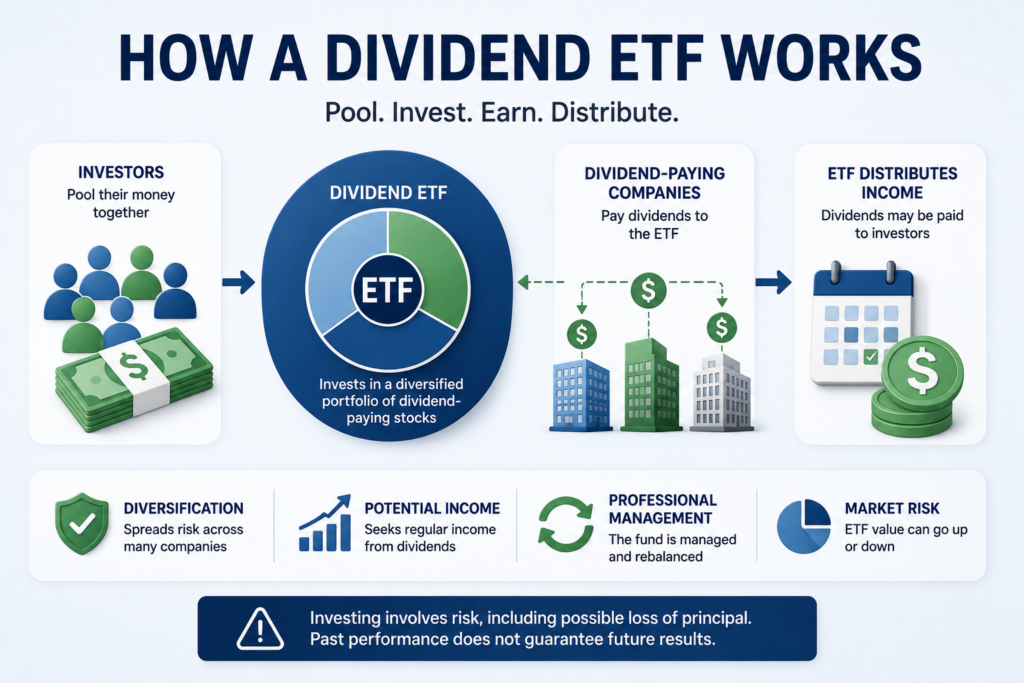
A dividend ETF begins with a rulebook. The fund may track an index or follow an active strategy. The rules decide which stocks qualify, how much weight each company receives, how often the portfolio is rebalanced, and how the fund handles companies that cut dividends.
Companies inside the fund may pay dividends to the ETF. The fund may then distribute income to shareholders, often quarterly or monthly, depending on the fund. The exact amount can change because company payouts, portfolio holdings, expenses, and market conditions change.
Investor.gov explains that ETF shares represent part ownership of a fund’s portfolio and the income it may generate. In a dividend fund, that income usually comes from stock dividends, but the fund still trades in the market and its share price can move up or down.
For a simple example, imagine an ETF owns 100 dividend-paying companies. If several companies raise dividends, the fund’s income may improve. If several companies cut dividends or leave the index, the fund’s distribution may decline.
Costs also matter. Every ETF has operating expenses. A low fee does not guarantee good results, but a high expense ratio can quietly reduce the benefit of dividend income. GSV’s guide to ETF expense ratios explains why fees deserve attention before buying any fund.
Dividend ETF vs Dividend Stock
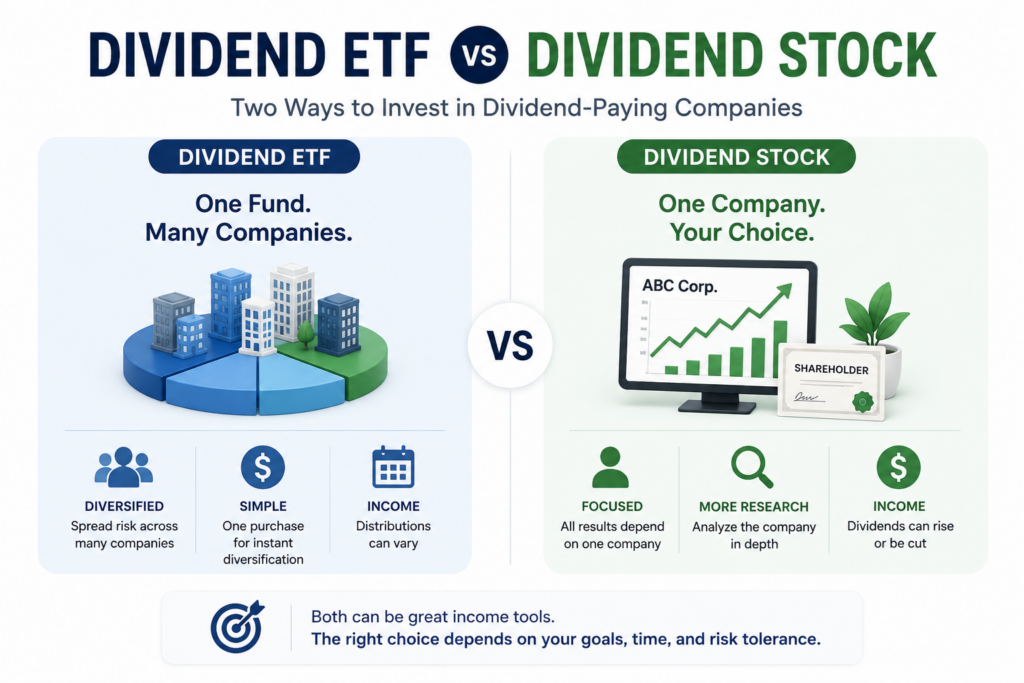
The main difference is diversification. A dividend stock gives you exposure to one company. A dividend ETF gives you exposure to many companies selected by the fund’s strategy.
That diversification can help reduce the damage from one company cutting its dividend. If one holding disappoints, the fund may still receive income from many others. But diversification does not remove stock market risk. If the whole market falls, dividend funds can fall too.
| Feature | Dividend ETF | Individual Dividend Stock |
|---|---|---|
| Diversification | Many companies in one fund | One company at a time |
| Research burden | Focus on fund rules and holdings | Analyze company financials directly |
| Income | Fund distributions can vary | Company dividend can rise or be cut |
| Costs | Expense ratio applies | No ETF fee, but trading costs may exist |
| Main risk | Market, sector, strategy, and fee risk | Company-specific risk |
An investor who enjoys researching businesses may prefer individual dividend stocks. A beginner who wants simple exposure may prefer a fund. Neither approach is automatically superior. The better choice depends on skill, time, risk tolerance, and goals.
Types of Dividend ETFs
Not all dividend ETFs are built the same way. The name can sound similar, but the strategy underneath can be very different.
High-yield dividend ETFs often look for stocks with larger dividend yields. That can be attractive, but it can also create a value trap if high yield reflects falling share prices or weak business fundamentals.
Dividend growth ETFs focus on companies that have raised dividends over time. These funds may have lower current yields, but they often emphasize consistency, quality, and financial strength. Dividend quality ETFs may screen for profitability, balance sheets, payout ratios, or dividend sustainability.
Some dividend ETFs are broad and diversified. Others are concentrated in sectors such as utilities, financials, real estate, energy, or consumer staples. Concentration can matter because a dividend fund that looks diversified by company count may still be heavily tilted toward a few sectors.
| Type | Common Goal | Risk to Watch |
|---|---|---|
| High-yield dividend ETF | Higher current income | Yield traps and dividend cuts |
| Dividend growth ETF | Rising dividends over time | Lower starting yield |
| Dividend quality ETF | Financially stronger payers | Screening rules may miss some winners |
| International dividend ETF | Income outside the U.S. | Currency, tax, and country risk |
| Sector dividend ETF | Targeted income exposure | Sector concentration |
This is why beginners should read the fund’s objective, index methodology, holdings, sector weights, distribution history, and expense ratio before investing.
Benefits and Risks of Dividend ETFs
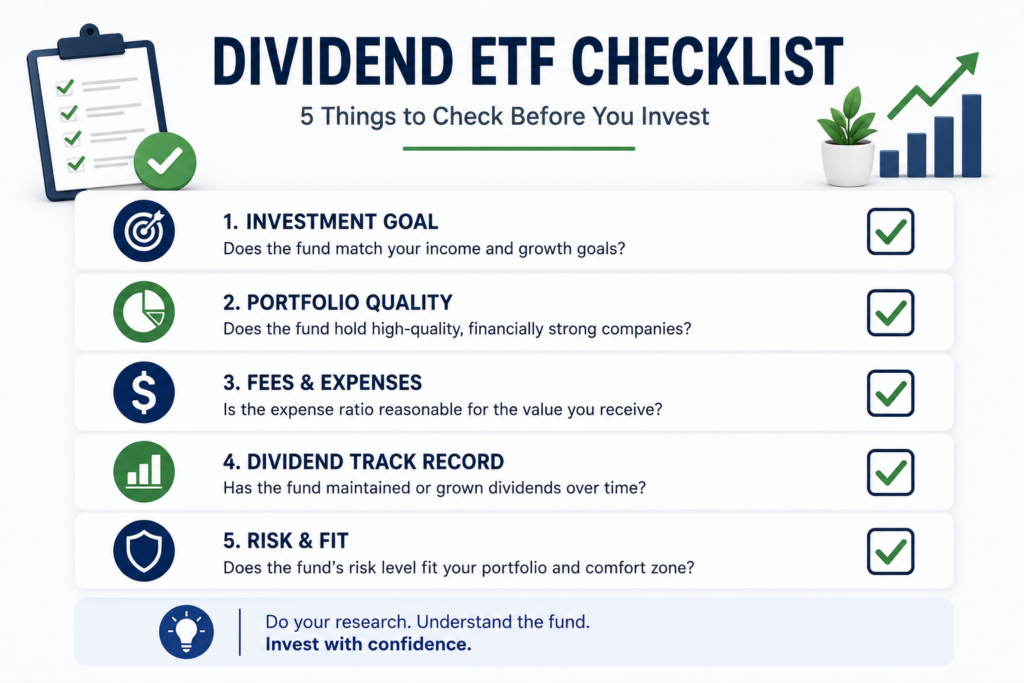
The biggest benefit is simplicity. A dividend ETF can give a beginner exposure to many dividend-paying companies with one purchase. That can be easier than building a basket of individual stocks from scratch.
Another benefit is income potential. Some investors like seeing regular distributions because it makes the portfolio feel more tangible. Retirees, income-focused investors, and people building a cash-flow plan may find that appealing.
But there are tradeoffs. Dividend ETFs are still equity investments. They can lose value. A fund can underperform a broad index if dividend-paying companies lag growth stocks or if the fund is concentrated in weaker sectors.
Taxes can also matter. The IRS has rules for qualified dividends, ordinary dividends, holding periods, and taxable accounts. A dividend ETF held in a taxable account may create tax bills even if you reinvest the distributions. Retirement accounts may treat the timing differently, but account rules matter.
A high yield deserves special caution. If the yield looks much higher than similar funds, ask why. It may come from riskier companies, slower growth, falling prices, or a strategy that sacrifices total return. GSV’s article on market capitalization can help beginners understand why company size and quality often matter when evaluating stock exposure.
Where a Dividend ETF Fits in a Portfolio
A dividend ETF can fit into the stock side of a portfolio. It may support an income tilt, a value tilt, or a quality-focused equity strategy. It should not be confused with cash, bonds, or a guaranteed income product.
Start with asset mix. GSV’s article on asset allocation explains why investors should decide how much belongs in stocks, bonds, and cash before choosing specific funds. A dividend ETF is one possible stock fund, not the entire plan.
It can also sit beside a broad index fund. A beginner might use a broad market fund as the core and a dividend fund as a smaller satellite position. GSV’s guide to index funds explains why broad diversification is often a useful starting point.
Investors comparing fund types may also want to understand how dividend ETFs differ from bond ETFs. A bond fund may focus on fixed income, while a dividend fund still owns stocks. Both can distribute cash, but their risks are very different.
Finally, think about time horizon. If you need money soon, a stock-based dividend fund may be too volatile. If you are investing for many years, dividend reinvestment can become part of a long-term compounding plan, similar in spirit to consistent investing habits like dollar-cost averaging.
Frequently Asked Questions
Can a dividend ETF lose money?
Yes. A dividend ETF owns stocks, so its share price can fall. Dividend payments may also change if companies reduce payouts or the fund changes holdings.
Do dividend ETFs pay monthly?
Some dividend ETFs pay monthly, while others pay quarterly or on another schedule. Always check the fund’s distribution policy and history before buying.
Is a dividend ETF good for beginners?
It can be useful for beginners who want diversified dividend exposure, but they should understand the fund’s strategy, fees, taxes, and stock market risk.
Is a dividend ETF better than an index ETF?
Not always. A broad index ETF may offer wider market exposure, while a dividend ETF tilts toward dividend-paying companies. The better choice depends on the role you need in the portfolio.
Are dividend ETF dividends guaranteed?
No. Dividends are not guaranteed. Companies can reduce or stop dividends, and fund distributions can change over time.
Final Thoughts
A dividend ETF can be a simple way to invest in a basket of dividend-paying companies. It may offer income potential and diversification without requiring beginners to pick every stock individually.
The key is understanding what you own. High yield, low fees, dividend growth, sector concentration, and tax treatment can all change the real experience of holding the fund.
Used thoughtfully, a dividend ETF can support a long-term portfolio. Used blindly, it can become just another stock fund with risks hidden behind an attractive yield.