

401k vs IRA compares a workplace retirement plan with an account you open for yourself. If your employer offers a 401(k) match, that usually deserves attention first. After that, the better place for the next dollar depends on fees, investment choices, taxes, and how much flexibility you need.
Does retirement saving feel like one more decision you are supposed to understand immediately? I understand that feeling. The account names sound technical, but the first decision is practical: Is your employer offering extra money, and can you afford to contribute enough to receive it?
This guide explains the choice in plain English. There is no perfect order for every household, but there is a sensible way to work through it without turning retirement planning into a guessing game.
Educational disclaimer: This article is for general financial education only. It is not personal financial, tax, legal, retirement, or investment advice. Retirement account rules can change, and employer plans can have their own rules. Check official IRS guidance, your plan documents, or a qualified professional for your own situation.
Key Takeaways
- A 401(k) is a workplace retirement plan, while an IRA is an individual retirement account.
- Employer matching contributions can make a 401(k) especially valuable when a match is available.
- IRAs may offer more provider choice and investment flexibility, but lower annual contribution limits.
- For 2026, the IRS announced a 401(k) employee deferral limit of $24,500 and an IRA contribution limit of $7,500 for eligible savers.
- Many beginners start by capturing the employer match, then compare IRA benefits, then decide whether to add more to the 401(k).
401k vs IRA: The Core Difference
The core difference in a 401k vs IRA comparison is who provides the account. A 401(k) is connected to an employer plan. Your employer chooses the plan provider, sets plan rules within legal limits, and may offer a matching contribution.

An IRA is opened by you. You choose the brokerage or financial institution, and you generally choose from the investments that provider makes available. That can create more flexibility, but it also places more responsibility on the individual investor.
Both accounts are tax-advantaged retirement accounts. That means they are designed for long-term retirement saving, not short-term spending. The details differ, but the purpose is similar: help money grow for retirement under special tax rules.
If you need the account basics first, read GSV’s guide to what a 401(k) is and the beginner guide to a traditional IRA. This article focuses on the side-by-side decision.
How a 401(k) Works
A 401(k) lets eligible workers contribute part of their paycheck to a retirement plan. Contributions may be traditional pre-tax contributions, Roth after-tax contributions, or both if the employer plan allows it.
The biggest advantage for many workers is the employer match. If an employer matches part of your contribution, the plan may add extra retirement money when you contribute enough to qualify. In a 401k vs IRA decision, that match can be hard to ignore.
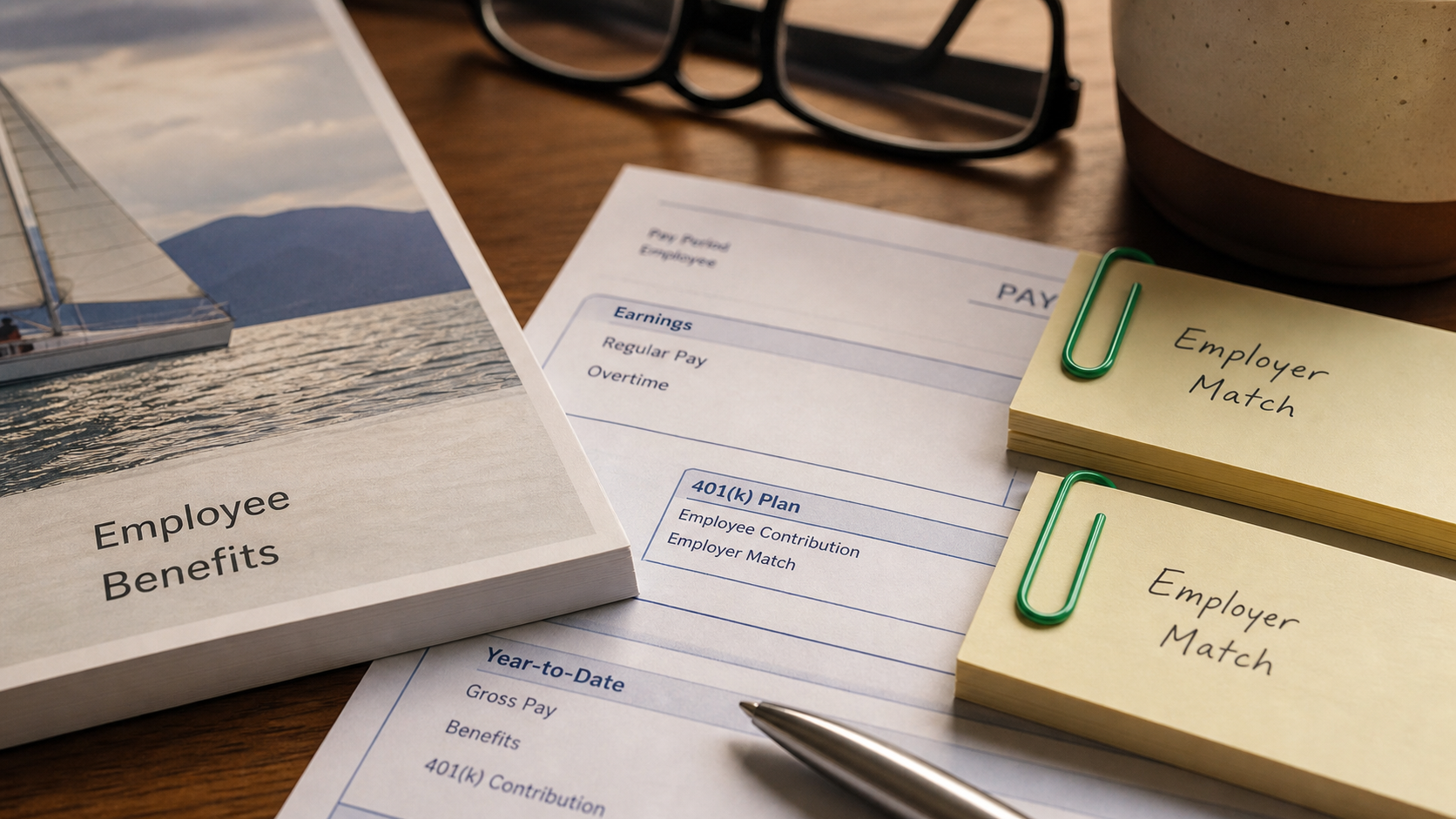
For example, if a plan matches 50% of contributions up to a certain percentage of pay, not contributing enough to receive the full match could mean leaving part of the compensation package unused. The exact formula depends on the employer plan.
A 401(k) can also make saving easier because money comes out of payroll automatically. That automatic structure can help beginners build consistency. The tradeoff is that investment choices and fees are limited by the plan menu.
Why the Automatic Part Matters to Me
My husband is a public employee in Korea, so retirement contributions are deducted from his paycheck automatically. A Korean public pension is not the same as a U.S. 401(k), and I do not want to pretend that the rules are interchangeable. Still, watching that money leave the paycheck before we have to make another monthly decision has shown me how powerful an automatic system can be.
My own situation felt different because I was not working in a traditional full-time job with the same kind of automatic retirement routine. Long-term retirement saving was easier to postpone when nothing happened unless I took the first step myself. That is one reason I view employer support positively. When an employer adds matching money, the worker is not carrying the entire effort alone—and that can make retirement saving feel more realistic.
Of course, “automatic” does not mean “ignore it forever.” A worker still needs to check the match formula, vesting schedule, fees, and investment menu. But consistency is valuable, especially when retirement still feels far away.
How an IRA Works
An IRA is separate from an employer. A person can usually open an IRA at a brokerage, bank, robo-advisor, or other eligible financial institution. The account may be a traditional IRA or a Roth IRA, depending on eligibility and tax goals.
Traditional IRAs and Roth IRAs have different tax treatment. A traditional IRA may provide a deduction if rules are met, while a Roth IRA uses after-tax contributions and may provide tax-free qualified withdrawals later.

In a 401k vs IRA comparison, the IRA often wins on provider choice. You may be able to choose from many ETFs, mutual funds, index funds, bonds, or other investments depending on the provider. That can be useful if your workplace plan has limited options or high fees.
The tradeoff is that an IRA does not come with an employer match. It also has lower annual contribution limits than a 401(k). For more detail on Roth IRA eligibility and annual limits, see GSV’s guide to Roth IRA contribution limits 2026.
Contribution Limits Are Very Different
Contribution limits are one of the clearest differences between the accounts. For 2026, the IRS announced that the 401(k) employee contribution limit increased to $24,500. The IRA contribution limit increased to $7,500 for eligible savers.
Those numbers are not interchangeable. The 401(k) limit applies to employee elective deferrals in eligible workplace plans. The IRA limit generally applies across traditional and Roth IRAs combined. Catch-up rules can also apply for eligible older savers.
| Feature | 401(k) | IRA |
|---|---|---|
| Who provides it? | Employer plan | Individual opens account |
| 2026 regular contribution limit | $24,500 employee deferral limit | $7,500 IRA limit |
| Employer match | Possible | No employer match |
| Investment menu | Plan-selected options | Provider-selected options, often broader |
| Best-known advantage | Payroll saving and possible match | Flexibility and provider choice |
The higher 401(k) limit can matter for workers who want to save aggressively. The lower IRA limit can still be useful, especially when the IRA offers lower-cost funds or a Roth structure that fits the saver.
Tax Treatment: Traditional and Roth Options
Both account types can involve traditional and Roth tax treatment. A traditional 401(k) or traditional IRA generally focuses on a potential tax benefit today and taxable withdrawals later. A Roth 401(k) or Roth IRA generally uses after-tax contributions and potential tax-free qualified withdrawals later.
This is why 401k vs IRA is not the same as traditional vs Roth. The first comparison is account type. The second comparison is tax treatment. Beginners sometimes mix the two together, but they are separate decisions.
For a tax-timing comparison inside IRAs, read Traditional IRA vs Roth IRA. For workplace Roth and traditional contributions, GSV’s Roth 401(k) vs Traditional 401(k) guide explains the account-level choice.
Investment Choice and Fees
A 401(k) investment menu is chosen by the plan. Some plans have excellent low-cost index funds, target date funds, and professional oversight. Other plans may have limited choices or higher expenses.
An IRA can provide more freedom because you can choose the provider. That may allow access to broad index funds, ETFs, bond funds, cash options, or target date funds. More choice is helpful only if it leads to a better, simpler plan.
Fees matter in both accounts. A high-cost 401(k) may be less attractive after capturing the employer match. A low-cost IRA may be useful for additional savings. But if the 401(k) has a strong match and good funds, it may still deserve priority.
If you are comparing fund costs, GSV’s guide to ETF expense ratios explains why small annual fees can matter over time.
Which Account Should Come First?
There is no universal order, but many beginners use a simple sequence. First, contribute enough to a 401(k) to capture the full employer match if one is available. Second, consider an IRA if you want Roth treatment, broader investment choice, or lower costs. Third, add more to the 401(k) if the plan is strong and you want to save more.
This order is not a law. It is a starting framework. A worker with a poor 401(k) plan and no match may lean toward an IRA sooner. A worker with a generous match and excellent plan funds may keep more savings inside the 401(k).
The 401k vs IRA decision should also consider cash flow. If you are still building emergency savings or paying high-interest debt, retirement contributions may need to fit within a broader money plan. GSV’s guide to how to start investing with little money explains that sequencing in more detail.
When a 401(k) May Fit Better
A 401(k) may fit better when your employer offers a meaningful match. The match can improve the value of each contribution, especially if the plan’s vesting rules and investment options are reasonable.
A 401(k) may also fit better if you want to save more than the IRA limit. The higher employee deferral limit can help workers who are trying to accelerate retirement savings during higher-income years.
Payroll automation is another advantage. Many people save more consistently when contributions happen before the money reaches a checking account. In a 401k vs IRA comparison, behavior can be just as important as technical features.
When an IRA May Fit Better
An IRA may fit better when you want more control over the provider, fund lineup, or account costs. It may also fit when you want a Roth IRA and meet the income rules for direct contributions.
An IRA can be especially useful if your employer does not offer a retirement plan, if the plan has no match, or if the plan’s investment options are expensive or limited. The account can also continue with you even when you change jobs.
However, an IRA is not automatically better just because it has more choices. More choices can lead to overcomplication. The goal is a clear retirement plan, not a crowded account with too many funds.
Common Mistakes to Avoid
The first mistake is skipping an employer match without understanding it. If a match is available and affordable to capture, it may be one of the strongest reasons to start with the 401(k).
The second mistake is assuming an IRA has a separate $7,500 limit for traditional and Roth accounts. The annual IRA limit generally applies across both traditional and Roth IRAs combined.
The third mistake is choosing only by account name. A great 401(k) plan can beat a poorly chosen IRA. A low-cost IRA can beat a weak no-match 401(k) after the match question is settled.
The fourth mistake is ignoring investment allocation. Account type does not replace portfolio design. GSV’s guide to asset allocation can help explain how stocks, bonds, and cash may fit together.
FAQ
Is a 401(k) better than an IRA?
Not always. A 401(k) may be better if it has an employer match, strong funds, and convenient payroll contributions. An IRA may be better if you want more provider choice, lower costs, or Roth IRA flexibility.
Should I max out my 401(k) before an IRA?
Some savers do, but many beginners first capture the employer match, then consider an IRA, then return to the 401(k) if they want to save more. The best order depends on match, fees, tax goals, and cash flow.
Can I contribute to both a 401(k) and an IRA?
Yes, many people can contribute to both, but tax deductibility, Roth IRA eligibility, and annual limits depend on income, filing status, workplace plan coverage, and IRS rules.
Does an IRA have an employer match?
No. An IRA is an individual account and does not include an employer match. Employer matching contributions are usually tied to workplace plans such as 401(k) plans.
Is 401k vs IRA the same as Roth vs traditional?
No. 401k vs IRA compares account types. Roth vs traditional compares tax treatment. A 401(k) and an IRA may each have traditional and Roth versions depending on rules and eligibility.
Final Thoughts
The 401k vs IRA decision is really about priority. A reasonable 401(k) with an employer match may deserve the first contribution. An IRA may deserve the next one when you want more control, lower-cost choices, or Roth IRA access.
If all of this still feels complicated, start with one question: Am I leaving employer matching money unused? Find that answer, then compare the IRA and the rest of the 401(k) plan carefully. You do not need to solve retirement in one afternoon. You need a first step you can keep taking, month after month.