

Roth IRA contribution limits 2026 are the annual IRS rules that decide how much you may put into a Roth IRA for the 2026 tax year and whether your income allows a direct contribution. For 2026, the IRA contribution limit is $7,500, with an additional $1,100 catch-up contribution for people age 50 or older, if they have enough taxable compensation.
The numbers are simple at first, but the details matter. Your age, taxable compensation, modified adjusted gross income, tax filing status, and contributions to other IRAs can all affect the amount you can contribute. This guide explains the 2026 Roth IRA limits in beginner-friendly terms, without turning the topic into a tax textbook.
Educational disclaimer: This article is for general education only and is not personal tax, legal, retirement, or investment advice. Roth IRA rules can depend on your filing status, income, compensation, and other facts. Consider checking IRS guidance or a qualified tax professional before making a contribution decision.
Key Takeaways
- The 2026 IRA contribution limit is $7,500 for eligible people under age 50.
- The 2026 IRA catch-up contribution is $1,100 for people age 50 or older, making the total potential limit $8,600.
- Roth IRA eligibility depends on modified adjusted gross income and tax filing status.
- The same annual IRA limit generally applies across traditional and Roth IRAs combined, not separately to each account.
- High earners may be limited or unable to make a direct Roth IRA contribution.
Roth IRA Contribution Limits 2026: The Basic Numbers
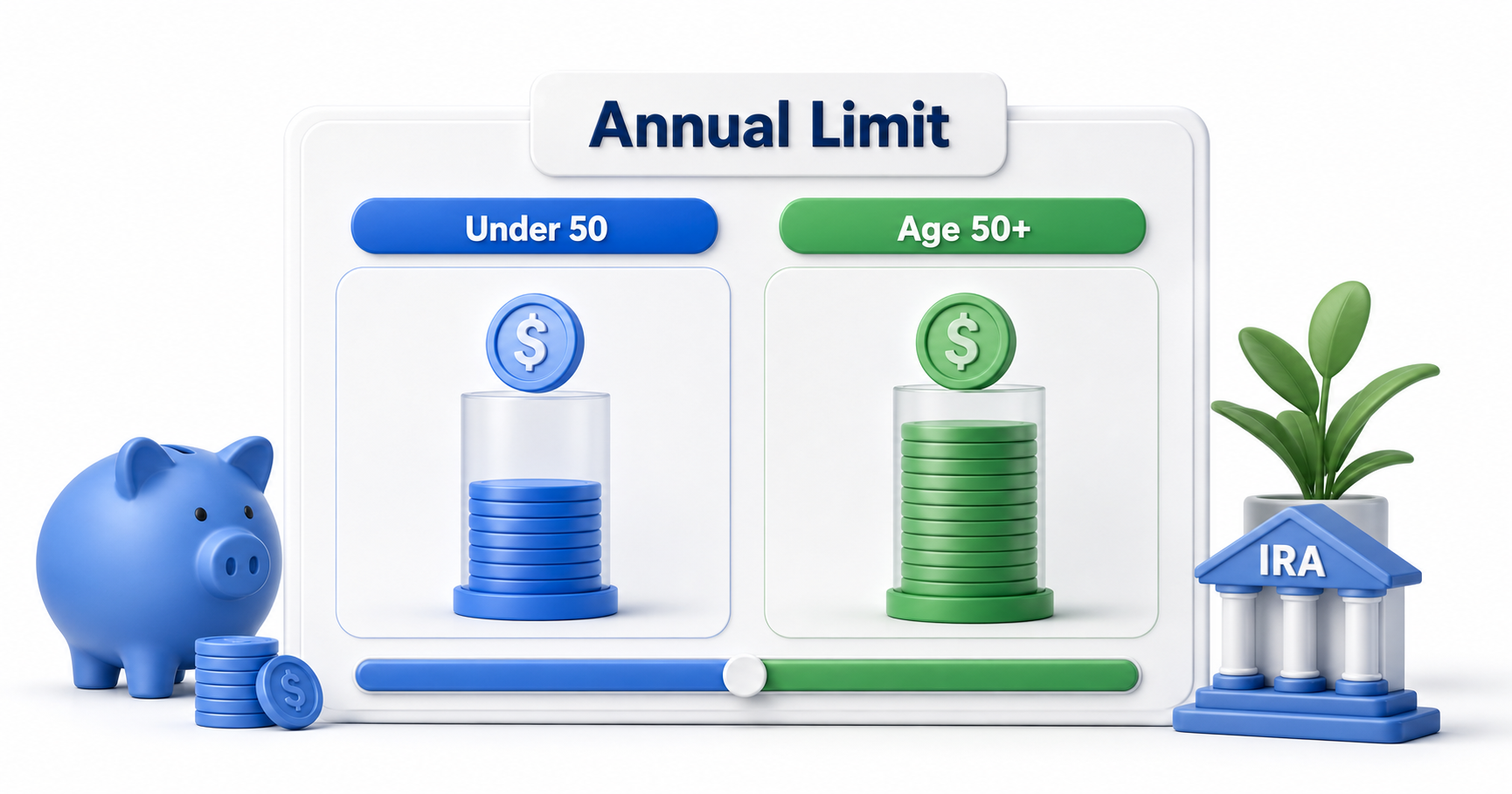
Roth IRA contribution limits 2026 start with the annual IRA limit. The IRS announced that the limit on annual IRA contributions increased to $7,500 for 2026. If you are age 50 or older by the end of the tax year, the IRA catch-up contribution limit is $1,100 for 2026.
That means a person under age 50 may be able to contribute up to $7,500 for 2026, while a person age 50 or older may be able to contribute up to $8,600. The phrase “may be able to” is important because the limit also depends on having enough taxable compensation and meeting Roth IRA income rules.
A Roth IRA is different from a workplace plan such as a 401(k). A 401(k) has its own contribution limits and employer rules. A Roth IRA is an individual retirement account, and the IRA limit applies to your combined traditional IRA and Roth IRA contributions for the year.
| 2026 IRA Saver | Maximum IRA Contribution | Beginner Note |
|---|---|---|
| Under age 50 | $7,500 | Applies across traditional and Roth IRAs combined |
| Age 50 or older | $8,600 | Includes the $1,100 catch-up contribution |
| Less taxable compensation than the limit | Limited to taxable compensation | You generally cannot contribute more than you earned |
The annual limit is not a target everyone must reach. It is simply the maximum allowed under the rules. For many beginners, a smaller automatic monthly contribution may be more realistic than trying to contribute the full amount at once.
How the 2026 Roth IRA Income Limits Work
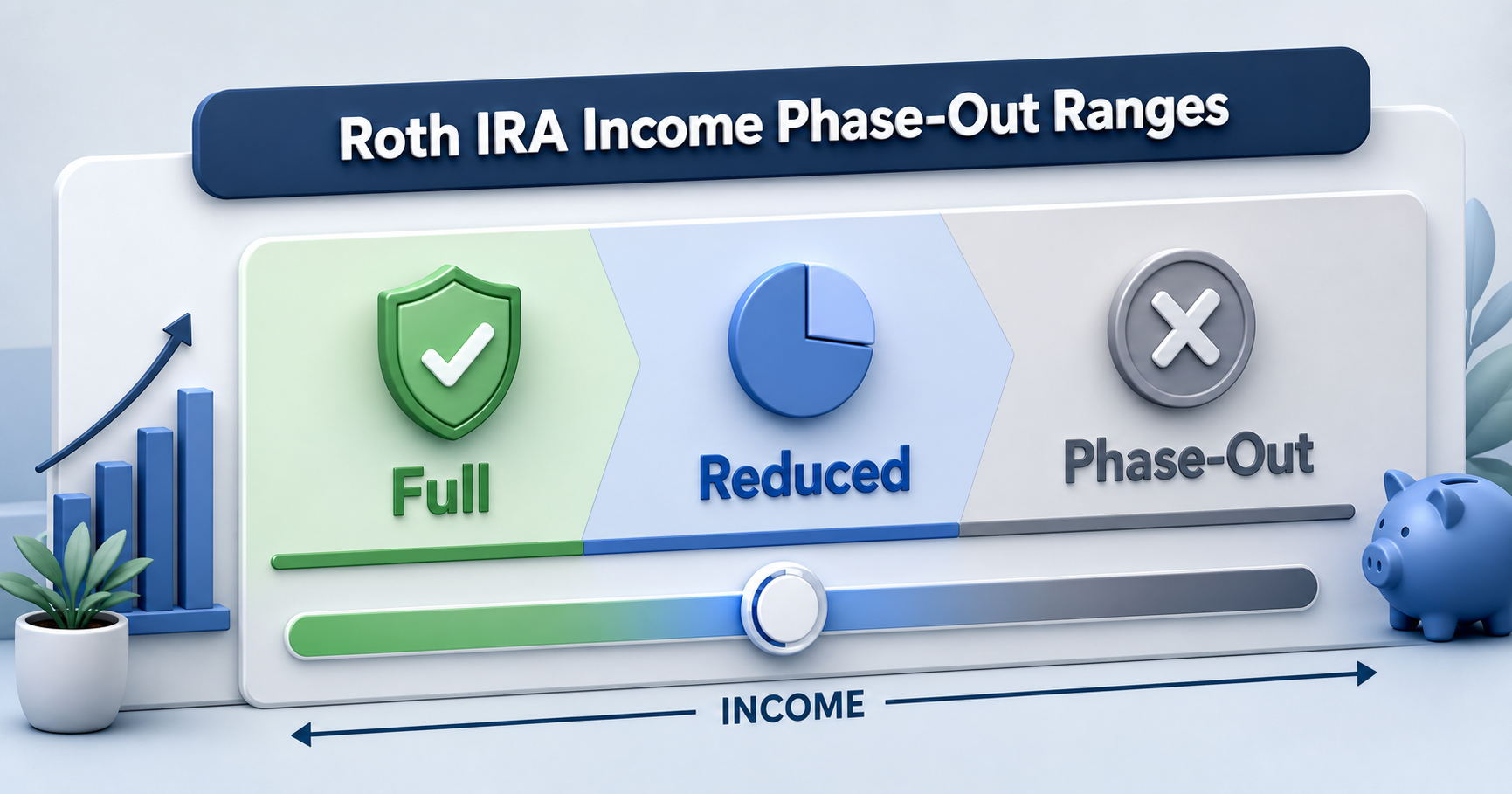
Roth IRA contribution limits 2026 also include income phase-out ranges. A phase-out range means your ability to contribute is gradually reduced as your modified adjusted gross income, often called MAGI, moves through a certain range.
For 2026, the IRS announced that the Roth IRA income phase-out range is $153,000 to $168,000 for single filers and heads of household. For married couples filing jointly, the phase-out range is $242,000 to $252,000. For a married individual filing separately, the phase-out range remains $0 to $10,000.
| Tax Filing Status | 2026 Roth IRA Phase-Out Range | What It Means |
|---|---|---|
| Single or head of household | $153,000 to $168,000 | Contribution may be reduced inside this range |
| Married filing jointly | $242,000 to $252,000 | Contribution may be reduced inside this range |
| Married filing separately | $0 to $10,000 | Very limited direct Roth IRA eligibility |
If your income is below the phase-out range for your filing status, you may be able to contribute up to the annual limit, assuming you have enough taxable compensation. If your income is inside the range, your allowed direct contribution may be reduced. If your income is above the top of the range, you generally cannot make a direct Roth IRA contribution for that year.
This is one reason Roth IRA articles can feel confusing. The annual dollar limit and the income eligibility rule are separate tests. Passing one test does not automatically mean you pass the other.
What Counts as Compensation for a Roth IRA?
A Roth IRA contribution generally requires taxable compensation. For many people, that means wages, salaries, commissions, tips, bonuses, or self-employment income. Investment income by itself usually does not count as compensation for IRA contribution purposes.
Here is a simple example. If a beginner earns $4,000 of taxable compensation in 2026 and is otherwise eligible, the IRA contribution limit is not automatically $7,500. The practical limit may be $4,000 because the person did not have enough compensation to support a larger contribution.
For a married couple, spousal IRA rules may allow contributions for a spouse with little or no compensation if the couple files jointly and has enough combined compensation. The rules can be useful, but they also require care because income limits and filing status still matter.
Roth IRA contribution limits 2026 should therefore be checked in this order: annual limit, age-based catch-up eligibility, taxable compensation, income phase-out range, and whether other IRA contributions have already used part of the combined limit.
Roth IRA vs Traditional IRA Limits in 2026
The annual IRA contribution limit is generally shared between traditional IRAs and Roth IRAs. It is not a separate $7,500 limit for each account. If you contribute $3,000 to a traditional IRA for 2026, that may leave $4,500 of the regular IRA limit for a Roth IRA, assuming you are under age 50 and otherwise eligible.
The tax treatment is different. A Roth IRA is funded with after-tax money, and qualified withdrawals may be tax-free. A traditional IRA may offer a tax deduction depending on income, workplace plan coverage, and filing status, while withdrawals are generally taxed later.
That difference is why a Roth IRA is often compared with a traditional IRA, not because one is always better. A younger investor who expects higher tax rates later may like the Roth structure. A saver looking for a current deduction may compare traditional IRA rules more closely. Our guide to what a Roth IRA is explains the account structure in more detail.
It can also help to understand where the account fits in your bigger portfolio. A Roth IRA can hold many types of investments, such as mutual funds, ETFs, or individual securities, depending on the provider. If you are still learning how investment accounts work, the guide to a brokerage account gives useful context.
Monthly Contribution Examples for 2026
Many beginners do not contribute the full amount in one deposit. They build a habit through monthly or paycheck-based contributions. The math is straightforward: divide the annual target by the number of contribution periods.
| Goal | Monthly Amount for 12 Months | Why It Helps |
|---|---|---|
| $7,500 regular limit | $625 per month | Spreads the full regular limit across the year |
| $8,600 age 50+ limit | About $716.67 per month | Spreads the catch-up limit across the year |
| $3,000 starter goal | $250 per month | More realistic for many new savers |
This approach is related to dollar-cost averaging, where a person invests on a regular schedule instead of trying to pick the perfect day. Regular contributions do not guarantee profits, but they can make retirement saving more consistent.
Consistency also supports compound interest. A Roth IRA does not guarantee compound growth, because investments can rise and fall. But leaving money invested for a long time may give returns, dividends, and reinvested gains more room to build on each other.
Common Roth IRA Contribution Mistakes
The first mistake is assuming the IRS limit is always your personal limit. Roth IRA contribution limits 2026 depend on compensation and income eligibility. A person with income above the phase-out range may not be allowed to make a direct Roth contribution even if the annual limit is $7,500.
The second mistake is forgetting that traditional and Roth IRA contributions share the annual IRA limit. You cannot contribute the full annual limit to a Roth IRA and then contribute the full annual limit again to a traditional IRA for the same year.
The third mistake is mixing up contribution limits with investment choices. The Roth IRA is the account. The investments inside the account are separate. You still need to choose investments that match your goals, time horizon, and risk tolerance. Our guide to asset allocation can help explain how stocks, bonds, and cash may fit together.
The fourth mistake is waiting until the last minute without checking eligibility. Some people contribute early, then later discover their income was too high. Others wait until tax season and rush the decision. Either way, keeping records and checking income rules can prevent confusion.
The fifth mistake is ignoring tax consequences outside the Roth IRA. Contributions themselves are one piece of your financial life. Taxable brokerage accounts, capital gains, dividends, workplace plans, and emergency savings can all matter too. The guide to capital gains tax explains one common taxable-account issue.
Simple Checklist Before You Contribute
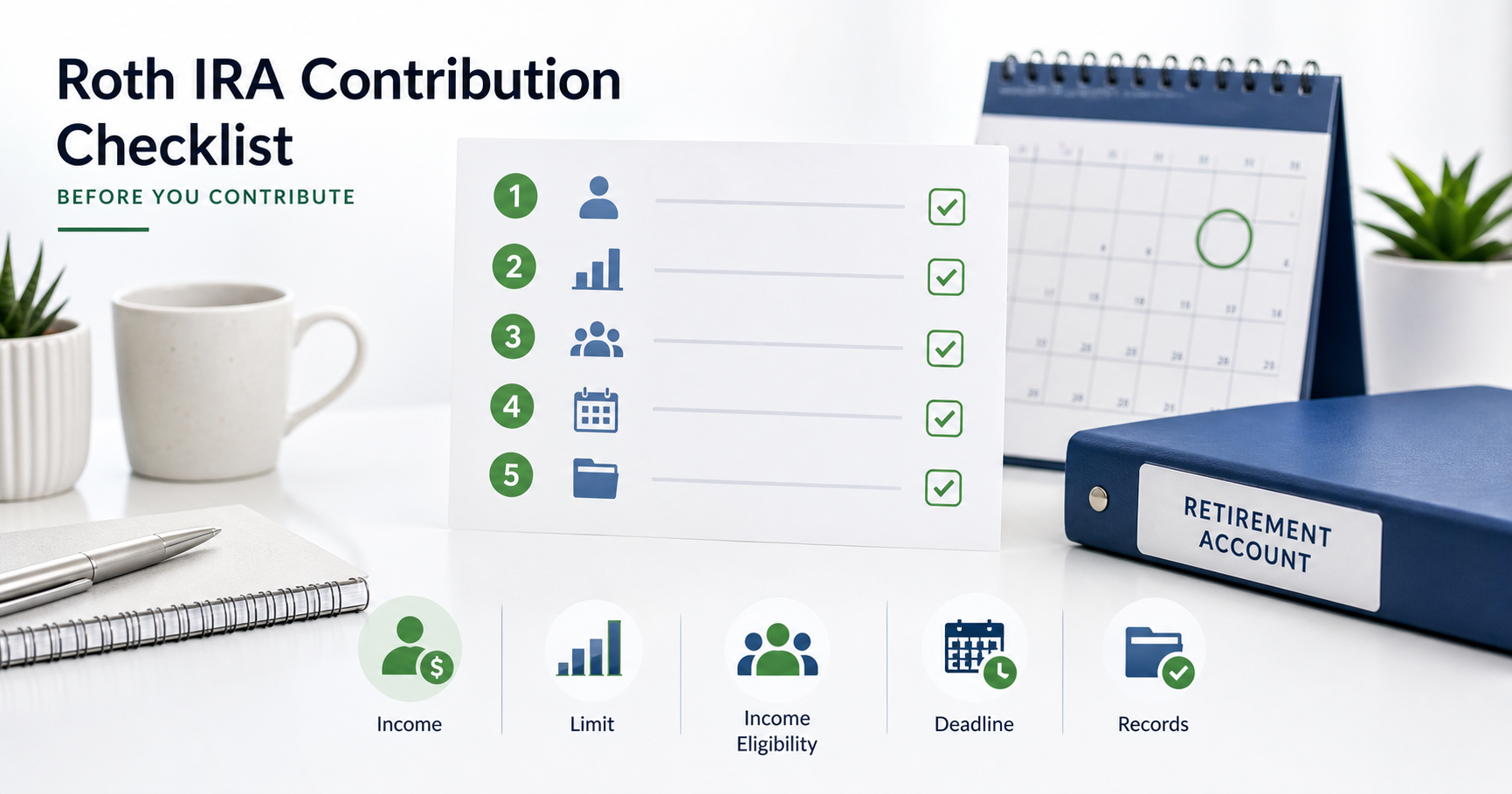
Before making a Roth IRA contribution for 2026, walk through a short checklist. This does not replace tax advice, but it can help you ask better questions.
- Confirm that you have taxable compensation for the year.
- Check your age by the end of 2026 to see whether the catch-up contribution applies.
- Estimate your modified adjusted gross income and filing status.
- Check whether you already contributed to any traditional IRA for the same year.
- Decide whether a Roth IRA fits your broader retirement and tax plan.
- Keep records of contributions, dates, and tax-year designation.
If you are also eligible for a workplace plan, compare the role of each account. Many savers first consider whether they can capture an employer match in a 401(k), then decide how a Roth IRA fits beside it. There is no single order that works for everyone.
Frequently Asked Questions About Roth IRA Contribution Limits 2026
What are the Roth IRA contribution limits 2026?
The 2026 IRA contribution limit is $7,500 for eligible people under age 50. People age 50 or older may qualify for an additional $1,100 catch-up contribution, for a total potential IRA contribution of $8,600.
Can I contribute to both a Roth IRA and a traditional IRA in 2026?
Yes, but the combined amount generally cannot exceed the annual IRA contribution limit for the year. The limit is shared across traditional and Roth IRAs.
What happens if my income is too high for a direct Roth IRA contribution?
If your income is above the direct Roth IRA phase-out range, you generally cannot make a direct Roth IRA contribution. Some high earners research other strategies, but those can involve tax complexity and should be reviewed carefully with qualified guidance.
Do Roth IRA contributions reduce taxable income?
Roth IRA contributions are generally made with after-tax dollars, so they do not usually reduce taxable income the way a deductible traditional IRA contribution might.
Can I contribute if I am retired?
Age by itself does not prevent a Roth IRA contribution, but you generally need eligible taxable compensation and must satisfy the income rules. Investment income alone usually is not enough.
Contribution limits tell you how much may go into an IRA, but they do not determine which tax treatment fits your plan. Use the full Traditional IRA vs Roth IRA guide to compare deductions, qualified withdrawals, income rules, and required distributions.
Final Thoughts
Roth IRA contribution limits 2026 are useful because they give savers a clear ceiling, but the ceiling is only part of the decision. You still need enough taxable compensation, income within the allowed range for direct contributions, and a plan for how the Roth IRA fits your bigger financial life.
For beginners, the best starting point is simple: understand the annual limit, check the income phase-out rules, avoid overcontributing, and choose an amount you can sustain. A Roth IRA can be a powerful retirement account, but it works best when the rules are understood before money goes in.