

Have you ever seen a retirement fund with 2040, 2050, or 2060 in its name and wondered what the year actually does? Those are often target date funds. I remember seeing Korean funds built around a goal such as investing for 30 years. The idea sounded simple: choose the horizon, keep contributing, and let the fund change with time.
From the publisher: Retirement investing did not feel urgent in my own life for a long time. My husband is a Korean public employee, so contributions to his public pension are deducted automatically from his salary. I am not working in a traditional full-time job, which meant a workplace retirement account requiring steady contributions for decades felt more distant from me.
That experience is not the same as owning a target date fund. A Korean public pension is a pension system; a target date fund is an investment portfolio that can rise or fall. But the automatic feeling is similar enough to create the same risk: when something happens quietly every month, do we stop asking what it is doing?
The date on the label is helpful, but it does not know your pension, irregular income, spouse’s retirement benefits, debt, other investments, or how you react when markets fall. That is why “set it and forget it” is only half right. The fund can automate the portfolio. It cannot understand your life.
Key Takeaways
- Target date funds combine stocks, bonds, and sometimes other assets in one diversified portfolio.
- The “target date” usually refers to the year near when an investor expects to retire or use the money.
- A glide path gradually changes the asset allocation, generally reducing stock exposure over time.
- Funds with the same target year can have very different risk levels, strategies, and fees.
- A target date fund is not guaranteed, does not guarantee retirement income, and can lose money before or after the target year.
What Are Target Date Funds?
A target date fund is a portfolio built for a future year, usually retirement. It commonly holds other stock and bond funds inside one package. You may see names such as “Target 2055,” “Retirement 2055,” or “Lifecycle 2055.” Think of the year as a destination on a map—not a promise that you will arrive with enough money.
The year is a planning reference, not an expiration date. An investor who expects to retire around 2055 might consider a 2055 fund. Someone with the same retirement year but lower risk tolerance might choose an earlier date, while a more risk-tolerant investor might consider a later date. The correct choice depends on the actual portfolio and the investor’s full financial situation.
Many workplace retirement plans offer target date funds as default investments for employees who do not select another option. That can be better than leaving long-term retirement contributions uninvested, but “default” does not mean personally optimized.
These funds handle three jobs automatically: asset allocation, diversification, and rebalancing. GSV’s asset allocation guide explains why the mix of stocks, bonds, and cash often matters more than the choice of one individual security.
How the Glide Path Works
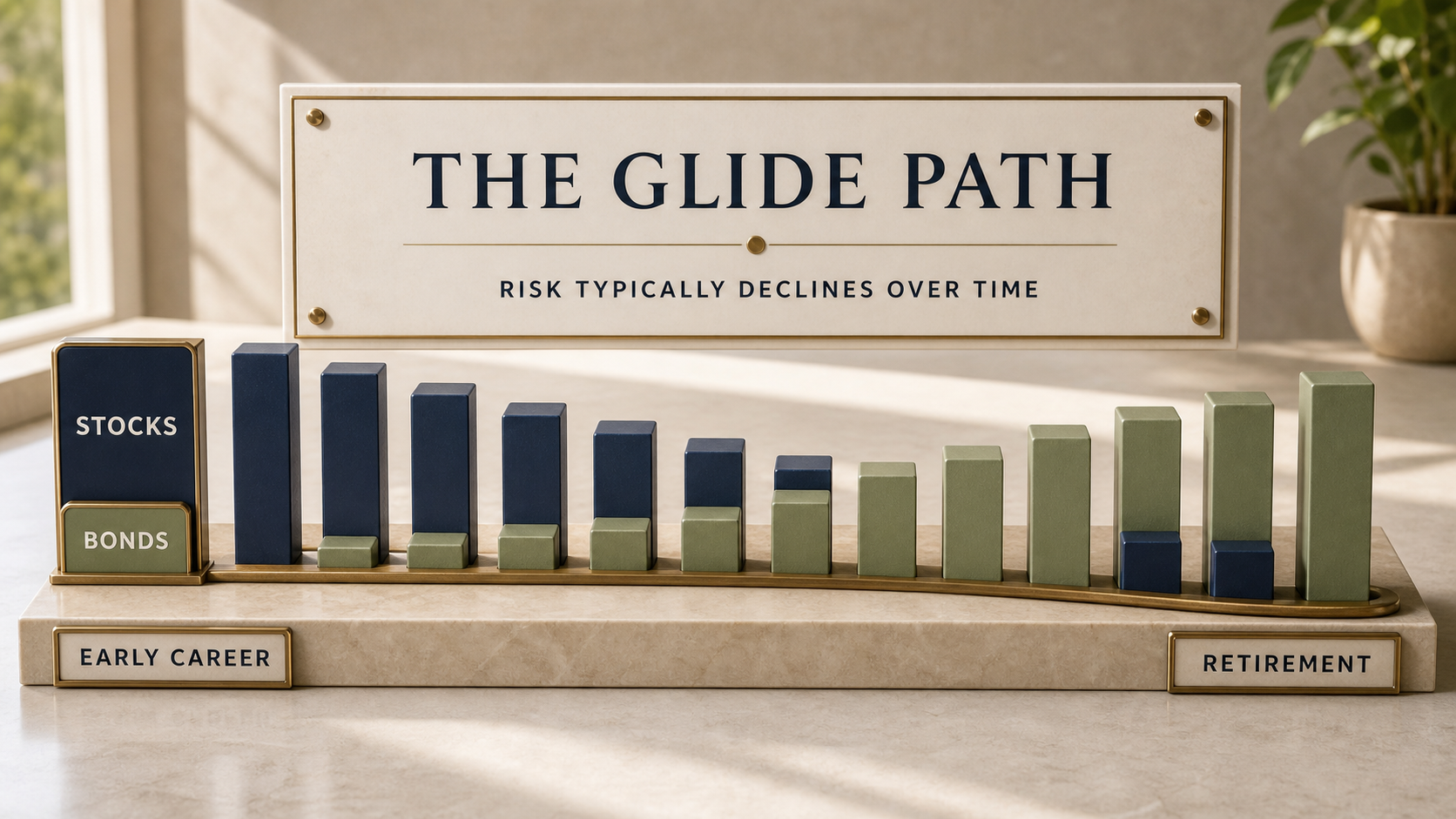
A glide path is simply the fund’s schedule for changing risk. When retirement is far away, the fund usually owns more stocks. As the target year gets closer, it generally adds bonds and cash-like investments. Picture an airplane descending gradually rather than dropping straight toward the runway.
Imagine a 25-year-old worker in a 2065 fund. The portfolio may begin with a high allocation to global stocks and a smaller allocation to bonds. The manager periodically rebalances it and gradually changes the target mix. The investor does not need to sell one fund and buy another each year.
“To Retirement” vs “Through Retirement”
A “to retirement” glide path generally reaches its most conservative allocation at or near the target date. A “through retirement” path continues reducing risk for years after that date. The second approach assumes investors may remain invested and make withdrawals throughout retirement rather than cash out immediately.
Neither design is automatically better. A person with a pension and substantial guaranteed income may tolerate more market risk than someone who expects to rely heavily on the account immediately. Your withdrawal plan, Social Security timing, other investments, and emotional tolerance for losses all matter.
Same Target Year, Different Risk

The target year is only a label. One 2055 fund might hold more U.S. stocks, another may hold more international stocks, and a third may include inflation-protected bonds, real estate, commodities, or actively managed strategies. The mix can lead to meaningful differences in volatility and returns.
This is why comparing performance alone can be misleading. A fund that performed better during a strong stock market may simply have held more stocks. That same aggressive allocation could fall further during a bear market. Risk-adjusted fit matters more than choosing the recent winner.
Fees also vary. Many target date funds invest in underlying funds, so investors should understand the total operating cost shown in the prospectus. A small annual difference can compound over decades. Low cost does not guarantee better performance, but higher cost creates a larger hurdle.
| What to Compare | Why It Matters | Where to Look |
|---|---|---|
| Current stock/bond mix | Shows today’s broad risk level | Fund page or fact sheet |
| Glide path | Shows how allocation may change | Prospectus or official glide-path chart |
| To vs through design | Shows when the fund becomes most conservative | Prospectus |
| Expense ratio | Reduces the return kept by investors | Fee table |
| Underlying holdings | Reveals diversification and active/passive exposure | Holdings report |
| Risk and drawdowns | Helps set realistic expectations | Performance and risk disclosures |
Why Automatic Can Feel Easier Than It Really Is
I understand the appeal. When retirement contributions leave a paycheck automatically, there is relief in knowing that something is happening without another monthly decision. For a person with irregular income or no workplace plan, the opposite can happen: because nothing is automatic, retirement saving keeps moving to the bottom of the list.
A target date fund can solve part of that problem. One fund handles diversification, rebalancing, and the gradual shift from stocks toward bonds. That simplicity is useful. A reasonable portfolio you can keep contributing to may work better than a “perfect” portfolio you constantly change.
But what does the fund not know? It does not know whether your spouse has a pension, whether your income is stable, when you will start withdrawals, or whether a 30% decline would make you sell. Two people retiring in 2055 may need very different portfolios.
What the Fund Does for You
- Combines stocks, bonds, and sometimes other assets in one portfolio.
- Rebalances after markets move.
- Usually reduces stock exposure as the target year approaches.
- Removes many small allocation decisions.
What You Still Need to Decide
- Whether the target year matches when you expect to use the money.
- Whether the current stock allocation feels tolerable.
- Whether the fees are reasonable.
- How the fund fits with pensions, a spouse’s account, taxable investments, and debt.
- Whether contributions are actually large and consistent enough for the goal.
That last point is easy to miss. The fund manages money after it arrives. It cannot make up for years when no money was contributed, and it does not guarantee a particular retirement income.
A Five-Minute Check Before You Choose
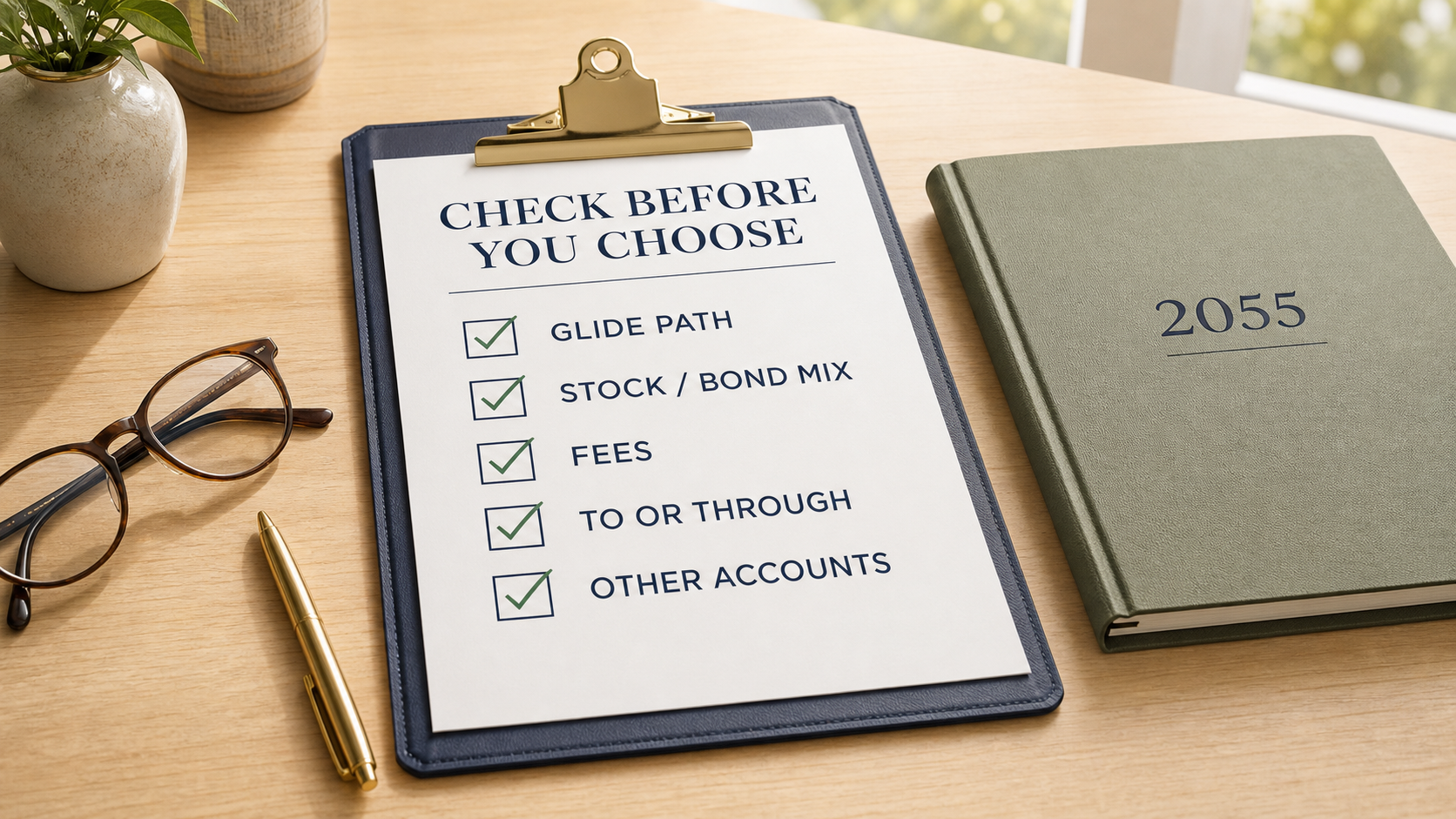
1. Look Past the Year
If you plan to retire near 2055, a 2055 fund is a starting point. It is not the answer. Check how much the fund owns in stocks today and what it expects to hold at retirement.
2. Ask “To” or “Through”
Does the fund reach its most conservative mix at retirement, or keep reducing risk through retirement? The second design may still hold substantial stock exposure after the date. Neither is automatically better, but you should know which journey you bought.
3. Check the Total Fee
An expense ratio is the percentage removed each year to operate the fund. Because target date funds often own other funds, review the complete fee table—not only a marketing headline. Small annual differences can grow into meaningful amounts over 20 or 30 years.
4. Include the Rest of the Household
A spouse’s pension, another retirement account, company stock, and taxable investments all change the household picture. The fund sees only the money inside itself. You need to see everything else.
5. Review It Without Watching It Every Day
Automatic does not mean ignored forever. Check after a major life change, a new retirement date, or a change in the fund’s allocation or fees. You do not need to react to every market move.
A target date fund may be held inside a 401(k), IRA, or brokerage account. Remember that the fund and the account are separate choices. See 401(k) vs IRA and Traditional IRA vs Roth IRA.
Common Target Date Fund Mistakes
- Choosing by birth year alone. Risk capacity and withdrawal plans also matter.
- Assuming every 2055 fund is similar. Allocations and fees can differ considerably.
- Treating the date as a guarantee. There is no promised balance or retirement income.
- Ignoring investments outside the fund. Overlap can distort the intended allocation.
- Chasing the best recent return. The winner may simply have taken more risk.
- Forgetting fees. Decades of compounding magnify ongoing costs.
- Mixing several target years without a reason. That often creates an unclear average allocation rather than better diversification.
How This Guide Was Verified
- Investor.gov: Target Date Funds Investor Bulletin
- U.S. Department of Labor: Target Date Retirement Funds
- Investor.gov: Mutual Fund and ETF Fees
Final Thoughts
For years, retirement accounts felt like something designed for people with a regular employer and a predictable paycheck. My husband’s public pension contributions happened automatically, while my own irregular work made a decades-long contribution plan feel easier to postpone.
That is why I see the value of target date funds more clearly now. They reduce decisions after the money enters the account. But they cannot decide how much I should save, make irregular income regular, or combine every part of a household retirement plan.
Even though retirement investing once felt distant to me, I do not think it is unimportant. If money is genuinely available after current living costs and an emergency reserve, I believe putting more toward retirement can be a good thing. It is an investment in the person I will become later.
Why prepare so far in advance? Because aging can make work harder. Our energy may change, our health may weaken, and income that feels dependable today may not always remain that way. Retirement savings cannot remove every uncertainty, but they can give an older version of ourselves more choices and less pressure.
If you see “2055” on a fund, ask one more question before choosing it: what will this fund actually own along the way? Then check the stock allocation, glide path, fees, and your other sources of retirement income. The year is convenient. The details are what you will live with.
Frequently Asked Questions
Are target date funds safe?
They are diversified investments, not guaranteed products. Their stocks, bonds, and other holdings can lose value, including near or after the target date.
Can I lose money in a target date fund?
Yes. Diversification and a more conservative glide path may reduce some risks, but they cannot prevent all market losses.
Should I put my entire 401(k) in one target date fund?
A single fund is designed to function as a complete portfolio for some investors. Whether it fits depends on its allocation, costs, risk, and your assets and income outside that account.
What happens when a target date fund reaches its date?
It normally continues operating or may eventually merge into a retirement-income fund. The exact process and allocation depend on the provider and should be described in official fund documents.
Are target date funds actively managed?
Some use actively managed underlying funds, some use index funds, and others combine both. Review the holdings and prospectus rather than assuming from the name.
Continue Learning
Connect the one-fund strategy to the rest of your retirement plan.
Educational disclaimer: This article is for general educational purposes only and is not personalized investment, financial, tax, or legal advice. Fund allocations, fees, glide paths, plan options, and regulations can change. Review official fund documents and consider your objectives, time horizon, other assets, withdrawal plan, and risk tolerance.