

A CD ladder is a savings strategy that splits money across several certificates of deposit with different maturity dates. Instead of locking all your cash into one CD, you create a schedule so part of the money becomes available at regular intervals.
The goal is simple: earn fixed CD interest while keeping more flexibility than a single long-term CD. A CD ladder can be useful for short- and medium-term savings, but it is not the same thing as an emergency fund, a stock portfolio, or a guaranteed way to beat inflation.
This beginner guide explains how a CD ladder works, when it may make sense, what mistakes to avoid, and how it compares with savings accounts, bonds, and long-term investing.
I have not personally built a U.S. CD ladder, but the problem it solves is easy to recognize. Locking all your cash until one date can feel uncomfortable. Keeping everything immediately available can mean accepting a lower return. A ladder divides that one difficult decision into several smaller ones.
Would you feel differently if part of the money became available every three or six months? That is the practical appeal. You are not predicting the perfect interest rate. You are creating repeated decision points so one rate and one maturity date do not control the entire cash balance.
The strategy still needs a purpose. Money for an emergency should not be trapped behind an early-withdrawal penalty, and money meant for decades of growth may not belong entirely in CDs. A ladder works best when the time horizon is clear before the deposits are opened.
Key Takeaways
- A CD ladder divides money among several CDs that mature on different dates.
- The strategy can create regular access to cash while still using fixed-rate deposits.
- CDs may be FDIC- or NCUA-insured when held at covered institutions and within coverage limits.
- A CD ladder is usually better for planned savings goals than for money you might need tomorrow.
- The biggest risks are early withdrawal penalties, automatic renewals, and choosing terms that do not match your real cash needs.
What Is a CD Ladder?
A CD ladder is a way to organize certificates of deposit so they mature at staggered times. For example, instead of putting $10,000 into one 12-month CD, you might divide it into four CDs that mature in 3, 6, 9, and 12 months.
When the first CD matures, you can use the money, move it to a high yield savings account, or reinvest it into a new longer-term CD. If you keep reinvesting matured CDs, the ladder continues.
The idea is not to make CDs exciting. The idea is to make cash planning less awkward. A single CD can create an all-or-nothing choice: lock up the whole amount or keep everything liquid. A ladder sits between those two extremes.
Investor.gov describes certificates of deposit as deposit products with a set term and interest rate. That fixed structure is why laddering exists. You are arranging several fixed-term products so your money does not all become available on the same day.
How a CD Ladder Works

To build a CD ladder, you choose a total amount, divide it into pieces, and place each piece into a CD with a different maturity date. The maturity date is the date when the CD term ends and you can usually withdraw the money without an early withdrawal penalty.
Here is a simple example. Suppose you have $12,000 for a planned goal and do not need all of it immediately. You could place $3,000 into a 3-month CD, $3,000 into a 6-month CD, $3,000 into a 9-month CD, and $3,000 into a 12-month CD.
After three months, the first CD matures. You can take the cash if you need it. If you do not need it, you might reinvest that money into a new 12-month CD. Three months later, the second CD matures, and the same decision repeats.
This creates a rhythm. Part of your cash becomes available regularly, while the rest may continue earning fixed CD rates. That rhythm is the main difference between laddering and buying one CD.
| Ladder Rung | Example Term | What Happens |
|---|---|---|
| Rung 1 | 3 months | First portion becomes available soonest |
| Rung 2 | 6 months | Second portion matures later |
| Rung 3 | 9 months | Another choice point arrives |
| Rung 4 | 12 months | Final starting rung matures |
A ladder can use short terms, long terms, or a mix. A conservative saver might use 3-, 6-, 9-, and 12-month CDs. Someone with a longer time horizon might use 1-, 2-, 3-, 4-, and 5-year CDs. The right structure depends on when you may need the money.
CD Ladder Example for Beginners
Imagine you are saving for a home repair project that might happen in stages over the next year. You want more yield than a regular checking account, but you do not want every dollar locked away until one final date.
A beginner CD ladder could look like this:
- $2,500 in a 3-month CD
- $2,500 in a 6-month CD
- $2,500 in a 9-month CD
- $2,500 in a 12-month CD
If the project starts early, you may have money coming available soon. If the project is delayed, you can reinvest maturing CDs and keep the ladder going. This is why CD ladders often fit planned expenses better than vague long-term wealth goals.
The structure also helps with interest-rate uncertainty. If rates rise, maturing CDs give you chances to reinvest at newer rates. If rates fall, some of your existing CDs may still keep their earlier fixed rates until maturity. A ladder does not predict rates, but it avoids making one giant rate decision on one day.
That matters because interest rates affect many parts of personal finance and investing. GSV’s guide to inflation and interest rates explains why cash yields, bond prices, and borrowing costs often move when rate expectations change.
CD Ladder vs High Yield Savings Account
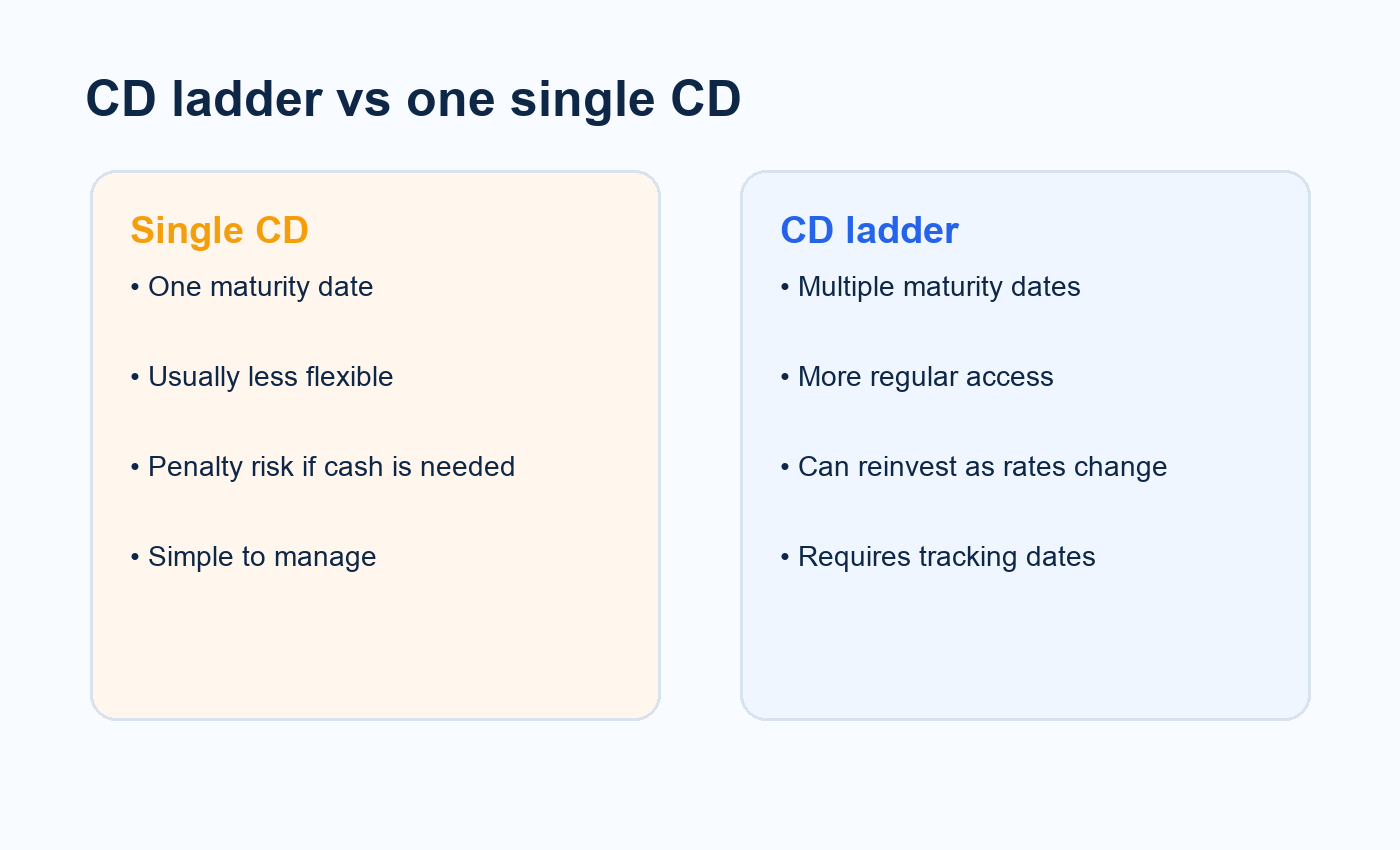
A CD ladder and a savings account can both hold cash, but they solve different problems. A savings account is usually better for money you may need quickly. A CD ladder may be better for money tied to a known future goal.
The Consumer Financial Protection Bureau explains that savings accounts are designed to hold money for future use. That flexibility is useful for surprise expenses. If the furnace breaks or your car needs urgent repairs, access matters more than squeezing out a little extra yield.
That is why a beginner emergency fund usually belongs in a safe, liquid place before you start locking extra cash into CDs. A CD ladder can support your cash plan, but it should not trap money you might need immediately.
| Feature | CD Ladder | High Yield Savings Account |
|---|---|---|
| Access | At maturity dates | Usually more flexible |
| Rate | Often fixed for each CD term | Usually variable |
| Best use | Planned future goals | Emergency cash and flexible savings |
| Main risk | Early withdrawal penalties | Rate can change |
Neither option is automatically better. The better choice depends on the job of the money. If the money is for rent, insurance deductibles, or next month’s uncertainty, liquidity usually wins. If the money is for a planned goal six to eighteen months away, a CD ladder may be worth considering.
Pros, Risks, and Common Mistakes
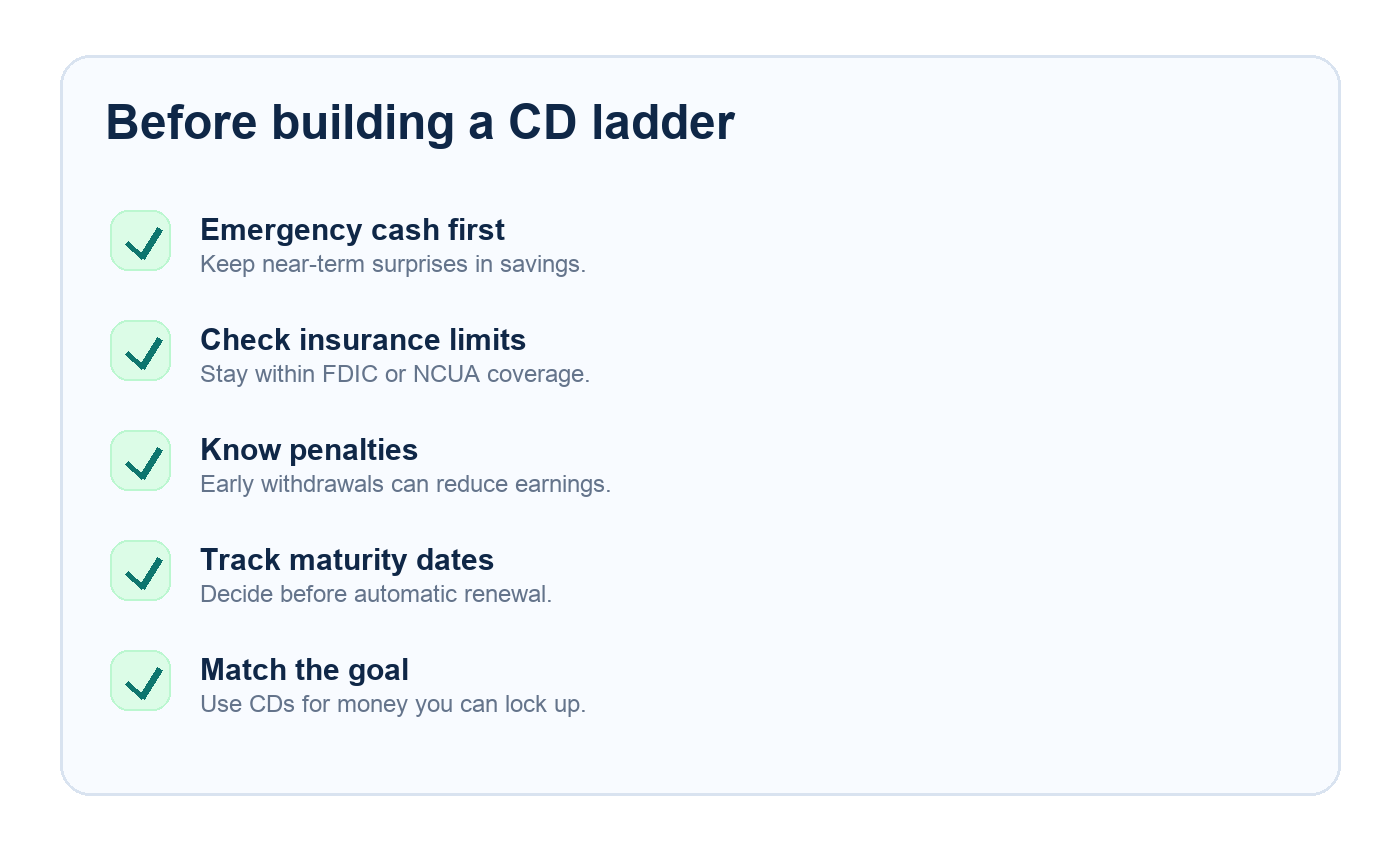
The biggest benefit of a CD ladder is balance. It can offer more structure than a savings account and more access than one long CD. It can also make savers more intentional because every maturity date becomes a decision point.
Another benefit is reduced reinvestment pressure. If you put all your money into one CD, the entire amount faces the same rate environment when it matures. With a ladder, only one rung matures at a time.
Still, a CD ladder has limits. It is not a stock replacement. It is not a bond fund. It is not a magic inflation hedge. Cash products can be useful, but holding too much cash for too long can create purchasing-power risk. GSV’s article on why holding cash can fail to beat inflation explains why money for long-term growth may need a different plan.
Early withdrawal penalties are another risk. If you break a CD before maturity, the bank or credit union may reduce the interest you earned. Penalty rules vary, so read the terms before opening the CD.
Automatic renewal is also easy to overlook. Some CDs may roll into a new term after a grace period if you do nothing. That can be convenient, but it can also lock money into a term you no longer want. Set reminders before each maturity date.
Insurance limits matter too. The FDIC says deposit insurance covers eligible deposits at FDIC-insured banks, including CDs, up to applicable limits. Credit union deposits may have similar federal protection through the NCUA. A large ladder should be planned around coverage limits, ownership categories, and institution rules.
Where a CD Ladder Fits in an Investing Plan
A CD ladder belongs on the cash side of a financial plan. It can help with near-term goals, expected expenses, and conservative savings buckets. It should not be confused with long-term investing.
If your goal is building wealth over decades, you may need a broader mix of assets. Stocks, bonds, ETFs, and cash play different roles. GSV’s guide to asset allocation explains why separating jobs inside a portfolio can make decisions clearer.
CDs can sometimes compete with short-term bonds for conservative money, but they are not identical. A bond can trade in the market and its price may move before maturity. A bank CD is usually a deposit product with its own terms, insurance considerations, and penalties.
For long-term investors, a CD ladder may sit beside the portfolio rather than inside the growth engine. It might hold next year’s tuition money, a car replacement fund, or a planned home project. Meanwhile, long-term investing can continue through diversified funds, retirement accounts, or a regular contribution habit such as dollar-cost averaging.
Think of the CD ladder as a scheduling tool. It tells your cash when to become available. It does not decide how much risk your long-term portfolio should take.
Frequently Asked Questions
Is a CD ladder a good idea?
A CD ladder can be a good idea for planned savings goals when you want fixed CD rates and periodic access to cash. It may not be ideal for emergency money or long-term growth money.
How many CDs do you need for a CD ladder?
Many simple ladders use three to five CDs, but there is no perfect number. The right number depends on how often you want money to mature and how much effort you want to manage.
Can you lose money in a CD ladder?
If CDs are held at properly insured institutions and within coverage limits, principal protection can be strong. However, early withdrawal penalties, inflation, and uninsured balances can still create risks.
What happens when one CD matures?
When a CD matures, you can usually withdraw the money, move it elsewhere, or reinvest it into a new CD. Check the grace period and renewal rules before the maturity date.
Is a CD ladder better than a savings account?
Not always. A savings account is usually better for immediate liquidity, while a CD ladder may work better for planned future expenses where you can wait for maturity dates.
A ladder is only one way to structure CD maturities. Investors comparing where and how a CD is purchased should also understand brokered CDs, including secondary-market price risk, call features, and the difference between bank and brokerage access.
Final Thoughts
A CD ladder is a simple way to make cash more organized. It spreads money across multiple CDs so all of it does not mature at once.
For beginner savers, the strategy can make sense after basic emergency cash is in place and the goal has a clear timeline. It can help balance access, fixed rates, and discipline.
Still, a CD ladder is only one tool. Use it for the right job: planned cash, not every dollar you own. If the money is for tomorrow’s emergency, keep it more liquid. If it is for long-term wealth, consider whether a diversified investing plan is more appropriate.