
A treasury bill is a short-term U.S. government security that matures in one year or less. Instead of paying regular interest like many bonds, a Treasury bill is usually bought for less than its face value and pays the full face value at maturity.
That simple structure is why Treasury bills, often called T-bills, attract investors who want a low-risk place for short-term cash. They are not the same as a bank savings account, and they are not designed to make you rich quickly. But they can be useful when you want to understand safe, short-term government-backed investments.
Key Takeaways
- A treasury bill is a short-term U.S. government debt security.
- Treasury bills currently come in terms such as 4, 6, 8, 13, 17, 26, and 52 weeks.
- Most bills are bought at a discount and pay face value when they mature.
- The investor’s interest is the difference between the purchase price and the amount received at maturity.
- Treasury bill interest is subject to federal income tax, but not state or local tax.
What Is a Treasury Bill?
A Treasury bill is a marketable security issued by the U.S. Department of the Treasury. In plain English, it is a way for the U.S. government to borrow money for a short period. Investors lend money by buying the bill, and the government pays the face value when the bill matures.
For example, an investor might buy a bill with a $1,000 face value for slightly less than $1,000. When the bill matures, the investor receives $1,000. The difference is the investor’s interest. TreasuryDirect explains that bills are sold at a discount or at par, and when the bill matures, the holder is paid face value.
This makes a Treasury bill different from many traditional bonds. A regular bond often pays interest every six months. A bill normally pays interest only through the discount between purchase price and maturity value. If you are still learning fixed income basics, start with GSV’s guide to what a bond is.
The main appeal is not excitement. It is stability, short maturity, and a clear payoff structure. That is why T-bills often come up when investors compare cash, savings accounts, CDs, money market funds, and short-term bond options.
How a Treasury Bill Works
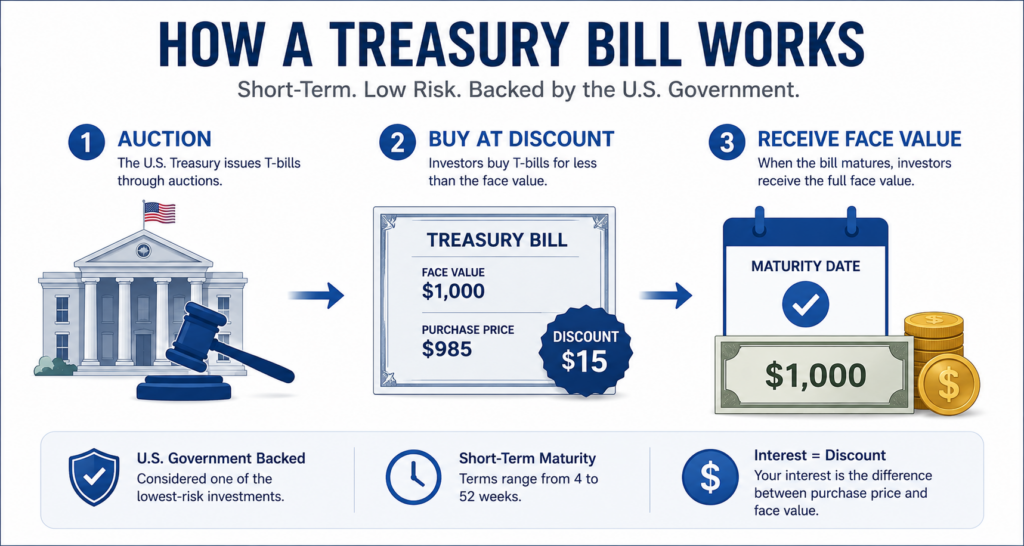
A Treasury bill works in three basic steps. First, the Treasury issues bills through auctions. Second, investors buy them either directly through TreasuryDirect or through a bank, broker, or dealer. Third, the bill matures and pays its face value.
The Treasury currently lists regular bill terms of 4, 6, 8, 13, 17, 26, and 52 weeks. That matters because the short maturity is the product’s defining feature. A bill is not meant to lock money away for decades. It is built for shorter time horizons.
The pricing can feel odd at first because the yield is built into the discount. Suppose a bill has a $1,000 face value and is purchased for $985. If the investor holds it until maturity and receives $1,000, the $15 difference is the interest. The actual yield depends on the price, time to maturity, and auction result.
TreasuryDirect’s pricing page explains the idea clearly: bills are short-term securities, and the difference between the face value and the discounted price is interest. Investors should understand this before comparing T-bills with a high yield savings account or a bank CD.
| Feature | Treasury Bill | Beginner Meaning |
|---|---|---|
| Issuer | U.S. Treasury | Backed by the U.S. government |
| Maturity | One year or less | Short-term cash-like use |
| Interest | Usually discount to face value | You earn the difference at maturity |
| Minimum purchase | $100 through TreasuryDirect | Accessible to many individual investors |
| Taxes | Federal tax, no state or local tax | After-tax yield can matter |
Treasury Bill vs CD vs High Yield Savings
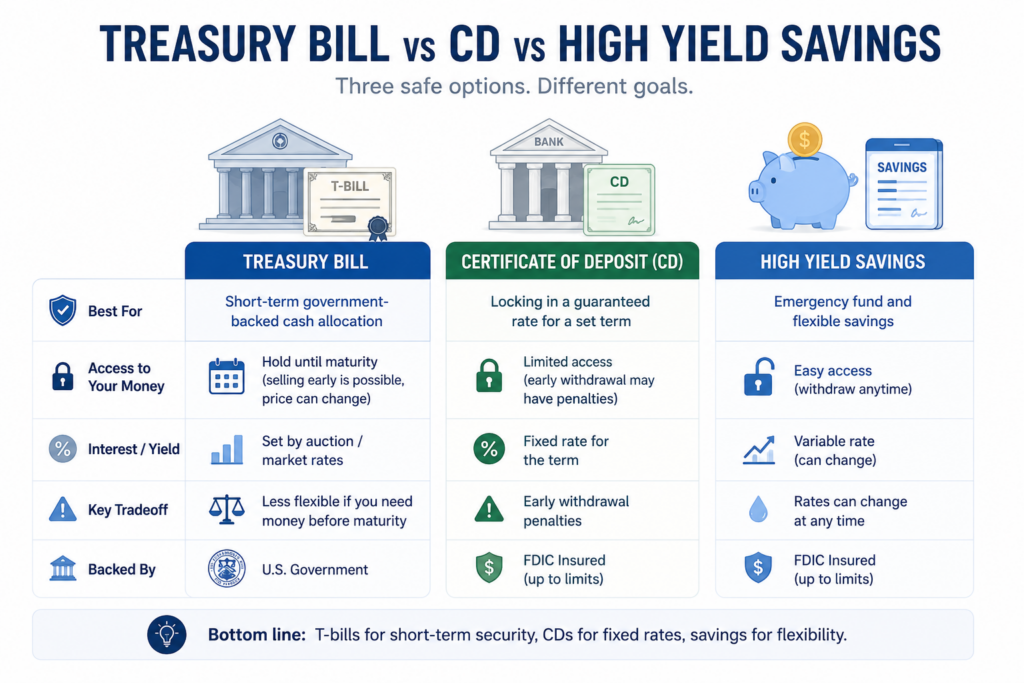
A Treasury bill is often compared with CDs and high yield savings accounts because all three can be used for short-term money. But they are not interchangeable. A brokered CD adds another wrinkle because selling before maturity may produce a market gain or loss instead of a standard bank early-withdrawal penalty. Each product solves a slightly different problem.
A high yield savings account is usually best for money that needs flexible access, such as emergency savings. A CD may be useful when you want a fixed bank rate for a set term and are comfortable with early withdrawal penalties. A T-bill may appeal when you want direct exposure to short-term U.S. government debt and can hold until maturity.
This is where liquidity matters. You can sell many marketable Treasury securities before maturity, but the sale price can change. A savings account generally gives easier access. A CD may penalize early withdrawal. A CD ladder can help manage maturity dates, while a T-bill ladder can serve a similar planning role for Treasury securities.
| Option | Best For | Main Tradeoff |
|---|---|---|
| Treasury bill | Short-term government-backed cash allocation | Yield is set by market/auction pricing |
| High yield savings | Emergency cash and flexible access | APY can change at any time |
| CD | Known bank term and fixed rate | Early withdrawal penalties may apply |
| Money market fund | Brokerage cash management | Not the same as FDIC-insured bank deposits |
If the money is for a true emergency, GSV’s emergency fund guide is a better starting point. If the money is part of a long-term portfolio, then the right question is not only yield. It is how the cash-like position fits with stocks, bonds, and other assets.
Why Investors Use Treasury Bills
Investors use Treasury bills for several reasons. The first is capital preservation. T-bills are backed by the U.S. government and mature quickly, which makes them a common choice for investors who want lower-risk short-term holdings.
The second reason is yield. When short-term interest rates are relatively high, T-bills may offer an attractive return compared with ordinary bank savings accounts. That does not mean they are automatically better. It means investors should compare after-tax yield, liquidity, account access, and personal goals.
The third reason is planning. Some investors build ladders of short-term bills so that money matures at regular intervals. This can create a rhythm of access without leaving all cash in one maturity date. The idea is similar to laddering CDs, but the securities and tax treatment are different.
Another reason is portfolio balance. Cash and short-term government securities can reduce the need to sell stocks during a downturn. But holding too much short-term cash can also reduce long-term growth. That tradeoff connects directly to asset allocation.
A beginner can think of a Treasury bill as a parking spot, not a race car. It can hold short-term money with relatively low risk, but it is not supposed to replace a long-term investing plan. For long-term growth, investors usually need to understand stocks, bonds, funds, and compounding.
Risks and Mistakes to Avoid
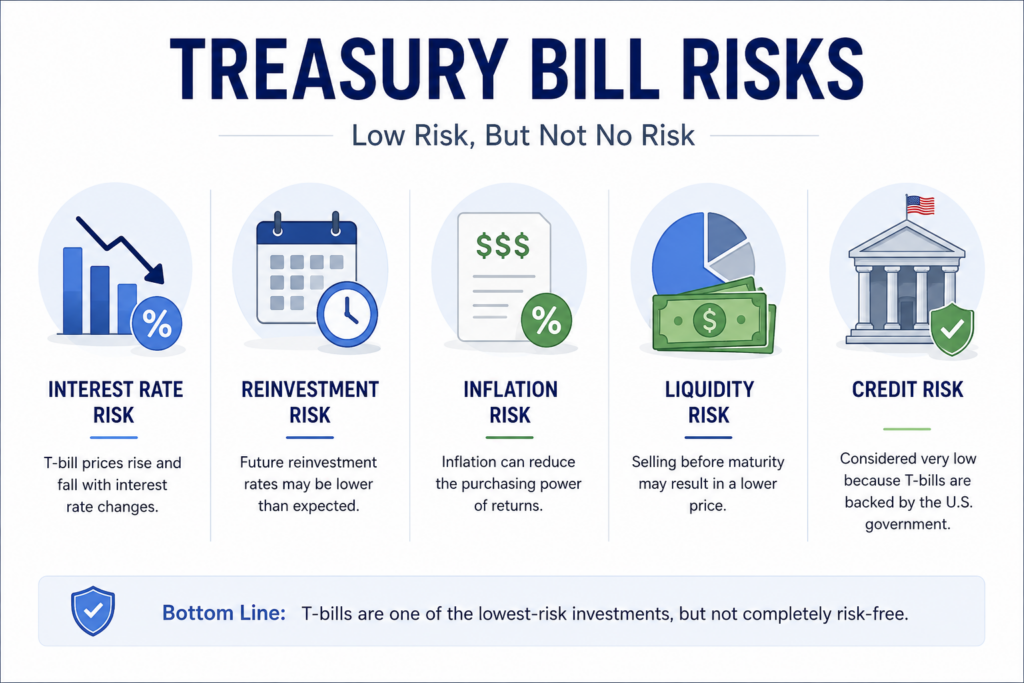
The first mistake is assuming a Treasury bill has no tradeoffs. It is low risk compared with many investments, but it is not magic. If you sell before maturity, the price can be affected by interest rates and market conditions. Holding until maturity is simpler, but it requires planning.
The second mistake is comparing only the headline yield. Taxes matter. TreasuryDirect states that bill interest is subject to federal tax but not state or local tax. That can make the after-tax comparison different from a CD or savings account, especially for investors in higher-tax states. IRS Topic No. 403 explains that interest income is generally taxable unless specifically excluded.
The third mistake is using T-bills for money that needs instant access. TreasuryDirect, brokerage settlement, and auction timing may not feel as flexible as a checking or savings account. If the money might be needed tomorrow morning, a bank account may be more practical.
The fourth mistake is confusing T-bills with longer-term bond funds. A T-bill matures quickly. A bond ETF may own many bonds and trade throughout the day, but its price can move as interest rates change. GSV’s guide to a bond ETF explains those differences in more detail.
The fifth mistake is letting cash become the whole plan. Short-term investments can feel comforting when markets are volatile. But if inflation is higher than your after-tax return, cash-heavy strategies can quietly lose purchasing power. This is why GSV also covers why holding too much cash can fail to beat inflation.
How Beginners Can Think About Treasury Bills
For beginners, the best way to evaluate a Treasury bill is to start with the job of the money. Is it for emergency savings, a home down payment, taxes due soon, a short-term goal, or part of a larger portfolio? The answer changes whether a T-bill makes sense.
If the money is needed very soon, flexibility may matter more than yield. If the money has a clear future date, a bill that matures before that date may be easier to evaluate. If the money is part of a long-term investment portfolio, then the T-bill should be compared with the role of bonds, cash, and other stabilizing assets.
Beginners should also decide where they want to hold the security. TreasuryDirect can be useful for buying directly from the government. Brokerage accounts may offer a different interface and access to secondary markets. Each route has practical pros and cons, so the easiest path depends on how the investor already manages money.
Finally, keep expectations realistic. A Treasury bill can be a useful tool for short-term money. It can help beginners understand interest rates, government debt, maturity dates, and after-tax yield. But it is one tool inside a broader financial life, not a complete investing strategy.
FAQ
Is a Treasury bill safe?
A Treasury bill is generally considered one of the lowest-risk marketable securities because it is issued by the U.S. government and matures in one year or less. It still has practical tradeoffs, especially if sold before maturity.
How does a Treasury bill make money?
A Treasury bill usually makes money by being sold at a discount to face value. When it matures, the investor receives the face value, and the difference is the interest earned.
Are Treasury bills better than CDs?
Not always. A T-bill may have tax advantages and government backing, while a CD may offer a fixed bank rate and FDIC insurance when held within limits. The better choice depends on yield, taxes, access, and timing.
Do Treasury bills pay monthly interest?
No. Treasury bills do not usually make monthly interest payments. The interest is reflected in the difference between the discounted purchase price and the face value paid at maturity.
Can beginners buy Treasury bills?
Yes. Individual investors can buy Treasury bills through TreasuryDirect or through financial institutions such as banks, brokers, or dealers. The TreasuryDirect minimum purchase is $100.
Final Thoughts
A treasury bill is a simple short-term government security, but simple does not mean unimportant. It teaches several core investing ideas at once: maturity, yield, taxes, liquidity, and the tradeoff between safety and growth.
For short-term money, T-bills can be worth understanding alongside high yield savings accounts, CDs, and money market funds. For long-term investing, they are only one small piece of the larger question: how much stability, growth, and flexibility your portfolio needs.
Official Sources
- TreasuryDirect: Treasury Bills
- TreasuryDirect: Understanding Pricing and Interest Rates
- TreasuryDirect: How Auctions Work
- IRS Topic No. 403: Interest Received