

Capital gains tax is the tax you may owe when you sell an investment for more than you paid for it. For beginner investors, it matters because selling stocks, ETFs, mutual funds, or other assets can create a tax bill even when the investment decision itself seemed simple.
The basic idea is straightforward: if you buy an asset at one price and later sell it at a higher price, the profit is called a capital gain. The tax treatment depends on the asset, the account type, how long you held it, your income, and whether you have losses that can offset gains.
Educational disclaimer: This article is for general education only and is not personal tax, legal, or investment advice. Tax rules can change, and your situation may be different. Consider a qualified tax professional for personal guidance.
Key Takeaways
- Capital gains tax may apply when you sell an investment for a profit in a taxable account.
- Unrealized gains are usually not taxed until you sell the investment.
- Short-term and long-term gains can be taxed differently.
- Losses may offset gains, but tax-loss rules and limits matter.
- Retirement accounts can change when and how investment gains are taxed.
What Is Capital Gains Tax?
Capital gains tax is a tax on profit from selling a capital asset. In investing, common examples include stocks, exchange-traded funds, mutual funds, bonds, and some other securities. If you sell for more than your cost basis, the difference is generally a capital gain.
Cost basis usually starts with what you paid for the investment, plus certain adjustments. Sale price is what you receive when you sell, minus selling costs when applicable. The simplified formula looks like this:
Sale proceeds – adjusted cost basis = capital gain or capital loss
For example, if you buy shares for $1,000 and later sell them for $1,300, the simplified gain is $300 before considering taxes, fees, wash sale rules, or other adjustments. If you sell for $800, you have a capital loss instead.
The IRS explains in Topic No. 409, Capital Gains and Losses that almost everything you own and use for personal or investment purposes is a capital asset, with examples including a home, furniture, and stocks or bonds held as investments.

Capital Gains Tax Explained for Investors
Here is capital gains tax explained in practical investing terms: you usually do not owe tax just because an investment went up on your screen. The tax issue generally appears when you sell and turn that paper gain into a realized gain.
A gain that exists only on paper is called an unrealized gain. If your ETF rises from $50 to $70 and you keep holding it, you have an unrealized gain. If you sell at $70, the gain becomes realized, and that sale may need to be reported on your tax return.
This distinction is important for long-term investors. A person who buys and holds diversified funds may see values rise and fall without triggering taxable gains each time prices move. A person who trades frequently in a taxable account may realize gains and losses more often.
Capital gains tax also connects to fund investing. ETFs and mutual funds can create taxable events in different ways. You may owe tax when you sell fund shares for a gain, and taxable funds may distribute capital gains to shareholders. If you are still learning fund basics, GSV’s guide to what an ETF is and how it works is a useful next step.
Short-Term vs Long-Term Capital Gains
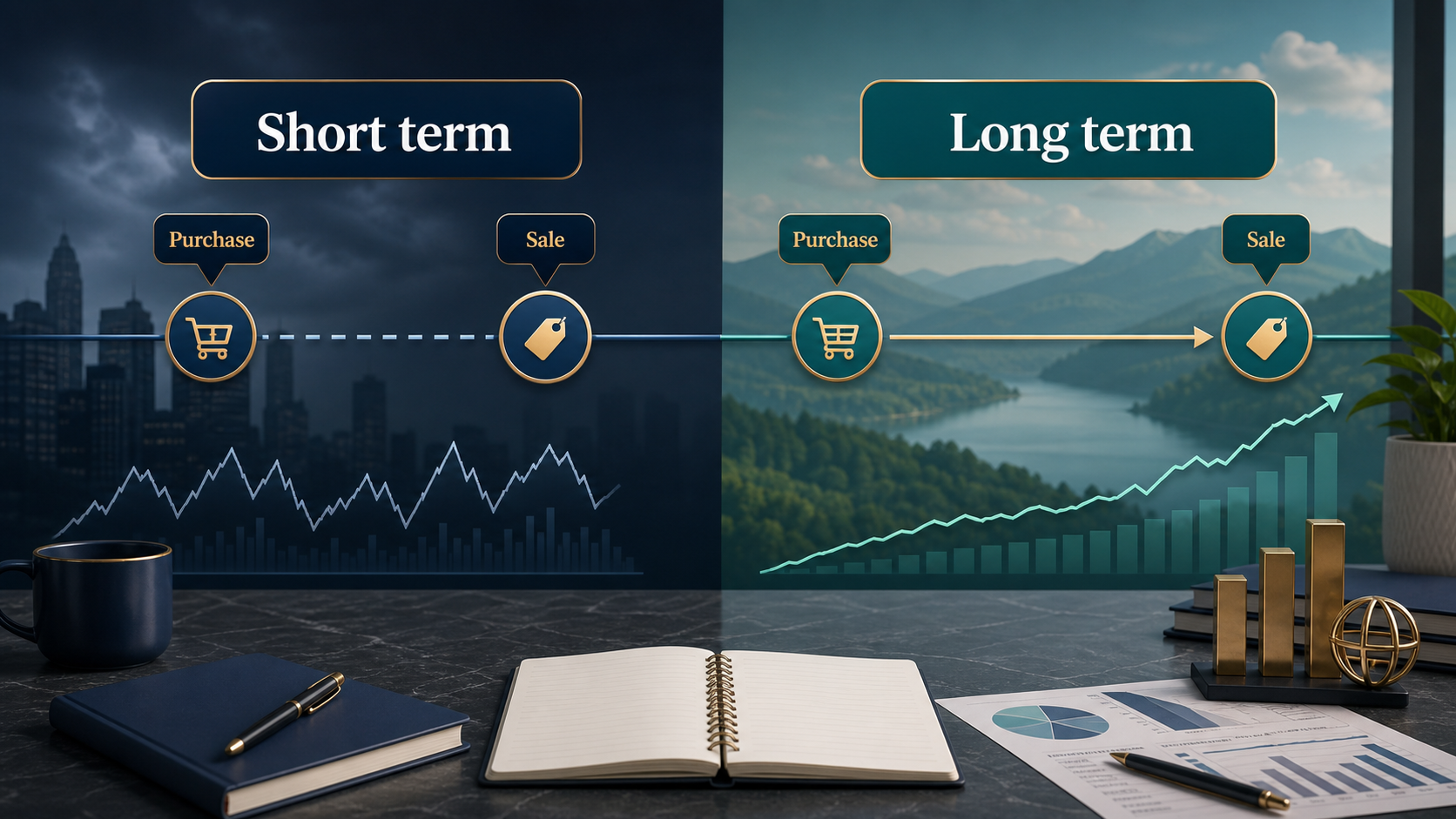
One of the most important differences is the holding period. In general, a short-term capital gain comes from an asset held for one year or less. A long-term capital gain usually comes from an asset held for more than one year.
Short-term gains are generally taxed at ordinary income tax rates. Long-term gains may qualify for separate long-term capital gains rates, depending on taxable income and filing status. The IRS notes that net capital gains may be taxed at different rates and that exceptions can apply.
This does not mean investors should hold a bad investment only to reach a tax milestone. Taxes matter, but they should not be the only reason for a buy or sell decision. Investment risk, diversification, time horizon, and the reason for selling still matter.
| Type of Gain | Typical Holding Period | Basic Tax Treatment | Beginner Note |
|---|---|---|---|
| Short-term gain | One year or less | Generally taxed like ordinary income | Frequent trading can create more taxable events |
| Long-term gain | More than one year | May qualify for long-term capital gains rates | Still depends on income, filing status, and rules |
If you use a simple long-term strategy such as dollar-cost averaging, holding period records become part of your tax history. Your brokerage may track lots, but it is still wise to understand the concept.
How Capital Gains Tax Works in Taxable Accounts
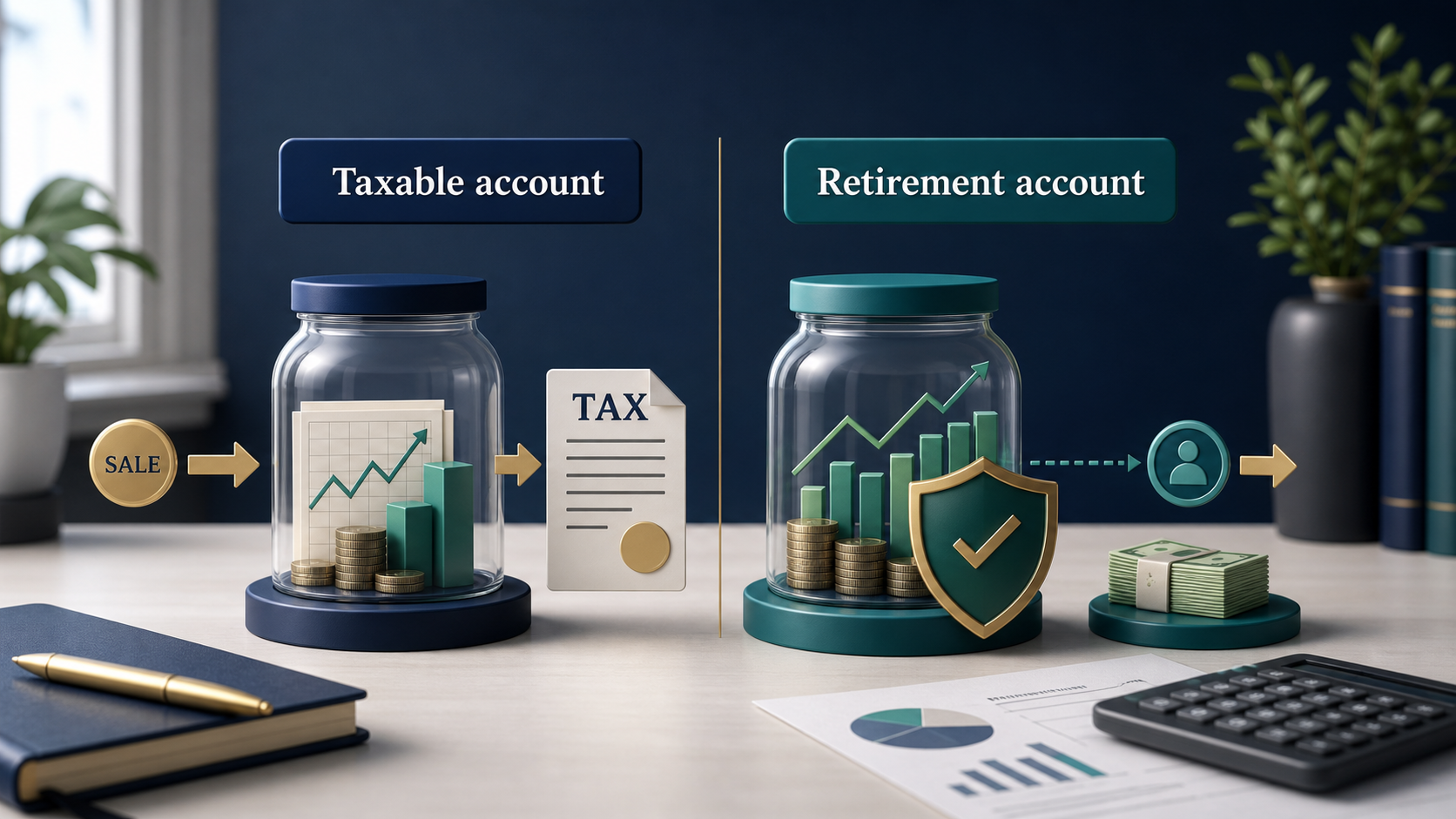
Capital gains tax is most visible in a taxable brokerage account. A taxable account does not have the same tax shelter as many retirement accounts. When you sell investments for a gain, receive dividends, or receive certain fund distributions, taxes may apply for that year.
For a simple example, imagine you buy a broad stock ETF in a taxable account. If you later sell shares for a profit, the sale can create a realized gain. If the ETF distributes qualified dividends, ordinary dividends, or capital gain distributions, those payments may also have tax consequences.
This is one reason account choice matters. GSV’s guide to brokerage accounts explains how taxable accounts work as a flexible place to hold investments. Flexibility is useful, but it comes with tax reporting responsibilities.
A taxable account can still be valuable. It has no retirement contribution limit, no required retirement age to access funds, and broad investment flexibility. The point is not to avoid taxable accounts entirely. The point is to understand what selling can trigger.
How Retirement Accounts Change the Tax Picture
Retirement accounts can change when taxes appear. In many tax-advantaged retirement accounts, buying and selling investments inside the account does not create the same immediate taxable capital gain that a sale in a regular taxable brokerage account might create.
That does not mean retirement accounts are tax-free in every way. Traditional retirement accounts may create taxable income when money is withdrawn. Roth accounts may offer tax-free qualified withdrawals if rules are met. Workplace plans and IRAs also have contribution limits, withdrawal rules, and eligibility details.
For investors comparing account types, GSV’s guides to 401(k) plans, Roth IRAs, and traditional IRAs can help explain the basic account differences.
Account location can affect investing decisions. A tax-efficient ETF may fit well in a taxable account. An income-heavy or frequently traded strategy may be easier to manage inside a tax-advantaged account, depending on the investor’s full situation.
Capital Losses and Tax-Loss Harvesting
Capital gains tax planning is not only about gains. If you sell an investment for less than your cost basis, you may have a capital loss. Capital losses can generally offset capital gains, and if losses exceed gains, a limited amount may offset ordinary income under IRS rules.
Tax-loss harvesting is the practice of intentionally realizing losses to offset gains or reduce taxable income within the rules. It can be useful, but it is not magic. Selling only for a tax benefit can backfire if it disrupts your investing plan or violates wash sale rules.
The wash sale rule is especially important. In simplified terms, if you sell a security at a loss and buy the same or a substantially identical security within a specified window, the loss may be disallowed for current tax purposes. The details can be technical, so investors should be careful.
Losses also do not remove investment risk. They only affect tax reporting. A better foundation is a portfolio that fits your goals before losses happen. GSV’s article on diversification explains why spreading risk matters.
How to Think About Capital Gains Before Selling
Before selling an investment in a taxable account, ask four simple questions. First, do you have a gain or a loss? Second, is the gain short-term or long-term? Third, are you selling for a strong investment reason? Fourth, how does the sale fit with your full tax picture?
The investment reason matters most. You might sell because your portfolio drifted away from your target mix, because you need cash, because a fund no longer fits your plan, or because you are simplifying. GSV’s guide to portfolio rebalancing explains how selling can be part of keeping a portfolio aligned.
Taxes should shape the timing and method, not replace the investment logic. A tax-efficient decision can still be a poor investment decision if it leaves you overconcentrated, under-diversified, or holding a fund you no longer understand.
Beginners should also avoid letting the tax tail wag the investing dog. Sometimes paying tax on a real gain is a normal part of investing. The goal is not to avoid taxes at any cost. The goal is to make thoughtful decisions with fewer surprises.
Common Capital Gains Tax Mistakes
The first mistake is forgetting that gains are usually triggered by selling, not by price movement alone. Watching a stock rise does not usually create a capital gains tax bill by itself. Selling it may.
The second mistake is ignoring holding periods. Selling just before a position becomes long-term can sometimes change the tax treatment. That does not mean waiting is always right, but the date can matter.
The third mistake is assuming all accounts work the same. A taxable brokerage account, traditional IRA, Roth IRA, HSA, and 401(k) can have very different tax rules. GSV’s guide to HSAs explains another account type where tax treatment can be unusual.
The fourth mistake is confusing dividends with capital gains. Dividends are payments from companies or funds, while capital gains usually relate to selling an asset for more than its basis. If you own dividend funds, GSV’s article on dividend yield can help separate income from price gains.
FAQ
Do I pay capital gains tax if I do not sell?
Usually, a price increase alone does not create capital gains tax because the gain is unrealized. Tax issues commonly appear when you sell, though fund distributions and other special situations can still matter.
Is capital gains tax the same as income tax?
Not exactly. Short-term gains are generally taxed at ordinary income tax rates, while long-term gains may qualify for different capital gains rates depending on income, filing status, and other rules.
Do ETFs create capital gains tax?
ETFs can create capital gains tax when you sell shares for a profit in a taxable account. Some funds may also distribute taxable income or gains, although ETF structure can sometimes be tax efficient.
Can capital losses reduce capital gains tax?
Capital losses can generally offset capital gains. If losses exceed gains, a limited amount may offset ordinary income under IRS rules, but wash sale and reporting rules matter.
Final Thoughts
Capital gains tax is not something beginners need to fear, but it is something they should understand before selling investments. The key distinction is realized versus unrealized gains: a gain on paper is different from a gain created by a sale.
A thoughtful investor checks the holding period, account type, cost basis, losses, and reason for selling before acting. Taxes are only one part of the decision, but knowing how capital gains tax works can help you avoid surprises and build a cleaner long-term investing plan.