

Do you own several stocks and ETFs? Then your portfolio must be diversified—right? I used to think the number of positions told most of the story. It does not.
I own individual companies such as NVIDIA, Microsoft, and Meta, and I also own ETFs that may include some of those same names. In Korea, I have watched Samsung Electronics and SK hynix pull a large part of the market in the same direction. The tickers look different, but the economic bet can still be heavily tilted toward technology, semiconductors, or AI.
Diversification means spreading your money so one company, sector, fund, country, or asset type does not control the whole result. It does not mean buying random things, and it does not make losses impossible. The useful question is not “How many positions do I own?” It is “How many genuinely different risks do I own?”
Diversification Key Takeaways
- The strategy means spreading money across different investments to reduce single-investment risk.
- It can happen across asset classes, sectors, company sizes, regions, account types, and fund holdings.
- ETFs, mutual funds, and index funds can make diversification easier, but not every fund is automatically diversified.
- It cannot prevent losses during broad market declines.
- The best mix depends on your goals, time horizon, risk tolerance, and need for access to cash.
How Diversification Works
Diversification works by reducing dependence on one source of return. If you own only one stock, your portfolio depends heavily on that company’s earnings, management, debt, industry, valuation, and investor sentiment. If that company disappoints, your portfolio can suffer even when the broader market is doing fine.
A more diversified investor owns several investments that do not all depend on the same exact outcome. One company may struggle while another grows. One sector may cool while another improves. Stocks may fall while cash or high-quality bonds help reduce the overall swing. The portfolio can still lose money, but one weak spot is less likely to wreck the entire plan.

Think of a portfolio like a table. A one-legged table can stand only if that single leg stays strong. A table with several strong legs is not perfect, but it can handle more pressure. Investing works differently from furniture, of course, because markets can push many assets down at the same time. Still, the basic lesson is useful: concentration raises the importance of being right about a small number of choices.
This is why the idea connects closely with asset allocation. Asset allocation decides how much of your portfolio goes into broad groups such as stocks, bonds, and cash. Spreading risk then looks inside and across those groups to avoid overreliance on one company, industry, region, or investment style.
Where Beginners Can Diversify
Beginners often hear that they should diversify, but the word can sound vague until you break it into practical layers. The first layer is asset-class mix. That means deciding how much to hold in stocks, bonds, cash, and cash-like investments. Stocks usually provide more long-term growth potential but more volatility. Bonds may provide income and stability, though they have their own risks. Cash can help with near-term needs but may not build long-term wealth after inflation.
The second layer is investment-type mix. Within stocks, you might own large companies, smaller companies, growth stocks, value stocks, U.S. stocks, and international stocks. Within bonds, you might compare Treasury bonds, corporate bonds, bond funds, and different maturities. Within cash, you might use a high yield savings account, Treasury bills, or a money market fund depending on the purpose of the money.
The third layer is sector balance. This is the one I feel most clearly in my own account. NVIDIA, Microsoft, Meta, Samsung Electronics, SK hynix, and a technology-heavy ETF may be separate positions, but several can react to the same AI spending cycle, chip demand, interest-rate expectations, or investor mood.
That does not automatically make the holdings wrong. I prefer established companies I understand, and I am willing to hold some concentration intentionally. The problem begins when an investor believes ten related tickers are ten independent safety nets. When the same theme reverses, they can fall together. Ah, that is when “I thought I was diversified” starts to feel very different from actually being diversified.
The fourth layer is account and tax mix. A taxable brokerage account, a 401k, a traditional IRA, and a Roth IRA can all have different tax rules and withdrawal rules. Account mix is not the same thing as investment mix, but it can matter for flexibility. For example, a brokerage account may be useful for non-retirement goals, while retirement accounts can provide tax advantages when used correctly.
| Portfolio Layer | What It Spreads | Beginner Example |
|---|---|---|
| Asset class | Risk across broad groups | Stocks, bonds, and cash |
| Company | Risk from one business | Many stocks instead of one stock |
| Sector | Risk from one industry | Technology, health care, financials, consumer stocks |
| Geography | Risk from one country or region | U.S. and international exposure |
| Account type | Tax and access rules | Taxable account, 401k, IRA, Roth IRA |
How Funds Make Diversification Easier
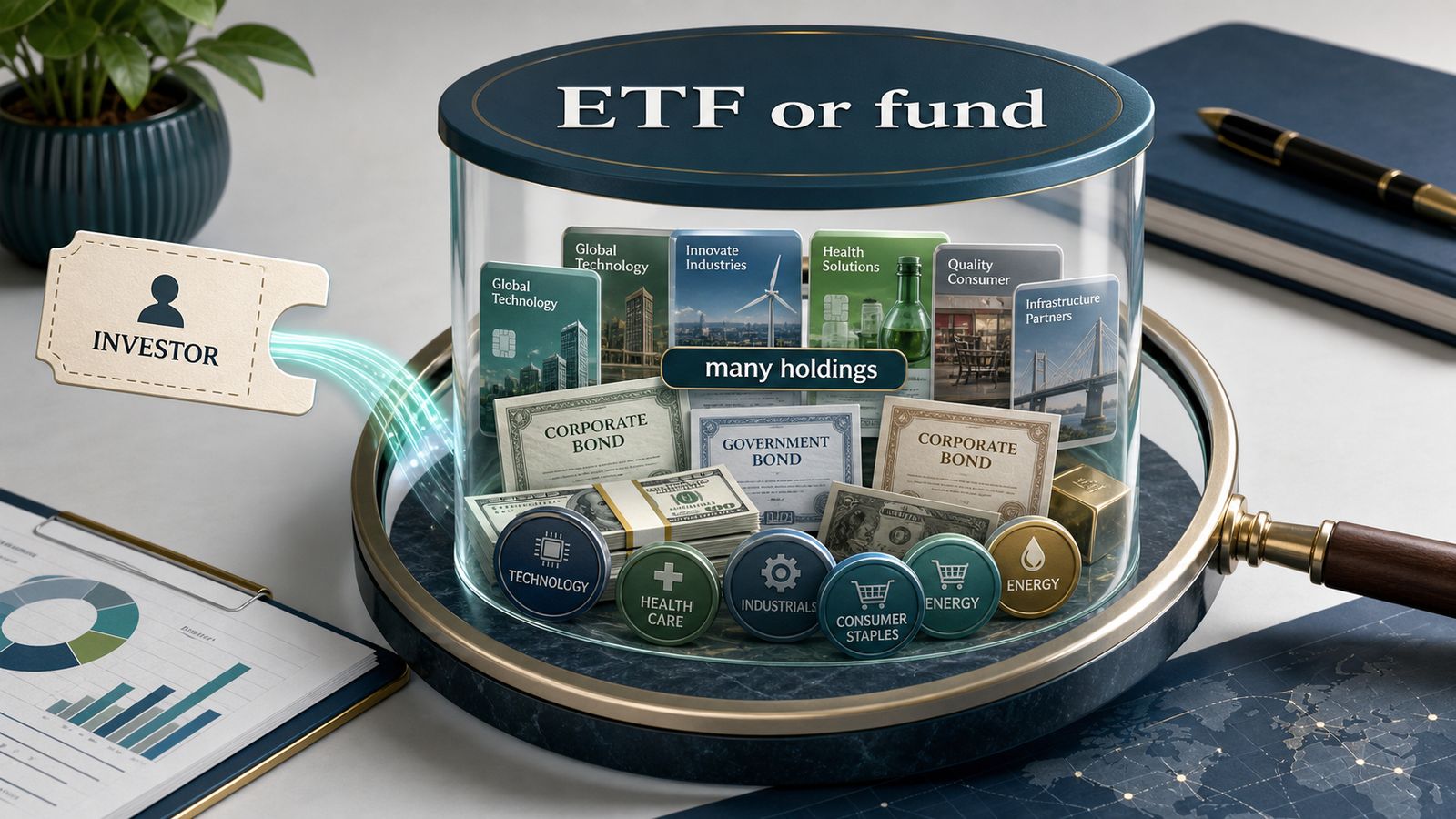
Many beginners do not want to research dozens of individual stocks and bonds. Funds can make diversification easier because one fund can hold many securities. An ETF, mutual fund, or index fund pools investor money and owns a basket of holdings. That gives a small investor access to a broader mix than they could easily build one security at a time.
A broad U.S. stock market index fund may own hundreds or thousands of stocks. A bond ETF may own many bonds with different issuers and maturities. A target-date fund may combine stock funds and bond funds in one retirement-oriented package. This does not mean every fund is right for every investor, but funds can reduce the need to pick individual winners.
If you are new to fund investing, start with the difference between an ETF, a mutual fund, and an index fund. These products can overlap, but they are not identical. ETFs trade during the day like stocks. Mutual funds usually trade once after the market closes. Index funds follow a benchmark rather than trying to pick winners through active management.
Funds also need a closer look. A fund with “technology” in the name may own many companies but still be concentrated in one sector. A dividend fund may hold many stocks but still lean toward certain industries. A bond fund may look conservative but carry interest-rate risk, credit risk, or liquidity risk. A portfolio becomes more resilient when the holdings are genuinely different, not when several funds all hold the same few companies.
Diversification vs Asset Allocation
Diversification and asset allocation are related, but they answer different questions. Asset allocation asks, “How much should I put in each broad asset class?” The next question is, “Am I too dependent on one holding, sector, region, or risk source inside that mix?”
For example, a beginner might choose a simple 80% stock and 20% bond portfolio. That is an asset allocation decision. The investor still needs to decide whether the stock portion is one stock, five stocks, one S&P 500 fund, a total U.S. market fund, or a global stock fund. That second question is about spreading risk inside the allocation.
The same is true for bonds. A 20% bond allocation could be one corporate bond, a Treasury bond ladder, a broad bond ETF, or a money market fund. Each choice has different trade-offs. A bond can help balance a portfolio, but bonds are not all the same. Duration, issuer quality, interest rates, inflation, and fund structure all matter.
Rebalancing ties the two ideas together. If stocks rise sharply, a portfolio that began at 80% stocks may drift to 90% stocks. That may be more risk than the investor intended. Portfolio rebalancing brings the mix back toward the target. It does not guarantee better returns, but it can help keep the portfolio aligned with the original plan.
Common Diversification Mistakes
The first mistake is assuming more holdings always means better risk spreading. Owning ten funds may sound diversified, but if all ten funds hold similar large U.S. growth stocks, the portfolio may still move like one big bet. Overlap matters. A beginner should check what funds actually own, not just count the number of ticker symbols.
The second mistake is ignoring concentration that came from success. Suppose one stock grows from 5% of your portfolio to 35%. That growth may feel like a win, but it also changes your risk. Now one company can have a much larger effect on your future results. Concentrated winners can create wealth, but they can also create fragile portfolios.
The third mistake is spreading money so widely that the plan becomes confusing. A diversified approach should make a portfolio easier to manage, not impossible to understand. If you cannot explain why each holding is there, the portfolio may need simplification. A few broad, low-cost funds can sometimes be more practical than a long list of overlapping positions.
The fourth mistake is using an investment portfolio as a substitute for an emergency fund. Market investments can fall when you need money. Cash for near-term bills, job loss, medical costs, or urgent repairs should usually be separated from long-term investing. GSV’s guide to emergency funds explains why cash reserves and investment portfolios serve different jobs.
What Diversification Cannot Do
The strategy reduces certain risks, but it cannot remove all risk. If the whole stock market falls, a diversified stock portfolio can still fall. If interest rates move sharply, many bond investments can be affected at the same time. If inflation stays high, cash can lose purchasing power even when the dollar balance does not go down.

This difference is important. Company-specific risk is the risk that one business performs poorly. Holding many businesses can reduce that risk. Market risk is the risk that broad markets move against investors. A diversified portfolio can manage market risk, but it cannot make it disappear.
It also does not guarantee higher returns. A concentrated portfolio may outperform if its few holdings do extremely well. A diversified portfolio may lag the hottest stock, sector, or theme during a strong run. The trade-off is that a diversified portfolio is usually built to avoid depending on one prediction being correct.
That trade-off is especially useful for long-term investors who do not want to spend their lives forecasting every market turn. A beginner using dollar-cost averaging may combine regular contributions with a diversified portfolio to build a repeatable process. The process still has risk, but it is less dependent on perfect timing or one winning idea.
FAQ About Diversification
How many stocks do I need to be diversified?
There is no universal number that works for everyone. A portfolio can become more diversified as it owns more companies across different sectors and asset types, but quality, overlap, and asset allocation matter too. Many beginners use broad ETFs or mutual funds because one fund can hold many securities.
Can I be diversified with one ETF?
Sometimes, but it depends on the ETF. A broad total-market or global allocation ETF may provide wide exposure, while a sector ETF may be concentrated even if it owns many stocks. Always check the fund’s holdings and strategy.
Does diversification protect me from a stock market crash?
It can reduce the impact of single-company or single-sector problems, but it cannot fully protect against broad market declines. Stocks can fall together during major selloffs.
Is diversification the same as not taking risk?
No. A diversified portfolio still takes risk. The point is to choose risks intentionally and avoid having one holding or one theme dominate the outcome.
Can too much diversification be a problem?
Yes. Too many overlapping holdings can make a portfolio harder to understand without meaningfully reducing risk. The strategy should support a clear plan, not create clutter.
Final Thoughts on Diversification
Open your account and ignore the ticker count for a moment. Which companies appear inside more than one fund? Which holdings depend on the same industry? How much of the portfolio would fall together if that one story stopped working?
I am not trying to remove every concentration from my own portfolio. Some of it reflects the companies I genuinely believe in. I simply want it to be a decision, not an accident. Diversification is useful when it helps you stay invested through disappointment without pretending that every loss can be avoided.
Official Sources
- Investor.gov: Asset Allocation and Diversification
- Investor.gov: Diversify Your Investments
- Investor.gov: What is Risk?
Educational disclaimer: This article is for general financial education only and is not personalized investment, tax, or legal advice. Investing involves risk, including possible loss of principal. Consider your own goals, time horizon, risk tolerance, and professional guidance when needed.