

Bond duration measures how sensitive a bond or bond fund’s price is to changes in interest rates. A higher duration generally means a larger price move when rates change, while a lower duration generally means less rate sensitivity.
That makes bond duration one of the most useful numbers to check before buying a bond fund. It does not predict returns, and it is not the same as maturity. Instead, it gives investors a practical estimate of interest-rate risk.
Key Takeaways
- Bond duration estimates a bond’s or bond fund’s sensitivity to interest-rate changes.
- A duration of 6 years suggests that a one-percentage-point rate increase could produce roughly a 6% price decline, before other factors.
- Longer maturity, lower coupons, and lower yields generally increase duration.
- Duration is an estimate, not a guarantee, and it does not capture every bond risk.
- Your appropriate duration depends on when you need the money and how much price volatility you can accept.
What Is Bond Duration?
Bond duration has two related meanings. Macaulay duration measures the weighted average time it takes to receive a bond’s cash flows. Modified duration translates that timing into an estimate of how much the bond’s price may change when its yield changes.
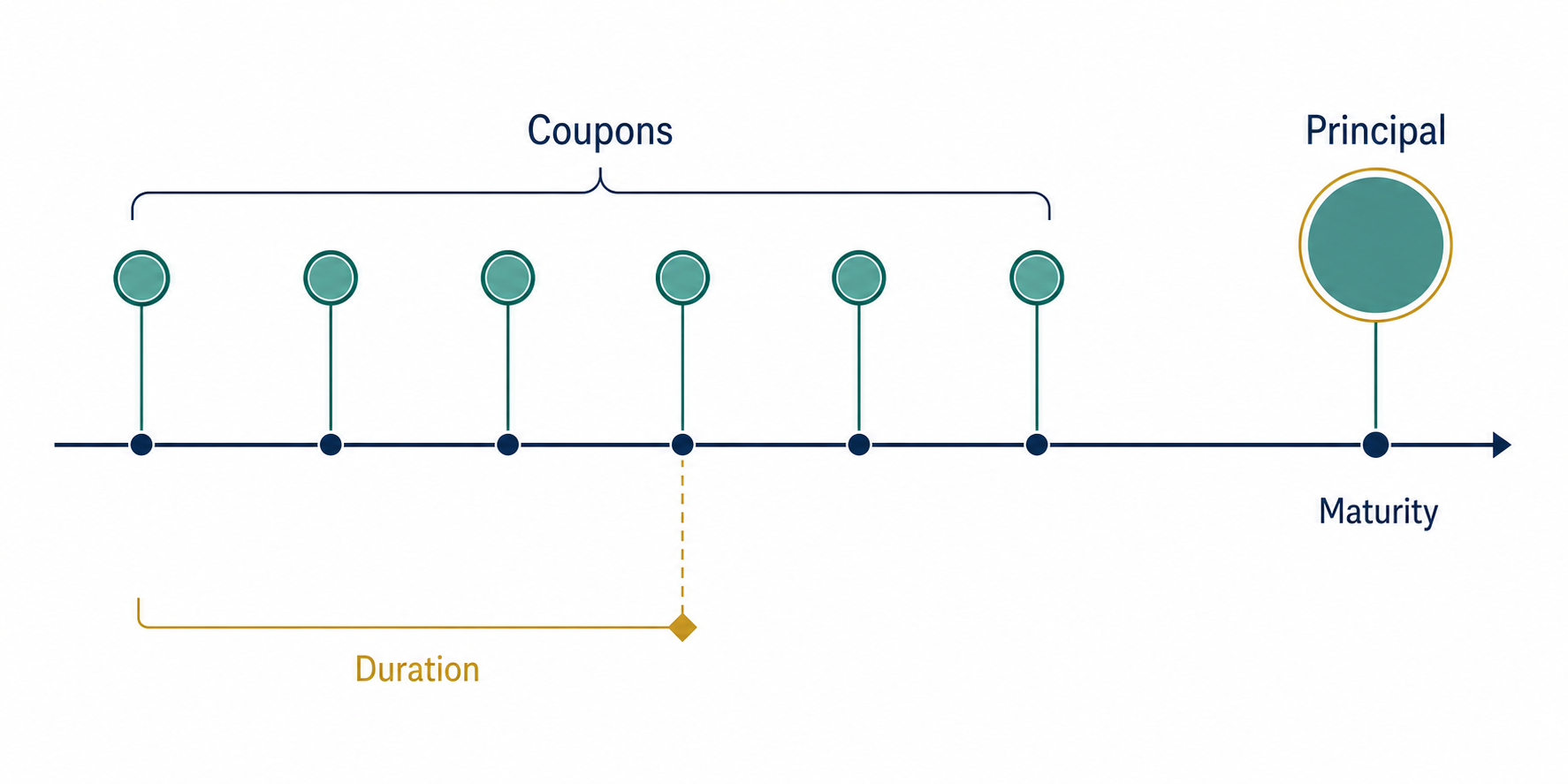
Imagine a bond as a series of payments on a timeline. Coupon payments arrive along the way, and principal is returned at maturity. Duration finds the present-value-weighted center of those payments. If more value arrives later, that center moves farther out and the bond becomes more sensitive to changing rates.
This is different from maturity. Maturity tells you when the bond issuer is scheduled to return principal. Duration accounts for both principal and coupon payments. A 10-year bond that pays coupons can therefore have a duration shorter than 10 years.
If the basic structure is new to you, start with GSV’s guide to what a bond is. Understanding the borrower, coupon, face value, yield, and maturity makes duration much easier to interpret.
How Bond Duration Estimates Interest-Rate Risk
Bond prices and market interest rates usually move in opposite directions. When newly issued bonds offer higher yields, older bonds with lower payments become less attractive, so their market prices tend to fall. When rates decline, existing bonds with comparatively attractive payments tend to rise in price.
Bond duration puts a rough number on that relationship. Suppose a bond fund has a duration of 5.5 years. If market yields rise by one percentage point, the fund’s price could fall by approximately 5.5%. If yields fall by one percentage point, its price could rise by roughly 5.5%.
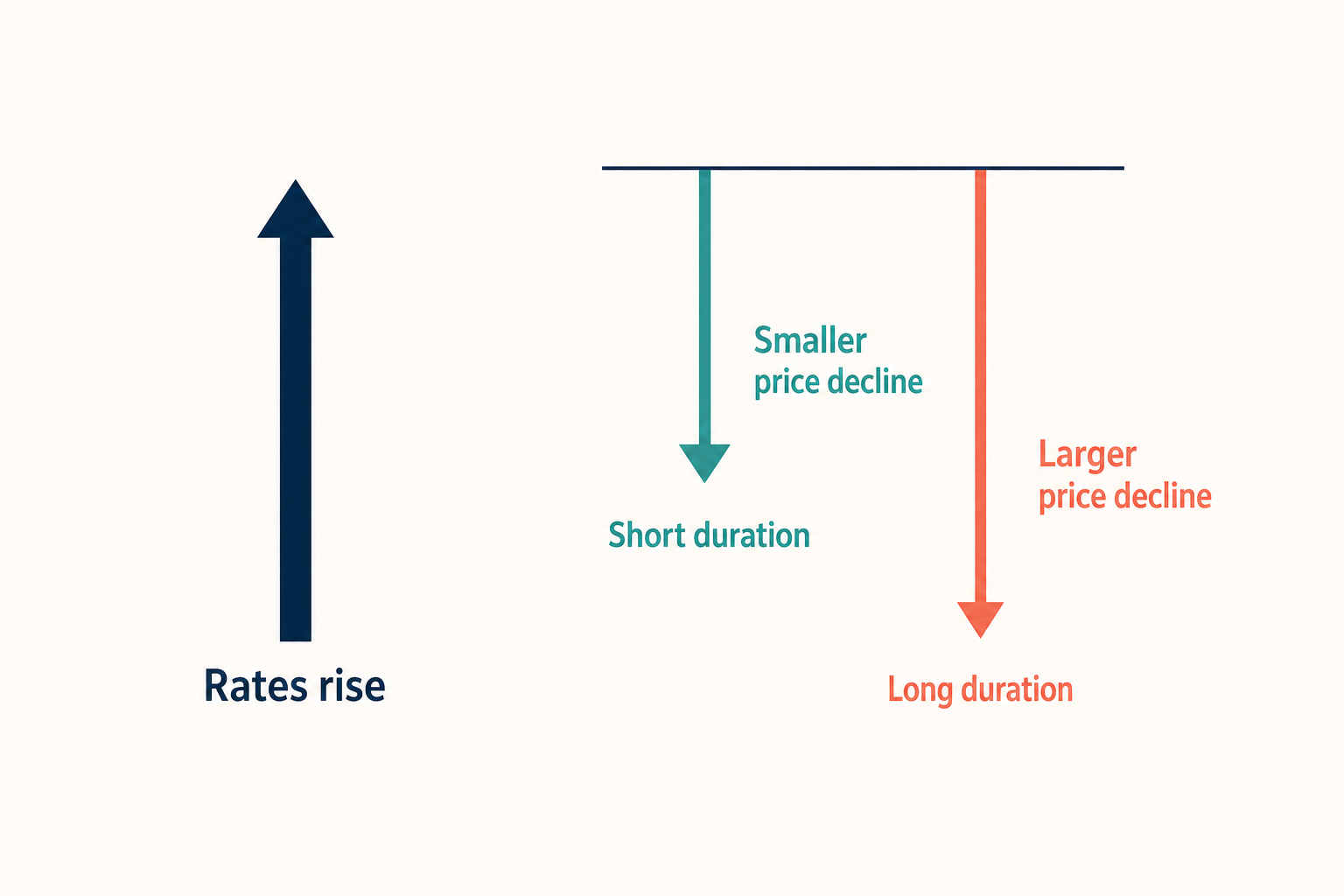
The estimate is a starting point, not a promise. The relationship is not perfectly linear, especially for large rate changes. Credit spreads, issuer risk, changing cash flows, fund expenses, and investor demand can also affect prices.
Still, duration lets you compare two funds quickly. A short-term bond fund with a duration near 2 years should normally react less to a given rate move than an intermediate fund with a duration near 6 years. A long-term fund with a duration above 12 years may experience much larger swings.
This rate sensitivity also explains why a bond ETF can lose value even when its underlying bonds make regular interest payments. Income and price movement are separate parts of total return.
A Simple Duration Example
Consider Fund A with a duration of 3 years and Fund B with a duration of 8 years. If yields rise by 0.50 percentage point, the simple estimate is a price decline of about 1.5% for Fund A and about 4% for Fund B.
The calculation is duration multiplied by the yield change, with the price direction reversed. For Fund B, 8 multiplied by 0.005 equals 0.04, or 4%. This approximation helps with planning, but actual returns can differ.
What Makes Duration Higher or Lower?
Three features have the biggest effect on bond duration: maturity, coupon rate, and yield. Understanding them can help you see why two bonds issued by similar borrowers may react differently to the same rate change.
| Bond Feature | Typical Effect on Duration | Why It Matters |
|---|---|---|
| Longer maturity | Higher | More of the bond’s value arrives farther in the future |
| Lower coupon | Higher | Less cash is returned before maturity |
| Higher coupon | Lower | More cash is returned earlier |
| Lower yield | Generally higher | Distant cash flows carry relatively more present value |
| Embedded options | Can change effective duration | Cash-flow timing may change when rates move |
A zero-coupon bond is a clear example. It makes no coupon payments, so all cash arrives at maturity. Its Macaulay duration equals its maturity. A coupon bond returns some cash earlier, which pulls its duration below its maturity date.
Callable bonds and mortgage-backed securities are more complicated because their expected cash flows can change. When rates fall, borrowers may refinance or issuers may call bonds. Analysts often use effective duration for securities with embedded options because it models changing cash flows.
How to Use Bond Duration in a Portfolio
The best duration is not simply the lowest or highest number. It should fit the job the bonds perform in your financial plan. Money needed soon generally calls for less price sensitivity, while money with a longer horizon may be able to tolerate more.

For a near-term goal, a Treasury bill or another short-duration holding may be easier to match with the spending date. Cash reserves may also belong in a money market fund when liquidity and stability matter more than pursuing a higher long-term return.
Intermediate duration can serve as a middle ground for the bond portion of a diversified portfolio. It may offer more yield potential than very short holdings while avoiding some of the price sensitivity of long-term bonds. The tradeoff changes with the yield curve and market conditions.
Long duration can be useful when an investor intentionally wants greater exposure to falling rates or is matching a distant liability. But the same sensitivity works in reverse when rates rise. A long-duration allocation should be a deliberate decision, not an accidental result of choosing the fund with the highest recent return.
Your overall mix matters too. GSV’s guide to asset allocation explains how stocks, bonds, and cash can serve different roles. Duration helps refine the bond portion; it does not replace the broader allocation decision.
Where to Find a Fund’s Duration
Bond mutual funds and ETFs usually report duration on the fund provider’s webpage, fact sheet, or portfolio characteristics page. Look for labels such as average duration, effective duration, or modified duration. Confirm which measure is being used before comparing funds.
Also check average maturity, yield to maturity, credit quality, expense ratio, and holdings. Two funds can have similar duration but different credit risk or sector exposure. Duration answers an interest-rate question, not every due-diligence question.
Common Bond Duration Mistakes and Limitations
The first mistake is treating bond duration as a holding-period recommendation. A duration of 6 years does not mean you must hold the fund for exactly six years. It describes cash-flow timing and rate sensitivity, not a mandatory ownership period.
The second mistake is confusing duration with maturity. A fund’s average maturity may be 9 years while its effective duration is 6 years. The numbers are related, but they answer different questions.
The third mistake is expecting a precise price forecast. Duration uses a local approximation. A two-percentage-point rate move may not produce exactly twice the estimated response because bond prices have curvature, known as convexity.
The fourth mistake is ignoring credit risk. A corporate bond fund may decline because investors become more worried about defaults, even if Treasury rates do not change much. The same is true for liquidity risk and sector-specific stress.
The fifth mistake is making a major portfolio shift based on one rate forecast. Forecasting interest rates is difficult. A better approach is to align duration with the timing of your goals, diversify, and choose a level of fluctuation that fits your risk tolerance.
Finally, remember that inflation affects the purchasing power of bond income. The relationship between inflation and interest rates can influence yields, real returns, and the relative appeal of different maturities.
Official Sources
- FINRA: Duration—What an Interest Rate Hike Could Do to Your Bond Portfolio
- SEC Investor.gov: Interest Rate Risk
Final Thoughts
Bond duration turns an abstract risk into a useful comparison number. It estimates how strongly a bond or bond fund may react when yields change and helps investors distinguish short-, intermediate-, and long-duration choices.
Use it alongside maturity, yield, credit quality, expenses, and your time horizon. The goal is not to predict the next rate move. It is to make sure the interest-rate risk you own matches the role bonds are supposed to play in your portfolio.
Frequently Asked Questions
Is higher bond duration better?
No. Higher duration provides more upside when rates fall but more downside when rates rise. The appropriate level depends on your goal, time horizon, and tolerance for price changes.
Why is bond duration measured in years?
Macaulay duration represents the present-value-weighted average timing of a bond’s cash flows, so it is expressed in years. Modified and effective duration use that foundation to estimate price sensitivity.
Can bond duration be negative?
Most traditional bonds and bond funds have positive duration. Some specialized securities or hedged strategies can have very low or negative duration, but they behave differently from a standard beginner bond allocation.
Does duration include credit risk?
No. Duration primarily estimates sensitivity to yield changes. Investors still need to evaluate default risk, credit spreads, liquidity, fees, and any embedded options.
Continue Learning
Ready for the next step? Explore these related investing guides.
- What Is Diversification? Beginner Guide
- What Is Portfolio Rebalancing? Beginner Guide
- What Is a Target Date Fund? Beginner Guide
Educational disclaimer: This article is for general educational purposes only and is not financial advice. Bond investments can lose value, and investors should consider their goals, time horizon, tax situation, and risk tolerance before making investment decisions.