

ETF tracking error measures how consistently an exchange-traded fund follows its benchmark. An index ETF may aim to mirror the S&P 500, a bond index, or another market benchmark, but its returns rarely match that index perfectly every day.
Have you ever compared two ETFs that seemed to follow the same market and wondered why their returns were not quite identical? I did not check tracking error when I first bought ETFs. I mostly looked at the companies inside the fund and trusted products that other investors recommended. Only later did I understand that funds with similar labels can still differ because of fees, trading, cash holdings, and the way the portfolio is managed. Tracking error is one way to see whether those small differences stay controlled or keep moving around.
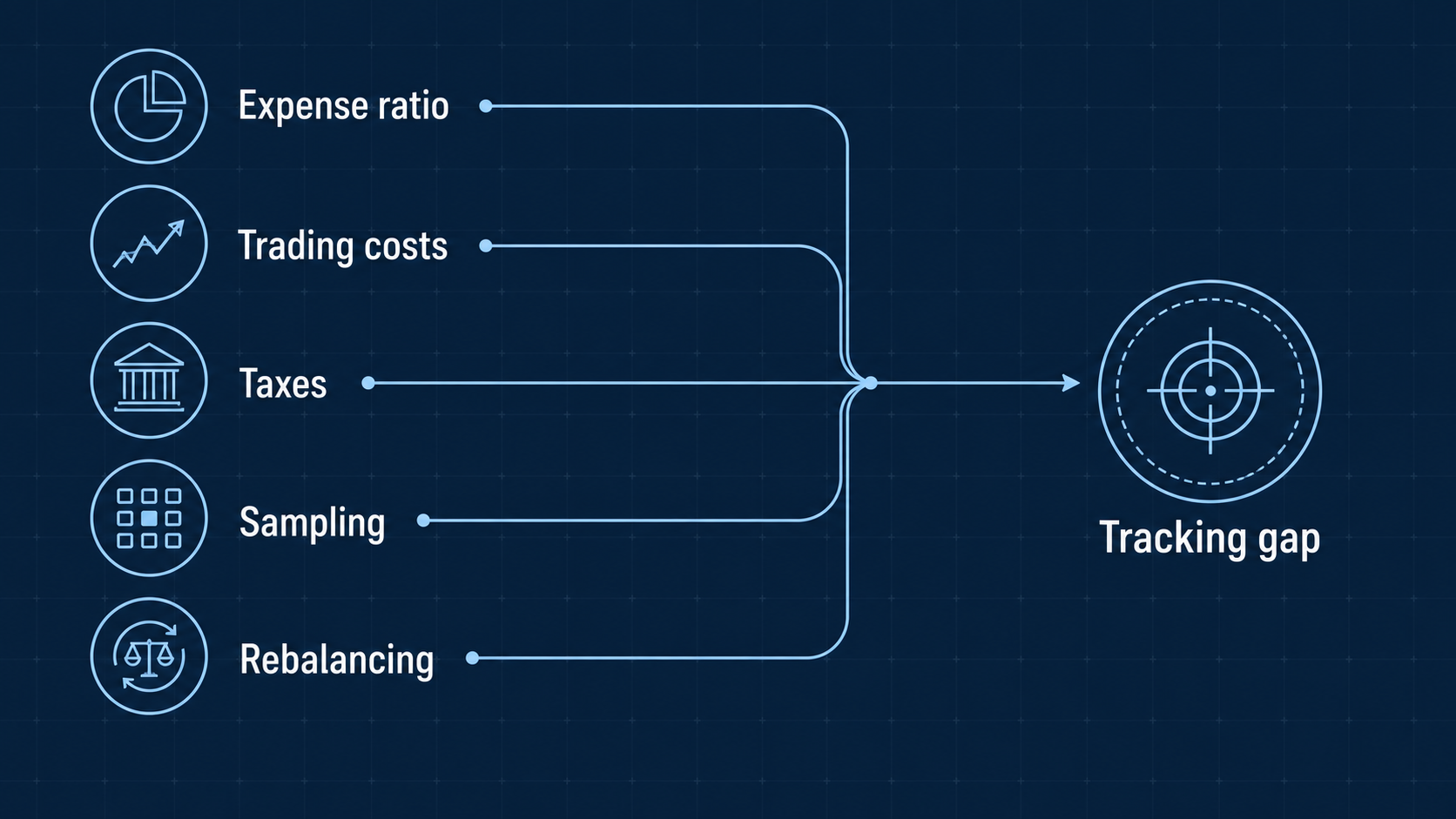
The gap can change because a real fund has expenses, trading costs, taxes, cash holdings, and portfolio-management constraints. Understanding ETF tracking error helps you look beyond the fund name and expense ratio to see how reliably the portfolio delivers the exposure it promises.
Key Takeaways
- ETF tracking error describes how much the fund’s return difference versus its benchmark varies over time.
- Tracking difference is the average return gap; tracking error is the variability of that gap.
- Fees, trading costs, sampling, taxes, cash drag, and index rebalancing can all affect results.
- A lower number usually indicates more consistent index replication, but it does not automatically make an ETF the best choice.
- Compare funds that follow the same benchmark and use the same measurement period.
What Is ETF Tracking Error?
ETF tracking error is commonly calculated as the standard deviation of the difference between an ETF’s return and its benchmark’s return. In plain English, it asks whether the fund-to-index gap stays relatively stable or moves around a lot.
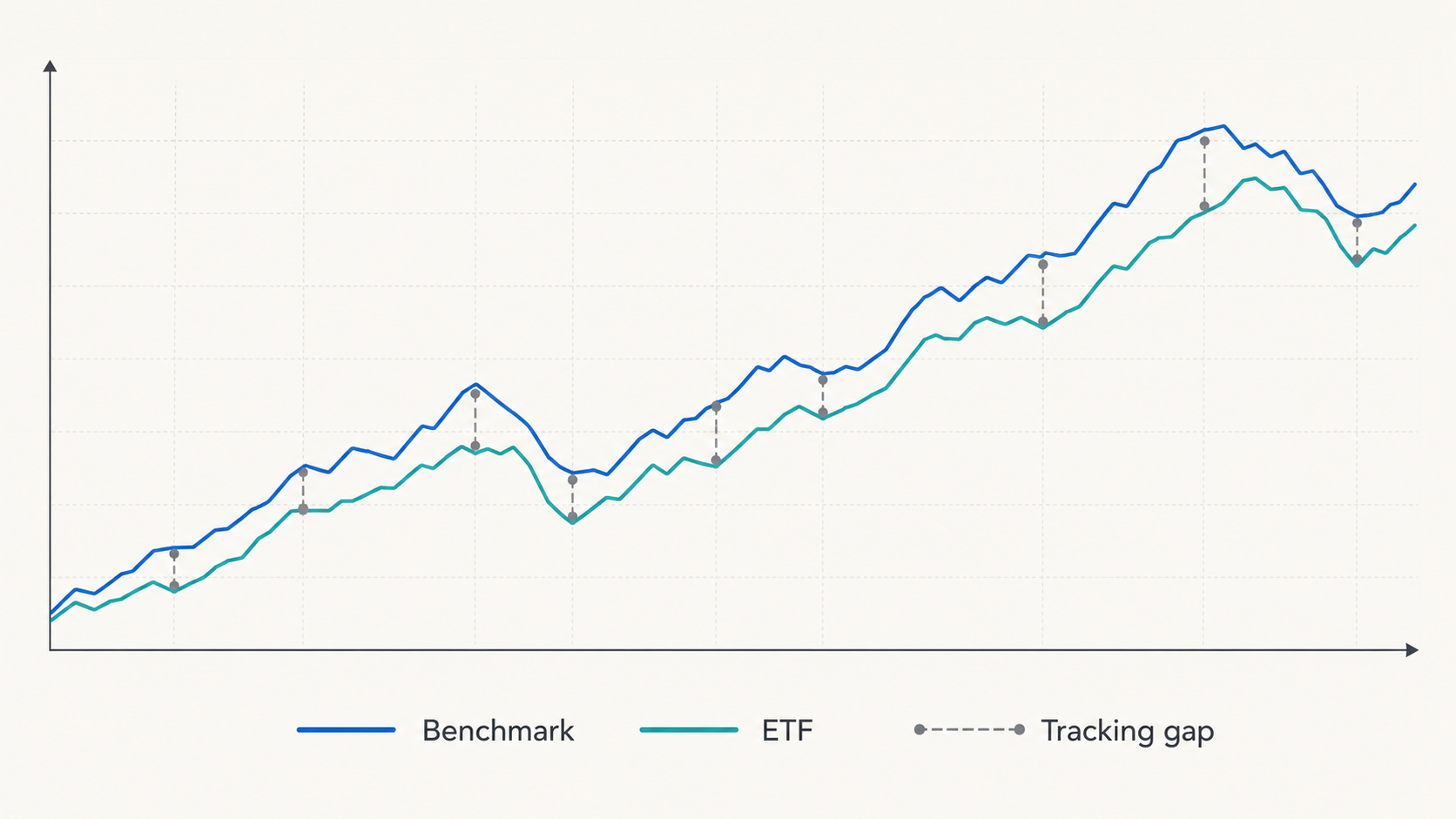
In the chart above, the two lines move in the same general direction, but the vertical distance between them is not identical at every observation. The amount that this distance fluctuates is the core idea behind ETF tracking error.
Suppose an ETF trails its index by almost the same small amount every month. It may have a negative tracking difference, yet relatively low tracking error because the shortfall is consistent. Another ETF might beat the index one month and trail it substantially the next. Its average gap could appear small even though its tracking error is high.
If you are still learning the product structure, begin with how an ETF works. The creation and redemption process, market price, net asset value, and underlying holdings all help explain why a fund can follow an index closely without matching it exactly.
Tracking Error vs. Tracking Difference
These terms are related but not interchangeable. Tracking difference measures the fund’s return minus the benchmark’s return over a period. Tracking error measures how variable those return differences are across multiple observations.
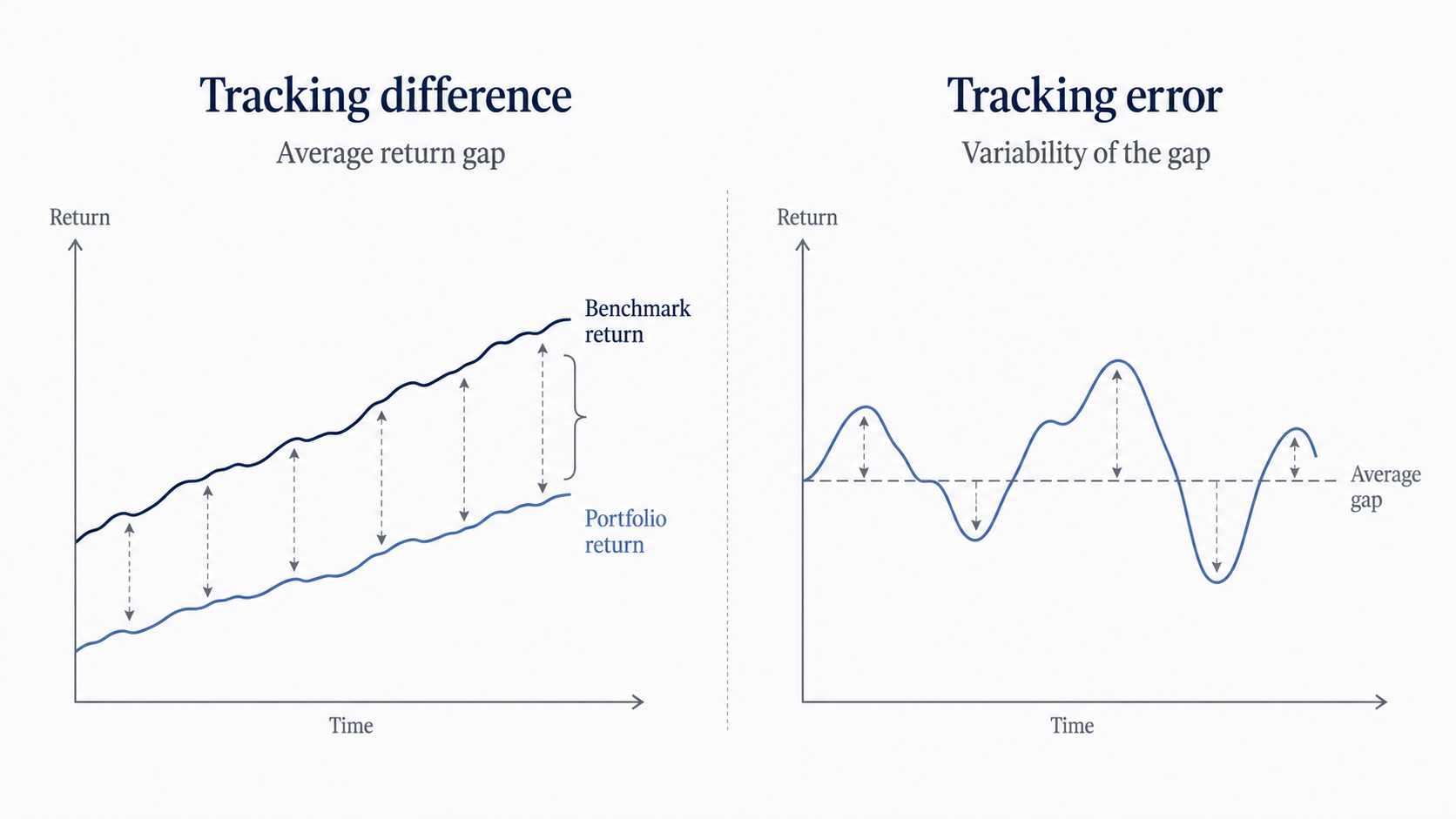
| Measure | Question It Answers | How to Read It |
|---|---|---|
| Tracking difference | How far did the ETF return finish above or below the index? | A persistent negative gap often reflects costs and implementation effects. |
| Tracking error | How consistent was that gap over time? | Lower variability generally means more predictable index replication. |
Consider a hypothetical index that returns 8% in a year. If a fund returns 7.8%, its annual tracking difference is negative 0.2 percentage point. That single result does not reveal ETF tracking error. You need a series of daily, weekly, or monthly return differences to calculate how widely the gaps vary.
This distinction matters because investors sometimes treat one year of underperformance as proof that a fund tracks poorly. A modest and stable shortfall may primarily reflect the fund’s operating costs. Conversely, an attractive one-year result can hide unstable replication during the year.
What Causes ETF Tracking Error?
An index exists as a calculation, while an ETF is a real portfolio. The fund must buy and sell securities, manage investor flows, hold small amounts of cash, and operate within legal and market constraints. Those practical differences create several sources of ETF tracking error.
Expense Ratio and Other Fund Costs
The benchmark does not pay a management fee, but the ETF does. All else equal, recurring expenses create a return drag. GSV’s guide to the ETF expense ratio explains how those operating costs are reflected in fund assets rather than appearing as a separate bill.
Fees often contribute more directly to tracking difference than to variation, but changing expenses and their interaction with other implementation factors can also influence measured tracking error.
Trading Costs and Market Liquidity
An ETF pays bid-ask spreads and may experience market impact when it adjusts holdings. Thinly traded securities, smaller international markets, and less liquid bonds can be more expensive to trade. The index calculation usually does not bear those same real-world costs.
Trading frictions can become more visible when the benchmark reconstitutes or when markets are volatile. An ETF manager may trade gradually to control costs, which can temporarily move the portfolio away from the index.
Full Replication vs. Sampling
Some funds buy every security in the benchmark at approximately the index weight. Others use sampling, holding a representative subset designed to reproduce the benchmark’s risk and return characteristics. Sampling can make a difficult index investable, but differences in securities and weights can raise ETF tracking error.
Sampling is common when an index contains thousands of securities or hard-to-trade bonds. It is not automatically a flaw. The important question is whether the manager has historically delivered the intended exposure with acceptable consistency.
Cash Holdings, Dividends, and Taxes
Funds may hold cash temporarily for operations, distributions, or portfolio changes. Cash can lag a rising market or cushion a falling one. Dividend timing also matters because the index and the ETF may make different assumptions about when income is reinvested.
International funds can face withholding taxes that are not fully represented in a headline index return. The correct comparison may depend on whether the benchmark is reported on a price, gross-return, or net-return basis.
Index Rebalancing and Corporate Actions
Indexes add, remove, and reweight constituents according to published rules. Funds need to implement those changes in actual markets. Prices may move before the official rebalance, and managers may trade at different times to reduce costs. Mergers, spin-offs, and other corporate actions create further implementation differences.
How to Evaluate ETF Tracking Error
Start by confirming the fund’s exact benchmark. Two broad-market ETFs can sound similar while following different indexes with different constituent rules. An index fund can only be evaluated properly against the benchmark it actually seeks to track.
Next, look for tracking information on the issuer’s performance page, prospectus, annual report, or fact sheet. Some providers publish tracking difference or tracking error directly. If they do not, compare the ETF’s net asset value return with the benchmark return over identical periods.
Use the same return frequency and time window when comparing funds. Daily observations can produce a different number from monthly observations, and a calm three-year period may look different from a volatile five-year period. Methodology matters as much as the headline statistic.
Compare like with like. A physical replication ETF should not be judged against a fund with a different index, currency treatment, or distribution policy. For international funds, check whether returns are hedged and which tax treatment the benchmark assumes.
Finally, examine the pattern rather than one isolated value. A temporary increase during a market disruption may have a reasonable explanation. Persistent instability, unexplained benchmark changes, or results that are consistently weaker than close peers deserve more investigation.
Does Lower Tracking Error Always Mean a Better ETF?
No. Low ETF tracking error is useful when precise benchmark exposure is your priority, but an ETF is more than one statistic. Liquidity, assets under management, trading spread, tax efficiency, securities-lending policy, portfolio transparency, and issuer quality can all matter.
A fund with slightly higher tracking error might have a lower market trading spread or a structure that fits your account better. Another fund might track consistently but follow an index that does not provide the exposure you actually want. Learn the broader selection process in GSV’s index ETF basics guide.
Portfolio fit is also essential. Buying several tightly tracking funds does not ensure that the combined portfolio is well designed. Review overlap, asset classes, and concentration through the lens of diversification.
Common Mistakes to Avoid
The first mistake is confusing market-price movement with benchmark tracking. ETF shares trade throughout the day and can move slightly above or below net asset value. A temporary premium or discount is not the same calculation as tracking error, which is based on a series of relative returns.
The second mistake is comparing funds with different benchmarks. Even two ETFs labeled “total market” may use different inclusion rules. Their returns can diverge because the indexes differ, not because one manager failed.
The third mistake is using inconsistent data. Comparing one fund’s market-price return with another fund’s net asset value return can distort the result. Use comparable return definitions, dates, frequencies, and benchmark versions.
The fourth mistake is choosing solely by expense ratio. Cost is important, but two similarly priced funds may differ in liquidity, sampling, tax treatment, and implementation. The lowest listed fee does not guarantee the smallest realized tracking difference or tracking error.
The fifth mistake is expecting zero ETF tracking error. Perfect replication is difficult because a real portfolio operates under costs and constraints. The practical goal is a result that is small, explainable, and consistent for the fund’s market and strategy.
Official Sources
Final Thoughts
ETF tracking error tells you how consistently a fund follows its benchmark, not simply whether it beat or trailed the index in one period. Pair it with tracking difference to understand both the size and stability of the fund’s relative performance.
Use the measure as part of a broader review. Confirm the benchmark, compare like-for-like funds, check expenses and liquidity, and understand the replication method. The best ETF is not necessarily the one with the smallest number; it is the one that delivers the exposure you need with reasonable cost and consistency.
Frequently Asked Questions
What is a good ETF tracking error?
There is no universal cutoff. Lower is generally better for a passive fund, but the appropriate range depends on the asset class, benchmark complexity, liquidity, taxes, and measurement method. Compare funds following the same index over the same period.
Can an ETF outperform its benchmark?
Yes. Securities lending revenue, tax treatment, trading decisions, or timing can occasionally help an ETF outperform. Outperformance in one period does not eliminate tracking error or guarantee future results.
Is tracking error the same as an ETF premium or discount?
No. A premium or discount compares an ETF’s market price with its net asset value at a point in time. Tracking error measures the variability of return differences between the fund and its benchmark across time.
Where can I find ETF tracking information?
Check the fund provider’s performance page, prospectus, annual report, and fact sheet. Look for benchmark returns, net asset value returns, tracking difference, and tracking error, while confirming the measurement period and methodology.
Continue Learning
Build on this guide with these related ETF and portfolio lessons.
Educational disclaimer: This article is for general educational purposes only and is not financial advice. ETFs can lose value, and investors should consider their objectives, costs, tax situation, time horizon, and risk tolerance before investing.