

Have you ever seen companies announce stock buybacks, felt encouraged, and then discovered that little—or none—of the plan actually happened? A big announcement sounds like a promise to shareholders. It often is not.
From the publisher: I have owned Korean stocks whose major shareholders or management talked about buying shares, only to delay the action or use the money elsewhere. Watching the announcement create hope and then lead nowhere was deeply disappointing. It taught me to stop treating the headline as the result.
That is why SK hynix’s recent shareholder-return actions felt different to me. The company reported that it had implemented a large return program through additional dividends and the cancellation of treasury shares, while continuing to review dividends and repurchases. As a shareholder, I was glad to see action rather than another vague promise—and the positive attention around the stock was welcome too.
This matters beyond one company. Korean stocks have long traded at a so-called Korea discount, meaning investors often value them more cheaply than comparable companies elsewhere. Weak shareholder returns and governance concerns are not the only reasons, but Korean regulators have identified them as important ones. In my view, more companies should move in the same direction: make a clear plan, execute it, and show ordinary shareholders what happened.
So are stock buybacks always good news? No. The useful question is simpler: did the company actually reduce the share count at a sensible price without weakening the business? Let’s work through that in plain language.
Key Takeaways
- A buyback can reduce shares outstanding and lift earnings per share even when total profit is unchanged.
- Authorization is permission to repurchase, not a promise that management will spend the full amount.
- Buying undervalued shares can increase value per remaining share; overpaying can destroy value.
- Stock-based compensation may offset repurchases, leaving the diluted share count flat.
- Free cash flow, debt, purchase price, and actual share-count reduction matter more than the headline dollar amount.
What Are Stock Buybacks?
Public companies can return capital by paying dividends or repurchasing shares. In a common open-market program, the board authorizes a maximum amount or number of shares, and the company buys shares over time through a broker. Other structures include tender offers and accelerated repurchase agreements.
Here is where I used to get confused: buying shares and cancelling them are not the same finish line. Repurchased shares may sit on the company’s books as treasury shares or be retired. If the total diluted share count truly falls, each share still in our hands owns a slightly larger piece. If it does not, the exciting headline may have changed very little.
Stock buybacks do not mechanically make the whole company more valuable. Cash leaves the balance sheet while shares disappear. The economic result depends on whether the company paid less or more than the shares were worth and whether another use of the cash would have produced a better return.
Three Actions That Sound Similar but Are Not
This is easy to mix up, especially in news headlines. Here is the difference:
- The company repurchases its own shares. Corporate cash is used to buy shares from the market. Those shares become treasury shares unless they are retired.
- A major shareholder or executive buys shares personally. The buyer uses personal or affiliated-company money. The company’s total share count does not automatically fall.
- The company cancels treasury shares. The shares are permanently retired. If no offsetting new shares are issued, each remaining share represents a larger percentage of the company.
A company announcement may cover only the first step. What happened next? Were the shares really purchased? Were they cancelled, or later used for employee compensation or an acquisition? I learned to look for those answers after being disappointed by promises that never became action.
SK hynix’s 2026 shareholder communication is a useful example of clearer follow-through. The company said it had delivered a shareholder-return program totaling 14.3 trillion won—roughly $9 billion at a rounded exchange rate—through extra dividends and treasury-share cancellation. The exact dollar equivalent changes with exchange rates, but the important point is the action: the company described an implemented program, not only an intention.
How Stock Buybacks Change EPS

Earnings per share, or EPS, means profit divided across shares. It is commonly calculated as net income divided by the weighted-average diluted share count. Imagine a company earns $100 million and has 100 million diluted shares. Its EPS is $1.00.
Now suppose the company reduces the diluted count to 90 million while profit stays at $100 million. EPS rises to about $1.11. Sounds like earnings growth, doesn’t it? The business did not make one extra dollar. The same profit was simply divided among fewer shares.
This is why investors must look below an EPS growth headline. During earnings season, compare net-income growth with EPS growth and inspect the diluted share count. If EPS rises 10% while total profit rises only 2%, repurchases or other share-count changes may explain much of the difference.
EPS improvement is not fake—it is valid arithmetic—but it is not the same as operating growth. Sales, margins, cash flow, and competitive strength reveal what the business produced. Share-count reduction reveals how that result is divided among owners.
When Stock Buybacks Can Create Value
The Shares Are Undervalued
A company that buys a dollar of intrinsic value for substantially less than a dollar can increase the value attributable to remaining shareholders. The logic resembles any investment: the return depends on the relationship between price and future cash flows.
Management should therefore explain why repurchasing shares is attractive relative to internal projects or acquisitions. A low price-to-earnings ratio alone does not prove undervaluation. Weak prospects, legal risk, or falling cash flows may justify the discount.
The Business Produces Excess Free Cash Flow
Good stock buybacks are normally funded after the business meets operating needs and worthwhile investment opportunities. Repurchasing with recurring free cash flow is more sustainable than borrowing heavily to support the stock price.
The Share Count Actually Declines
Some companies repurchase shares while issuing nearly as many through employee compensation or acquisitions. The gross repurchase number may look large, yet diluted shares barely change. Investors should compare diluted shares over several years rather than relying on a press release.
The Balance Sheet Remains Strong
Capital returned today should not force expensive financing tomorrow. Examine net debt, interest expense, upcoming maturities, credit ratings, and the cyclicality of cash flow. GSV’s guide to credit spreads explains why financing conditions can deteriorate when business risk rises.
When a Buyback Promise Is Not Enough

My biggest lesson as a shareholder is that an authorization is permission, not execution. A board can approve a maximum amount, but management may buy only part of it—or nothing at all. The company may change its mind when cash needs, debt, investment plans, or market conditions change.
Sometimes changing the plan is reasonable. A company should not buy expensive shares while ignoring a factory, essential research, or a dangerous balance sheet. The problem is weak communication: announcing a shareholder-friendly plan, allowing investors to celebrate it, and then quietly doing something else.
Management Pays Too Much
A buyback can destroy value when the company purchases overpriced shares. Think of it like any other investment. Paying $150 for something worth $100 does not become smart simply because the buyer is the company itself.
The Share Count Does Not Fall
A company may buy shares while issuing nearly as many to executives or employees. Billions can be spent without meaningfully increasing your ownership. Compare the diluted share count over several years instead of trusting the gross repurchase amount.
Debt or Missing Investment Pays the Bill
Borrowing heavily for a buyback can leave shareholders with more financial risk. So can cutting research, maintenance, or productive investment merely to lift short-term EPS. Shareholder return should come from genuine excess cash, not from weakening tomorrow’s business.
Stock Buybacks vs Dividends
| Feature | Buyback | Dividend |
|---|---|---|
| Who receives cash? | Shareholders who sell | Eligible shareholders of record |
| Ownership effect | Can raise remaining owners’ percentage | Usually no share-count change |
| Management flexibility | High; purchases may change | Lower after a recurring pattern forms |
| Valuation sensitivity | High; price paid drives value | Cash amount is explicit |
| Investor choice | Investor decides whether to sell | Payment generally arrives automatically |
| Main analytical risk | Overpayment or hidden dilution | Unsustainable payout |
Which feels more real to you: cash arriving as a dividend, or the company buying shares somewhere in the market? Dividends are easier to see. Buybacks require more checking. Learn how the cash side works in What Is Dividend Yield? and GSV’s dividend reinvestment guide.
Companies do not need to choose only one method. A durable dividend plus valuation-sensitive repurchases can work well when supported by free cash flow. The central test is whether each dollar is allocated to its highest realistic risk-adjusted return.
How to Analyze a Buyback Program
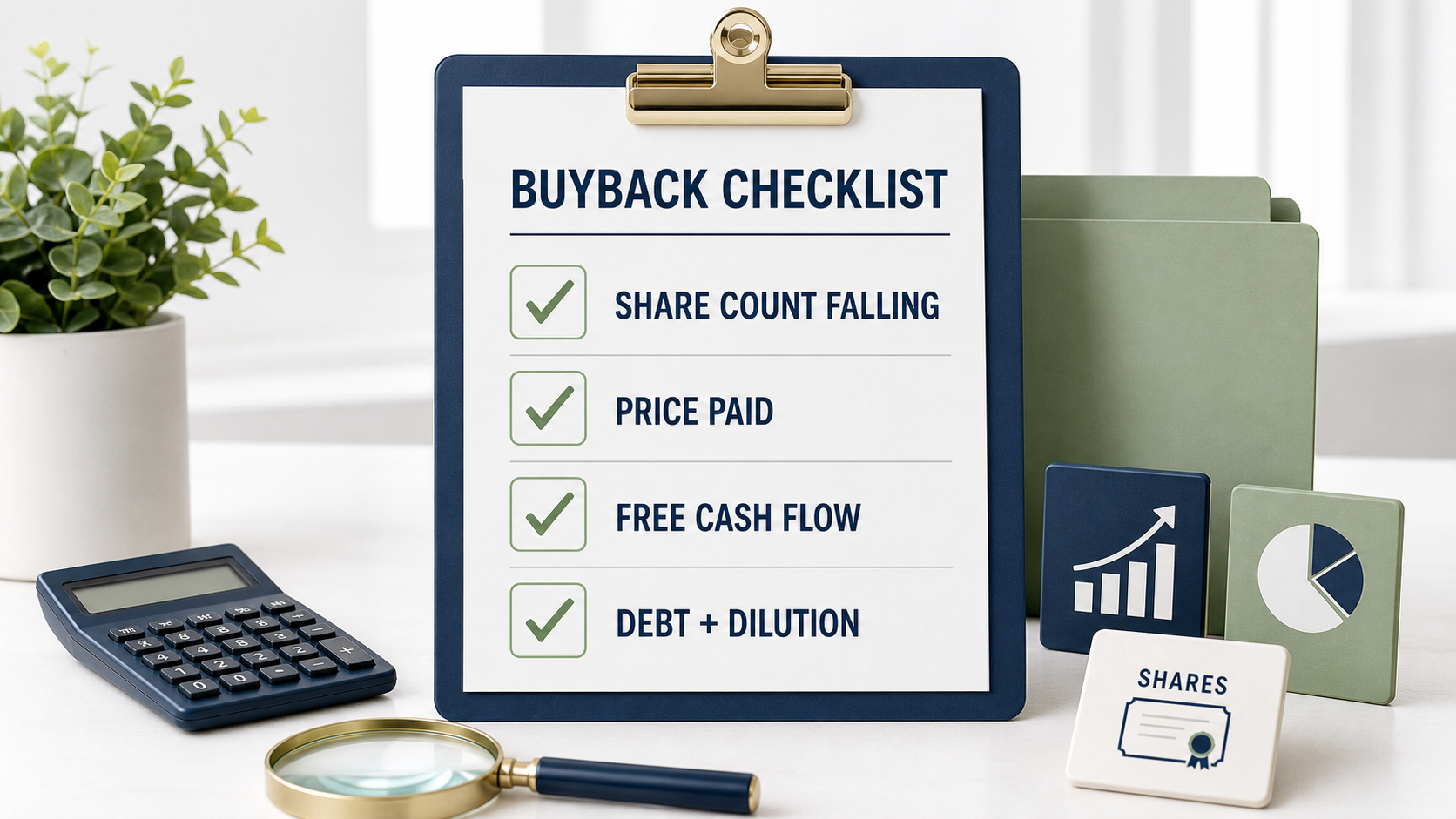
- Confirm actual purchases. Read the repurchase table in quarterly and annual filings rather than the announcement alone.
- Track diluted shares. Compare the weighted-average diluted count over three to five years.
- Estimate the average price paid. Relate it to earnings, free cash flow, and a reasonable valuation range.
- Compare EPS with net income. Separate operating growth from financial engineering.
- Measure stock compensation. Determine how much of the program offsets new issuance.
- Check funding quality. Review free cash flow, cash balances, debt, and interest expense.
- Compare alternatives. Ask whether investment, acquisitions, dividends, or debt reduction offered a stronger return.
- Read management’s rationale. Look for disciplined criteria rather than vague confidence.
Would I buy a stock only because management announced a repurchase? Not anymore. I still want to know whether the business is strong, debt is manageable, the price is sensible, and the position fits the portfolio. One shareholder-friendly action cannot rescue a weak investment thesis.
How This Guide Was Verified
- SEC: Rule 10b-18 and Issuer Repurchases
- SEC: Rule 10b-18 Frequently Asked Questions
- SK hynix: 2026 Shareholder Meeting and Return Program
- Korea Financial Services Commission: Treasury-Share Reform
- Korea Financial Services Commission: 2026 Buyback and Cancellation Disclosure Reform
Final Thoughts
I no longer get excited by a buyback announcement alone. I have seen companies talk about buying shares and then fail to follow through. Now I want evidence: the purchase record, the average price, the final share count, and—when appropriate—the cancellation.
That is why SK hynix’s recent shareholder-return actions felt encouraging. The point is not that one policy guarantees a higher stock price. It is that shareholders can see capital being returned and treasury shares being cancelled rather than hearing only another promise.
Could stronger shareholder returns help Korean stocks earn more trust and reduce part of the Korea discount? I believe so. Companies still need to invest, protect their balance sheets, and buy shares only at sensible prices. But when excess cash truly exists, ordinary shareholders should share in the result.
The next time you see “buyback” in a headline, do not stop there. Ask: Was it announced, executed, or cancelled? Those three words can lead to three very different outcomes.
Frequently Asked Questions
Do stock buybacks always increase the share price?
No. Purchases can support demand and reduce share count, but the market price still reflects earnings, valuation, interest rates, and investor expectations.
Do buybacks automatically increase EPS?
EPS generally rises if net income is unchanged and the diluted weighted-average share count falls. New stock issuance or weaker earnings can offset that effect.
Why would a company choose buybacks over dividends?
Repurchases offer more flexibility and allow shareholders to decide whether to sell. They also let management buy shares when it believes the price is attractive.
Where can investors find buyback information?
Start with the issuer’s Forms 10-Q and 10-K, repurchase tables, cash-flow statement, earnings releases, and notes about stock compensation.
Continue Learning
Build the rest of your stock-analysis framework.
Educational disclaimer: This article is for general educational purposes only and is not personalized financial, tax, or legal advice. Repurchase authorizations, transactions, tax rules, and company conditions can change. Review current filings and consider your objectives and risk tolerance.