

Interest rates and stocks are closely connected because rates change what companies pay to borrow, what future profits are worth today, and how attractive shares look beside bonds and cash. Higher rates can pressure stock valuations and profits, while lower rates can help—but the reason rates are moving often matters more than the direction alone.
The question is especially timely in 2026. On June 17, the Federal Reserve kept its target range at 3.50%–3.75%, leaving investors focused on inflation, employment, and the next policy move. Here are seven changes investors should watch without trying to predict the Fed’s every decision.
Key Takeaways
- Interest rates and stocks interact through corporate borrowing costs, consumer demand, profits, and valuations.
- Growth stocks can be more rate-sensitive because more of their expected cash flows lie farther in the future.
- Rate cuts are not automatically bullish: a cut caused by recession stress can arrive alongside falling earnings.
- Banks, real estate, utilities, and highly indebted companies can respond differently to the same rate move.
- Long-term investors usually benefit more from diversification and disciplined rebalancing than from guessing the next Fed meeting.
Interest Rates and Stocks: How the Connection Works
The Federal Reserve directly targets a very short-term rate, the federal funds rate. Its decisions influence broader financial conditions, but the Fed does not directly set mortgage rates, corporate bond yields, or stock prices. Markets also react to inflation expectations, economic growth, Treasury supply, credit risk, and what investors already expected.
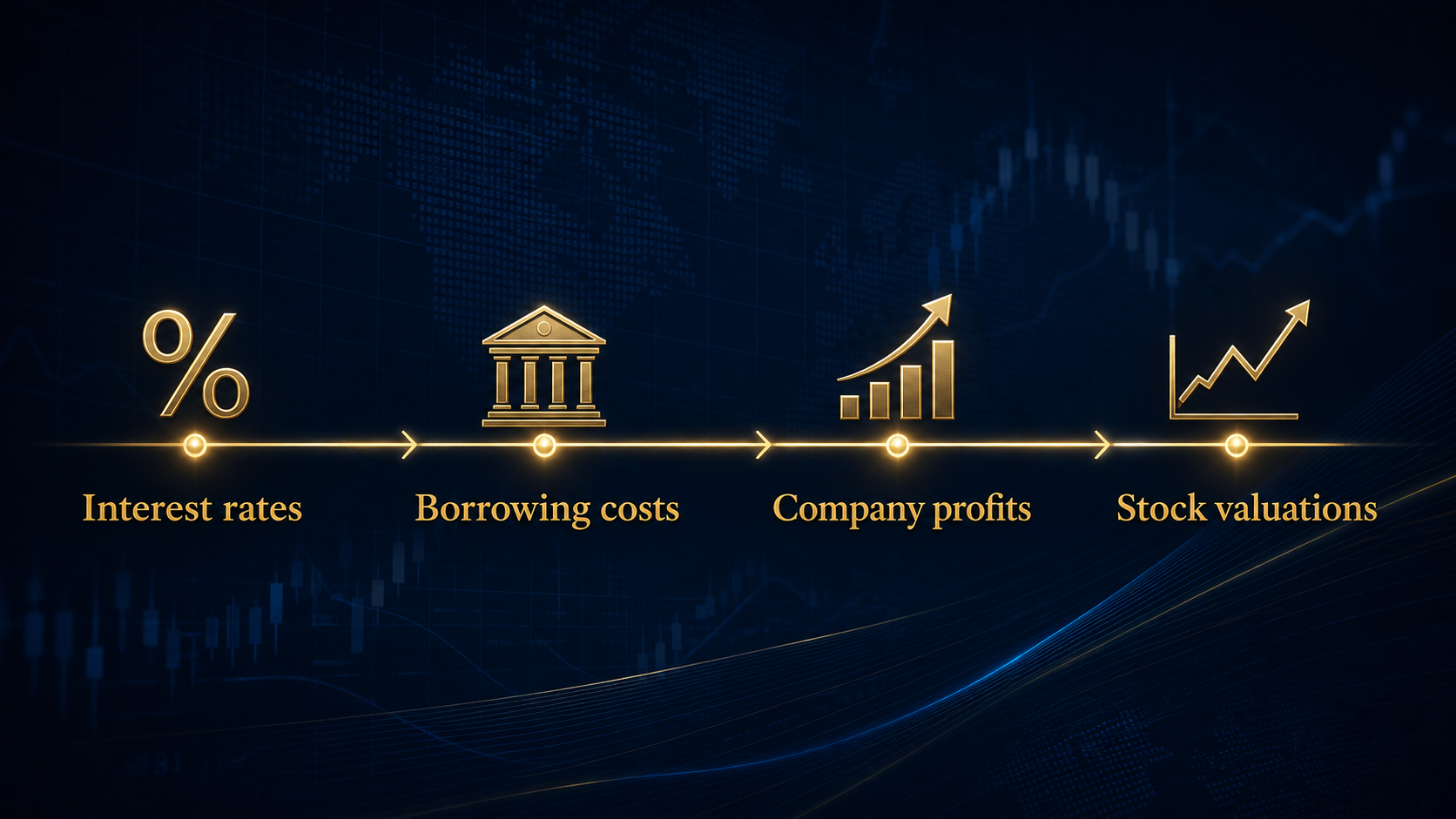
The basic transmission chain is straightforward. When financing becomes more expensive, companies may pay more interest, delay projects, and face weaker customer demand. Those changes can reduce expected profits. At the same time, investors use higher discount rates when valuing future cash flows, which can lower the price they are willing to pay for a stock.
When rates fall, the process can reverse. Borrowing may become cheaper, financing pressure may ease, and future profits may receive a higher present value. But interest rates and stocks never follow a mechanical rule: the economic reason behind the rate change determines whether lower financing costs outweigh weaker growth.
For the broader macro relationship, see GSV’s guide to inflation and interest rates. The seven effects below focus specifically on stock investors.
7 Changes Investors Should Watch
1. Corporate Borrowing Costs Change
Companies regularly borrow to build factories, acquire competitors, fund inventory, or refinance old debt. When market yields rise, newly issued debt usually becomes more expensive. Businesses with large floating-rate loans or upcoming maturities may feel the pressure sooner than companies with little debt and long-dated fixed-rate financing.
Higher interest expense can reduce net income even when sales remain steady. It can also make fewer expansion projects economically attractive. When comparing interest rates and stocks, examine the balance sheet, debt maturity schedule, interest coverage, and free cash flow—not just the industry label.
2. Stock Valuations Can Compress or Expand
A stock represents a claim on future business cash flows. Analysts estimate what those future dollars are worth today by discounting them. A higher discount rate reduces present value, while a lower rate raises it, all else equal.
This is why a profitable company can report decent results while its price-to-earnings multiple falls during a rate shock. The business may not have deteriorated, but investors may be less willing to pay a premium for distant growth. Understanding market capitalization helps separate a company’s market value from its accounting results.
For investors comparing interest rates and stocks, valuation matters most when market prices already assume years of rapid profit growth.
3. Growth and Value Stocks May React Differently
Growth companies are often valued on earnings expected many years from now. Those distant cash flows are more sensitive to changes in discount rates. Value stocks tend to derive more of their valuation from current earnings and nearer-term cash flows, although individual companies vary widely.
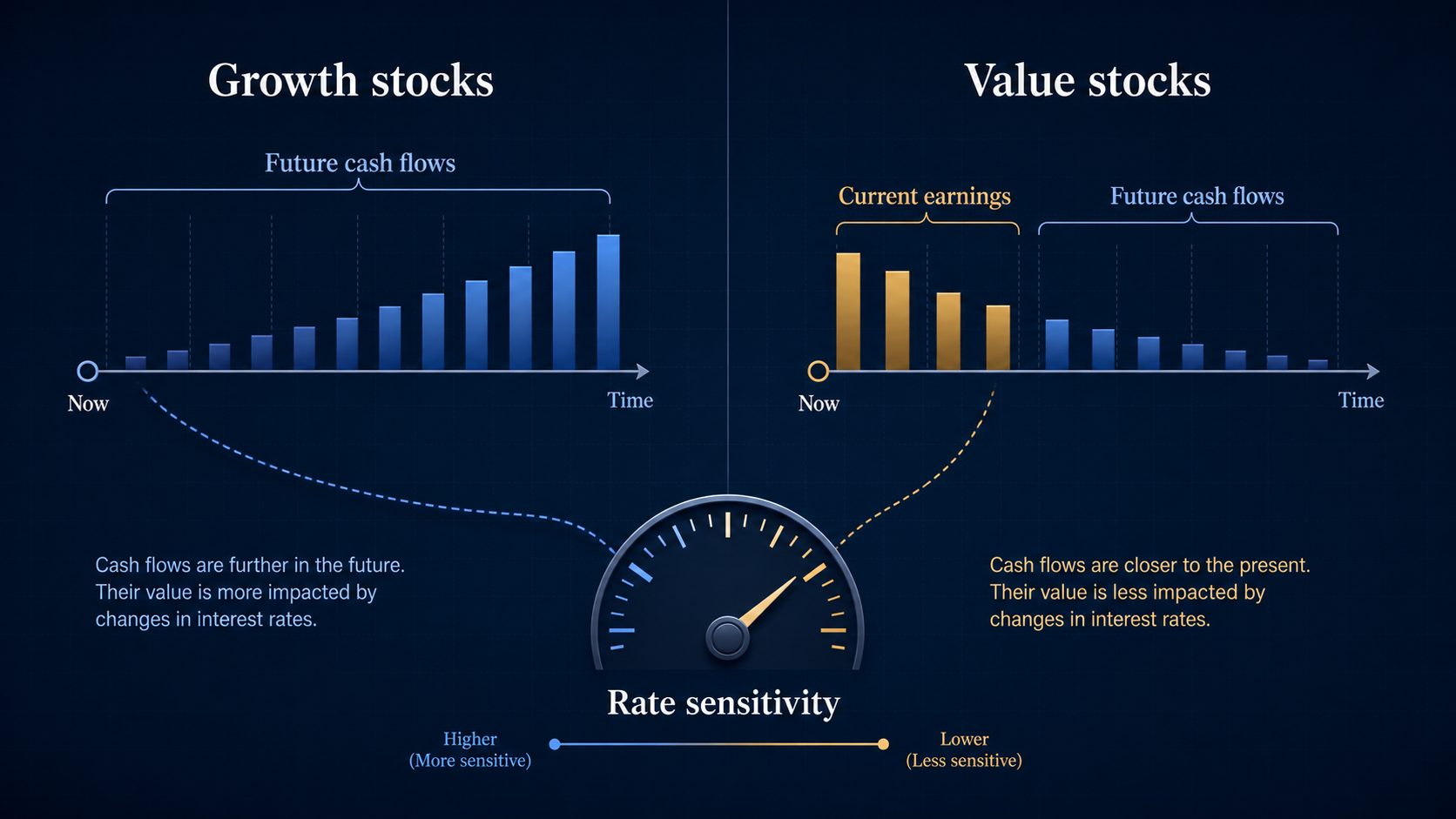
That does not mean growth always loses when rates rise or value always wins. Exceptional earnings can overcome valuation pressure, and a weak economy can hurt cyclical value companies. The relationship between interest rates and stocks depends partly on when investors expect the business to generate cash.
4. Financial Stocks Face a Two-Sided Tradeoff
Banks can earn more when the spread between the interest received on loans and the interest paid on deposits widens. But high rates can also weaken loan demand, increase funding costs, and lead to more defaults. A simple “higher rates equal better bank profits” rule is unreliable.
Insurers, brokers, and asset managers have different exposures. Insurers may reinvest at higher yields, while asset managers can suffer if falling markets reduce assets under management. Investors should study the company’s actual revenue sources rather than treating the financial sector as one trade.
This is another reason interest rates and stocks cannot be reduced to one simple sector rule.
5. Bonds and Cash Become Stronger—or Weaker—Competitors
When Treasury bills, savings accounts, and high-quality bonds offer higher yields, investors can earn more without accepting full stock-market risk. That can reduce the price investors are willing to pay for stocks, particularly slow-growing dividend shares purchased mainly for income.
When short-term rates fall, yields on cash-like investments often decline. Some investors then move toward bonds or stocks in search of return. Compare the roles carefully: a Treasury bill, a money market fund, and a stock fund solve different portfolio problems.
The relative appeal of interest rates and stocks therefore changes with both available yields and each investor’s tolerance for risk.
6. Rate-Sensitive Sectors Can Move Unevenly
Real estate companies may benefit from cheaper financing but can still struggle with vacancies or weak property demand. Utilities often carry substantial debt and may look more attractive when bond yields fall, yet regulation and capital spending also matter. Consumer discretionary companies can gain from easier credit, but only if households remain willing and able to spend.
Technology is not automatically the most rate-sensitive sector, and every dividend stock is not a bond substitute. Balance-sheet strength, pricing power, growth quality, and valuation can matter more than broad sector stereotypes. This complexity is central to understanding interest rates and stocks.
7. The Reason for a Rate Cut Can Change Everything
Investors often assume a Fed rate cut is automatically good for stocks. A cut made as inflation cools and growth remains resilient can reduce financing pressure without a major earnings collapse. A cut made because unemployment is rising and demand is deteriorating can coincide with lower corporate profits and falling share prices.
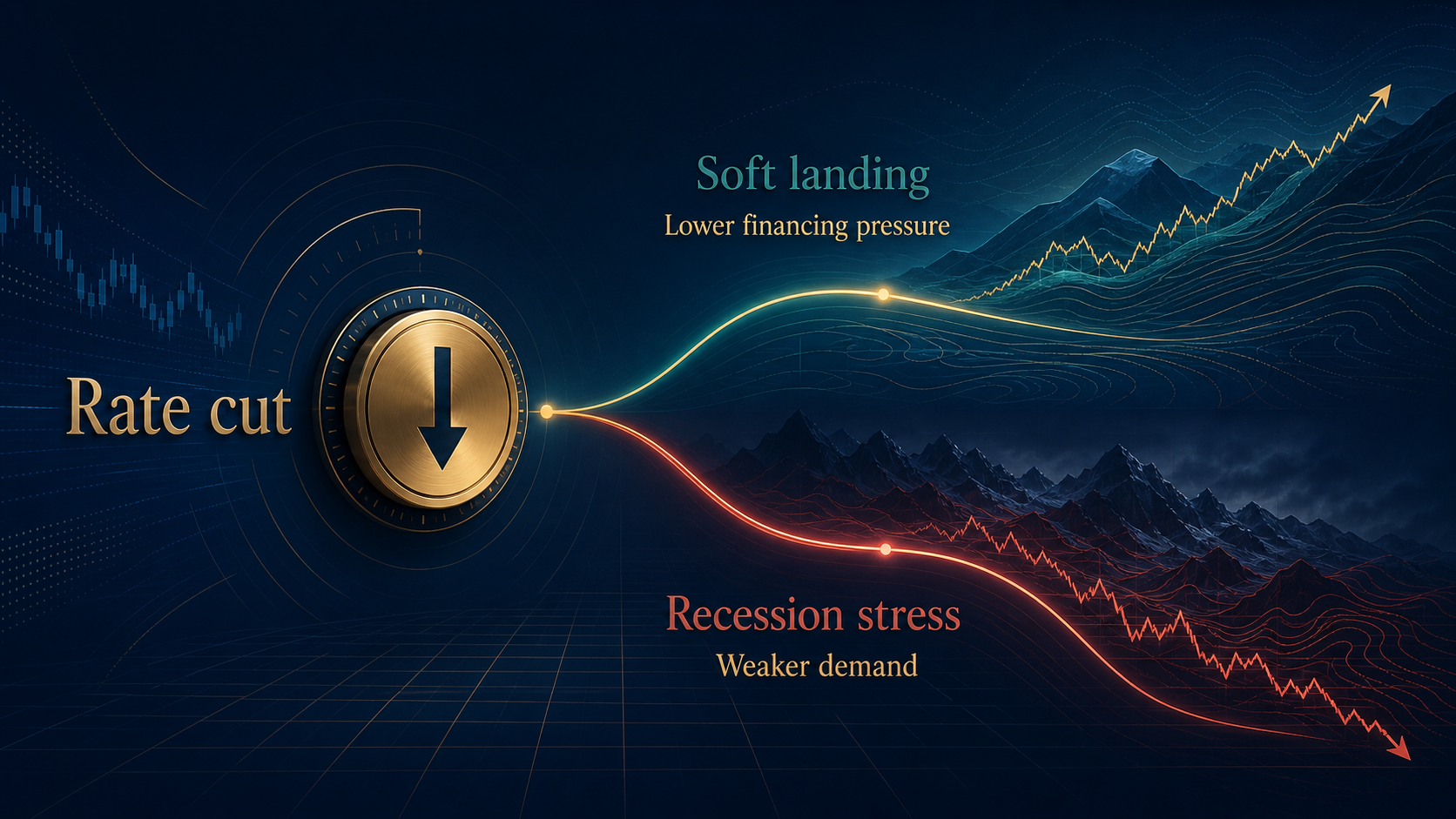
The stock market also moves before official decisions. If investors widely expect a cut, prices may already reflect it. The announcement can then produce little gain—or even a decline—if the Fed’s outlook disappoints. Always ask what the market expected and why policy is changing.
In practice, interest rates and stocks often react to expectations months before a policy decision becomes official.
What Higher Interest Rates Usually Mean for Investors
Higher rates generally create a tougher valuation environment, especially for expensive businesses with profits expected far in the future. Debt-heavy companies may face rising interest expense, and consumers may reduce purchases financed with credit. At the same time, strong economic growth can support earnings even while rates remain elevated.
That mixed outcome explains why interest rates and stocks can rise together when stronger growth supports company earnings.
For diversified investors, higher yields can restore the portfolio role of fixed income. Bond prices and rates normally move in opposite directions, which GSV explains in its guide to bond duration. New bond purchases may offer more income, even if existing long-duration holdings experience price pressure.
Cash can also become more productive, but holding too much for too long introduces inflation and opportunity-cost risks. A high-yield savings account is useful for emergency funds and short-term goals, not necessarily as a permanent substitute for a long-term investment plan.
What Lower Interest Rates Usually Mean for Investors
Lower rates can support valuations, reduce refinancing costs, and make cash yields less competitive. Rate-sensitive assets may respond quickly, while the effect on actual corporate profits can take longer. Investors often focus on growth stocks, real estate, and dividend-paying shares, but leadership varies across cycles.
The connection between interest rates and stocks is most favorable when inflation cools without a sharp deterioration in earnings.
The danger is chasing whatever rallied immediately after an announcement. Markets continuously price future expectations, so a widely anticipated cut may already be reflected in prices. A diversified allocation reduces the need to identify the single winning sector.
Investors should also distinguish short-term Fed policy from long-term Treasury yields. Mortgage rates and stock valuations can remain under pressure if long-term yields rise because inflation expectations or government borrowing increases, even when the Fed cuts its overnight target.
How Long-Term Investors Can Respond
First, review debt exposure rather than making a broad market prediction. Companies with durable cash flow and manageable refinancing needs may be better positioned for multiple rate paths. A diversified fund can reduce the damage from being wrong about one company or sector.
A practical interest rates and stocks strategy begins with balance-sheet quality, diversification, and a time horizon—not a one-meeting forecast.
Second, connect risk to your time horizon. Money needed soon should not depend on a stock-market reaction to the next Fed meeting. GSV’s guide to asset allocation explains how stocks, bonds, and cash can serve different jobs.
Third, rebalance instead of reacting emotionally. Large rate-driven market moves can push a portfolio away from its target. Portfolio rebalancing offers a rules-based way to restore risk without betting everything on one forecast.
Finally, remember that understanding interest rates and stocks does not make rate timing reliable. Diversification, reasonable valuations, low costs, and consistent contributions remain useful in every policy regime.
Official Sources
- Federal Reserve: June 17, 2026 FOMC Statement
- Federal Reserve: Monetary Policy Explained
- Investor.gov: Bonds and Interest Rates
Higher and Lower Rates: A Stock Investor’s Checklist
| Factor | When Rates Rise | When Rates Fall |
|---|---|---|
| Borrowing costs | New or floating-rate debt may become more expensive | Refinancing and new borrowing may become cheaper |
| Valuation | Higher discount rates can pressure present values | Lower discount rates can support present values |
| Cash and bonds | Yields may become more competitive with stocks | Cash yields may become less competitive |
| Economic signal | May reflect inflation or strong demand | May reflect cooling inflation or economic stress |
These are tendencies, not guarantees. The reason rates move, the company’s debt and cash flow, and what investors already expected can matter more than the direction alone.
Final Thoughts
Interest rates and stocks move through borrowing costs, consumer demand, corporate profits, valuation math, and competition from safer assets. But no single rule predicts the market because expectations and economic conditions change the outcome.
Watch the reason rates are moving, the financial strength of the companies you own, and the role each asset plays in your plan. That approach is more durable than rebuilding a portfolio around every Fed headline.
Frequently Asked Questions
Do stocks always fall when interest rates rise?
No. Higher rates can pressure valuations and profits, but stocks may still rise when economic growth and earnings are strong or when the increase was already expected.
Do stocks always rise after a Fed rate cut?
No. Stocks may benefit from lower financing costs, but cuts associated with recession risk can arrive alongside weaker demand and falling earnings.
Which stocks are most sensitive to interest rates?
Highly valued growth companies, debt-heavy businesses, real estate firms, utilities, and some financial companies can be sensitive, but balance sheets and business conditions matter more than labels alone.
Does the Fed control mortgage rates and Treasury yields?
Not directly. The Fed targets an overnight bank rate. Longer-term rates also reflect inflation expectations, growth, credit risk, market demand, and Treasury supply.
Continue Learning
Ready for the next step? Explore these related investing guides.
Educational disclaimer: This article is for general educational purposes only and is not financial advice. Investments can lose value. Consider your objectives, time horizon, financial situation, and risk tolerance before making investment decisions.