

Treasury yields influence far more than government bonds. They help set the hurdle rate for stocks, mortgages, corporate borrowing, and nearly every other financial asset. When yields move sharply, markets often reprice before the economic headlines catch up.
That is why investors watch the 2-year and 10-year Treasury rates so closely. The first is highly sensitive to expectations for Federal Reserve policy, while the second also reflects long-run inflation, growth, bond supply, and the extra compensation investors demand for holding long maturities.
Key Takeaways
- Treasury yields are market-based returns on U.S. government debt, not rates set directly by the Federal Reserve.
- Bond prices and yields move in opposite directions.
- Short maturities respond strongly to expected Fed policy; long maturities also absorb inflation, supply, demand, and term-premium risk.
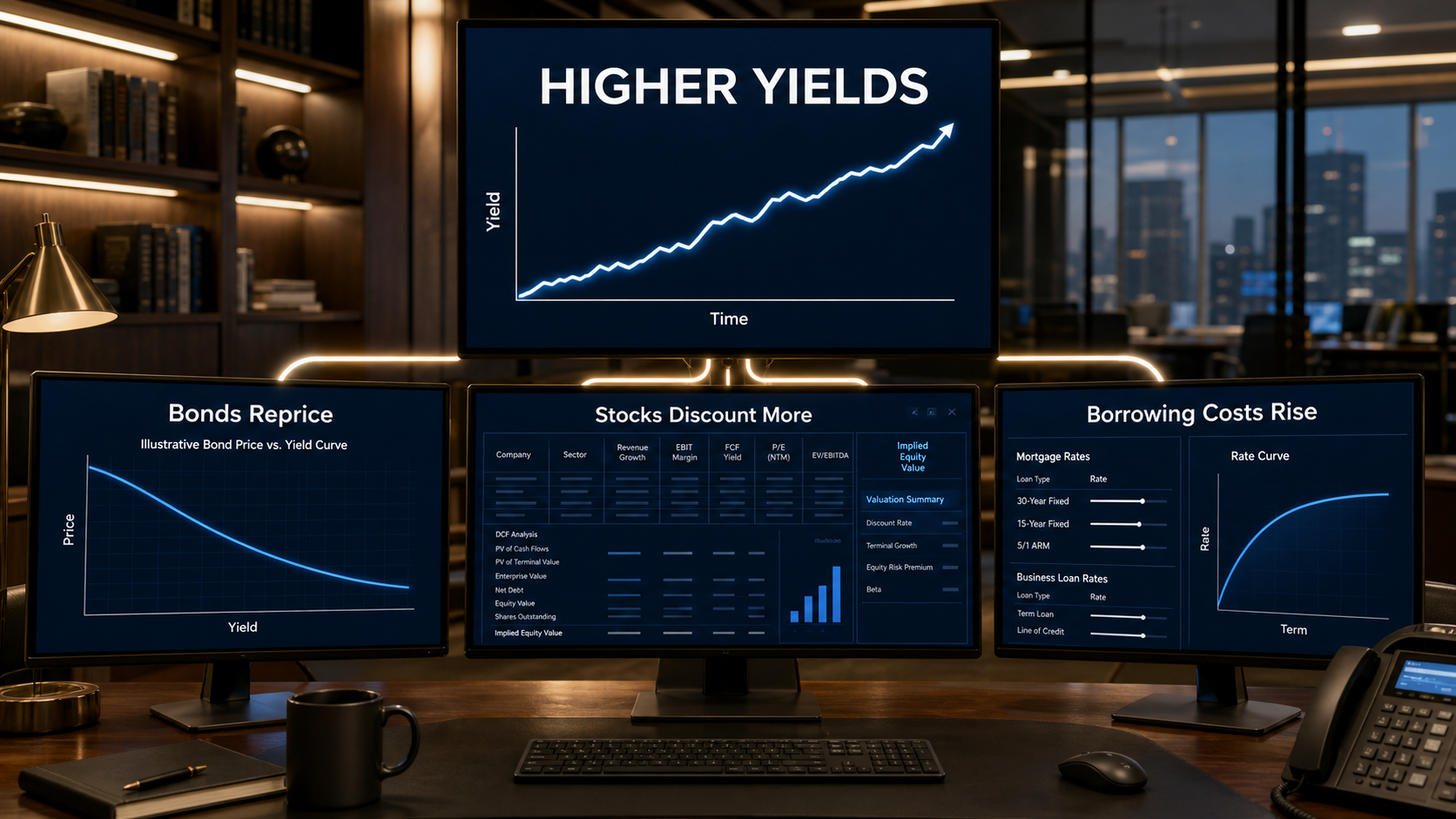
- Higher yields can pressure existing bonds, reduce stock valuations, and raise borrowing costs.
- The level, direction, and shape of the yield curve matter more than one isolated daily move.
What Are Treasury Yields?
The U.S. Treasury finances the federal government by issuing bills, notes, and bonds. Bills mature in one year or less, notes generally span two to ten years, and bonds extend to 20 or 30 years. GSV’s Treasury bill guide explains the short end, while What Is a Bond? covers the basic contract.
A bond’s coupon is the scheduled interest payment. Its yield is the return implied by the price an investor pays and the cash flows the bond promises. A newly issued security may begin near its stated rate, but once it trades, its market price changes continuously.
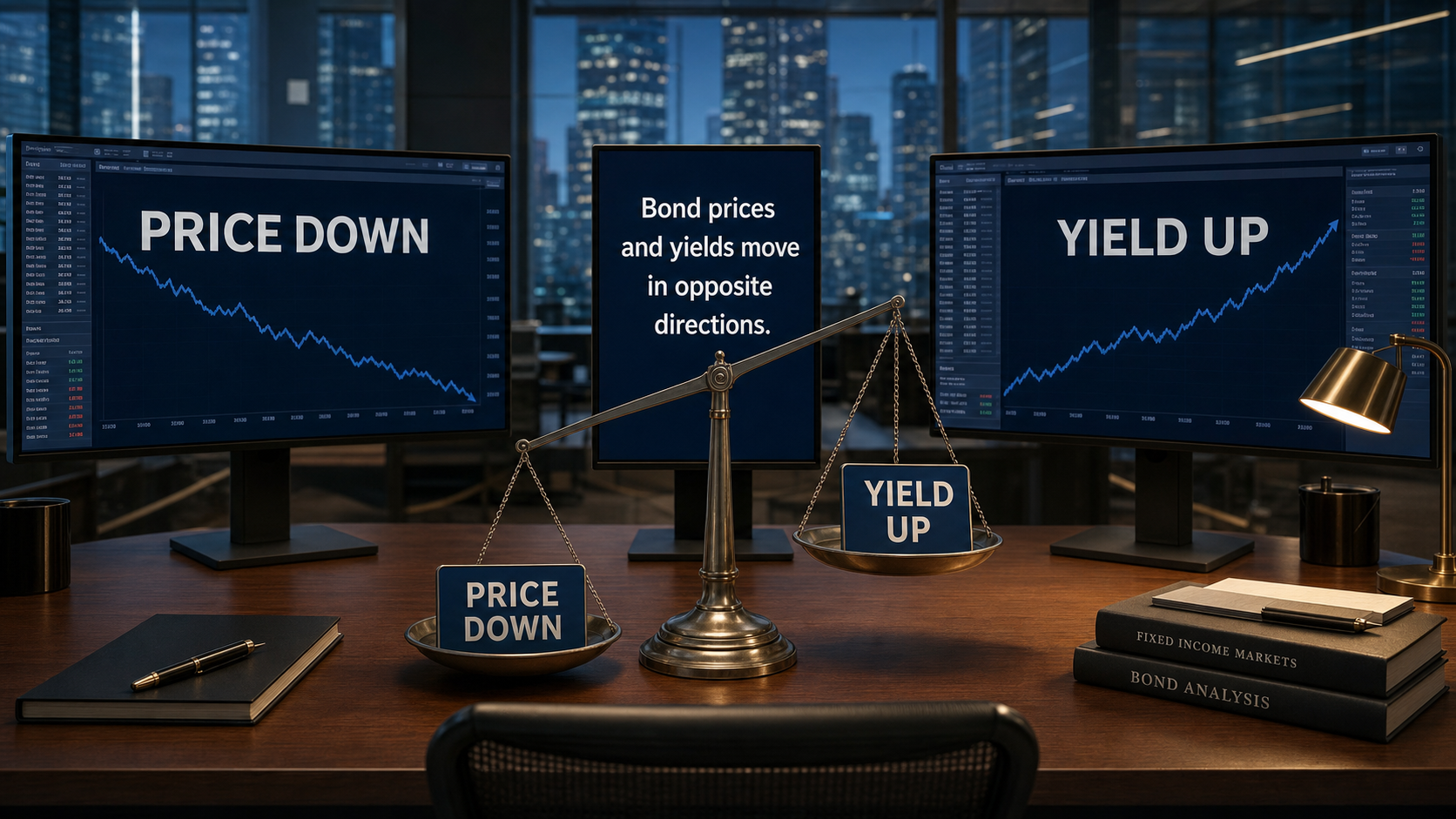
If comparable new bonds offer more income, an older low-coupon bond becomes less attractive. Its price must fall until its return competes. If market rates decline, the older coupon becomes more valuable and its price can rise. This inverse relationship is the first principle for understanding Treasury yields.
The U.S. Treasury publishes a daily par yield curve based on market inputs across standard maturities. It is a reference curve, not a promise that every investor can transact at one displayed rate. Bid-ask spreads, timing, taxes, and the specific security still affect realized returns.
Why Treasury Yields Move
No single person controls Treasury yields. Buyers and sellers reprice government securities as their expectations change. Four forces explain much of the movement.
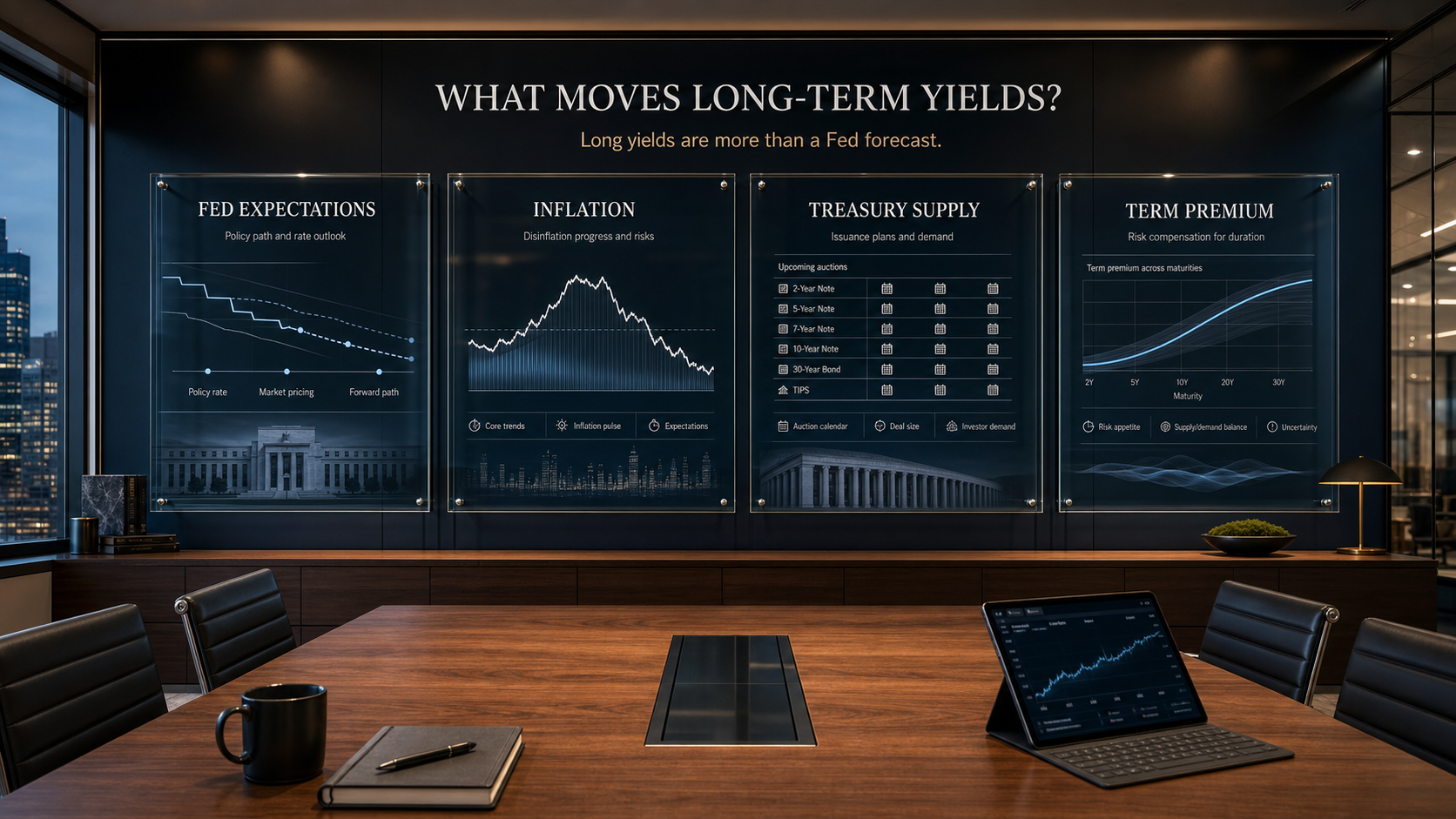
1. Expected Federal Reserve Policy
The federal funds target influences overnight money, and investors estimate where that policy rate may go next. Strong economic data or persistent inflation can push expected rate cuts further away. Weak growth or falling inflation can do the opposite. Short-dated Treasuries usually react most directly.
2. Inflation Expectations
Future dollars buy less when inflation is high. Investors therefore tend to demand more nominal yield as compensation. The Consumer Price Index is one important input, but markets also examine wages, energy, rents, surveys, and inflation-protected securities.
3. Treasury Supply and Investor Demand
Deficits must be financed. When the market expects more issuance, investors may require a higher yield to absorb it, especially if demand is uncertain. Banks, pension funds, insurers, foreign reserve managers, mutual funds, and households all influence the auction and secondary markets.
4. The Term Premium
The term premium is the extra compensation investors may require for locking money into a long bond instead of repeatedly holding short securities. It can rise when inflation uncertainty, debt supply, or interest-rate volatility increases. Federal Reserve researchers estimate it with models because it is not directly observable.
These forces can pull in opposite directions. Markets may expect future Fed cuts while the 10-year yield rises because supply concerns or the term premium increase. That is why saying “yields rose because of the Fed” is often incomplete.
Why the 2-Year and 10-Year Yields Matter
The 2-year Treasury is often treated as a market referendum on the likely policy path over the next several meetings. It can move before the Fed acts because traders continuously update expectations from inflation, employment, and growth data.
The 10-year Treasury is a broader benchmark. It combines expected future short rates with longer-run inflation, real growth, and the term premium. Mortgages and many corporate borrowing rates do not copy the 10-year rate exactly, but they often use it as a foundation plus an additional spread.
The difference between maturities forms the yield curve. A normal upward slope usually pays more for longer commitments. An inverted curve places some short rates above long rates and can reflect tight current policy plus expectations for slower growth or eventual easing. It is a signal, not a countdown clock.
Investors should distinguish nominal yields from real yields. A nominal return includes expected inflation; a real yield aims to measure return after inflation. Stocks and other long-duration assets can be especially sensitive when real yields rise because the discount rate increases without an offsetting inflation explanation.
How Treasury Yields Affect Markets
Existing Bonds Reprice
When Treasury yields rise, prices of existing fixed-rate bonds generally fall. The sensitivity depends on maturity, coupon, and cash-flow timing. GSV’s bond duration guide explains why a longer-duration portfolio usually moves more for the same rate change. A bond ETF does not escape this arithmetic simply because it trades like a stock.
Stock Valuations Face a Higher Hurdle
Valuation models discount future cash flows back to today. A higher risk-free rate can reduce their present value and make safe bonds more competitive with equities. Companies whose expected profits sit far in the future may be especially rate-sensitive. The effect is explained in more detail in Interest Rates and Stocks.
Higher yields do not guarantee falling stocks. Yields can rise because growth expectations improve, which may support earnings. The market outcome depends on why rates moved, how valuations started, and whether profit expectations change at the same time.
Borrowing Costs Can Rise
Mortgage, auto, business, and corporate rates typically equal a benchmark plus compensation for credit, liquidity, and other risks. If the benchmark rises while spreads stay constant, the all-in borrowing cost rises. If credit spreads also widen, the increase can be larger; see GSV’s guide to credit spreads.
Cash Becomes More Competitive
Higher short-term yields can improve the income available from bills and cash-like products. That can reward savers, but it can also draw money away from riskier assets. Investors comparing options should examine maturity, liquidity, fees, and insurance or government backing rather than headline yield alone. A money market fund is not identical to a bank deposit.
How Investors Can Read Treasury Yields
Start with a small dashboard instead of trying to predict every tick.
- Level: Compare today’s 2-year and 10-year rates with their recent ranges.
- Direction: Determine whether the move is persistent or one volatile session.
- Curve: Compare short, intermediate, and long maturities rather than one point.
- Real yields: Ask how much of the move comes from inflation expectations versus real rates.
- Credit spreads: Check whether corporate risk compensation is moving with the Treasury benchmark.
- Catalyst: Identify the data release, auction, policy message, or positioning shift associated with the move.
Then connect the signal to your holdings. A long-duration bond fund, highly valued growth stock, floating-rate loan, and short Treasury bill have very different exposures. The useful question is not “Where will yields go tomorrow?” but “What happens to my plan if rates remain higher or fall more slowly than expected?”
Official data should be the starting point. The Treasury’s daily curve provides the benchmark, while the Federal Reserve publishes policy statements, economic projections, and research on term premiums. Financial commentary can add interpretation, but it should not replace the source.
Common Treasury Yield Mistakes
- Confusing the Fed rate with the 10-year yield. The Fed targets an overnight rate; long yields are market prices.
- Assuming rising yields are always bearish. Growth-driven and inflation-driven increases can have different effects.
- Ignoring bond duration. Two funds with similar yields can have very different price risk.
- Reading inversion as a precise timer. The curve can remain unusual for a long period.
- Chasing the highest displayed yield. Credit risk, call features, liquidity, taxes, and fees still matter.
- Reacting to one daily move. Auctions, positioning, and thin liquidity can create noise.
Official Sources
- U.S. Treasury: Daily Treasury Par Yield Curve Rates
- Federal Reserve: Treasury Yield and Term Premium Models
- Federal Reserve: The Causal Effect of Debt on Interest Rates
How Different Treasury Yields Are Used
| Yield Area | Often Reflects | Common Investor Use |
|---|---|---|
| Short-term Treasury yields | Federal Reserve policy expectations and near-term cash conditions | Comparing Treasury bills with savings and money market options |
| Intermediate yields | Expected policy, inflation, growth, and term risk over several years | Evaluating medium-term bond risk and portfolio income |
| Long-term Treasury yields | Long-run inflation, growth, fiscal supply, and term-premium expectations | Assessing long-duration bonds and discount-rate pressure on assets |
The maturity buckets are descriptive rather than forecasts. A yield at any maturity can move for several reasons at once, so investors should avoid treating one change as proof of a single economic outcome.
Final Thoughts
Treasury yields are the market’s continuously updated price for time, inflation, policy expectations, and uncertainty. They matter because almost every asset must compete with the return available from government debt.
Watch the level, direction, curve, and reason for the move. Then translate those signals into duration, valuation, borrowing-cost, and portfolio effects. That framework is more durable than trying to trade every headline.
Frequently Asked Questions
Who sets Treasury yields?
Market trading and Treasury auctions determine them. The Federal Reserve strongly influences short-term expectations but does not directly set every maturity.
Why do bond prices fall when yields rise?
New bonds offer more competitive income, so older lower-coupon bonds generally must trade at lower prices to offer comparable returns.
Which Treasury yield matters most for stocks?
There is no universal answer. The 10-year and real yields are common valuation references, while the 2-year helps reveal expected policy. The reason for the move matters as much as the maturity.
Are higher Treasury yields good or bad?
They can improve income for new bond buyers and savers, while reducing existing bond prices and raising financing or valuation hurdles. The net effect depends on the investor and the cause of the move.
Continue Learning
Use these guides to connect rates with portfolio risk.
- What Is the Yield Curve?
- Inflation and Interest Rates Explained
- What Is Diversification?
Educational disclaimer: This article is for general educational purposes only and is not personalized financial, tax, or legal advice. Bond prices and yields can change, and investments may lose value. Consider your objectives, time horizon, liquidity needs, and risk tolerance.