
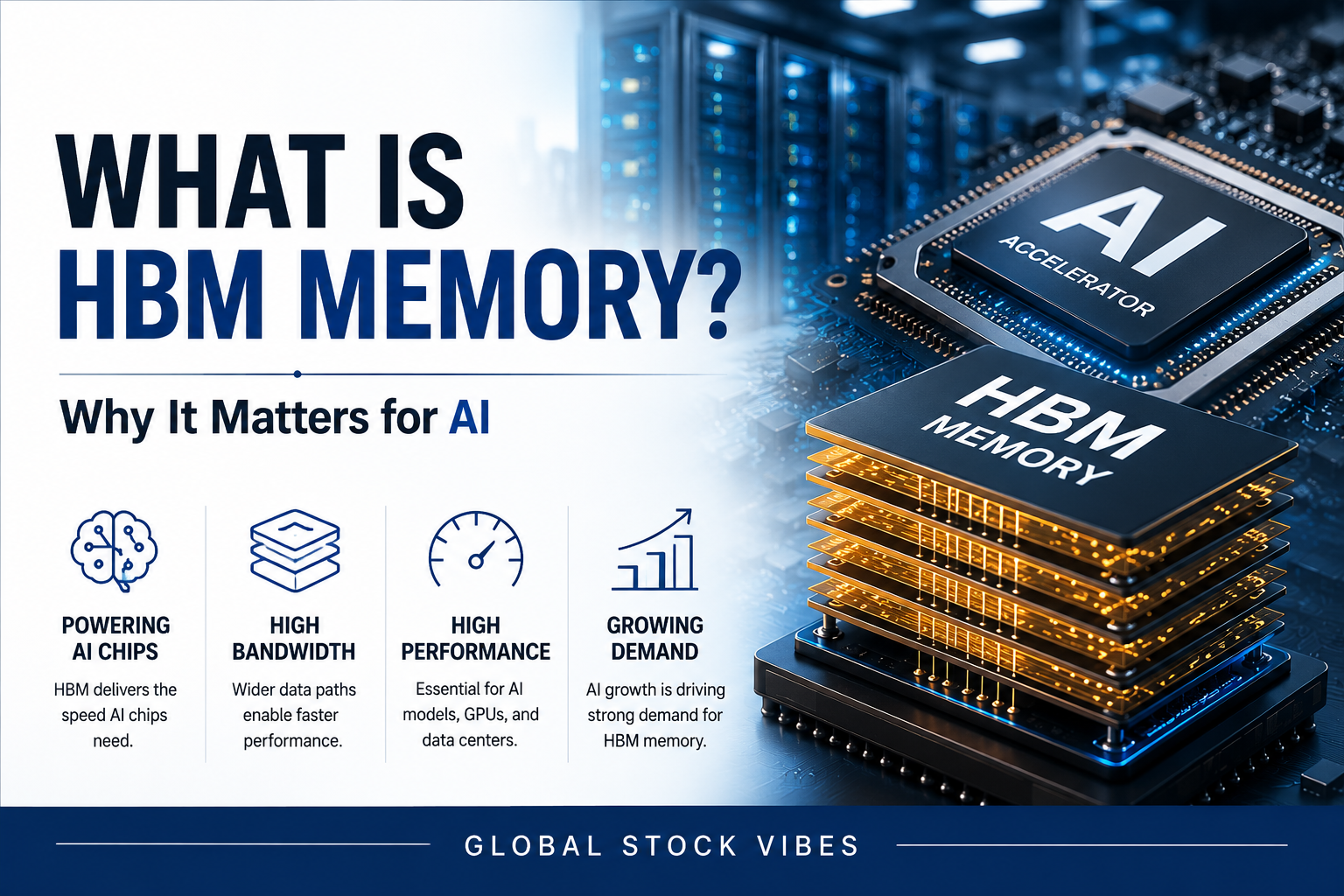
What is HBM memory? High bandwidth memory is a specialized memory technology designed to move data quickly for demanding AI workloads.
What Is HBM Memory? Why It Matters for AI Chips
If you follow artificial intelligence stocks, you have probably seen the term HBM memory appear again and again. Nvidia, AMD, SK Hynix, Samsung, and Micron are all connected to the AI chip boom, but many beginner investors still do not understand the memory side of the story. So, what is HBM memory, and why does it matter so much for AI chips?
HBM stands for high-bandwidth memory. It is a specialized type of memory designed to move huge amounts of data very quickly. That makes it especially important for artificial intelligence, data centers, supercomputing, and advanced graphics processors. In simple terms, AI chips need fast memory because they process enormous amounts of data. HBM helps reduce the bottleneck between memory and processors. To see where memory fits beside power, cooling, networking, and cloud services, continue with GSV’s AI data center investment guide.
Educational Disclaimer: This article is for educational purposes only and is not personal financial advice. Semiconductor stocks can be volatile, and all investments involve risk, including the possible loss of principal.
Key Takeaways
- HBM stands for high-bandwidth memory.
- HBM is used in AI chips because it can move large amounts of data quickly.
- AI accelerators need both computing power and memory bandwidth.
- SK Hynix, Samsung, and Micron are major companies connected to the HBM market.
- HBM demand can benefit semiconductor stocks, but it also carries supply, pricing, and valuation risks.
What Is HBM Memory?
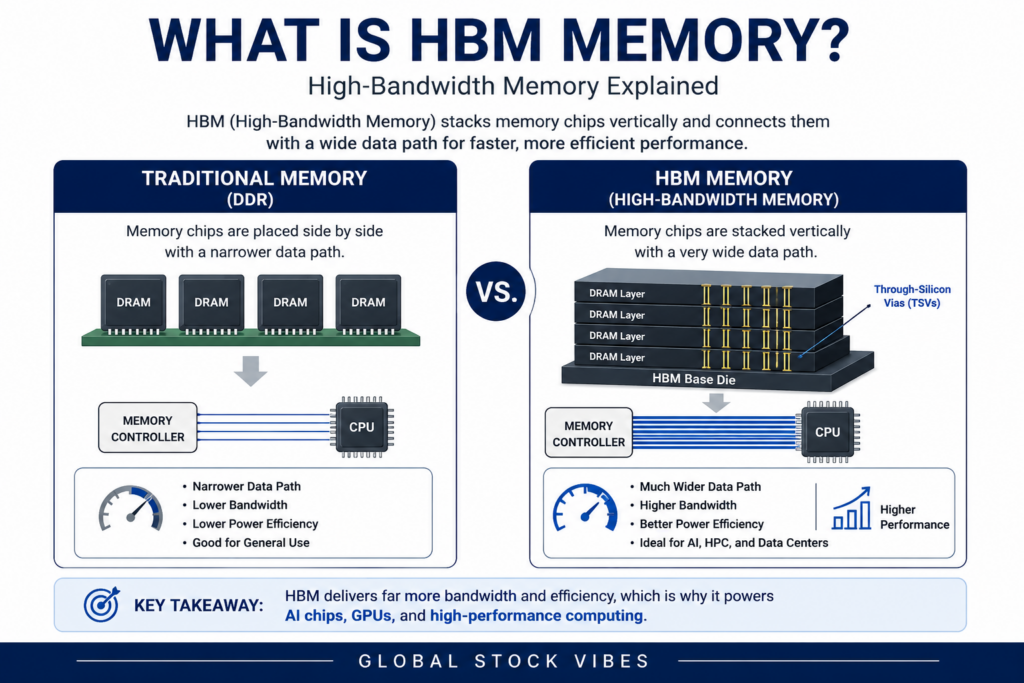
HBM memory is a type of advanced memory chip that stacks memory layers vertically instead of spreading them out in a traditional flat layout. These stacked layers are connected through advanced packaging technology, allowing data to move across a very wide path.
The main benefit is bandwidth. Bandwidth means how much data can move between memory and a processor within a certain amount of time. A wider data path allows more information to move at once. For AI workloads, this is extremely important because large models must constantly access, move, and process huge amounts of data.
This is why the question what is HBM memory has become important for investors. HBM is not just a technical detail. It is one of the key components that allows high-performance AI chips to work efficiently.
Why AI Chips Need HBM Memory
AI chips are built to perform massive calculations. But computing power alone is not enough. If the processor cannot access data quickly, performance suffers. This is often called a memory bottleneck.
Imagine a very fast factory that can produce thousands of products per hour. If the supply trucks arrive slowly, the factory cannot run at full speed. AI chips face a similar problem. The processor may be extremely powerful, but it still needs fast memory to feed it data.
HBM helps solve this problem by placing high-speed memory close to the processor and allowing much faster data movement. This is why HBM is commonly associated with AI accelerators, graphics processing units, high-performance computing, and data center hardware.
HBM Memory vs Traditional Memory
Traditional memory is still widely used in computers, servers, and consumer devices. It is not going away. But HBM is designed for a different purpose. It is optimized for performance, bandwidth, and efficiency in demanding computing environments.
| Category | Traditional Memory | HBM Memory |
|---|---|---|
| Layout | Usually spread across a board | Stacked vertically |
| Main Goal | General memory use | High bandwidth for intensive workloads |
| Common Use | PCs, servers, consumer electronics | AI chips, GPUs, supercomputing |
| Cost | Generally lower | Generally higher |
| Investor Relevance | Broad memory market | AI memory growth market |
The important point is not that HBM replaces all other memory. Instead, HBM serves a premium market where performance matters more than ordinary cost efficiency. That makes it valuable, but also more technically difficult to manufacture.
Which Companies Make HBM Memory?
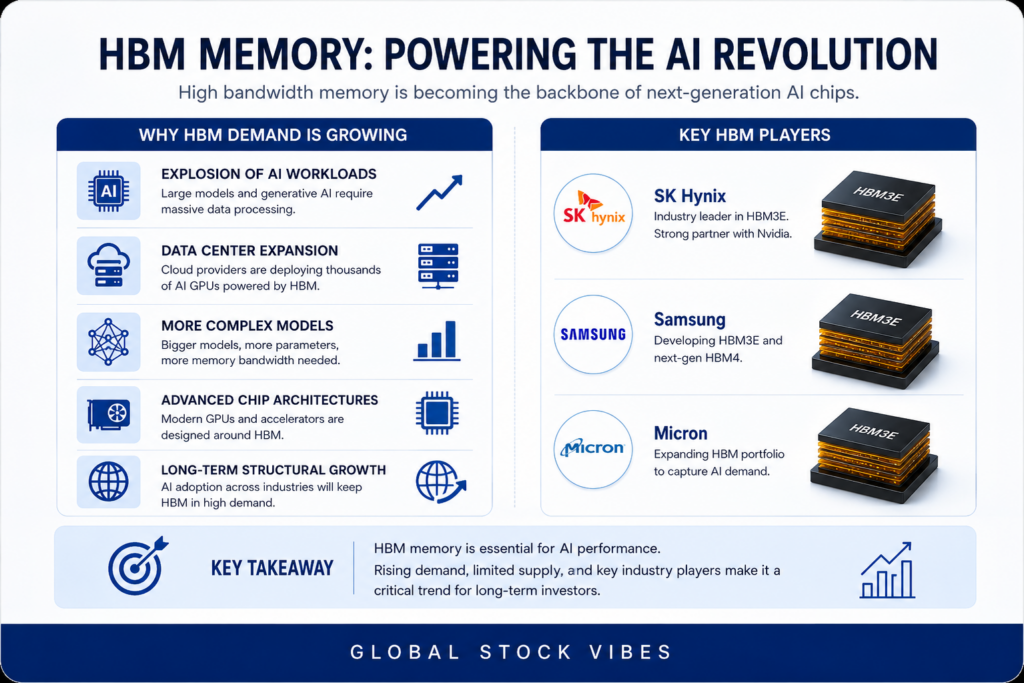
The most important HBM companies include SK Hynix, Samsung Electronics, and Micron. These companies are major memory manufacturers, and each is trying to benefit from rising AI demand.
SK Hynix is widely associated with HBM leadership because it invested early and became a key supplier in the AI memory market. Samsung has enormous manufacturing scale and is working to improve its advanced HBM position. Micron is also competing in HBM and promotes high-bandwidth memory for AI and supercomputing workloads.
For U.S. investors, HBM also matters because it is connected to companies like Nvidia and AMD. These companies design AI accelerators, but those accelerators need advanced memory to perform well. That means the AI chip story is not only about processors. It is also about memory, packaging, geopolitical supply chain riskss, and manufacturing capacity.
Why HBM Memory Matters for Investors
HBM memory matters for investors because it sits at the center of the AI infrastructure boom. If demand for AI data centers continues to grow, demand for high-performance memory may also remain strong. That can support revenue growth for companies that successfully produce advanced HBM products.
However, investors should avoid thinking of HBM as a guaranteed profit machine. Semiconductor markets are cyclical. Strong demand can lead to aggressive capacity expansion. If too much supply enters the market, pricing can weaken. This has happened many times in memory chip history.
A useful way to think about HBM is this: it is a powerful growth driver, but it does not remove investment risk. Investors still need to consider valuation, supply growth, customer concentration, margins, and the possibility that AI spending may slow.
Risks of Investing in HBM-Related Stocks
The first risk is the memory cycle. Memory prices can rise quickly when supply is tight, but they can also fall sharply when supply increases or demand weakens. HBM is more specialized than ordinary memory, but it is still part of the semiconductor industry.
The second risk is customer concentration. HBM suppliers depend on a relatively small number of large AI chip and data center customers. If one major customer changes orders, delays production, or shifts suppliers, earnings expectations can change quickly.
The third risk is valuation. When investors become excited about AI, stock prices may rise faster than earnings. A strong company can still become a risky investment if the market price already assumes perfect growth.
The fourth risk is execution. HBM is technically difficult to produce. Manufacturing yield, packaging quality, heat management, and customer qualification all matter. A company that announces a new product still needs to prove it can deliver that product reliably at scale.
How Beginners Should Think About HBM Memory
Beginner investors should treat HBM memory as an important theme, not as a reason to buy any stock blindly. The technology is real, and AI demand is meaningful. But the stock market often prices future expectations before profits fully appear.
A conservative approach is to understand the full value chain. AI chips need processors, memory, packaging, networking, power, cooling, and data center infrastructure. HBM is one critical piece of that chain, but it is not the only piece.
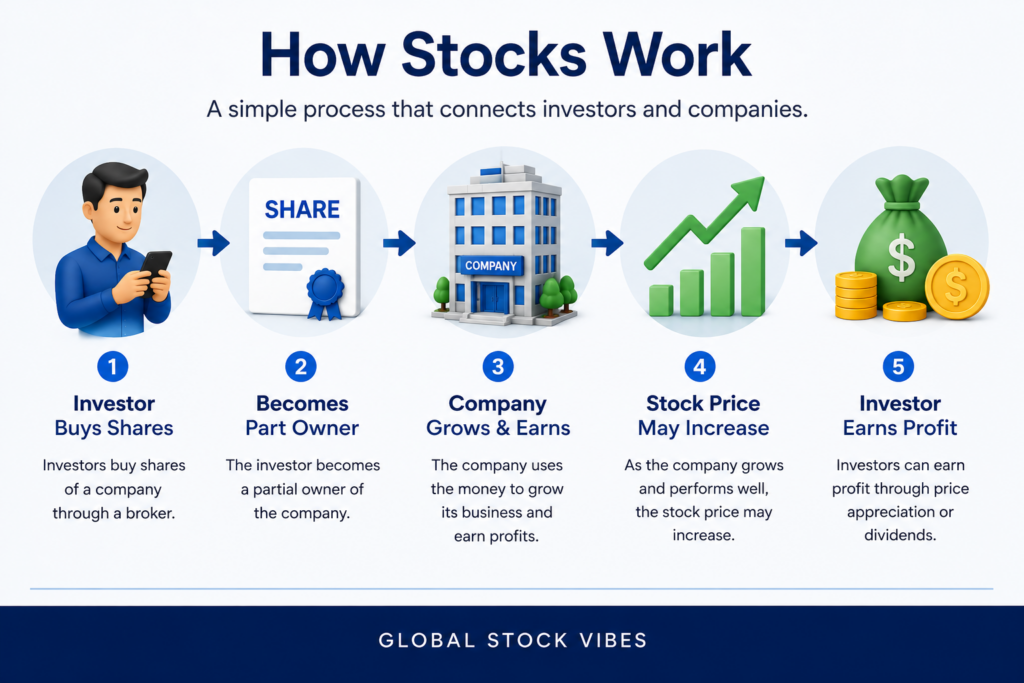
If you are still learning investment basics, start with our guide on what a stock is and how stocks work. If you prefer diversified index fund and ETF investing instead of choosing individual semiconductor companies, read our article on what an ETF is and how it works. You may also want to review ETF expense ratios before choosing funds that hold semiconductor stocks.
Frequently Asked Questions
What is HBM memory in simple terms?
HBM memory is a high-speed memory technology that stacks memory chips vertically and allows large amounts of data to move quickly. It is commonly used in AI chips, GPUs, and high-performance computing.
Why does Nvidia need HBM memory?
Nvidia AI chips process massive workloads. HBM memory helps those chips access data quickly, which can improve performance for AI training, inference, and data center applications.
Who makes HBM memory?
Major HBM memory makers include SK Hynix, Samsung Electronics, and Micron. These companies compete to supply advanced memory for AI chips and high-performance computing systems. Understanding what is HBM memory also helps investors see why these companies play an important role in the AI semiconductor industry.
Is HBM memory only used for AI?
No. HBM is also used in high-performance computing, advanced graphics, and data-intensive workloads. However, AI has become one of the most important demand drivers for HBM.
Are HBM stocks safe investments?
No stock is completely safe. HBM-related companies may benefit from AI demand, but they still face semiconductor cycles, valuation risk, competition, customer concentration, and supply-demand changes.
Final Thoughts
Understanding what is HBM memory helps investors see the AI chip boom more clearly. AI is not only about processors from companies like Nvidia and AMD. It also depends on fast memory, advanced packaging, and reliable semiconductor supply chains.
What is HBM memory? It is one of the most important technologies behind modern AI hardware and a key technology powering today’s AI infrastructure. It can create opportunities for memory makers such as SK Hynix, Samsung, and Micron. However, investors should stay disciplined. Strong technology does not eliminate investment risk. Understanding what is HBM memory can help investors better evaluate AI semiconductor companies, compare opportunities more effectively, and make informed long-term investment decisions.