
Geopolitical risks explained simply means understanding how political events can affect markets, companies, currencies, and investor behavior. Geopolitical risks can affect stock prices, supply chains, inflation and interest rates, and investor confidence. When wars, trade disputes, sanctions, or political tensions disrupt global capital flows, companies often face higher costs and slower growth. For long-term dollar-cost averaging investors, understanding geopolitical risks is not about predicting every crisis. It is about knowing how these events can affect portfolios and business fundamentals.
This guide explains geopolitical risks in plain English. We will look at how global conflicts affect the stock market, why supply chains matter, which industries are most exposed, and how investors can think about risk without making emotional decisions.
Educational Disclaimer: This article is for educational purposes only and is not personal financial advice. Investing involves risk, including the possible loss of principal.
Key Takeaways
- Geopolitical risks include wars, sanctions, trade disputes, political instability, and supply chain disruptions.
- These risks can affect stocks by raising costs, slowing growth, and reducing investor confidence.
- Energy, defense, technology, shipping, and semiconductor companies are often sensitive to global tensions.
- Long-term investors should avoid panic decisions and focus on diversification, valuation, and business quality.
- Geopolitical risks are not always short-term events. Some can reshape global supply chains for years.
Geopolitical Risks Explained: Key Takeaways
Geopolitical risks are risks that come from political conflict, government policy, military tension, trade restrictions, or instability between countries. These risks can affect markets because companies operate across borders. They buy materials from one region, manufacture products in another, and sell to customers around the world.
Examples of geopolitical risks include wars, shipping route disruptions, sanctions, export controls, tariffs, cyberattacks, and diplomatic conflicts. Even when a company is not directly involved in a conflict, it may still be affected through higher shipping costs, limited access to materials, or changes in customer demand.
For investors, the key point is simple: geopolitical risks can change the expected future profits of a company. If profits become less predictable, stock prices may become more volatile.
How Geopolitical Risks Affect the Stock Market
The stock market reacts to uncertainty. When investors are unsure about energy supply, trade rules, inflation, or global demand, they often become more cautious. This can lead to lower stock prices, higher volatility, and a shift toward safer assets.
Geopolitical risks can affect stocks in several ways. First, companies may face higher input costs. Second, shipping delays can reduce sales or raise expenses. Third, sanctions and export controls can limit access to important markets. Fourth, investors may demand a lower valuation because future earnings look less certain.
This does not mean every crisis causes a lasting market crash. Some events create short-term volatility and then fade. Others can permanently change supply chains, industry profits, or government policy. Investors should separate headline fear from real business impact.
How Supply Chains Are Disrupted
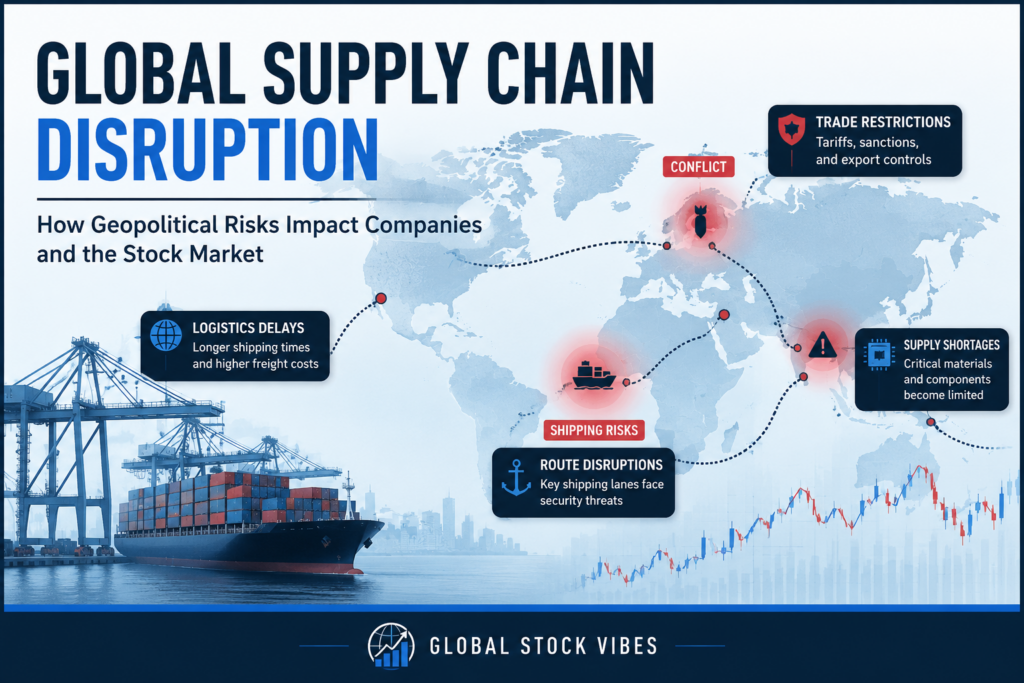
Global supply chains are highly connected. A smartphone, electric vehicle, or AI server may depend on chips, metals, chemicals, software, logistics, and assembly facilities from many different countries. When one part of the chain is disrupted, the effects can spread quickly.
For example, shipping route problems can increase freight costs. Export controls can restrict access to advanced chips or manufacturing equipment. Political tension can make companies move production to safer regions, a process often called reshoring or friend-shoring.
These changes can make companies more resilient over the long run, but they are not free. Building new factories, duplicating suppliers, and holding more inventory can raise costs. That is why geopolitical risks can pressure profit margins even when demand for a product remains strong.
Which Industries Are Most Affected?
Some industries are more sensitive to geopolitical risks than others. Energy companies can be affected by oil and gas supply disruptions. Defense companies may see higher demand when governments increase military spending. Shipping companies can be affected by route changes, port delays, and insurance costs.
Technology and semiconductor companies are also highly exposed. Advanced chips require complex global supply chains. Companies involved in AI chips, memory, foundry services, and semiconductor equipment may be affected by export controls, trade restrictions, and regional manufacturing policies.
This is why investors following AI and semiconductor stocks should pay attention to global risk. If you are learning about AI hardware, our article on what HBM memory is and why it matters for AI explains one important part of the semiconductor supply chain.
| Industry | Possible Impact |
|---|---|
| Energy | Oil and gas prices may rise during supply disruptions. |
| Defense | Government spending may increase during military tension. |
| Technology | Export controls and supply chain limits can affect growth. |
| Semiconductors | Chip production depends on global equipment, materials, and customers. |
| Shipping | Freight costs and delivery times may rise when routes are disrupted. |
How Investors Can Manage Geopolitical Risk
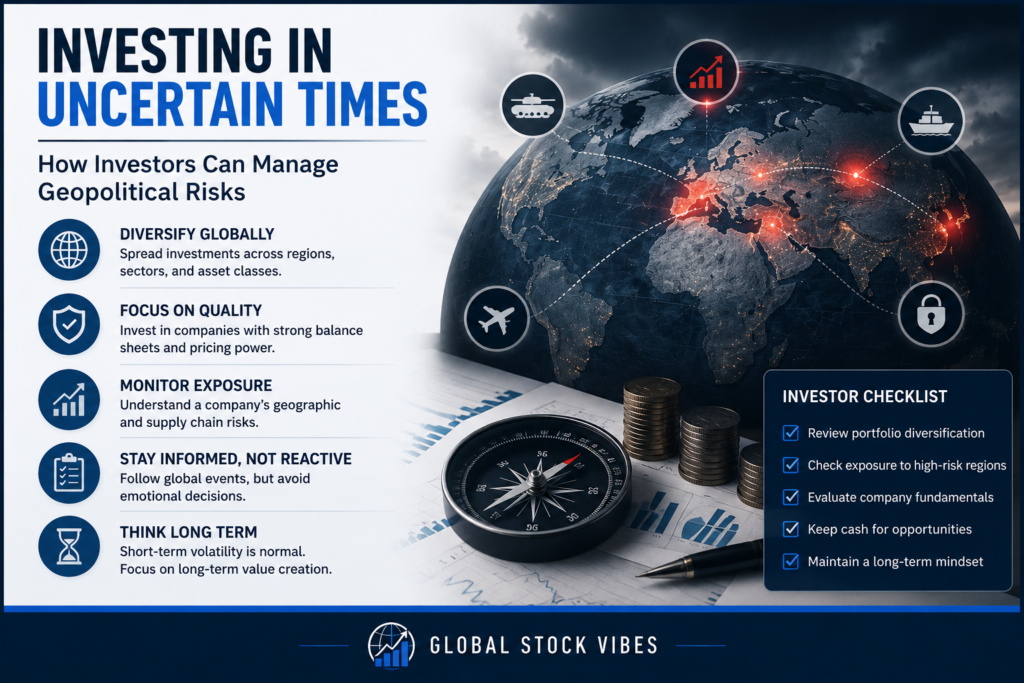
Investors cannot control geopolitical events. But they can control how much risk they take, how diversified their portfolio is, and whether they make decisions based on panic or analysis.
The first step is diversification. Owning only a few stocks can increase risk if one company is heavily exposed to a conflict region or supply chain disruption. Broad ETFs can help reduce company-specific risk by spreading exposure across many businesses.
The second step is understanding business exposure. A company with suppliers, factories, or customers concentrated in one high-risk region may face more uncertainty than a company with diversified operations. Investors should read company filings, earnings calls, and management commentary when available.
The third step is avoiding emotional trading. Selling every time global headlines become scary can damage long-term returns. At the same time, ignoring real risks is also dangerous. A disciplined investor should ask whether the event changes the company’s long-term earnings power, not just whether the news sounds alarming.
Why Long-Term Investors Should Care
Geopolitical risks are important because they can affect long-term investment returns. A short conflict may cause temporary market volatility. But trade fragmentation, sanctions, and supply chain relocation can influence corporate strategy for years.
Long-term investors should not try to predict every crisis. Instead, they should build portfolios that can survive uncertainty. That means focusing on quality businesses, reasonable valuations, diversified exposure, and a time horizon long enough to absorb market volatility.
If you are still learning the basics, start with our guide on what a stock is and how stocks work. If you prefer diversified investing, read our article on what an ETF is and how it works. For fund investors, our guide to ETF expense ratios explains how costs affect long-term returns.
How Geopolitical Risk Moves Through a Portfolio
Geopolitical risk usually reaches investors through a chain reaction. A conflict, sanction, election surprise, trade restriction, or shipping disruption can affect commodity prices, corporate costs, consumer confidence, currency values, and interest rate expectations. Markets then reprice companies based on the new uncertainty.
For example, an energy shock can raise transportation and production costs. Higher costs can pressure profit margins. If inflation expectations rise, central banks may keep interest rates higher for longer, which can affect stock valuations and bond prices. One political event can therefore touch several parts of a portfolio at once.
Beginner Checklist for Geopolitical Risks
- Revenue exposure: Does the company or fund depend heavily on one country or region?
- Supply chain exposure: Are key inputs, factories, or shipping routes concentrated in vulnerable areas?
- Currency exposure: Could exchange-rate moves affect earnings or purchasing power?
- Commodity exposure: Would oil, gas, food, or metals price changes help or hurt the investment?
- Portfolio exposure: Does one sector or theme dominate more of the portfolio than intended?
This checklist does not predict the next crisis. It helps investors understand where surprises may show up. A broad fund, a diversified portfolio, and a disciplined plan can reduce the need to react emotionally to each headline.
What Long-Term Investors Can Control
Investors cannot control wars, elections, sanctions, or global supply chains. They can control position size, diversification, emergency savings, debt levels, time horizon, and how often they check their portfolio. Those choices often matter more than trying to forecast every geopolitical event.
A practical next step is to review diversification, asset allocation, and portfolio rebalancing. These concepts give beginners a framework for handling uncertainty without turning every news story into a trading decision.
Frequently Asked Questions
What are geopolitical risks in investing?
Geopolitical risks in investing are risks caused by political conflict, war, sanctions, trade disputes, or instability between countries. These risks can affect stock prices, business costs, supply chains, and investor confidence.
How do wars affect the stock market?
Wars can affect the stock market by increasing uncertainty, raising energy prices, disrupting supply chains, and changing government spending. The impact depends on the size of the conflict, the regions involved, and how companies are exposed.
Which stocks benefit from geopolitical risks?
Some defense, energy, cybersecurity, and infrastructure companies may benefit during certain geopolitical events. However, this is not guaranteed. Investors should evaluate valuation, earnings quality, and long-term demand before buying any stock.
Should investors sell during geopolitical crises?
Not automatically. Investors should first determine whether the crisis changes the long-term fundamentals of their holdings. Panic selling can lead to poor decisions, especially when the portfolio is already diversified and built for the long term.
How can beginners manage geopolitical risks?
Beginners can manage geopolitical risks by diversifying, avoiding overconcentration, understanding company exposure, and keeping a long-term perspective. Understanding geopolitical risks can help investors make calmer decisions during uncertain markets.
Final Thoughts
What are geopolitical risks? They are political and global events that can affect markets, companies, supply chains, and investor confidence. For long-term investors, the goal is not to predict every conflict. The goal is to build a portfolio that can handle uncertainty.
Geopolitical risks will not disappear. Wars, trade disputes, sanctions, and policy shifts are part of global investing. Investors who stay diversified, focus on business fundamentals, and avoid emotional decisions are more likely to manage these risks successfully over time.