
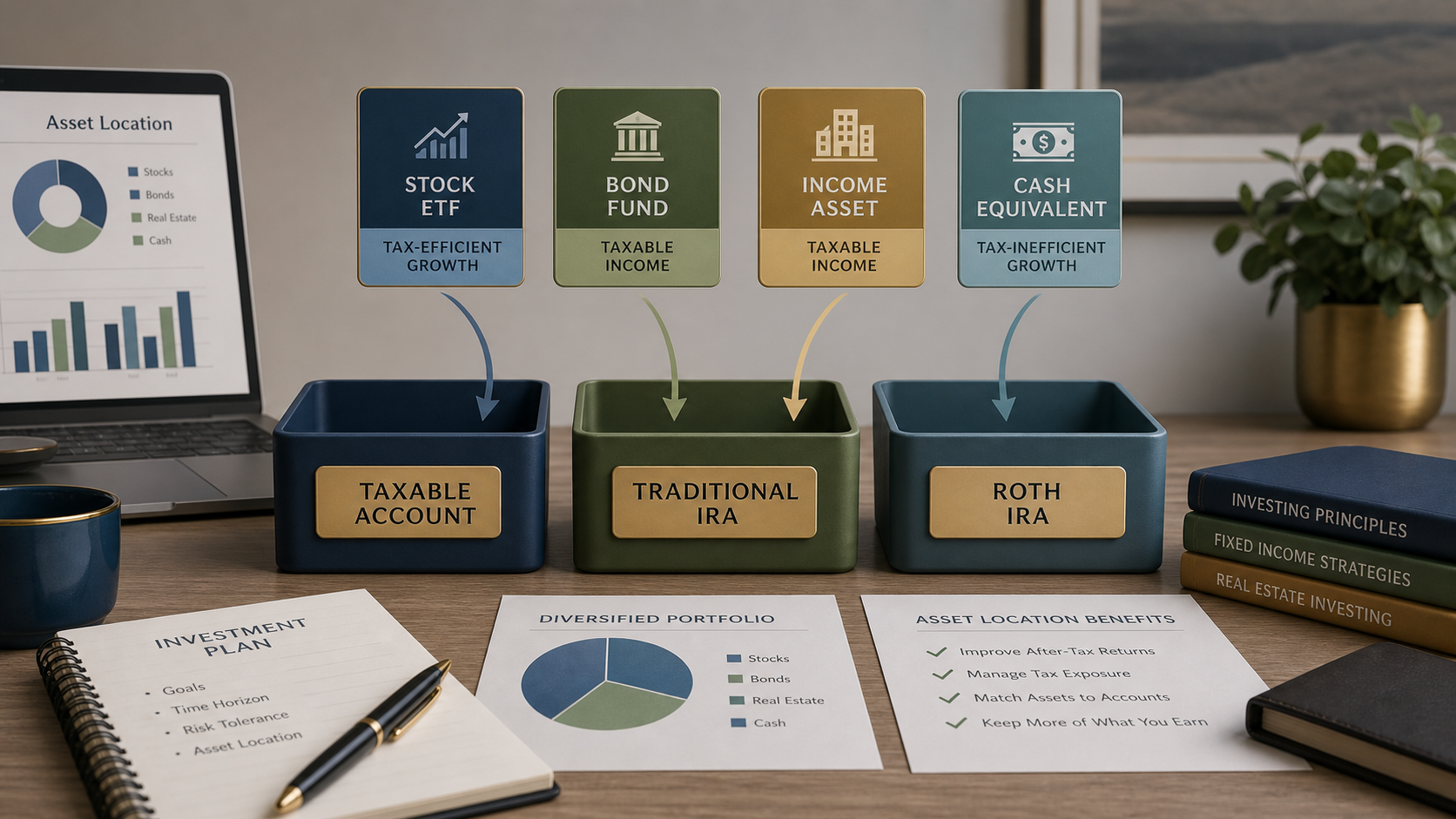
Asset location is the strategy of deciding which investments to hold in which account types. Instead of asking only what you should own, this approach asks whether a stock fund, bond fund, cash holding, or income-producing investment may fit better in a taxable brokerage account, traditional IRA, Roth IRA, 401(k), or other account.
The goal is not to create a perfect tax puzzle. The goal is to keep your investment plan intact while reducing avoidable tax drag where it makes sense. For beginners, this usually matters after you have more than one account type and enough investments for account placement to make a real difference.
Educational disclaimer: This article is for general education only and is not personal tax, legal, investment, or financial advice. Tax rules can change, and the best account placement depends on your income, filing status, state taxes, retirement plan, contribution limits, withdrawal rules, and full portfolio. Consider a qualified professional before making tax-sensitive decisions.
Key Takeaways
- Asset location is about where investments are held, not which investments you own.
- It works alongside asset allocation, diversification, and rebalancing.
- Taxable accounts, traditional retirement accounts, and Roth accounts can treat investment growth differently.
- Tax-efficient assets are often easier to hold in taxable accounts than high-tax-drag assets.
- Beginners should avoid letting tax optimization damage a simple, diversified portfolio.
Asset Location vs Asset Allocation
Asset allocation is your overall mix of stocks, bonds, cash, and other assets. If you decide to hold 80% stocks and 20% bonds, that is an allocation decision. GSV’s guide to asset allocation explains that portfolio mix in more detail.
The account-placement question is different. It asks where each part of that mix should live. A stock index fund could be held in a taxable account, a Roth IRA, a traditional IRA, or a 401(k). A bond fund could also be held in any of those places. The investments may be similar, but the tax treatment around the account can change the result.
A simple way to remember the difference is this: allocation chooses the ingredients; location chooses the containers. Both matter, but allocation is usually the first decision. A poorly chosen portfolio mix cannot be fixed by clever account placement.
How Different Account Types Affect Asset Location
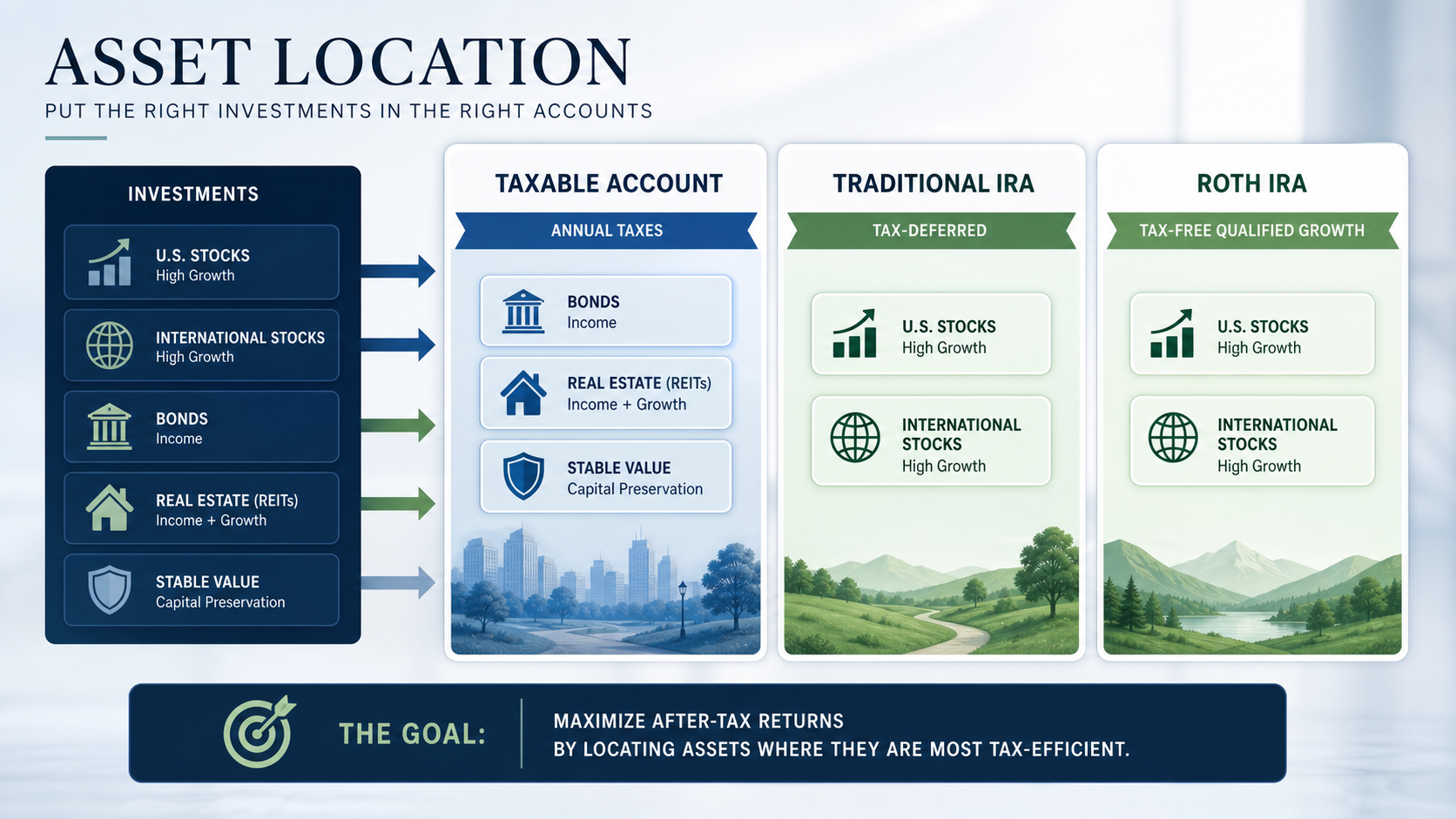
The reason asset location exists is that account types are not taxed the same way. A taxable brokerage account may create annual tax reporting when you receive dividends, interest, capital gain distributions, or sell investments for gains. A retirement account may defer taxes or change when taxes appear.
A taxable brokerage account is flexible, but it does not shelter all activity from current tax. If you sell an investment for a profit, capital gains tax may matter. If you sell at a loss, tax rules such as the wash sale rule can also matter.
A traditional IRA or traditional 401(k) is generally tax-deferred. Investment activity inside the account usually does not create annual taxable capital gains in the same way a taxable account does, but withdrawals may be taxed later under retirement-account rules. A Roth IRA has different rules and may allow qualified tax-free withdrawals if requirements are met.
Why Asset Location Can Improve After-Tax Returns
Two investors can own the same overall portfolio and still have different after-tax results. The difference may come from which account holds which assets. That is the basic promise of asset location: keep the portfolio strategy similar, but reduce unnecessary taxes along the way.
For example, a broad stock index fund that pays modest qualified dividends and mostly grows through price appreciation may be relatively tax-efficient in a taxable account. A high-turnover fund, high-yield bond fund, or income-heavy investment may create more annual taxable income if held in a taxable account.
This does not mean every bond must go in a retirement account or every stock must go in taxable. Real life is messier. Account balances, available investments, risk tolerance, contribution room, withdrawal timing, and estate goals can all change the answer.
Tax-aware placement is useful because taxes compound too. A little less tax drag each year may leave more money invested. But the benefit should be weighed against simplicity, costs, and the risk of making the portfolio harder to manage.
Common Account Buckets for Beginners
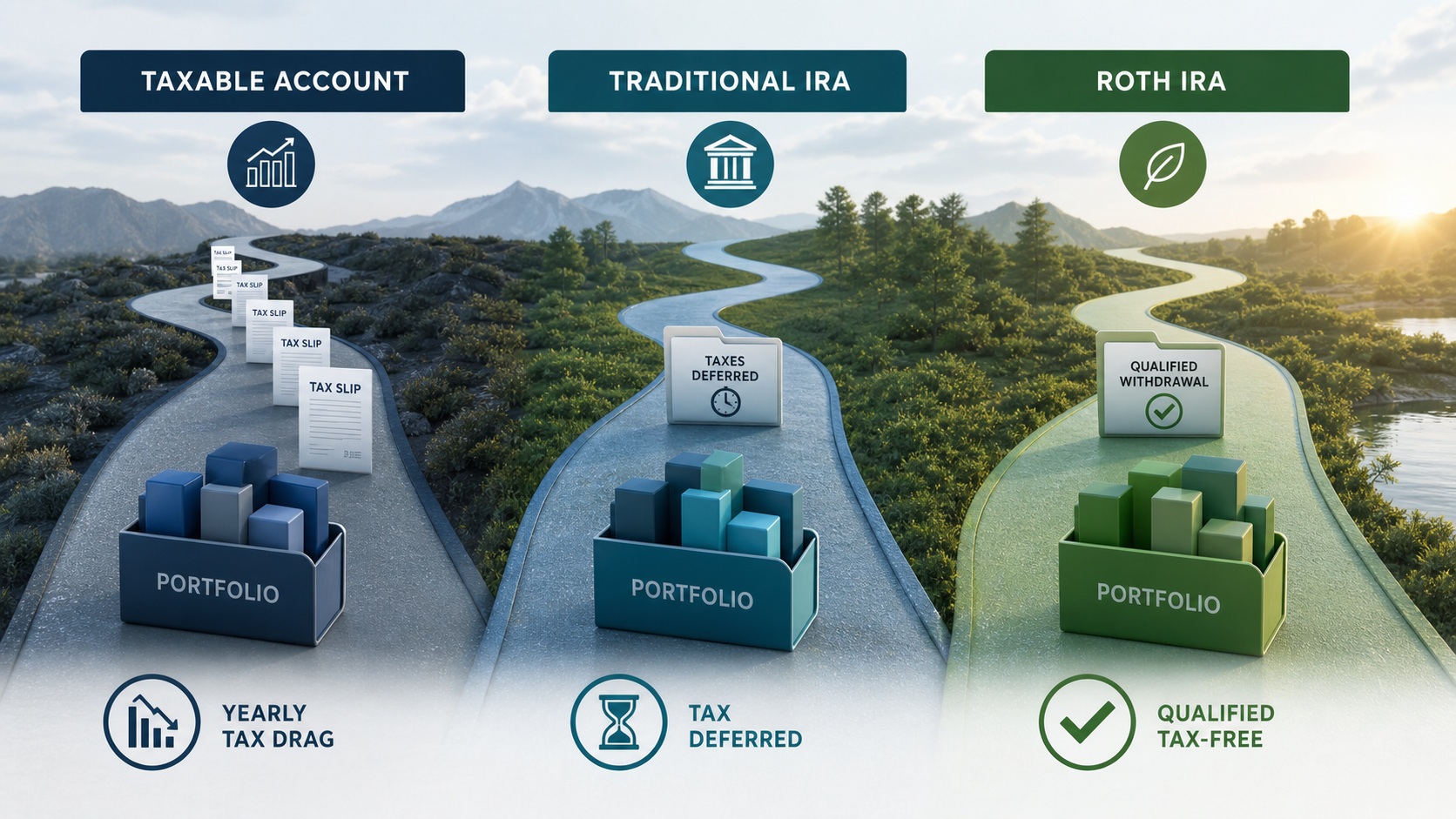
Most beginner investors eventually deal with three broad buckets: taxable accounts, tax-deferred accounts, and Roth-style accounts. Each bucket has a different role.
Taxable accounts are flexible and can be useful for goals before retirement. They may be a reasonable place for tax-efficient index funds, ETFs, and investments you may need before retirement age. Investors who use ETFs should also understand how an ETF expense ratio affects long-term returns.
Tax-deferred accounts, such as many traditional IRAs and 401(k)s, can be useful for assets that would otherwise create more annual taxable income. The trade-off is that withdrawals later may be taxed as income, and retirement-account rules can limit access or require distributions.
Roth accounts can be especially valuable for long-term growth because qualified withdrawals may be tax-free. That is why some investors like holding higher-growth assets in Roth accounts. Still, a Roth account should not become reckless simply because future tax treatment may be favorable.
Examples of Asset Location Decisions
Imagine a beginner with a taxable brokerage account, a traditional IRA, and a Roth IRA. Their target allocation is a diversified mix of stock funds, bond funds, and cash. The first priority is making sure the total portfolio matches the plan, not making each account look identical.
One possible approach is to hold broad, tax-efficient stock index funds in the taxable account, income-producing bond funds in the traditional IRA, and long-term growth-oriented stock funds in the Roth IRA. This is a simplified example, not a universal rule.
Another investor may choose a different setup because their taxable account is small, their 401(k) has limited fund choices, or they need cash outside retirement accounts. A retiree may also care more about withdrawal sequencing than a younger worker building wealth.
The lesson is that account placement should be customized around constraints. It is not a ranking system where one account is always best. It is a coordination process across accounts.
How Asset Location Works With Rebalancing
Account placement can make portfolio rebalancing more complicated. If your stock funds rise and your bond allocation falls below target, you may need to rebalance across multiple accounts instead of just one.
In a tax-deferred account, selling one fund and buying another generally may not create the same immediate taxable capital gain that a taxable account sale can create. In a taxable account, selling appreciated assets can trigger taxes. That is why many investors prefer to rebalance first with new contributions, dividends, or trades inside retirement accounts when practical.
Tax loss harvesting can also connect to this decision. If a taxable holding falls in value, an investor might harvest the loss, choose a non-identical replacement, and keep the overall allocation on track. But the investor still needs to avoid wash sale problems and maintain the intended portfolio exposure.
Good rebalancing keeps the portfolio aligned. Good account placement tries to do that with fewer avoidable tax costs. The two ideas work best when they support each other.
Common Asset Location Mistakes
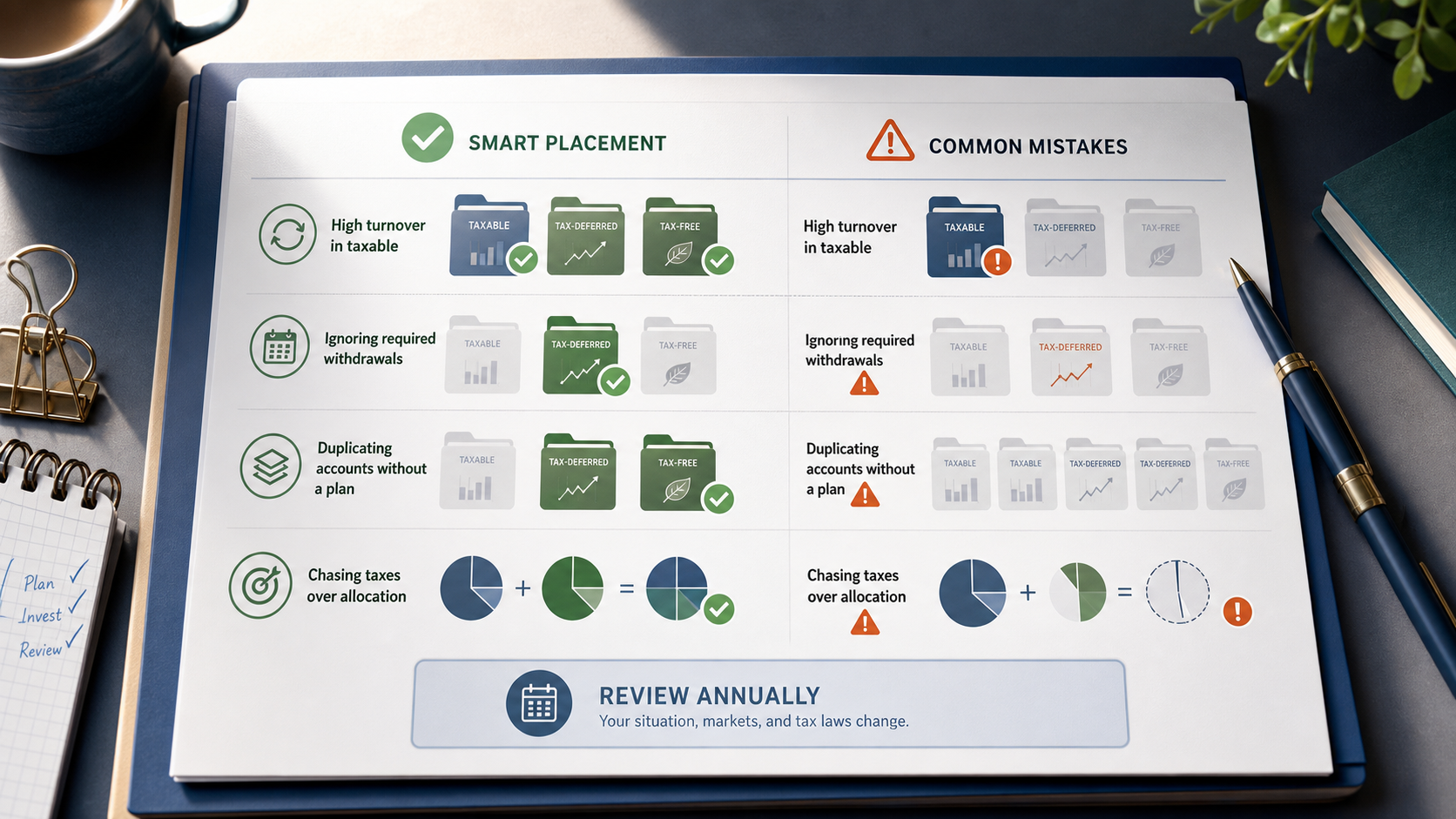
The first mistake is chasing taxes before building a sound portfolio. If a beginner does not understand diversification, account placement will not solve the bigger risk problem.
The second mistake is treating every rule of thumb as permanent. A fund that is tax-efficient today may change its distributions later. Your income, tax bracket, account balances, and retirement timeline may also change. Account placement is not a one-time decision you never revisit.
The third mistake is ignoring liquidity. A taxable account can be useful for goals before retirement, even if another account looks better for taxes. Tax efficiency should not trap money where you cannot reasonably use it when needed.
The fourth mistake is creating a portfolio that is too hard to manage. If the account-location plan is so complex that you avoid reviewing it, the plan may be too complicated. A slightly less optimized but understandable portfolio can be better than a fragile one.
Beginner Checklist Before Optimizing Account Placement
- Choose your target asset allocation first.
- List every account you own and its tax treatment.
- Check which funds or investments are available in each account.
- Identify which holdings create interest, dividends, turnover, or capital gains.
- Consider whether you need liquidity before retirement.
- Review rebalancing options before selling appreciated taxable assets.
- Keep the plan simple enough to maintain.
- Ask a tax professional if large balances, retirement withdrawals, or state taxes are involved.
This checklist keeps the strategy in its proper place. It is a useful improvement layer, not the foundation of investing. The foundation is still saving consistently, diversifying, keeping costs reasonable, and staying aligned with your goals.
Final Thoughts
Asset location can help investors think more clearly about taxes across taxable, tax-deferred, and Roth-style accounts. The strategy is most useful when you already have a sensible asset allocation and more than one account type to coordinate.
For beginners, the best version of asset location is practical and modest. Put the right investments in the right accounts when it is easy and meaningful, but do not let tax optimization turn a simple long-term plan into something confusing or hard to maintain.
Frequently Asked Questions About Asset Location
What is asset location?
Asset location is the strategy of deciding which investments to hold in which account types, such as taxable brokerage accounts, traditional IRAs, Roth IRAs, and workplace retirement plans.
Is asset location the same as asset allocation?
No. Asset allocation is your overall mix of stocks, bonds, cash, and other assets. Asset location is where those assets are held across different account types.
Does asset location matter for beginners?
It can matter once a beginner has multiple account types. Before that, saving, diversification, low costs, and a sensible allocation usually matter more.
Which assets are best for taxable accounts?
Many investors prefer tax-efficient assets in taxable accounts, such as broad index ETFs or funds with relatively low turnover. The right answer depends on the full portfolio and tax situation.
Should bonds go in an IRA?
Bond funds are often considered candidates for tax-deferred accounts because interest can create taxable income. However, this is a rule of thumb, not a universal requirement.
Continue Learning
Ready for the next step? Explore these related investing guides.