

Municipal bonds are debt securities issued by states, cities, counties, and related public entities to finance schools, roads, hospitals, water systems, and other projects. Their interest is often exempt from federal income tax, but “tax-free” does not mean risk-free—or automatically better than a taxable bond.
Demand for municipal debt remained strong in the second quarter of 2026 even as Treasury yields moved higher. That makes the after-tax comparison especially relevant, but investors still need to examine credit quality, maturity, call features, liquidity, and the exact tax treatment before buying.
I have not owned U.S. municipal bonds, so I cannot offer a personal success story about them. What caught my attention was the phrase “tax-free income.” It sounds like an advantage everyone should want—until you ask the more important question: tax-free compared with what?
A lower-yield municipal bond may produce more after-tax income for one investor and less for another. State residence, tax bracket, account type, maturity, and credit quality can change the answer. That is why the taxable-equivalent yield in this guide matters more than the label alone.
If a product leads with a tax benefit, pause before treating the benefit as the investment thesis. The issuer still has to repay the debt, market rates still move, and a callable bond may disappear just when its income looks most attractive.
Key Takeaways
- Municipal bonds fund state and local governments, agencies, and public-purpose projects.
- Interest on many munis is exempt from federal income tax and may receive state or local tax benefits, but exceptions apply.
- General obligation bonds and revenue bonds rely on different repayment sources.
- Taxable-equivalent yield helps compare a tax-exempt muni with a taxable bond.
- Munis still carry interest-rate, credit, call, inflation, and liquidity risks.
What Are Municipal Bonds?
When a public issuer needs money for a long-lived project, it can borrow from investors by selling bonds. In exchange for the purchase price, the issuer generally promises periodic interest and repayment of principal at maturity. The official terms depend on the individual security.
A city might issue debt to build a school, a public authority might finance an airport terminal, or a water district might upgrade pipes. The purpose of the project does not by itself determine safety. Investors need to know who is responsible for repayment and which revenues or legal pledges support it.
Most individual bonds have a stated maturity and coupon, but their market prices can change every day. If comparable yields rise, an existing fixed-rate bond generally becomes less valuable; if yields fall, it generally becomes more valuable. GSV’s beginner bond guide explains that price-yield relationship.
Individual municipal bonds often trade in larger denominations, commonly around $5,000 per bond according to the Municipal Securities Rulemaking Board. Mutual funds and ETFs allow investors to access diversified muni portfolios with smaller amounts, though funds do not have a single maturity date.
General Obligation vs Revenue Bonds

General Obligation Bonds
General obligation, or GO, bonds are backed by an issuer’s pledge and taxing power rather than the cash flow from one specific project. The precise legal pledge varies by state and issuer. Evaluating a GO bond may involve the local tax base, budget, debt burden, pension obligations, reserves, governance, and legal protections.
Revenue Bonds
Revenue bonds are generally repaid from a defined stream of money, such as tolls, utility bills, airport fees, hospital revenue, or lease payments. Investors should ask how stable that revenue is, whether rates can be increased, how much debt must be serviced, and what protections exist if cash flow disappoints.
A busy bridge can still have excessive debt, while a small water utility may have stable essential-service revenue. The label is only a starting point. The official statement explains the security pledge, use of proceeds, financial information, risk factors, and repayment structure.
Credit ratings can help summarize an agency’s opinion of default risk, but they are not guarantees and can change. Investors should also review continuing disclosures and material event notices. Credit spreads, discussed in GSV’s Credit Spreads guide, reflect the extra yield markets demand for risks beyond a benchmark.
Are Municipal Bonds Really Tax-Free?
Interest on many municipal bonds is excluded from federal gross income when the issuer and financing meet federal tax requirements. If you live in the issuing state, the interest may also be exempt from state or local income tax. The exact result depends on the bond, your residence, and current tax law.
Several important exceptions prevent a blanket “triple tax-free” claim:
- Some municipal securities are taxable at the federal level.
- Interest on certain private activity bonds may be included in the federal alternative minimum tax calculation.
- A capital gain from selling a bond above your adjusted cost basis can be taxable.
- Buying a bond at a market discount can create additional tax consequences.
- A municipal bond fund can distribute taxable gains or income from taxable holdings.
- State tax treatment may depend on whether the bonds were issued in your home state.
Tax-exempt bonds are usually most attractive in taxable accounts for investors facing higher marginal rates. Holding them inside a tax-deferred retirement account can waste the federal income-tax advantage because the account already provides tax deferral and withdrawals may be taxable. GSV’s Asset Location guide explains how account type and investment tax treatment interact.
Tax rules are personal and can change. Review the bond’s official statement and consult a qualified tax professional when state taxes, the alternative minimum tax, discounts, or other complications are material.
Taxable-Equivalent Yield: The Fair Comparison
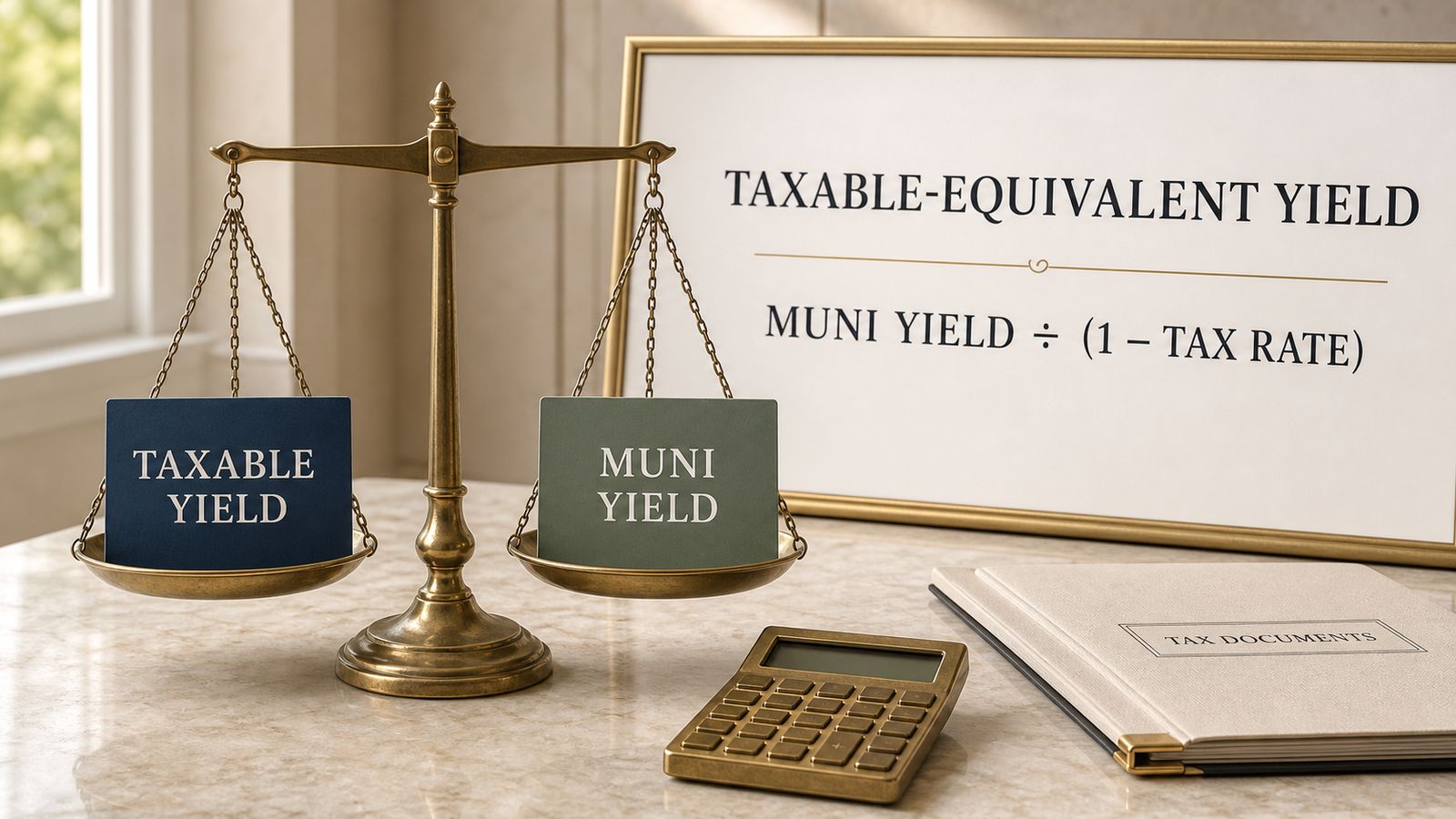
A muni’s quoted yield may look lower than the yield on a Treasury or corporate bond because part of its value can come from tax savings. Taxable-equivalent yield estimates the taxable yield needed to produce the same after-federal-tax income.
Taxable-equivalent yield = tax-exempt yield ÷ (1 − marginal tax rate)
Suppose a tax-exempt bond yields 3.0% and an investor’s relevant marginal federal tax rate is 24%. The taxable-equivalent yield is approximately 3.95%: 3.0% ÷ 0.76. A comparable taxable bond would need to yield about 3.95% before federal income tax to match that simplified result.
The formula is a screening tool, not a complete investment decision. It does not automatically account for state taxes, alternative minimum tax exposure, capital gains, fees, credit differences, maturity, call features, or liquidity. Compare securities with similar risks and time horizons.
| Comparison Question | Why It Matters |
|---|---|
| Same maturity? | Longer bonds usually carry more interest-rate risk. |
| Similar credit quality? | A higher yield may compensate for greater default risk. |
| Callable? | The issuer may repay early when rates fall. |
| Same account type? | Tax advantages can be redundant in retirement accounts. |
| After all taxes and fees? | Headline yield may not equal income kept. |
For a taxable government benchmark, see GSV’s Treasury Yields guide. Treasuries and munis have different issuers, tax treatment, liquidity, and credit structures, so a yield difference is not free money.
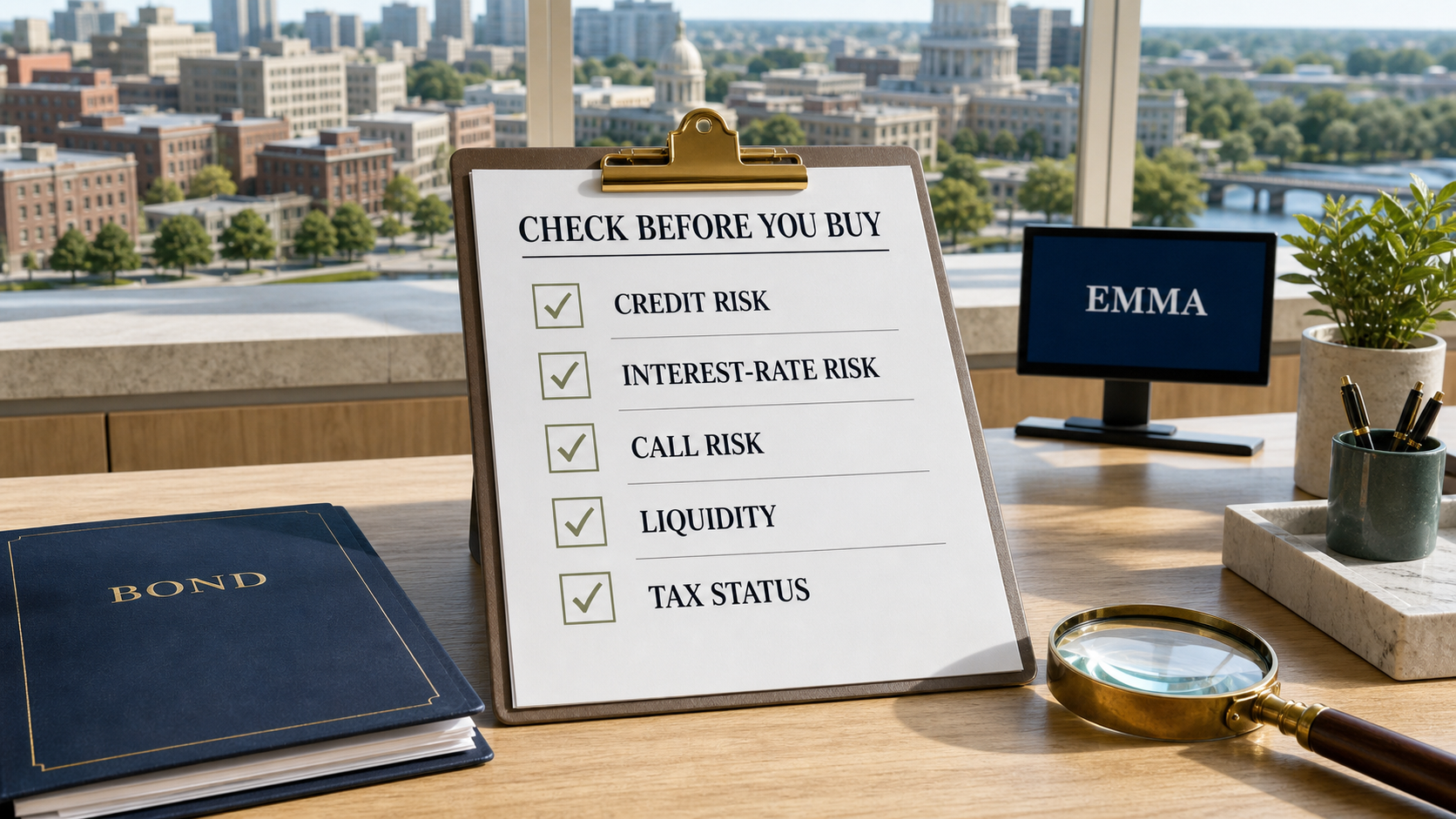
Five Municipal Bond Risks to Check
1. Credit Risk
The issuer or obligated party may experience weaker revenue, rising costs, legal constraints, or financial distress. Defaults are not the normal outcome for high-quality munis, but they can occur, and recovery can be uncertain. Sector, issuer, and security pledge matter.
2. Interest-Rate Risk
When market yields rise, existing bond prices generally fall. Longer maturities and lower coupons usually create greater sensitivity. If you must sell before maturity, the market price can be below the amount originally paid. Learn the measurement in What Is Bond Duration?
3. Call Risk
Many municipal bonds allow the issuer to redeem the security before maturity. Calls often become more likely when rates fall because the issuer may refinance at a lower cost. The investor receives principal back but may have to reinvest at a lower yield.
4. Liquidity Risk
Municipal securities do not all trade frequently. A small or unusual issue can have a wide bid-ask spread, making it costly to sell. The price shown on a statement may not be the price available for a large or urgent trade. GSV’s Bid-Ask Spread guide explains this hidden trading cost.
5. Tax and Legislative Risk
A bond’s expected advantage depends on tax rules and the investor’s situation. Tax status may differ across securities, and future legislation can affect relative value. “Municipal” and “tax-exempt” are not interchangeable in every case.
Other risks include inflation, reinvestment risk, fund-management risk, and concentration. A single-state portfolio may provide a state tax benefit but increase geographic exposure. Diversification can reduce issuer-specific damage, although it cannot prevent losses; see Diversification.
How to Invest in Municipal Bonds
Individual Bonds
Buying individual securities can provide known maturity dates and cash-flow planning if the issuer pays as promised and the bond is not called. It also requires credit research, price comparison, adequate diversification, and attention to markups or markdowns. Investors can review official statements, trade data, and continuing disclosures through the MSRB’s free EMMA system.
Mutual Funds and ETFs
Muni funds make diversification and reinvestment easier. National funds spread exposure across states, while single-state funds seek additional state tax advantages for eligible residents. Short-term funds generally have less rate sensitivity than long-term funds, and high-yield funds accept more credit risk.
A bond fund does not mature like an individual bond. Its net asset value changes with yields, credit conditions, flows, and portfolio decisions. Compare expense ratio, duration, credit distribution, state concentration, AMT exposure, distribution yield, and the method used to report yield. GSV’s Bond ETF guide covers the structure.
A Practical Buying Checklist
- Define the goal, time horizon, and need for liquidity.
- Calculate after-tax yield using your relevant tax rate.
- Compare maturity, duration, credit, and call provisions.
- Read the official statement or fund prospectus.
- Review trade prices and disclosures on EMMA for individual bonds.
- Check total portfolio exposure by issuer, state, and sector.
- Understand how and when you could sell.
Municipal bonds are not automatically the best choice for every investor. Someone in a low tax bracket may keep more after-tax income from a taxable bond with a higher yield. Someone in a high bracket may find the tax exemption valuable, provided the risks are comparable.
Common Municipal Bond Mistakes
- Assuming all muni interest is tax-free. Verify federal, state, local, and AMT treatment.
- Comparing headline yields only. Use after-tax yield and match risk and maturity.
- Buying one local issuer for familiarity. Familiarity is not diversification.
- Ignoring the call date. Yield to maturity may overstate the likely return on a callable premium bond.
- Confusing an individual bond with a bond fund. A fund has no single maturity or guaranteed redemption value.
- Assuming a high rating eliminates risk. Ratings are opinions, not guarantees.
- Skipping price research. Thin trading can make transaction costs less obvious.
Official Sources
- Investor.gov: Municipal Bonds Investor Bulletin
- MSRB: Municipal Bond Basics
- MSRB: Municipal Bond Tax Treatment
- MSRB: Ways to Buy Municipal Bonds
Final Thoughts
Municipal bonds can provide useful after-tax income while financing public projects. Their value is clearest when an investor compares the after-tax result with taxable alternatives of similar maturity and risk.
The tax exemption is only one feature. Repayment source, credit quality, duration, call provisions, liquidity, fees, and account location determine whether a muni actually fits. Read the documents, use EMMA, and treat “tax-free” as a starting point—not the conclusion.
Frequently Asked Questions
Are municipal bonds guaranteed by the government?
No. Repayment depends on the specific issuer, obligated party, and security pledge. They are not U.S. Treasury securities and are not generally guaranteed by the federal government.
Can municipal bonds lose money?
Yes. Prices can fall because of rising yields, deteriorating credit, illiquidity, calls, or market stress. Bond funds can also decline and do not have a single maturity value.
Are municipal bonds exempt from state taxes?
Interest may be exempt from state or local income tax when an investor resides in the issuing jurisdiction, but rules and bond status vary. Verify current treatment.
What is a taxable-equivalent yield?
It estimates the taxable yield needed to equal a tax-exempt yield after applying a marginal tax rate. The simple formula is muni yield divided by one minus the tax rate.
Where can I research a municipal bond?
The MSRB’s EMMA website provides official statements, continuing disclosures, trade data, and other information for municipal securities.
Continue Learning
Compare municipal debt with other income tools.
Educational disclaimer: This article is for general educational purposes only and is not personalized investment, financial, tax, or legal advice. Bond prices, yields, credit conditions, tax treatment, fees, and laws can change. Review official documents and consult qualified professionals for your circumstances.