
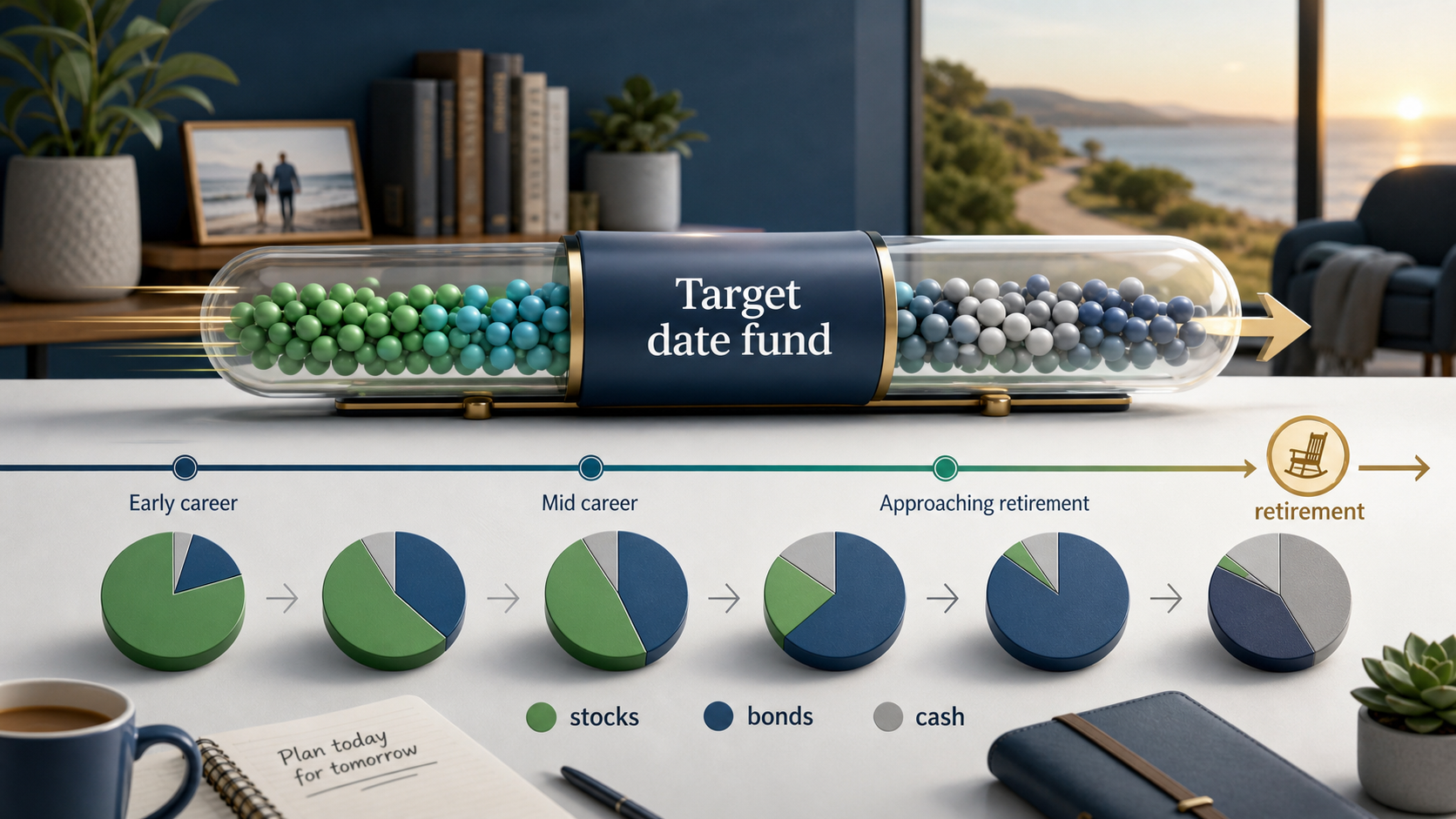
What is a target date fund? A target date fund is a diversified retirement fund that automatically adjusts its mix of stocks, bonds, and cash-like investments as a future target year gets closer. The target year usually matches the year you expect to retire or start using the money.
For many beginners, a target date fund is the simplest way to invest inside a 401k, IRA, or other retirement account. Instead of choosing several funds and rebalancing them yourself, you pick one fund with a date near your planned retirement year. The fund manager handles the asset allocation, diversification, and gradual shift toward a more conservative portfolio over time.
Target Date Fund Key Takeaways
- It is designed as a one-fund retirement portfolio.
- The fund usually owns a mix of stock funds, bond funds, and sometimes cash-like investments.
- Its glide path gradually changes the asset mix as the target year approaches.
- It can be convenient, but it does not guarantee returns or prevent losses.
- Before choosing one, check the target year, fees, glide path, holdings, and risk level.
How a Target Date Fund Works
The fund works by combining several investments into one professionally managed portfolio. A 2060 fund, for example, is generally built for someone whose retirement date is around 2060. A 2035 fund is generally built for someone closer to retirement. The date is a guide, not a promise.
Most of these funds start with a higher stock allocation when the target year is far away. Stocks can be volatile, but they also provide long-term growth potential. As the target year gets closer, the fund typically shifts more toward bonds and cash-like investments. That shift is meant to reduce volatility as the investor moves closer to needing the money.
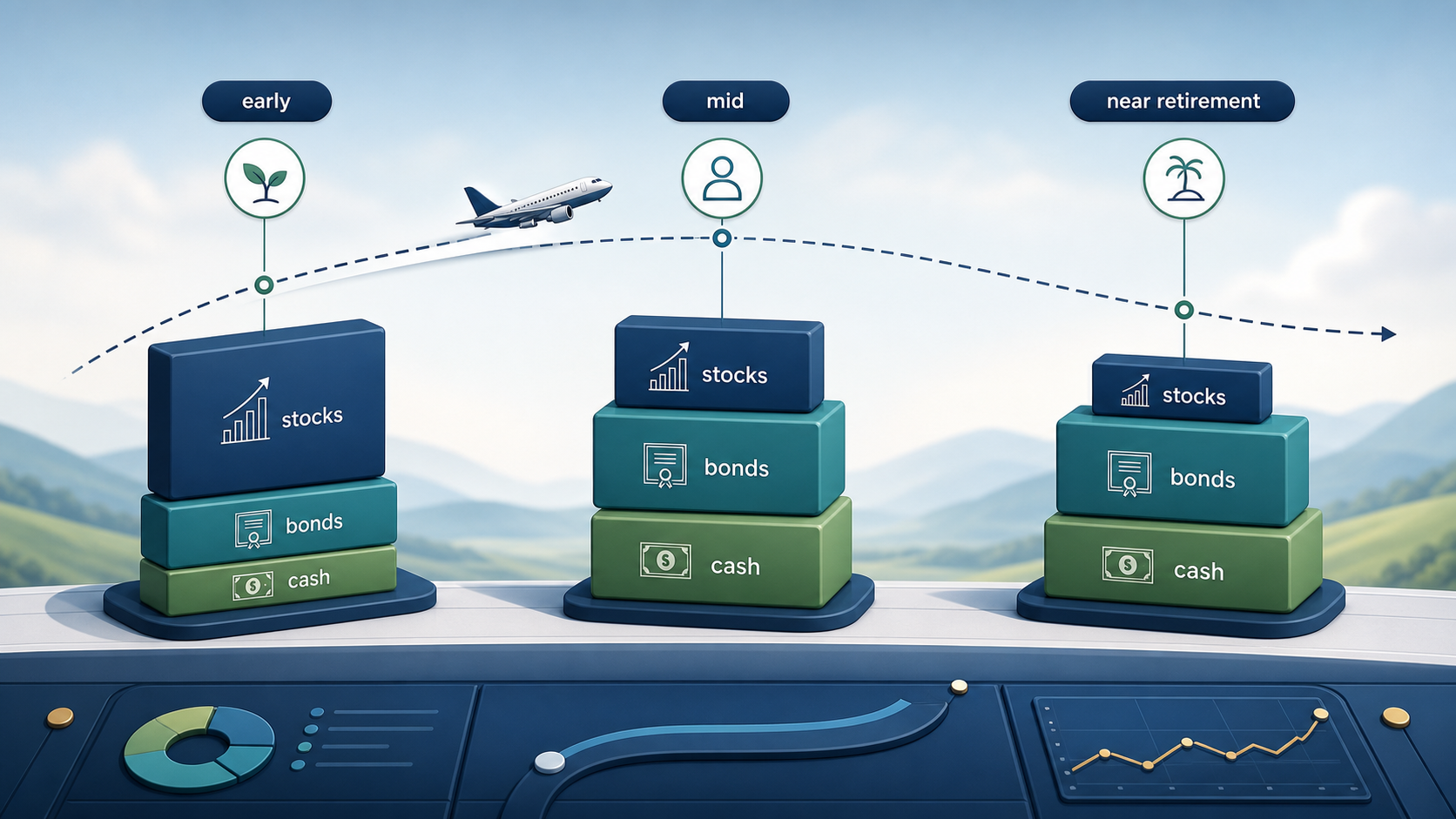
The path of that gradual shift is called the glide path. Different fund companies can use different glide paths, even for funds with the same target year. One 2055 fund may hold more stocks than another 2055 fund. That is why the date alone is not enough to understand the risk.
This structure makes the product closely related to asset allocation. Asset allocation decides how much of a portfolio goes into stocks, bonds, and cash. The fund manager makes those decisions inside the fund, then changes them over time according to the glide path.
Why Beginners Use Target Date Funds
The biggest benefit is simplicity. A beginner may not feel ready to choose individual stock funds, bond funds, international funds, and cash options. This all-in-one structure packages those choices into one fund. That can reduce decision stress and help people start investing instead of waiting until they feel like experts.
Another benefit is built-in diversification. Many of these retirement funds own several underlying mutual funds or similar pooled investments. Those underlying funds may cover U.S. stocks, international stocks, bonds, and other asset groups. If you are still learning how spreading risk works, GSV’s guide to diversification explains the basic idea.
The fund may also rebalance automatically. If stocks rise and become a larger share of the fund than intended, the manager can bring the mix back toward the fund’s target allocation. That can be useful for investors who do not want to monitor their portfolio every month. GSV’s guide to portfolio rebalancing explains why keeping a portfolio aligned with a plan matters.
The convenience is especially important in workplace retirement plans. Many 401k menus offer dated retirement funds because they are easy for employees to understand. A person who expects to retire around 2050 may see a 2050 fund and know where to begin. That does not make the fund perfect, but it gives the investor a starting point.
Target Date Fund vs Building Your Own Portfolio
This is not the only way to invest for retirement. Some investors build their own portfolio using separate funds. For example, they may use a U.S. stock index fund, an international stock fund, and a bond fund. This gives more control, but it also requires more decisions.
| Feature | Target Date Fund | DIY Fund Portfolio |
|---|---|---|
| Number of funds to choose | Usually one | Several |
| Rebalancing | Handled inside the fund | Investor handles it |
| Customization | Limited | Higher |
| Ease for beginners | High | Depends on knowledge and discipline |
| Risk level | Depends on glide path | Depends on investor choices |
A do-it-yourself portfolio can be cheaper or more tailored if the investor knows what they are doing. It can also become messy if the investor owns overlapping funds, chases performance, or forgets to rebalance. The all-in-one fund trades customization for simplicity.
Funds themselves also come in different wrappers. Some are mutual funds. Some retirement plans may use collective investment trusts. A beginner comparing account choices should understand how a mutual fund works and how it differs from an ETF.
How to Choose a Target Date Fund
Start with the target year. A common approach is to choose the fund closest to the year you expect to retire. If you are 30 and expect to retire around age 65, a fund roughly 35 years in the future may be a starting point. But the year is only a starting point, not a personal financial plan.
Next, check the stock and bond mix. If the fund holds much more stock than you can tolerate, you may panic during a downturn. If it holds too little stock for your long time horizon, it may be too conservative for your goals. The right balance depends on your risk tolerance, income stability, savings rate, and time horizon.

Fees matter too. The fund charges expenses, and the underlying funds may also have costs. Even small fee differences can matter over decades. Compare the expense ratio with similar choices in your retirement plan, but do not choose on fees alone if the investment design is not a good fit.
Look at the glide path. Ask how quickly the fund becomes more conservative and whether it continues changing after the target year. Some funds are designed to reach their most conservative mix at the target date. Others keep changing after the target date. This “to” versus “through” retirement difference can affect risk near and after retirement.
Finally, check the underlying holdings. A fund may include U.S. stocks, international stocks, bonds, inflation-linked bonds, or other assets. It may be index-based, actively managed, or a mix. If you already hold other funds in the same account, make sure you are not accidentally doubling up on the same exposure.
Risks and Limits of Target Date Funds
The fund can lose money. It may own stocks, bonds, and other market investments, and those assets can fall. A fund with a near retirement date may still have meaningful stock exposure. The target year does not mean the fund becomes a bank account.

The second risk is mismatch. Two people planning to retire in the same year may have very different financial lives. One may have a pension, large savings, and low expenses. Another may have debt, uncertain income, and no other retirement assets. A single target year cannot capture every personal detail.
The third risk is misunderstanding the fund’s role. It is usually designed to be the main retirement investment, not one small piece among many random holdings. If you combine it with several other funds, you may change the risk mix without realizing it.
The fourth risk is ignoring taxes and account type. These funds are often used inside tax-advantaged retirement accounts. Holding one in a taxable account can create different tax considerations because fund distributions may be taxable. If you are comparing account types, review how a 401k, traditional IRA, or Roth IRA may fit your situation.
When a Target Date Fund May Make Sense
This type of fund may make sense if you want a simple retirement portfolio and do not want to build your own asset mix. It can be useful for beginners who are just starting a workplace plan and would otherwise leave money in cash because the investment menu feels confusing.
It may also make sense if the fund is low cost, broadly diversified, and aligned with your risk tolerance. A good all-in-one retirement fund can help a saver focus on the bigger habits that often matter most: starting early, contributing consistently, avoiding panic selling, and increasing contributions over time when possible.
It may be less suitable if you want a highly customized portfolio, have complex tax planning needs, already work with a qualified adviser, or strongly disagree with the fund’s glide path. In that case, separate funds may give more control, but they also require more responsibility.
For many beginners, the practical question is not whether the fund is perfect. The better question is whether it is a reasonable, low-cost, diversified default that helps you invest consistently. If it does, it can be a useful tool while you keep learning.
FAQ About Target Date Funds
Is a target date fund safe?
It is not risk-free. The fund can lose money because it usually owns market investments such as stocks and bonds. The target year does not guarantee principal protection or a certain return.
Can I use a target date fund in a 401k?
Yes. These funds are common in 401k plans. Many workplace plans offer them as easy retirement investing choices for participants who want one diversified fund.
Should I choose the fund with my exact retirement year?
The closest target year is often a starting point, but you should also check the fund’s risk level, fees, holdings, and glide path. The date alone does not tell the whole story.
Can I own more than one target date fund?
You can, but it usually defeats the purpose. These funds are typically designed as all-in-one portfolios. Owning several may create a confusing mix rather than better diversification.
What happens after the target date?
It depends on the fund. Some funds keep adjusting after the target year, while others settle near their long-term retirement allocation. Check the fund documents for the specific glide path.
Final Thoughts on Target Date Funds
A target date fund can be a practical retirement investing tool because it turns a complicated portfolio decision into one fund choice. It handles diversification, asset allocation, and rebalancing inside the fund, which can help beginners start investing with less confusion.
The trade-off is that the fund is not personalized. It can still lose money, charge fees, and hold a risk level that may not match your life. Before choosing one, look beyond the year in the name. Check the glide path, costs, holdings, and whether the fund fits your real retirement plan.
Official Sources
- Investor.gov: Target Date Fund
- Investor.gov: Asset Allocation and Diversification
- Investor.gov: What is Risk?
Educational disclaimer: This article is for general financial education only and is not personalized investment, tax, or legal advice. Investing involves risk, including possible loss of principal. Retirement account rules and fund options can vary, so review official fund documents and consider professional guidance when needed.