
Quantum computing stocks give investors exposure to companies trying to turn quantum physics into useful computing power. The opportunity could be enormous, but today’s market also contains fragile business models, limited commercial revenue, high cash burn, uncertain timelines, and valuations driven more by future expectations than proven profits.
Interest is rising again in 2026 as governments and large technology companies commit billions of dollars to research, manufacturing, cybersecurity, and quantum infrastructure. That momentum is real. It still does not mean every publicly traded company associated with quantum computing will become a durable winner.
Key Takeaways
- Quantum computers use qubits and specialized physics to tackle certain problems differently from conventional computers.
- Pure-play quantum companies offer direct exposure but often carry the highest financing, execution, and valuation risk.
- Diversified technology companies can fund long research programs, but quantum may be too small to move their total earnings for years.
- Hardware suppliers, photonics, cooling, control systems, cybersecurity, and cloud infrastructure may provide indirect exposure.
- Qubit counts alone do not prove commercial value; error rates, fidelity, uptime, useful workloads, customers, and revenue matter.
- A genuine scientific breakthrough can still be a poor investment if the expected success is already priced into the stock.
What Are Quantum Computing Stocks?
Quantum computing stocks are shares of companies involved in quantum processors, software, cloud access, control electronics, cooling systems, photonics, cybersecurity, or related infrastructure. The label covers very different businesses. Some depend almost entirely on quantum technology, while others earn nearly all their revenue elsewhere.
A classical bit is represented as 0 or 1. A qubit can be prepared in a combination of states and linked with other qubits through entanglement. Quantum algorithms may use those properties to explore some problems in chemistry, materials, optimization, and cryptography in ways that differ from ordinary computation.
Quantum computers are not simply faster laptops. They require highly specialized hardware and are unlikely to replace conventional computers for everyday tasks. Many useful systems are expected to combine classical processors, accelerators, and quantum resources, much as today’s AI infrastructure combines CPUs, GPUs, networking, memory, and software.

The investment lesson is simple: impressive science is not the same as a profitable company. A business must convert technical progress into paying customers, repeatable demand, defensible intellectual property, acceptable margins, and enough cash to survive a long development cycle.
Why Investors Care About Quantum Computing Stocks in 2026
Quantum technology has moved higher on government and corporate agendas. In May 2026, the U.S. Department of Commerce announced letters of intent with nine companies for $2 billion in planned quantum investments. IBM separately announced plans to invest more than $10 billion over five years across research, manufacturing, acquisitions, and ecosystem development.
Those commitments support laboratories, fabrication, supply chains, talent, and customer experimentation. They can reduce some financing pressure across the ecosystem. They do not guarantee that public shareholders in every participating or adjacent company will earn attractive returns.
The technology also matters for security. A sufficiently capable future quantum computer could threaten widely used public-key cryptography. Organizations are therefore beginning multi-year migrations toward post-quantum cryptography even before a cryptographically relevant quantum computer exists. This creates a commercial theme that extends beyond quantum processors themselves.
Investor attention can move faster than revenue. Small quantum computing stocks may react sharply to research announcements, government awards, partnerships, conference presentations, or roadmap updates. That volatility resembles other early technology cycles discussed in GSV’s guide to the AI bubble debate.
Three Ways to Invest in Quantum Computing

1. Pure-Play Quantum Companies
Pure-play quantum computing stocks represent companies that build quantum hardware, software, networking, or specialized services as their primary business. Their share prices can respond strongly to technical milestones because quantum progress is central to the investment story.
The same concentration creates risk. Early-stage revenue may come from research contracts, cloud access, consulting, or government projects rather than scalable commercial workloads. Investors should examine cash burn, share dilution, customer concentration, and whether bookings are converting into recognized revenue.
2. Diversified Technology Companies
Large technology companies can fund quantum research from profitable cloud, software, advertising, or enterprise businesses. Their balance sheets may allow them to pursue multiple hardware approaches and wait longer for commercialization.
This is usually a less concentrated way to gain exposure. It is also less sensitive: even an important quantum milestone may have little near-term effect on a diversified company’s total revenue. Investors evaluating these businesses should understand the broader AI stock, cloud, semiconductor, and software drivers rather than buying solely for a small quantum program.
3. Picks-and-Shovels Suppliers
Quantum systems need precision components, cryogenic equipment, lasers, photonics, wafers, test tools, control electronics, and data-center connections. Suppliers may benefit from industry investment even when no single processor architecture becomes dominant.
Indirect exposure is not automatically safer. A supplier may receive only a tiny portion of revenue from quantum customers, and a niche component can be replaced as architectures change. The investor must separate a meaningful earnings driver from a marketing association.
Funds can provide another route, but thematic ETFs may hold many companies with limited direct quantum revenue. Before buying, check holdings, concentration, turnover, and costs using the principles in GSV’s ETF beginner guide and expense ratio guide.
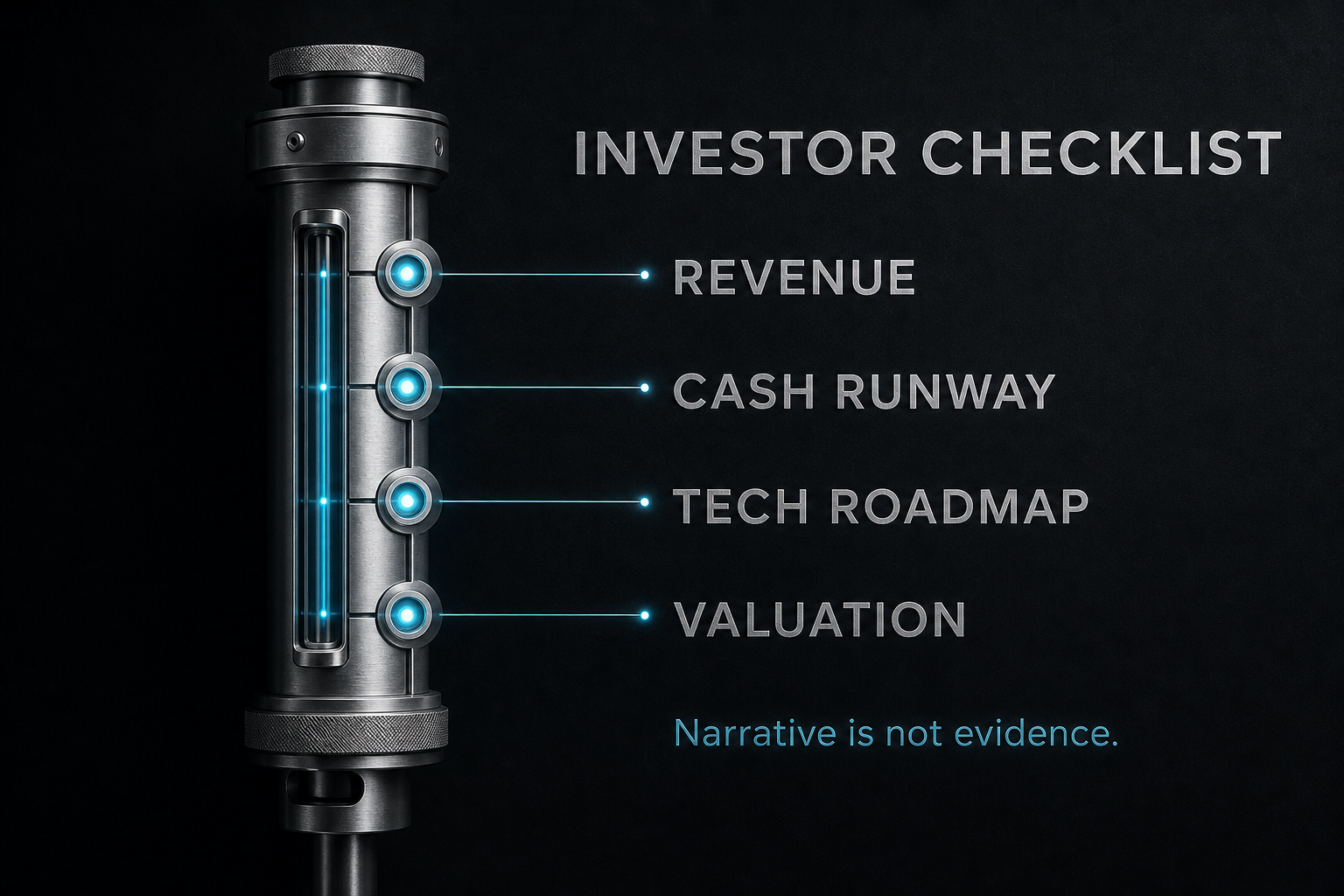
How to Evaluate Quantum Computing Stocks
Revenue Quality
Ask who pays the company and why. Revenue from recurring cloud usage or repeat enterprise deployments can be more informative than a one-time research contract. Track whether customers move from experiments to larger commitments and whether reported backlog has cancellation or funding conditions.
Cash Runway and Dilution
Developing hardware and software can consume cash for years. Compare cash and liquid investments with operating cash burn, capital spending, debt, and planned hiring. If a company repeatedly sells new shares, existing investors may own a smaller percentage even when the business survives.
Technology Roadmap
A roadmap should connect engineering milestones to useful computation. Relevant measures may include error rates, gate fidelity, coherence, connectivity, logical qubits, uptime, and the ability to run verifiable workloads. No single metric works across every architecture, so avoid ranking companies by physical qubit count alone.
Commercial Evidence
Look for customers willing to pay, not only partners willing to explore. A credible use case should explain why a quantum method improves cost, speed, accuracy, or discovery relative to classical alternatives. Third-party validation is more useful than an unsupported claim of “quantum advantage.”
Valuation
Many early quantum computing stocks cannot be valued with mature-company earnings multiples. Investors may compare enterprise value with revenue, cash, contract quality, and plausible future margins, but every forecast contains substantial uncertainty.
A strong narrative can make valuation feel irrelevant until sentiment reverses. GSV’s explanation of earnings expectations shows why a company can report progress and still fall when the market expected more.
Major Risks of Quantum Computing Stocks
| Risk | Why It Matters | What to Check |
|---|---|---|
| Technical failure | Error correction or scaling may take longer than expected | Independent milestones and roadmap changes |
| Commercial delay | Useful machines may arrive before profitable demand—or much later | Paid usage, renewals, and customer outcomes |
| Cash burn | Long development cycles require repeated financing | Runway, debt, dilution, and spending |
| Architecture risk | A competing technical approach may win | Modality, ecosystem, and switching costs |
| Valuation risk | Years of success may already be reflected in price | Scenario ranges rather than one target |
| Policy dependence | Grants and contracts can change with budgets | Revenue concentration and funding terms |
Small technology companies can experience sharp price gaps, wide bid-ask spreads, and limited liquidity. Investors should understand the bid-ask spread and avoid using a market order simply because a stock is moving quickly.
Concentration is another danger. Owning several quantum computing stocks does not create true diversification if all depend on the same funding cycle and investor narrative. A speculative allocation should fit the investor’s risk tolerance and broader diversification plan.
A Practical Investor Framework
- Define the thesis. Decide whether the investment depends on hardware, software, security, infrastructure, or broad technology exposure.
- Separate evidence from promotion. Distinguish paid adoption and verified technical results from partnerships or press-release language.
- Build downside scenarios. Model delays, lower revenue, additional share issuance, and a lower valuation multiple.
- Limit position size. Treat early-stage exposure as speculative unless the underlying business is already diversified and profitable.
- Review each milestone. Compare new results with the original thesis instead of reacting to every headline.
A beginner does not need to own quantum computing stocks to benefit if the technology succeeds. Broad-market funds may eventually own the winners, while diversified technology businesses can adopt quantum tools as customers or providers. Missing one speculative surge is less damaging than taking a position whose risks you cannot explain.
Official Sources
- NIST: Planned $2 Billion Quantum Investment
- IBM: Five-Year Quantum Investment
- IBM Quantum 2026 Roadmap
- SEC: Cybersecurity Resources
Final Thoughts
Quantum computing stocks offer exposure to a potentially transformative field, but the distance between laboratory progress and durable shareholder returns remains wide. The strongest analysis connects technology to revenue, cash runway, customer evidence, competitive advantage, and a price that leaves room for uncertainty.
Investors do not need to decide whether quantum computing will “win.” They need to decide whether a specific company can survive long enough to create value—and whether today’s stock price offers a reasonable return if progress is slower and messier than the headline suggests.
Frequently Asked Questions
What are quantum computing stocks?
They are shares of companies involved in quantum processors, software, cloud services, control systems, components, security, or related infrastructure.
Are quantum computing stocks risky?
Yes. Many face technical uncertainty, limited revenue, high cash burn, dilution, volatile prices, and long commercialization timelines.
How can beginners invest in quantum computing?
Possible routes include pure-play companies, diversified technology businesses, suppliers, and thematic funds. Each offers a different balance of concentration and indirect exposure.
What metric matters most for quantum companies?
No single metric is sufficient. Investors should evaluate technical performance, useful workloads, customers, revenue quality, cash runway, and valuation together.
Will quantum computers replace normal computers?
Probably not for general everyday work. Quantum systems are expected to complement classical computing for selected problems rather than replace it entirely.
Continue Learning
Ready for the next step? Explore these related investing guides.
Educational disclaimer: This article is for general educational purposes only and is not personalized financial, tax, or legal advice. Emerging technology stocks can be highly speculative and may lose substantial value. Verify current company disclosures and consider your objectives, time horizon, and risk tolerance.