

Do you have cash ready to invest but still feel nervous every time AI stocks bounce? That is the emotional side of the AI bubble debate. Even during a correction, I wonder whether the market will suddenly race higher again without me. Then I look at a holding that has fallen and ask the opposite question: should I buy more while it is down?
From the publisher: I own NVIDIA, Microsoft, Meta, Samsung Electronics, and SK hynix. I am not watching the AI boom from the sidelines. NVIDIA led the first powerful stage, and the demand for AI computing spread through the memory chain to Samsung Electronics, SK hynix, and Micron. Their businesses and financial results give investors something real to examine.
But I have also watched small companies I had barely heard of rise simply because the market connected them with AI. I usually ignore that noise because I focus on established, high-quality businesses. Still, I can see how easily a beginner could mistake a rising ticker for proof that the company is becoming valuable.
Here is the uncomfortable part: owning excellent companies does not remove price risk. A great business can still be bought at a price that assumes years of perfect growth. And cash on the sidelines can make every rally feel like a personal mistake.
So is this an AI bubble, a real industrial boom, or both at once? I do not think one label can answer that. A better approach is to separate real demand from an expensive stock price—and a serious company from one borrowing the trend’s vocabulary.
Key Takeaways
- A technology boom becomes vulnerable when valuation and financing grow much faster than durable earnings.
- Real demand for chips, cloud capacity, software, and data centers argues against dismissing the entire AI market as empty hype.
- Seven useful warning signs include extreme valuation, weak monetization, falling returns on capital, debt growth, circular financing, concentration, and indiscriminate speculation.
- Investors should examine each company rather than assume every AI-related stock will rise or fall together.
- Diversification and position sizing are more reliable than trying to predict the exact day a boom reverses.
What Is an AI Bubble?
A market bubble is not simply a period of strong prices. It is a feedback loop in which exciting expectations attract capital, rising prices appear to validate the story, and new buyers pay still more because they fear missing out. The cycle becomes fragile when future success already embedded in prices is much greater than the profits businesses can plausibly deliver.
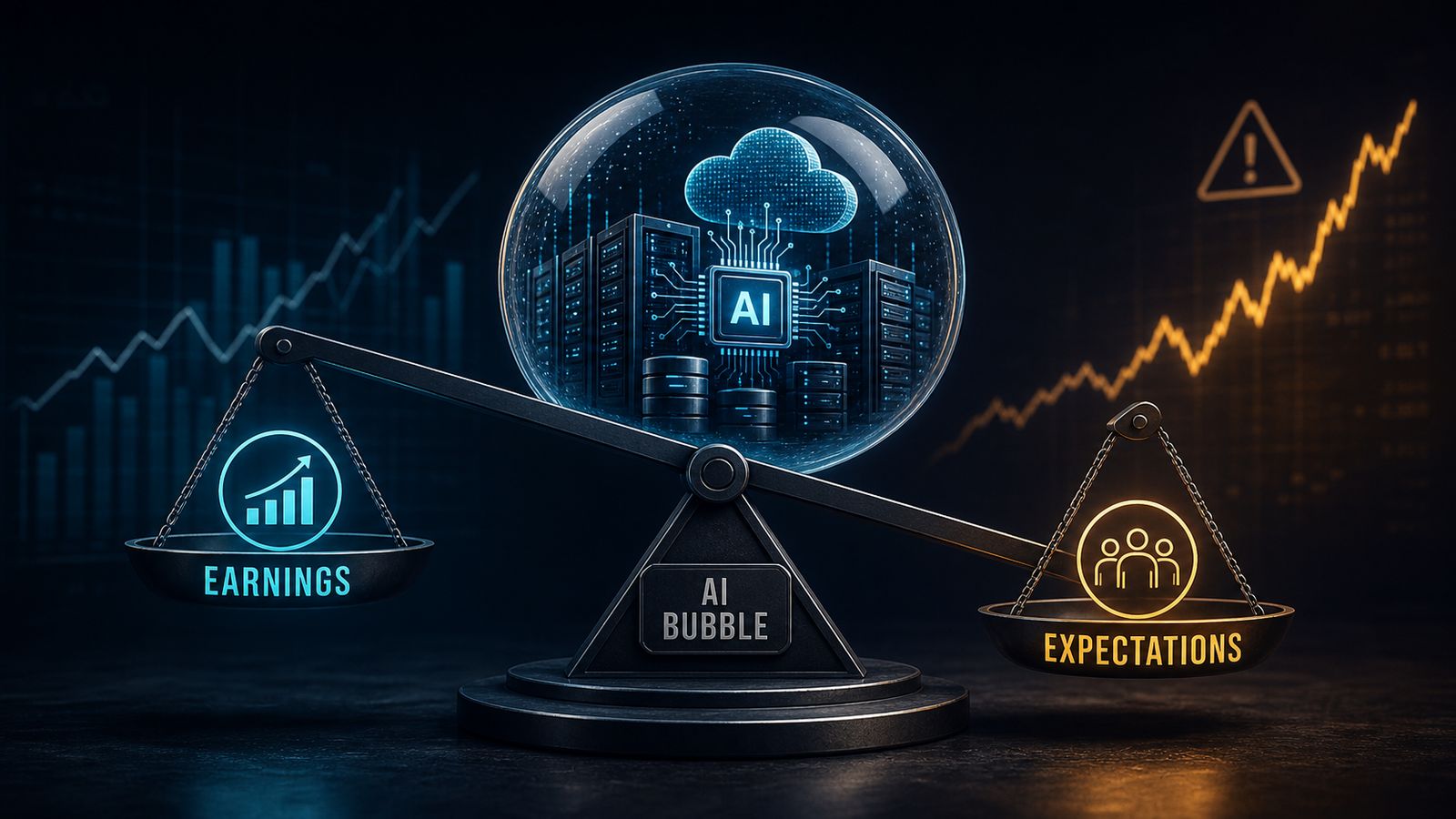
Artificial intelligence has real products, customers, infrastructure, and productivity potential. Semiconductor demand, cloud usage, and enterprise software adoption are measurable. That makes the debate harder than a simple comparison with an asset that has no underlying cash flow.
The correct question is therefore not “Is AI real?” It is “How much future revenue and profit does today’s price already assume?” Investors new to the theme should first understand what AI stocks represent. A powerful technology does not automatically make every company exposed to it a good investment.
Boom, Bubble, or Both?
What if the technology is real but some stock prices are still unreasonable? That is not a contradiction. Railroads and the internet changed the world, yet many investors lost money by paying too much for the wrong companies.
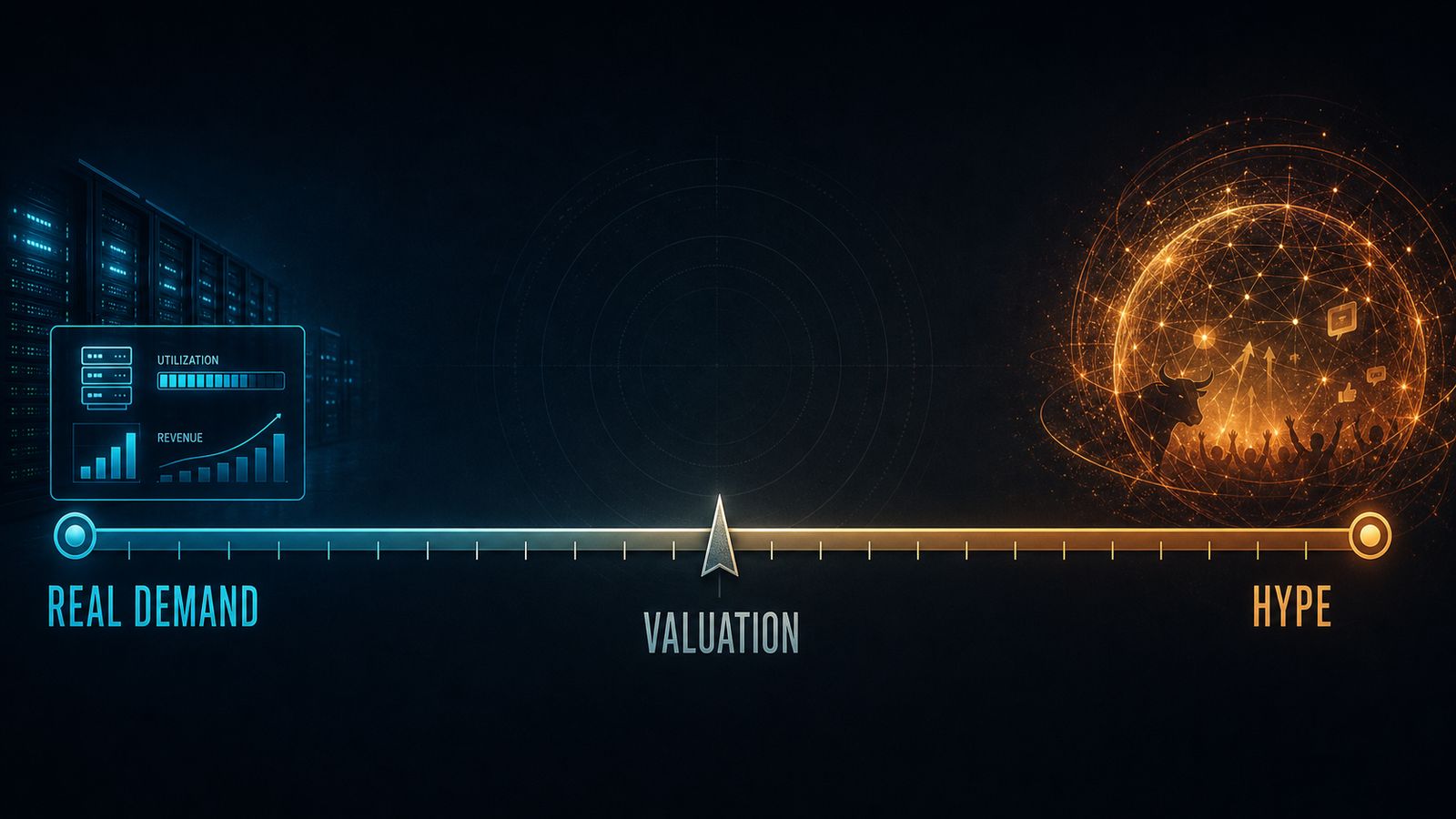
NVIDIA’s latest reported results showed record revenue and data-center sales. Micron also reported record quarterly results and tied the strength of memory demand to AI. Those numbers do not guarantee future stock returns, but they are very different from a tiny company adding “AI-powered” to a presentation without meaningful customers or cash flow.
This is how I divide the market in my own mind. First are companies selling chips, memory, cloud capacity, and software to paying customers. Second are strong companies whose stock prices may have run ahead of even good results. Third are speculative names rising mainly because investors want the next NVIDIA. The word AI appears in all three groups, but the investment risk is not remotely the same.
Market concentration adds another layer. Large AI-related companies carry significant weights in major indexes, so their prices can influence an investor who never bought a dedicated AI fund. Understanding the S&P 500 and market capitalization helps reveal that indirect exposure.
Seven AI Bubble Warning Signs
An AI bubble signal is most useful when it connects market enthusiasm to a measurable weakness in the underlying businesses. No single item below is decisive; several deteriorating together would make the risk more credible.
1. Valuations Require Flawless Growth
Valuation becomes dangerous when a company must compound revenue rapidly for many years, preserve unusually high margins, and defeat capable competitors merely to justify its current price. A high valuation alone is not proof of an AI bubble; fast-growing businesses often deserve premiums. The warning appears when even small disappointments make the investment case collapse.
2. AI Spending Grows Faster Than AI Revenue
Capital expenditure can lead revenue by years because data centers and networks must be built before customers fully use them. But eventually, spending must create billable demand. Watch whether cloud utilization, software subscriptions, inference volume, and customer retention grow with the installed capacity.
Gartner’s May 2026 forecast of 47% growth in worldwide AI spending confirms the extraordinary scale of the buildout. Investors should treat that as a starting point for analysis, not evidence that every dollar will earn an attractive return.
3. Revenue Rises but Margins Do Not
AI products can generate sales while consuming expensive chips, electricity, engineering talent, and network capacity. If revenue grows but gross margin, operating margin, or free cash flow keeps weakening, customers may be receiving more value than shareholders.
4. Debt and Financing Complexity Increase
A durable boom is safer when investment is funded by strong operating cash flow. Risk rises when projects depend on rapidly expanding debt, off-balance-sheet commitments, aggressive leasing, or continuous access to optimistic capital markets.
5. Customers, Suppliers, and Investors Fund One Another
Healthy ecosystems contain partnerships and strategic investments. However, circular relationships deserve scrutiny when a supplier invests in a customer that uses the money to buy the supplier’s products, or when reported demand depends heavily on related financing.
6. The Market Depends on a Few Winners
When a small group of companies drives a large share of index returns, a disappointment in one can affect far more portfolios than its ticker suggests. Concentration does not prove an AI bubble, because profitable leaders can legitimately become large. It does increase the market’s sensitivity to earnings, regulation, supply constraints, and capital-spending guidance.
Check overlap among individual stocks, technology funds, thematic funds, and broad indexes. GSV’s guide to diversification explains why owning many funds does not always mean owning many independent risks.
7. Investors Stop Distinguishing Quality
Have you noticed unfamiliar stocks jumping after one AI announcement? That is when I become cautious. In a speculative phase, promotional language starts replacing paying customers, durable revenue, and cash flow. Buyers focus on the rising chart because everyone else appears to be making money.
The SEC has taken enforcement action against misleading claims about AI use, commonly described as “AI washing.” Treat vague statements such as “AI-powered” as a research prompt, not an investment thesis. Evidence should appear in products, paying customers, margins, patents, contracts, or detailed filings.
How Investors Can Test the AI Story

Start with five connected variables: capital expenditure, revenue, margins, valuation, and debt. Capital spending should eventually support revenue. Revenue should eventually produce margins and cash flow. The resulting cash flows should support valuation, while debt must remain serviceable through a weaker scenario.
| Signal | Healthy Evidence | Warning Evidence |
|---|---|---|
| Capex | Capacity additions match contracted or visible demand | Buildout repeatedly outruns utilization |
| Revenue | Paying customers and recurring use expand | Pilots and promotional partnerships dominate |
| Margins | Unit economics improve with scale | Compute and acquisition costs absorb growth |
| Valuation | Price allows several reasonable outcomes | Only an exceptional outcome justifies price |
| Debt | Cash flow comfortably supports obligations | Refinancing depends on continued enthusiasm |
What to Do When Cash Is Waiting
This is the part I wrestle with myself. If I keep cash, I worry about missing the next surge. If I buy immediately, I worry that the correction is not finished. There is no signal that removes both fears.
For a beginner, the cleanest answer may be to stop making one decision carry the whole future. Divide a planned purchase into several smaller entries. This does not guarantee a better price, but it reduces the pressure to identify the exact bottom today.
What about buying more of a stock that has fallen—often called averaging down? Ask why the price fell. If the business, competitive position, and long-term thesis remain intact, a lower price may improve the opportunity. If revenue expectations, margins, debt, or the technology itself deteriorated, buying more can simply increase exposure to a mistake.
I also separate “I want to own more of this business” from “I want my loss to disappear faster.” Those thoughts can feel identical inside an order screen. They are not. The second one is about emotion, not value.
A concern about an AI bubble does not require selling every technology holding. Calculate direct and indirect exposure first. You may own the same companies through individual shares, a broad index fund, a retirement account, and a technology ETF.
Then set a maximum position size before volatility makes the choice for you. Your risk tolerance is the loss you can endure without abandoning the plan—not the gain you hope the next rally will deliver.
Finally, compare companies instead of buying the theme. A profitable infrastructure leader, an established platform, and a promotional small-cap stock should not receive the same valuation method or position size. Real AI demand can survive even if weak companies do not.
How This Guide Was Verified
- NVIDIA: First-Quarter Fiscal 2027 Results
- Micron: Third-Quarter Fiscal 2026 Results
- SEC: Enforcement Actions Involving Misleading AI Claims
- Investor.gov: Artificial Intelligence and Investment Fraud
- SEC EDGAR Company Filings
Final Thoughts
I feel the urgency too. I have cash available, I own major AI and semiconductor companies, and every rebound raises the same question: what if this is the last chance before prices run again?
But urgency is not research. NVIDIA, Microsoft, Meta, Samsung Electronics, SK hynix, and Micron still need to justify their prices through revenue, margins, cash flow, and durable demand. Smaller companies deserve even more skepticism when the story is louder than the financial evidence.
When one of my holdings falls, I do not want to buy more merely because my account is red. I want to ask whether I would choose that company at today’s price if I did not already own it. That question is not perfect, but it is more useful than trying to erase discomfort.
Will AI stocks surge again soon? They might. They might also fall further. I cannot know the next turn, and neither can the loudest person on the screen. What I can control is the quality I buy, the price I accept, the size of each position, and whether I still have room to think after the market moves.
Frequently Asked Questions
Is AI definitely in a bubble in 2026?
No. Strong spending, high valuations, and investor concern are warning inputs, not definitive proof. Different companies can show very different demand, profitability, and valuation conditions.
What could cause an AI stock correction?
Slower customer adoption, weaker margins, reduced capital-spending guidance, higher interest rates, regulation, supply changes, or earnings below elevated expectations could trigger a correction.
Would an AI bubble hurt the entire stock market?
It could affect broad indexes because several large AI-related companies have substantial weights, but the impact would depend on the size, duration, and economic spillovers of any decline.
How can beginners invest in AI more safely?
No investment is safe from loss. Beginners can limit single-stock concentration, understand fund overlap, use position-size rules, diversify, and avoid buying solely because prices recently rose.
Continue Learning
Ready for the next step? Explore these related investing guides.
Educational disclaimer: This article is for general educational purposes only and is not personalized financial, tax, or legal advice. Consider your objectives, time horizon, financial situation, and risk tolerance before investing.