
AI stocks are shares of public companies that may benefit from artificial intelligence, either because they build AI tools, supply AI infrastructure, use AI to improve their business, or sell products tied to the AI boom. For beginners, the important point is simple: an AI stock is still a stock. It can rise when expectations are high, but it can also fall if revenue, profits, valuation, or investor confidence disappoint.
The AI theme is one of the biggest market stories of 2026. Investors are watching chipmakers, cloud platforms, software companies, data center suppliers, and businesses that claim AI will improve margins. That makes the topic exciting, but also easy to misunderstand. A company using the phrase “AI” is not automatically a good investment, and a great technology trend does not guarantee that every AI-related stock will make money.
This guide explains what AI stocks are, how they work, why they can move so sharply, and how beginners can think about them without turning a long-term portfolio into a bet on hype.
I own NVIDIA, Microsoft, Meta, Samsung Electronics, and SK Hynix, so the AI boom is not an abstract story to me. NVIDIA led the first wave, then memory demand pulled Samsung, SK Hynix, and Micron into the spotlight. When those names move, the excitement can spread far beyond the companies producing the strongest results.
I have also watched small companies with little-known businesses rise simply because the whole AI theme was hot. That is where beginners can get hurt. A powerful trend makes it easy to believe every company attached to the trend will become a winner.
I prefer established businesses I can understand, but even a great company can be a painful investment at an unrealistic price. Before buying an AI stock, ask what it actually sells, how AI changes revenue or profit, who pays for it, and how much future success the current price already assumes.
Key Takeaways
- AI stocks are companies with business exposure to artificial intelligence, but the exposure can be direct, indirect, or mostly promotional.
- The strongest AI companies usually need real revenue, durable demand, financial strength, and a reasonable valuation, not just a popular story.
- AI stocks can be volatile because expectations, competition, interest rates, and market concentration can change quickly.
- Beginners do not need to pick individual AI winners to get AI exposure; broad index funds and ETFs may already own major AI-related companies.
- Official filings, risk disclosures, and basic stock research matter more than headlines or social media excitement.
What Are AI Stocks?
AI stocks are public companies whose future business may be affected by artificial intelligence. Some are obvious. A semiconductor company may sell chips used to train AI models. A cloud company may rent computing power to businesses building AI tools. A software company may sell AI-powered products to customers.
Other AI stocks are less direct. A retailer may use AI to manage inventory. A bank may use AI to detect fraud. A manufacturer may use AI to improve productivity. These companies may benefit from AI, but their stock prices still depend on the whole business, not just the AI story.
That is why beginners should separate three ideas: technology, business, and stock price. A technology can be real and useful. A business can still struggle to turn that technology into profits. And a stock can still be too expensive if investors have already priced in years of success.
If you are new to equities, start with the basic idea that a stock represents ownership in a company. GSV’s guide to what a stock is explains that foundation. AI does not change the basic rule: shareholders benefit only if the business creates value over time and the price paid makes sense.
How AI Stocks Make Money
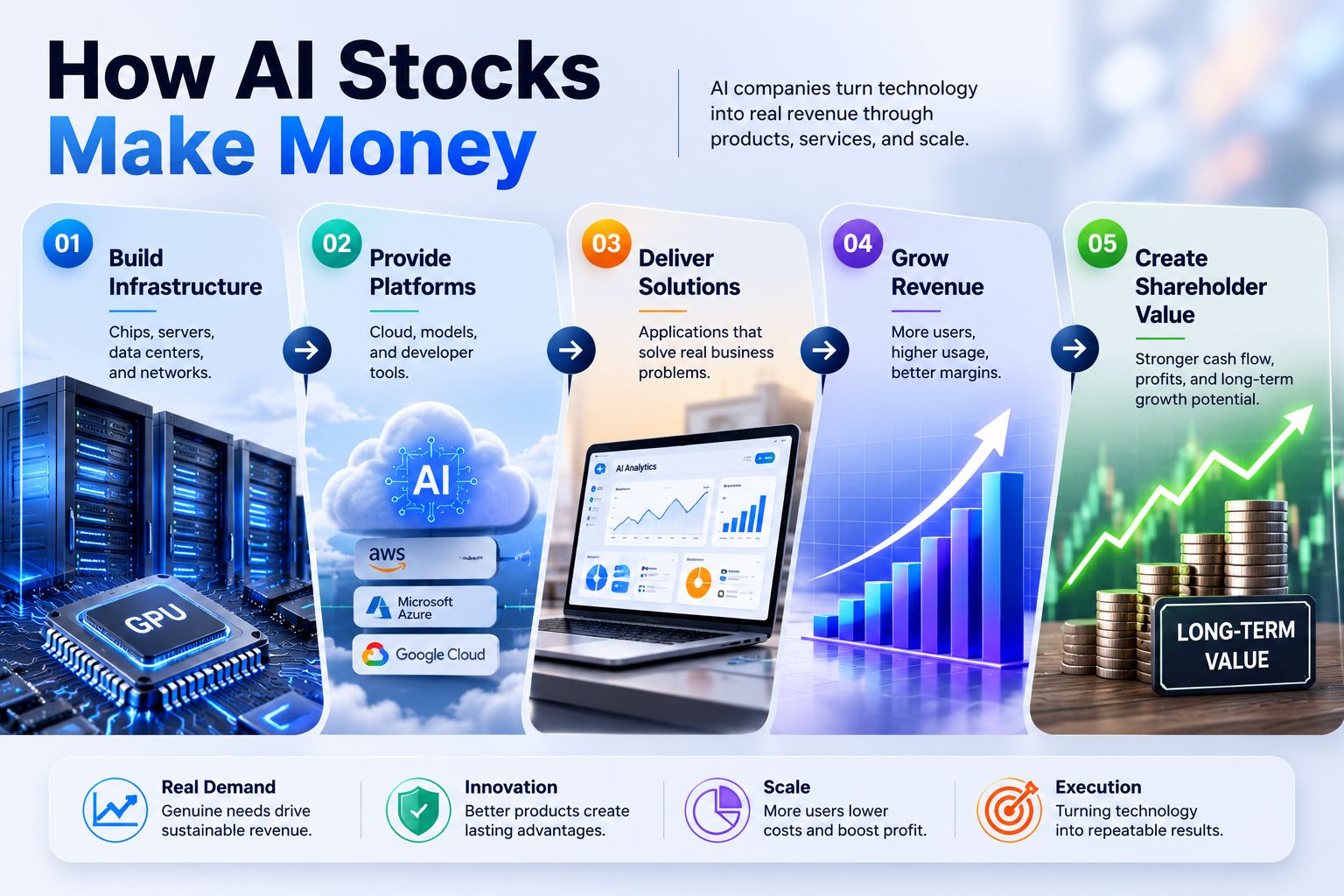
AI stocks can make money in several different ways. The first group sells the infrastructure behind AI: chips, servers, networking equipment, power systems, and data center components. These companies may benefit when other businesses spend heavily to build AI capacity. GSV’s guide to investing in AI data centers follows that physical stack from electricity to paying customers.
The second group sells platforms. Cloud providers, enterprise software firms, and cybersecurity companies may add AI features to products customers already use. Their goal is to increase revenue, improve retention, or charge more for higher-value tools.
The third group uses AI internally. A company may not sell AI products at all, but it may use automation, data analysis, or machine learning to cut costs or improve service. If AI improves margins, that can matter to shareholders.
The fourth group is more speculative. These companies may talk about AI before they have meaningful AI revenue. Some will eventually build useful businesses. Others may mostly benefit from temporary investor excitement. This is where beginners need to be careful.
The SEC has warned that companies and advisers should not make false or misleading claims about artificial intelligence. In a 2024 enforcement action, the SEC described misleading AI claims as “AI washing,” where firms claimed AI capabilities they did not actually have or overstated how AI was used. That warning matters because popular themes attract both real innovation and aggressive marketing.
One practical way to think about AI stocks is to ask where the cash comes from. Is the company selling real products? Are customers paying? Are margins improving? Are profits growing? If the answer is unclear, the stock may be more of a story than an investment.
AI Stocks and Valuation
Valuation is the price investors pay for a company’s future. AI stocks can become expensive because investors expect rapid growth. Sometimes that optimism is justified. Sometimes expectations become so high that even good results are not enough.
Market capitalization is one quick way to understand how much the stock market values a company. It is calculated by multiplying the stock price by the number of shares outstanding. If a company’s market cap is already enormous, it may need very large future profits to justify that price. GSV’s article on market capitalization explains why size matters when comparing companies.
AI also affects stock indexes. Many large AI-related companies are major parts of broad market benchmarks. If you own an S&P 500 index fund, you may already own exposure to some of the biggest AI names. That is why the AI theme can influence the whole market, not only a small set of technology stocks.
GSV’s guide to the S&P 500 is helpful here because many beginners do not realize how index weighting works. Larger companies can have more influence on market-cap-weighted indexes. When a handful of large technology companies perform well, the index can look strong even if many smaller companies are not doing as well.
This does not mean AI stocks are bad. It means price matters. A good company can still be a poor investment if expectations are unrealistic. A slower-growing company can sometimes be a better investment if the price already reflects modest expectations.
Common Types of AI Stocks
AI stocks are not all the same. Beginners often group them together, but the risks can be very different.
| Type | What It Means | Main Risk |
|---|---|---|
| Chip and hardware companies | Supply processors, memory, servers, or networking equipment used for AI | Demand cycles, competition, and high expectations |
| Cloud platforms | Provide computing power and services for AI development | Heavy capital spending and margin pressure |
| Software companies | Add AI features to business or consumer products | Customers may not pay enough for new features |
| Data center and infrastructure firms | Support power, cooling, storage, or connectivity needs | Project delays, debt, and energy constraints |
| AI users | Use AI to improve productivity inside an existing business | Benefits may be hard to measure or slow to appear |
Some companies fit more than one category. A large technology company may sell cloud services, develop AI models, buy chips, and use AI in its own products. That can make the business powerful, but it can also make analysis more complicated.
For semiconductor-related AI exposure, GSV’s article on HBM memory and AI explains one infrastructure layer behind the AI boom. It is a good example of how AI demand can flow through suppliers, not just the companies with the most recognizable AI products.
Risks Beginners Should Understand
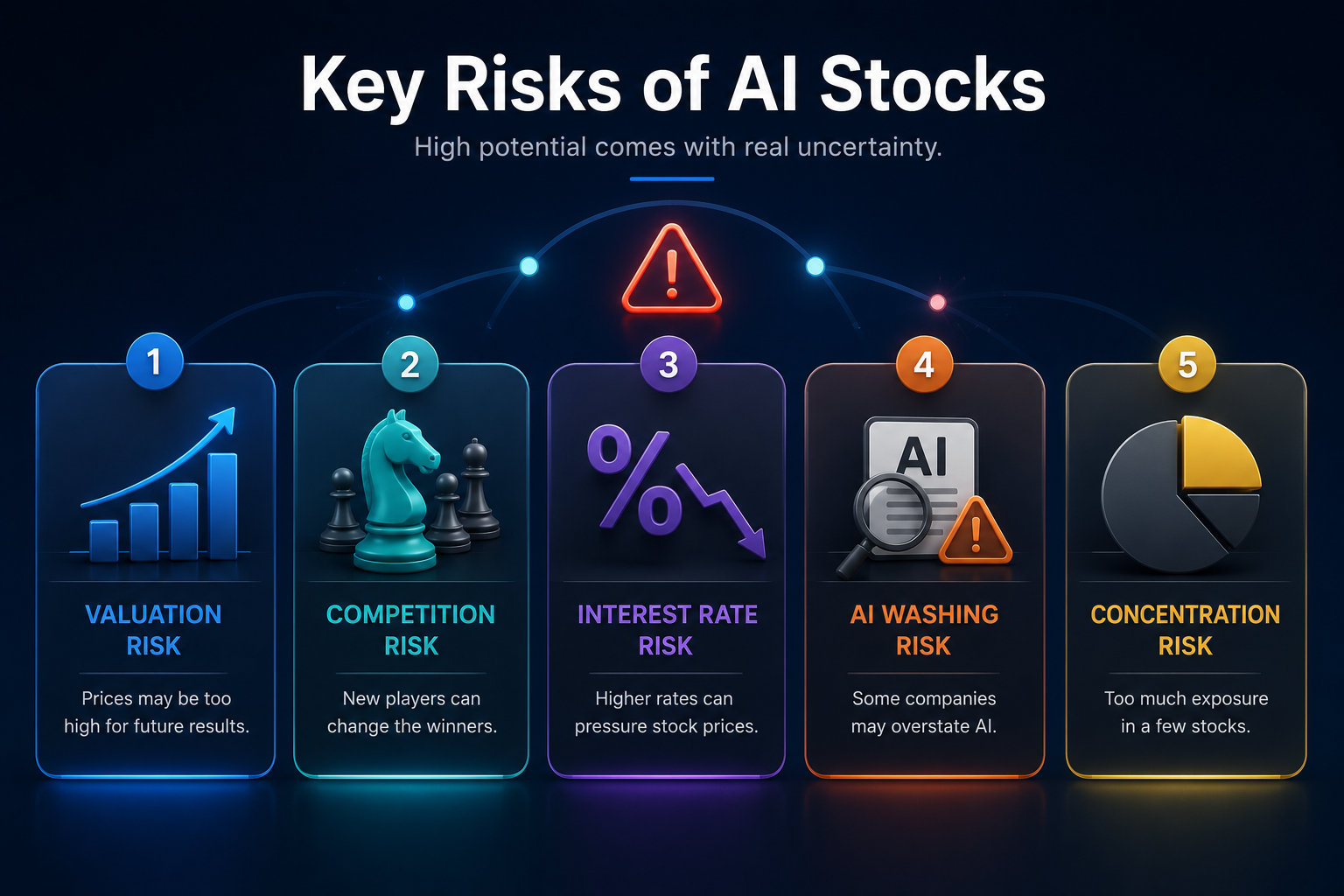
The first risk is concentration. If too much of a portfolio depends on one theme, one sector, or a few large companies, the investor may feel diversified while still carrying a lot of hidden exposure. This is especially important when AI-related companies dominate headlines and major indexes.
The second risk is valuation. A stock can fall even after reporting good growth if investors expected even more. High expectations leave less room for disappointment.
The third risk is execution. AI projects require talent, data, infrastructure, and customer adoption. A company may have an impressive demo but still struggle to create a profitable product.
The fourth risk is competition. Many companies are trying to capture the same AI opportunity. If competition pushes prices down or raises spending needs, shareholders may not receive as much benefit as the headlines suggest.
The fifth risk is hype and fraud. New themes can become especially speculative when investors chase companies before the technology has a proven business model. The same caution applies to quantum computing stocks, where real scientific progress and stock-market expectations can move at very different speeds. The SEC’s AI washing warning is a reminder that investors should verify claims. If a company says AI is central to its future, look for evidence in official filings, revenue discussion, risk factors, and management commentary. Do not rely only on social media clips, promotional videos, or vague claims.
The sixth risk is interest rates. Growth stocks often depend heavily on future profits. When rates rise or stay high, investors may become less willing to pay high prices for profits expected far in the future. GSV’s guide to inflation and interest rates explains why rates can affect stock valuations.
AI Stocks vs AI ETFs and Index Funds
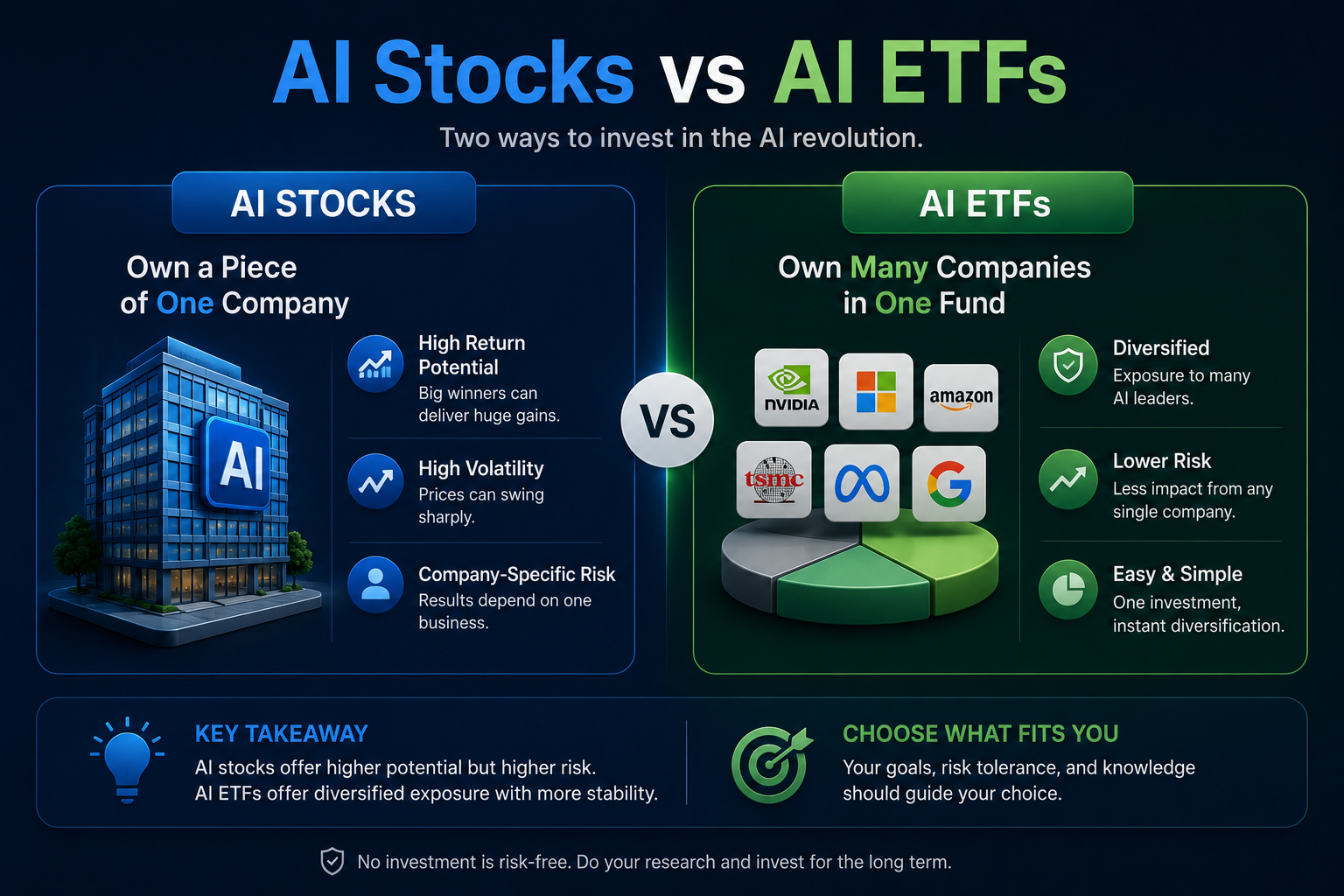
Beginners do not have to pick individual AI stocks. Many investors get AI exposure through broad index funds, sector ETFs, or technology ETFs. This can reduce single-company risk, although it does not remove market risk.
A broad index fund may already own major AI-related companies because those companies are large parts of the market. An ETF can also provide exposure to a basket of companies instead of one stock. GSV’s guide to what an ETF is explains how that structure works.
The tradeoff is control. If you buy one AI company, you choose the specific business you believe in. If you buy a fund, you accept a basket. The basket may include strong winners, weaker companies, and stocks that only loosely connect to AI.
Costs also matter. If two funds offer similar exposure, a lower expense ratio can help long-term returns. GSV’s article on ETF expense ratios explains why small fund fees can add up over time.
For many beginners, a broad portfolio plus modest thematic exposure is easier to manage than a concentrated bet on a few AI names. The goal is not to avoid innovation. The goal is to avoid letting excitement replace a plan.
How to Research AI Stocks Before Buying
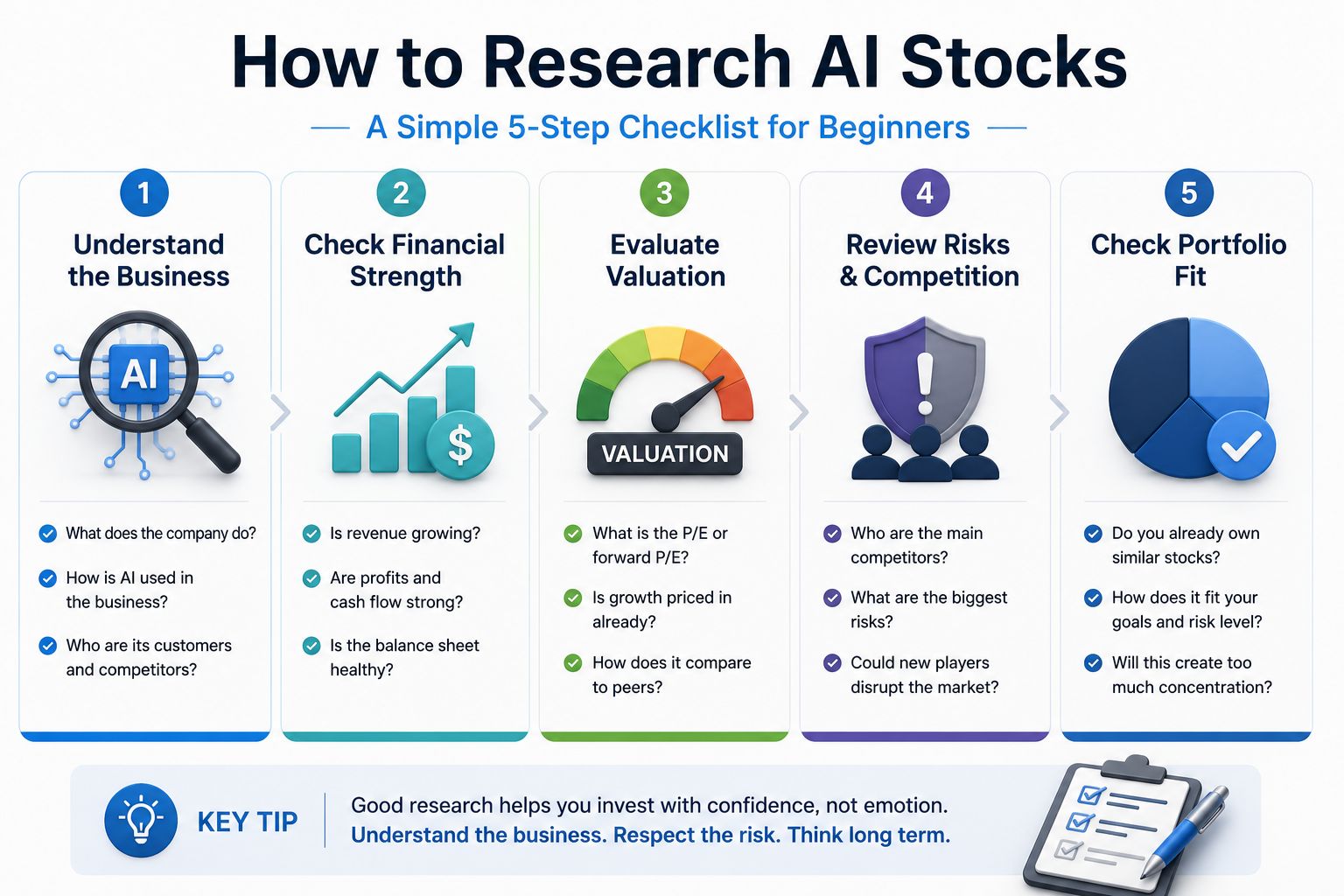
Start with the company’s official filings. Public companies file reports with the SEC, and those reports can show revenue, profit, debt, risks, and management discussion. The language may feel dry, but it is usually more reliable than promotional summaries.
Next, identify the company’s real AI exposure. Ask whether AI is a current revenue driver, a future growth plan, a cost-saving tool, or mostly a marketing theme. The difference matters.
Then compare growth with valuation. A company growing quickly may deserve a higher valuation than a slow-growth company, but there is still a limit. If the stock price assumes years of flawless execution, the risk of disappointment is higher.
Also check concentration inside your own portfolio. You may already own AI-related companies through an employer retirement plan, an S&P 500 fund, a technology ETF, or a brokerage account. Adding more individual AI stocks could increase overlap without you realizing it.
GSV’s guide to asset allocation can help you think about how stocks fit with bonds, cash, and long-term goals. If a theme grows too large after a big run, portfolio rebalancing can bring risk back toward your plan.
Common Mistakes With AI Stocks
The first mistake is buying only because a stock is popular. Popularity can push prices higher for a while, but long-term returns still depend on business results and valuation.
The second mistake is assuming every AI company benefits equally. Some companies may spend heavily on AI without earning attractive returns. Others may use AI quietly and profitably without getting much attention.
The third mistake is ignoring existing exposure. A beginner may buy several AI stocks while also owning index funds that already hold the same companies. That can make the portfolio more concentrated than it looks.
The fourth mistake is confusing a great product with a great stock. A company can build impressive technology and still disappoint shareholders if the price is too high or competitors move faster.
The fifth mistake is treating AI as a guaranteed return story. No technology removes the basic risks of investing. Stocks can fall. Forecasts can be wrong. Strong companies can go through long periods of weak returns.
Final Thoughts
AI stocks can be an important part of the market, but they are not magic. They are shares of real companies with revenues, costs, competitors, valuations, and risks. The best approach for beginners is to understand the business first, check the price second, and think about portfolio fit before buying.
If you want AI exposure, you can get it through individual stocks, broad index funds, ETFs, or simply by owning a diversified portfolio that already includes large technology companies. The right choice depends on your knowledge, risk tolerance, and investment plan.
The key is to stay curious without becoming careless. AI may reshape many industries, but disciplined investors still need diversification, valuation awareness, and a healthy respect for hype.
FAQ
Are AI stocks good for beginners?
AI stocks can be interesting for beginners, but they can also be volatile. Many beginners may be better served by learning the basics first and using diversified funds before buying individual AI companies.
What is the safest way to invest in AI stocks?
There is no risk-free way to invest in AI stocks. A diversified index fund or ETF may reduce single-company risk, but it can still lose value when the market falls.
Do index funds already include AI stocks?
Many broad U.S. index funds include major AI-related companies because those companies are large parts of the stock market. Investors may already have AI exposure through an S&P 500 fund or total market fund.
What is AI washing?
AI washing is when a company or adviser overstates or misrepresents its use of artificial intelligence. The SEC has warned investors about misleading AI claims.
Should I buy AI stocks after a big rally?
A big rally does not automatically mean a stock is bad, but it does raise the importance of valuation and expectations. Beginners should avoid buying only because prices have recently gone up.