

Buffer ETFs are exchange-traded funds that use options to absorb a stated portion of losses in a reference asset over a defined outcome period. The trade-off is equally important: gains are usually limited by an upside cap, protection is not guaranteed in every situation, and buying mid-period can produce a different result from buying on day one.
Buffer ETFs have grown rapidly as investors look for a middle ground between full stock-market exposure and moving entirely to cash or bonds. They can be useful risk-management tools, but their advertised buffer only makes sense when you understand the starting date, remaining cap, remaining buffer, fees, and reference asset.
When the market falls hard, the word “buffer” sounds comforting. I have watched long-term holdings drop even when the businesses themselves still looked strong, and I understand the appeal of putting a floor under part of that pain. But I become cautious whenever protection is presented without equal attention to its price.
With a buffer ETF, the price is often an upside cap. If the market rises sharply, the fund may stop participating after the cap while an ordinary index fund keeps moving. Buying after the outcome period has already begun can also leave you with a very different trade-off from the one shown in the headline.
Before buying, ask two uncomfortable questions: How much protection is actually left today, and how much upside am I giving away for it? If those numbers cannot be explained in plain English, the product may be too complicated for the job you want it to do.
Key Takeaways
- Buffer ETFs generally protect against an initial slice of reference-asset losses during a specified outcome period.
- Investors normally give up gains above a stated cap in exchange for that downside buffer.
- The quoted outcome is designed for investors who enter near the beginning and hold through the end of the period.
- A buffer is not a floor: losses beyond the protected range can still be substantial.
- Fees, dividends, taxes, trading prices, and mid-period purchases can make the investor’s result differ from a simple illustration.
What Are Buffer ETFs?
Also called defined-outcome ETFs, buffer ETFs seek to deliver a predesigned range of returns tied to a reference asset, such as a broad stock index ETF. They usually combine exchange-traded options with cash or collateral rather than simply owning every stock in the reference index.
The options are arranged to create three features: exposure to gains in the reference asset, a cushion against an initial amount of loss, and a limit on the maximum gain. Those terms apply over an outcome period, often approximately one year, although periods vary.
The word “defined” can sound more certain than it is. The outcome is defined by a formula and conditions, not promised by a government or insurance company. Market price, expenses, taxes, option valuation, and the timing of the purchase and sale still affect what an investor receives.
Buffer ETFs remain ordinary exchange-traded funds in important ways: their shares trade during the day, can trade above or below net asset value, charge expenses, and can be bought or sold through a brokerage. GSV’s ETF beginner guide explains the wrapper.
How Buffer ETFs Work
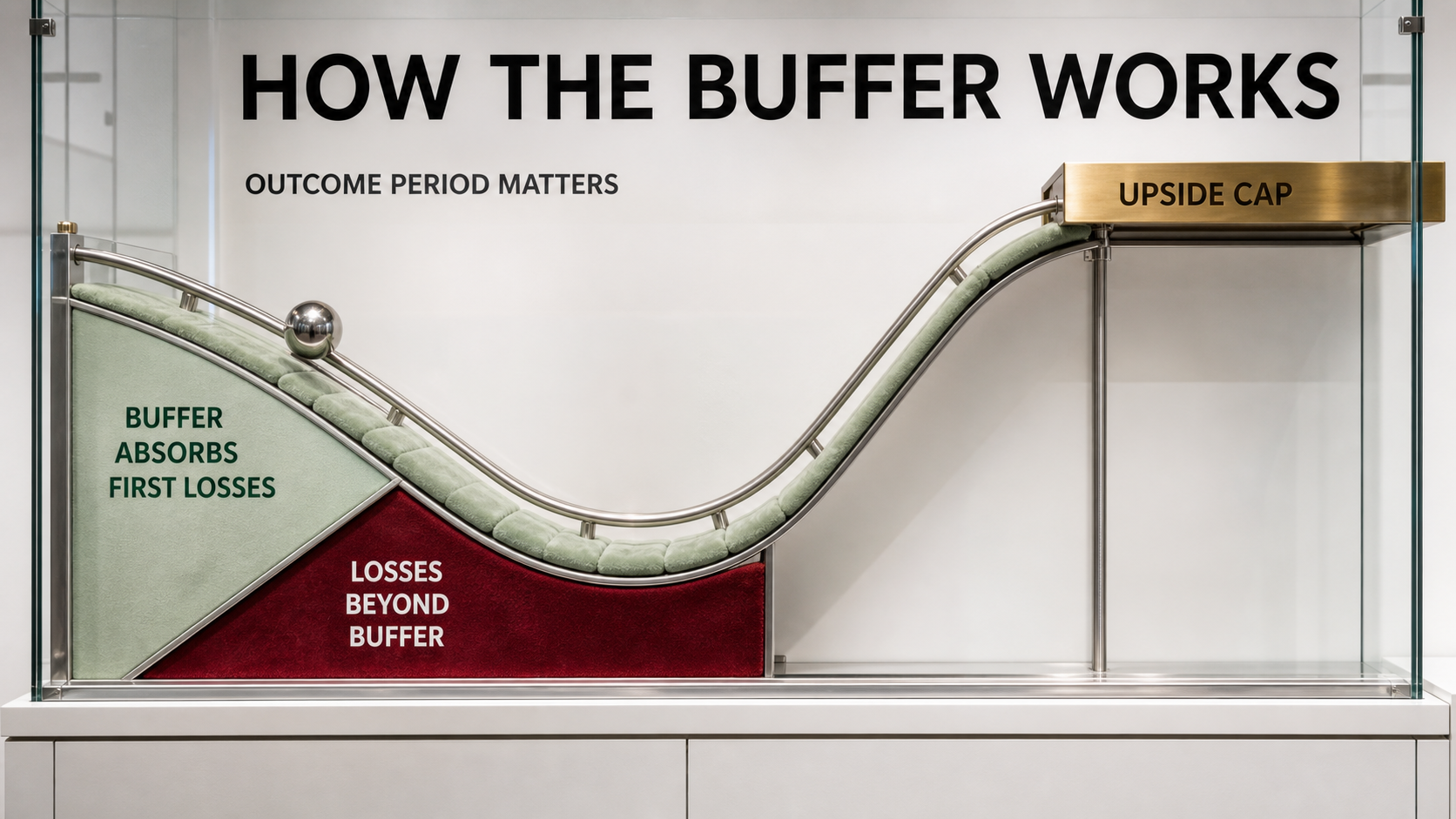
Consider a simplified fund with a 10% buffer and a 15% cap for a one-year outcome period. These figures are hypothetical, exclude fees and taxes, and are used only to explain the mechanism.
If the Reference Asset Rises
If the reference asset rises 8% over the full period, the fund may seek to deliver approximately that price return before expenses. If it rises 25%, the fund’s return would generally stop around the 15% cap. The investor gives up gains above the cap to help finance downside protection.
If the Reference Asset Falls Within the Buffer
If the reference asset falls 7%, the 10% buffer is designed to absorb that loss before expenses. The ETF’s result may be near flat under the simplified design, but it is not guaranteed to be exactly zero because costs, trading, distributions, and implementation matter.
If the Loss Exceeds the Buffer
If the reference asset falls 25%, a 10% buffer does not limit the loss to 10%. In a simple first-loss design, the fund might decline approximately 15% before expenses: the market loss beyond the initial 10% remains with the investor.
| Reference-Asset Return | Simplified ETF Outcome | Why |
|---|---|---|
| +8% | About +8% | Gain is below the hypothetical cap |
| +25% | About +15% | Gain is limited by the hypothetical cap |
| −7% | About 0% | Loss falls inside the hypothetical buffer |
| −25% | About −15% | Loss exceeds the hypothetical buffer |
Not all products use the same structure. Some buffer the first 5%, 10%, 15%, or another portion of losses. Others seek protection against losses after a deductible-like first layer, or use a floor that targets a maximum loss. Always read the prospectus rather than applying one fund’s diagram to another.
Many designs track the price return of the reference asset rather than its total return, so dividends may not be included in the same way as owning a conventional index fund. This can widen long-term performance differences. Compare the reference carefully with GSV’s guide to index funds.
Why Your Buffer ETF Purchase Date Matters
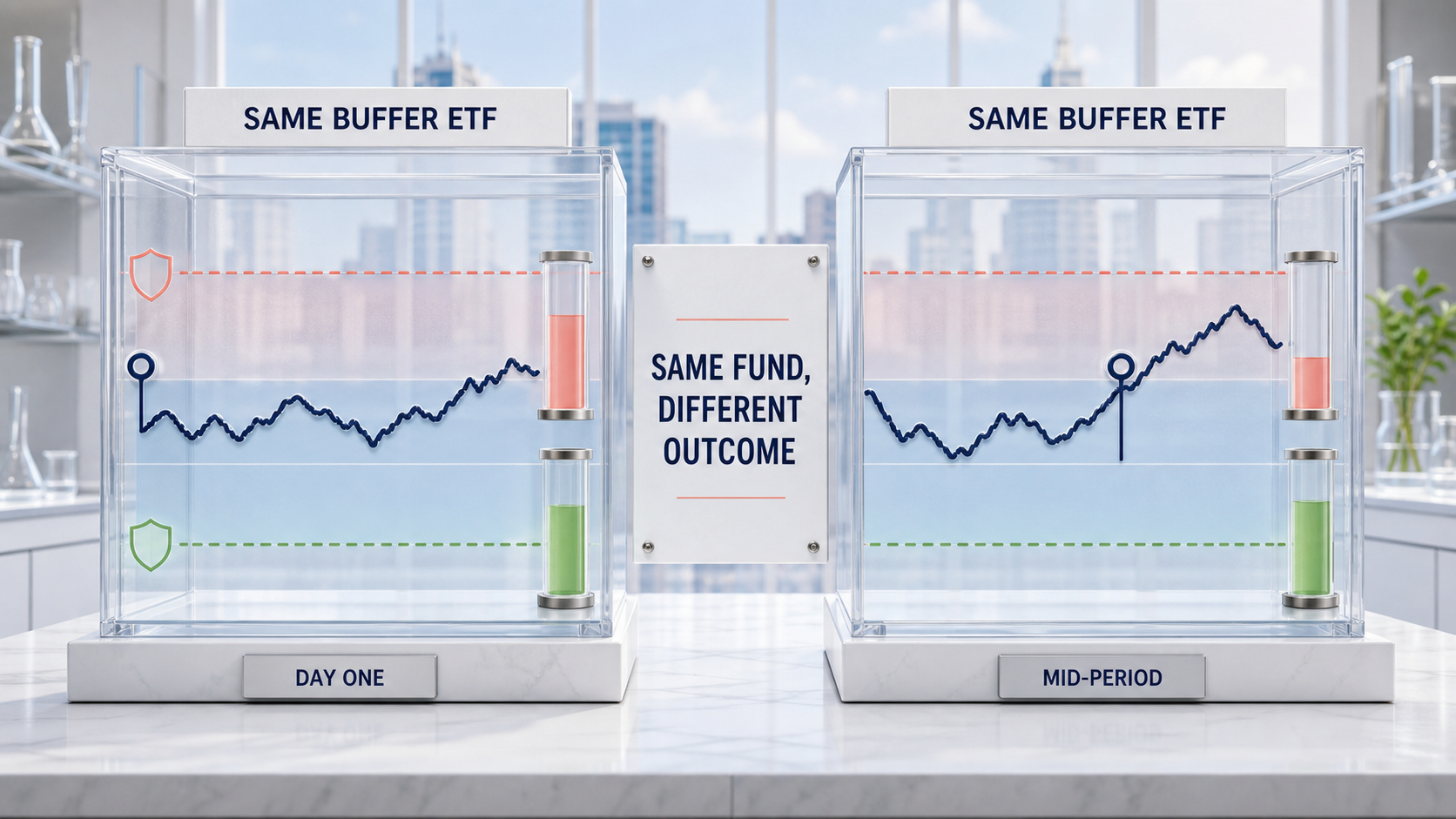
The stated cap and buffer are generally calibrated at the beginning of an outcome period. As the reference asset moves and option values change, the protection and upside remaining for a new buyer change too. The fund may publish daily estimates, but the original headline numbers no longer describe a mid-period purchase.
Suppose the market has already risen close to the cap. A new buyer may have little upside remaining while still facing meaningful downside. If the market has fallen into the buffer, a new buyer may not receive the full original buffer from that lower purchase price. The ETF ticker is the same; the economic starting point is not.
Selling before the outcome period ends creates a similar issue. The ETF’s market value reflects remaining time, option prices, market volatility, interest rates, and the reference asset’s level. The full-period payoff diagram does not determine the exact interim sale price.
This path dependence makes buffer ETFs more complex than a broad index ETF. Two investors in the same fund can experience different returns because they entered and exited on different dates. A fund-of-funds that ladders several outcome periods may reduce dependence on one start date, but adds another layer of strategy and expense.
Advantages and Disadvantages of Buffer ETFs
Potential Advantages
- Defined risk framework: The cap, buffer, reference asset, and outcome period create an understandable decision structure.
- Behavioral support: A downside cushion may help a nervous investor remain invested during moderate declines.
- ETF access: The strategy is available through exchange-traded shares rather than a privately negotiated options portfolio.
- No direct options management: The fund handles option selection, expiration, and reset mechanics.
- Portfolio customization: Different buffers and periods can address specific risk budgets.
The behavioral benefit can be meaningful. A risk-appropriate strategy that an investor holds may work better than a higher-return strategy abandoned during a downturn. Still, the fund should fit the overall allocation and not substitute for an emergency fund or short-term cash need.
Potential Disadvantages
- Capped upside: Strong rallies can leave the fund far behind the reference asset.
- Incomplete protection: Losses beyond the buffer remain with the investor.
- Timing complexity: Mid-period buyers receive a different remaining payoff profile.
- Higher expenses: Complex strategies commonly cost more than broad index ETFs.
- Dividend gap: The reference may be based on price return rather than total return.
- Options risk: Derivative pricing, liquidity, and implementation affect results.
A cap is especially costly during a powerful bull market. The investor may experience years of modest protection that is not used while repeatedly surrendering returns above the cap. Conversely, a severe crash can move far beyond the protected layer. Protection has a price in both opportunity cost and expenses.
Compare this structure with simpler ways to reduce risk: holding fewer stocks, adding high-quality bonds, keeping required cash separate, or using a diversified allocation aligned with your time horizon. GSV’s Asset Allocation guide provides that broader context.
How to Evaluate Buffer ETFs Before Buying

1. Identify the Reference Asset
Know whether buffer ETFs under review are tied to a broad U.S. index, small-cap stocks, international equities, a sector, or another ETF. The buffer changes the payoff; it does not remove the underlying market’s economic risk.
2. Mark the Outcome Period
Record the start and end dates. Determine whether you are buying near day one or after markets have moved. Check what happens at expiration: many funds reset into a new period with a new cap and buffer rather than liquidating.
3. Check the Remaining Cap and Buffer
Do not rely on the product name or original marketing number. Use the issuer’s current outcome data and read its methodology. Remaining upside can be small, and remaining protection can differ from the original headline.
4. Read the Buffer Sequence
Confirm whether the fund absorbs the first losses, begins protection after an initial loss, or targets a floor. “10% buffer” can describe a different payoff from “10% floor.” Look at multiple market scenarios in the prospectus.
5. Compare Fees and Forgone Dividends
Expense ratio is visible, but opportunity cost also matters. Compare the ETF with the total return—not only the price chart—of a conventional reference investment. GSV’s ETF Expense Ratio guide explains how ongoing costs compound.
6. Inspect Liquidity and Trading
Look at assets, volume, bid-ask spread, premium or discount, and the liquidity of the underlying options. A limit order may help control the price paid, especially in a thinly traded fund. See Bid-Ask Spread and Limit Orders.
7. Decide the Portfolio Role
Define what the fund replaces. If it replaces stocks, the cap can reduce long-term growth. If it replaces bonds, it can introduce much larger equity losses beyond the buffer. If it is simply added, the portfolio may become more complicated without improving diversification.
Buffer ETFs may fit an investor who wants measured equity exposure for a defined horizon and understands the full payoff. They are less suitable for someone who needs principal certainty, immediate liquidity at a known value, uncapped equity growth, or a product that can be understood from its ticker alone.
Common Buffer ETF Mistakes
- Reading “buffer” as “guarantee.” The fund can lose money, including large amounts beyond the buffer.
- Buying mid-period using day-one terms. Remaining cap and protection have changed.
- Ignoring the cap. Downside protection is financed partly by surrendering upside.
- Comparing price return with total return. Dividends may make a conventional ETF’s result higher.
- Assuming all buffer structures match. First-loss buffers, floors, and other designs differ.
- Selling early without understanding option value. Interim returns need not match the end-of-period diagram.
- Using the fund as cash. It remains a market investment with possible loss and fluctuating price.
Another mistake is stacking several complex products without examining their combined exposure. More tickers do not necessarily create more diversification. Review reference assets, dates, caps, buffers, and correlations across the whole portfolio. GSV’s Diversification guide explains why structure and underlying exposure both matter.
Official Sources
- FINRA: Alternative and Emerging Products
- Investor.gov: Exchange-Traded Funds
- Investor.gov: Introduction to Options
- Investor.gov: Mutual Fund and ETF Fees
Final Thoughts
Buffer ETFs can make a portion of downside risk more explicit, but they do not make equity investing safe. The buffer applies under stated conditions, losses beyond it remain possible, and the upside cap can create substantial opportunity cost.
Before buying, check the reference asset, exact outcome dates, remaining buffer, remaining cap, expense ratio, dividend treatment, and portfolio role. The most important number is often not the advertised buffer—it is the payoff still available at the price and date you enter.
Frequently Asked Questions
Can buffer ETFs lose money?
Yes. They can lose money when losses exceed the buffer, when bought or sold during the outcome period, and because of fees, trading prices, and implementation factors.
Are buffer ETFs guaranteed?
No. They are market investments, not bank deposits or government-guaranteed insurance products. Read the prospectus for the fund’s exact risks.
What happens when the outcome period ends?
Many funds reset into a new period with a newly calculated cap and buffer. The investor generally remains invested unless shares are sold.
Do buffer ETFs pay dividends?
Terms vary, but many defined-outcome strategies target the price return of a reference asset and may not deliver dividends in the same way as directly owning a conventional index ETF.
Is a larger buffer always better?
No. More protection generally comes with a lower cap, higher cost, a different structure, or another trade-off. Compare the entire payoff and portfolio role.
Continue Learning
Compare complex ETFs with simpler structures.
Educational disclaimer: This article is for general educational purposes only and is not personalized investment, financial, tax, or legal advice. Caps, buffers, outcome periods, fees, option values, and market prices change. Read the current prospectus and official outcome information before investing.