

Have you ever seen a stock surge, noticed a 2x ETF beside it, and wondered whether the faster product was the smarter way to catch the move? That extra speed looks attractive on the way up. It becomes much harder to understand when the market starts swinging.
From the publisher: I watched Korean semiconductor shares rise sharply, then saw asset managers release a flood of products concentrated in Samsung Electronics and SK hynix, including single-stock leveraged ETFs. When the market later fell violently, long-term shareholders and beginners who bought near the top were left staring at painful losses.
I did not lose confidence in the companies I own, but I was angry. Their business results could remain strong while prices were pulled around by foreign selling, index moves, profit-taking, leverage, and crowded fund flows. For someone who had just entered the market, a 20% or 30% fall was not an abstract chart. It was savings disappearing on the screen.
Does that mean leveraged ETFs caused every decline? No. Markets rarely have one cause, and the effect of one product cannot be isolated from all the other trading around it. But concentrated leveraged products can add pressure because they must keep adjusting exposure as prices move. That is exactly why beginners need to understand the machinery before buying the exciting name.
Leveraged ETFs usually promise a multiple of one day’s return—not a multiple of whatever happens over a month or a year. That single word, daily, changes almost everything.
Key Takeaways
- Leveraged ETFs usually target a multiple of one day’s return, not a multiple of a long-term return.
- Daily resetting creates path dependence, so volatility can pull performance away from the simple 2x or 3x result investors may expect.
- A 2x fund can lose twice as much as its benchmark in one day, before fees and tracking differences.
- Single-stock leveraged products add concentrated company risk and remove the diversification offered by broad funds.
- These products generally require active monitoring and are usually unsuitable as set-it-and-forget-it holdings.
What Are Leveraged ETFs?
Leveraged ETFs use contracts such as swaps and futures to create amplified daily exposure to an index, sector, commodity, or individual stock. You do not need to master every contract first. You do need to know that the fund is rebuilt around a daily target. A 2x fund aims for approximately twice the benchmark’s daily percentage move before fees and other frictions. A 3x fund aims for approximately three times that daily move.
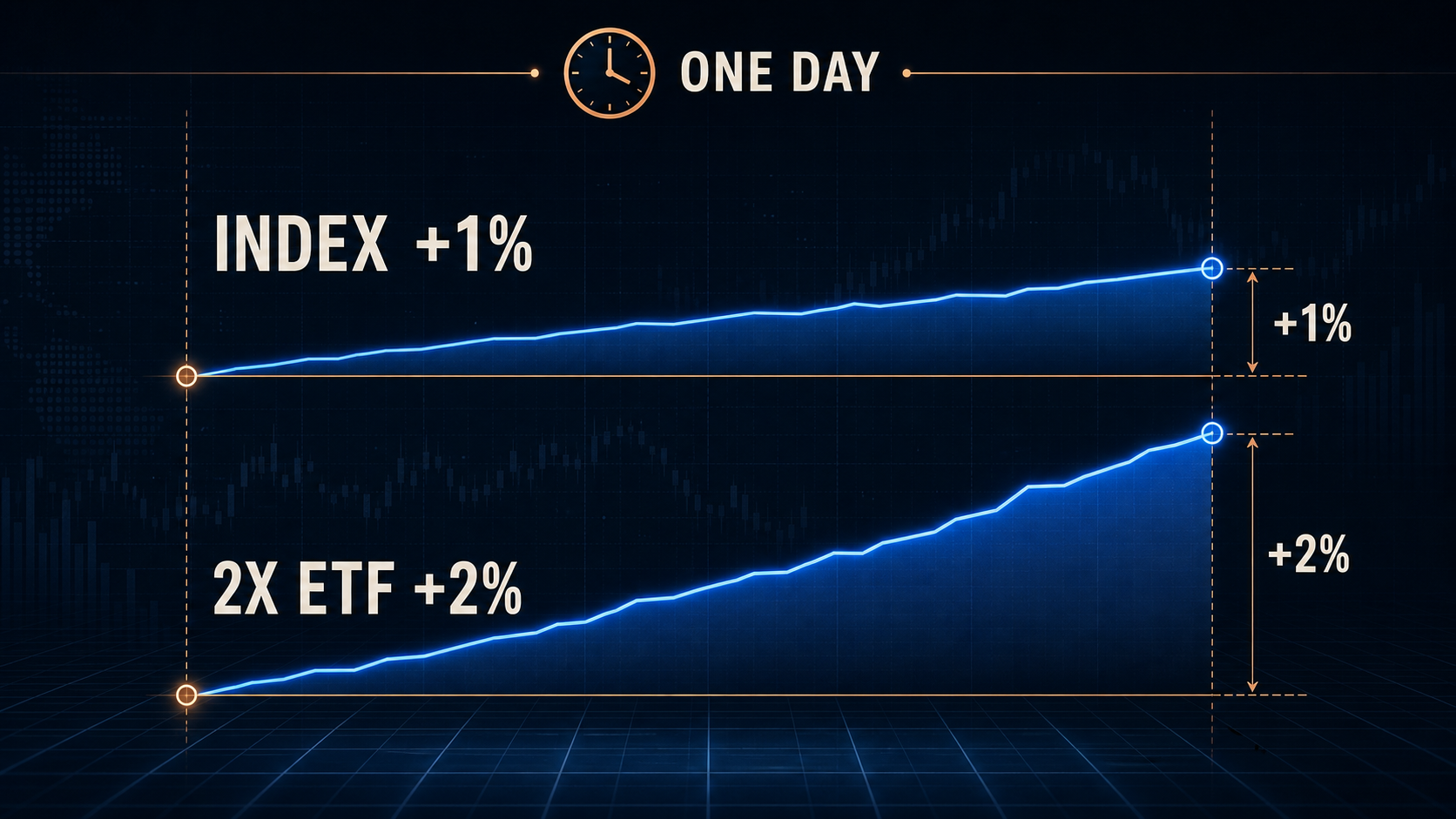
If an index rises 1% on a trading day, a 2x product generally targets a 2% gain. If the index falls 1%, the same product generally targets a 2% loss. The target applies from one market close to the next, and actual results can differ because of expenses, trading costs, financing costs, and imperfect execution.
That daily objective separates leveraged ETFs from a traditional ETF designed to track a benchmark without leverage. It also means investors should read the prospectus rather than assuming the number in a fund’s name describes every holding period.
How Leveraged ETFs Work Each Day
A leveraged fund adjusts its exposure near the end of each trading day so it can begin the next session near its stated multiple. When the fund gains, it may need to increase exposure. When it loses, it may need to reduce exposure. This rebalancing is what keeps the daily target in place.
Suppose a benchmark starts at $100 and rises 10% on day one, ending at $110. A 2x fund starting at $100 would target a 20% gain and end near $120. If the benchmark then falls 10% on day two, it ends at $99. The 2x fund would target a 20% loss from its new $120 base and end near $96.
The benchmark lost 1% across the two days, while the 2x fund lost 4%. The fund delivered its daily objective on both days, yet it did not deliver twice the benchmark’s two-day return. This is why comparing ETF tracking error is useful but not enough: daily compounding is part of the product design, not merely an execution mistake.
Why a Crowded Single-Stock Product Can Feel Different
A broad leveraged index fund spreads its amplified bet across many companies. A single-stock leveraged ETF does not. It takes the daily move of one company and turns the volume up. If that company already has a large weight in the national index, heavy trading around it can also affect how the wider market feels.
Korean regulators warned in 2026 that single-stock leveraged and inverse products are high-risk, vulnerable to concentrated company and industry conditions, and subject to negative compounding when held longer. That warning matters because the product can look familiar—it still says ETF—even though its behavior is much closer to a short-term leveraged trade.
Here is the question I wish every beginner would ask: Am I buying this because I understand the daily reset, or because I am afraid the ordinary stock will rise without me? Fear of missing out is not a holding-period strategy.
These funds can also rebalance near the market close. Depending on the product, market move, assets, and hedging process, that trading may add to buying or selling pressure. It would be wrong to blame one day’s decline on the ETF alone. It would also be wrong to pretend leverage and crowded positioning never matter.
Why Daily Reset and Volatility Matter
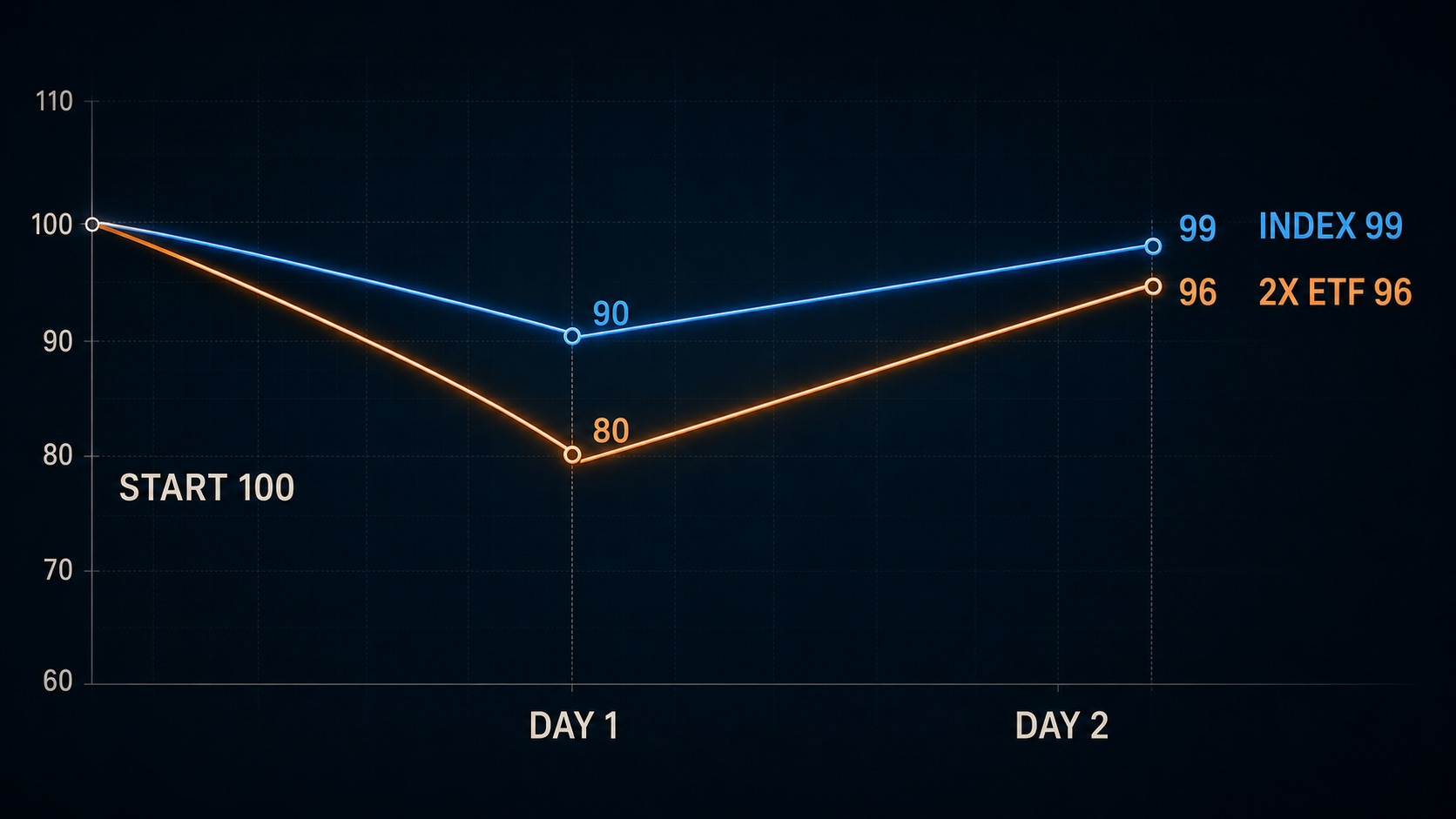
Why can a 2x fund lose more than twice as much over several days? Because every percentage move starts from a new balance. Gains and losses do not cancel each other evenly. The larger the daily swings and the higher the leverage, the more this changing base can work against the investor.
Costs compound too. These products often have higher expense ratios and financing expenses than broad passive funds. GSV’s guide to the ETF expense ratio explains why even ordinary fund costs matter; with leveraged products, investors must also consider derivatives, spreads, and frequent rebalancing.
Five Major Risks Investors Should Understand
1. Magnified Losses
Leverage works in both directions. A sharp adverse move can cause a large one-day loss, and recovering from a loss requires a larger percentage gain. A 50% decline, for example, requires a 100% gain merely to return to the starting value.
2. Long-Term Performance Can Surprise You
Leveraged ETFs do not promise two or three times a benchmark’s return over a month or year. The SEC warns that results over periods longer than one day can differ significantly from the stated daily objective and may expose investors to sudden losses.
3. Single-Stock Concentration
A single-stock leveraged ETF amplifies the daily movement of one company rather than a diversified index. It combines leverage with company-specific earnings, regulatory, management, and valuation risk. Understanding diversification helps clarify what these products remove.
4. Trading and Liquidity Costs
Market price can differ from net asset value, especially during volatile trading. Wider spreads increase the cost of entering and exiting. Before trading, investors should understand the bid-ask spread and avoid treating a displayed price as the full cost.
5. Behavioral Risk
Fast gains can encourage larger positions, performance chasing, or repeated short-term bets. Fast losses can trigger panic selling. A realistic assessment of risk tolerance matters more here than with a diversified long-term fund.
Leveraged ETFs vs Traditional ETFs
| Feature | Traditional Index ETF | Leveraged ETF |
|---|---|---|
| Typical objective | Track a benchmark before costs | Multiply a benchmark’s daily return |
| Daily reset | Usually not relevant | Usually central to the strategy |
| Long-term predictability | Generally closer to benchmark less costs | Highly path-dependent |
| Volatility | Reflects underlying portfolio | Intentionally amplified |
| Typical use | Long-term allocation | Short-term trading or hedging |
| Monitoring need | Periodic review may be enough | Frequent monitoring is often necessary |
Questions to Ask Before Buying

Before pressing Buy, answer these in your own words—not with the fund’s advertisement open beside you:
- What exactly is being multiplied, and how often does it reset?
- How long do I intend to hold it?
- What happens if the underlying stock falls 10% tomorrow?
- Could several volatile days hurt even if the stock later returns near its starting price?
- What are the expense ratio, financing cost, and bid-ask spread?
- What event or date will make me exit?
- Am I making a planned trade—or chasing a stock that already ran?
If you cannot explain the two-day $100 → $120 → $96 example without looking back, pause. That is not a test of intelligence. It is a sign that the product may be moving faster than your understanding.
A stop-loss order can define an exit trigger, but it cannot guarantee the execution price during a gap or fast market. Risk control begins with position size and product understanding, not with an order type alone.
How This Guide Was Verified
- Investor.gov: Leveraged and Inverse ETFs
- SEC: Public Comment on Novel Exchange-Traded Funds
- SEC: Single-Stock Leveraged and Inverse ETFs
- Korea Financial Services Commission: Risks of Single-Stock Leveraged Products
Final Thoughts
I understand why these products attract people. When a semiconductor stock is rising quickly, the ordinary return can suddenly feel too slow. A 2x label seems like a way to catch up.
But a leveraged ETF is not simply the same investment with a larger reward. It is a daily trading mechanism with a changing base, amplified losses, extra costs, and—sometimes—one-company concentration. Holding it longer does not turn the daily promise into a long-term promise.
As a long-term shareholder, I am already exposed to the success and failure of the businesses I own. I do not need to turn every conviction into maximum speed. And when crowded leveraged products appear after a huge rally, I think beginners deserve clearer warnings before the market teaches the lesson through losses.
Would you still buy the fund if the underlying stock fell tomorrow and then moved violently sideways for a week? If you cannot picture that outcome, the 2x gain should not be the only outcome you picture either.
Frequently Asked Questions
Can leveraged ETFs go to zero?
They can suffer extremely large losses, and fund documents may allow closures or reverse splits. The exact outcome depends on the product structure and market move, so investors should read the prospectus.
Are leveraged ETFs good for long-term investing?
They are generally not designed as set-it-and-forget-it holdings. Daily resetting and volatility can cause long-term returns to diverge sharply from the stated multiple.
Do leveraged ETFs use borrowed money?
They typically obtain exposure through derivatives such as swaps and futures rather than simply borrowing cash to buy twice as many securities.
What is the difference between leveraged and inverse ETFs?
A leveraged fund seeks a positive multiple of a daily return, while an inverse fund seeks the opposite daily return. Some products combine both features.
Continue Learning
Ready for the next step? Explore these related investing guides.
Educational disclaimer: This article is for general educational purposes only and is not personalized financial, tax, or legal advice. Leveraged products can produce rapid and substantial losses. Consider your objectives, time horizon, financial situation, and risk tolerance before investing.