
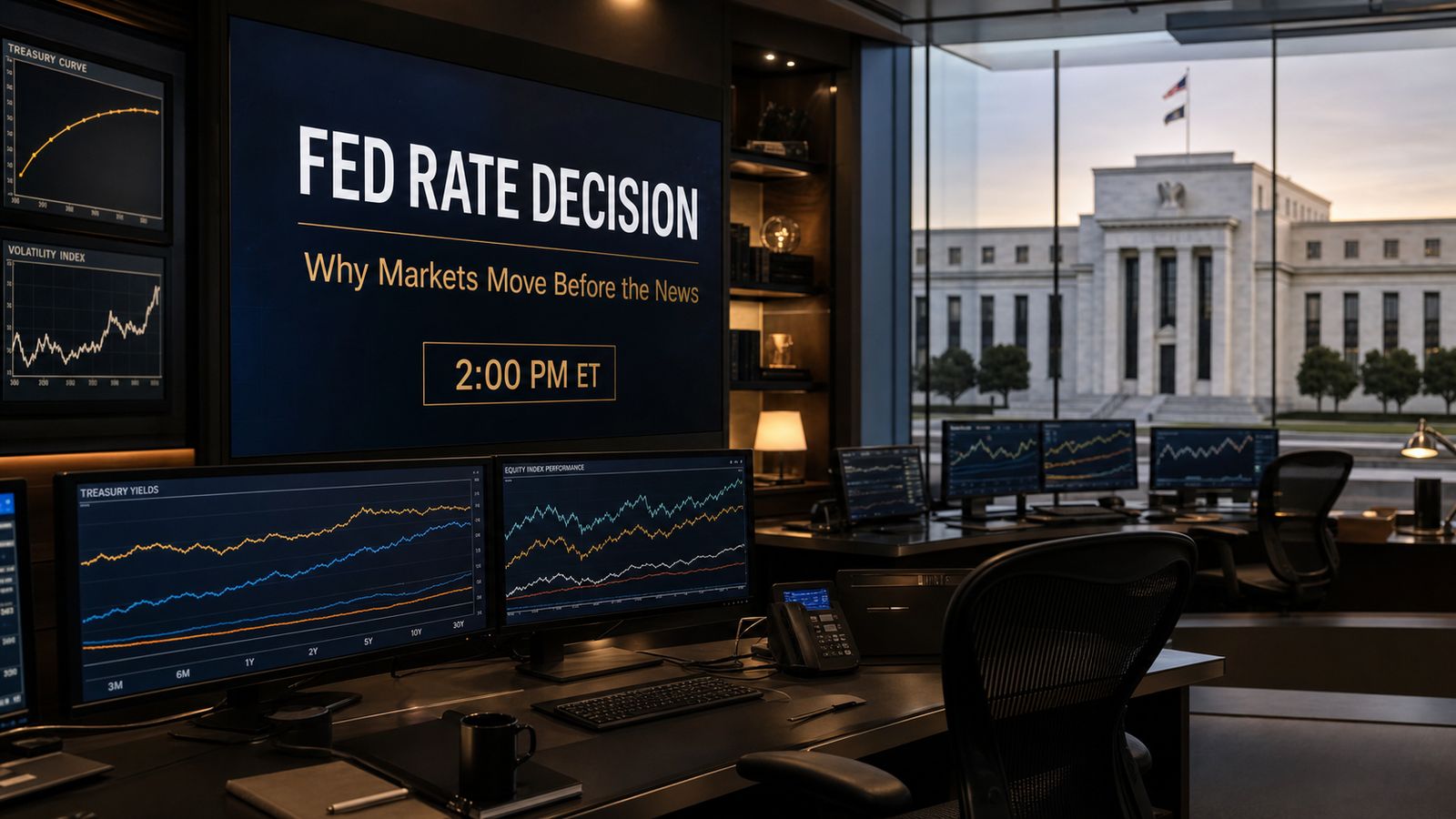
A Fed rate decision changes the price of short-term money in the United States, but the shock does not stop at the U.S. border. It can move the dollar, global bond yields, foreign investment flows, and stock markets—including South Korea.
From the publisher: When I first started investing, I kept hearing about U.S. interest rates. Rates went up, rates went down—so why was my Korean stock moving? I could not see the connection. Yet every Fed announcement seemed to make the Korean market shake, and oil-price news only added more volatility.
Have you ever thought, “The Fed cut rates. Isn’t that good news? Then why are stocks falling?” That confusion is completely reasonable. Markets do not react only to the decision. They react to what they expected, what the Fed says may come next, and why the decision was made.
This guide follows that chain slowly: Fed policy, expectations, the dollar, foreign capital, the Korean won, company costs, and finally the stock price on your screen. No economics degree required.
Key Takeaways
- Markets price probabilities before the announcement, so an expected decision may produce little reaction.
- The policy statement, vote, projections, and press conference can matter more than the rate change itself.
- The Fed directly targets a short-term rate range; mortgage and long-term bond rates are set in broader markets.
- Stocks can rise after a hike or fall after a cut when the message differs from expectations.
- Investors should read the decision as one update in a continuing policy process, not a one-day trading signal.
What Is a Fed Rate Decision?
The Federal Open Market Committee, or FOMC, is the part of the Federal Reserve that sets U.S. monetary policy. It normally holds eight scheduled meetings a year. After each meeting, it announces whether it will raise, lower, or hold its target range for the federal funds rate.
That name sounds technical, but the basic idea is simple. The federal funds rate is an overnight interest rate used between banks. The Fed does not directly type a new rate into your mortgage, credit card, or stock account. Instead, its decision influences many other borrowing costs and financial prices across the economy.
You will often hear that the Fed moved rates by 25 basis points. One hundred basis points equal one percentage point, so 25 basis points mean 0.25 percentage point. For example, a move from 3.50% to 3.75% is a 25-basis-point increase.
The announcement is also more than one number. Investors read what the Fed says about inflation, employment, growth, and future policy. Sometimes one sentence about the future matters more than today’s rate.
GSV’s guide to inflation and interest rates explains why policymakers use rates to cool or support demand. The Consumer Price Index guide covers one major inflation measure.
Why Markets Move Before a Fed Rate Decision
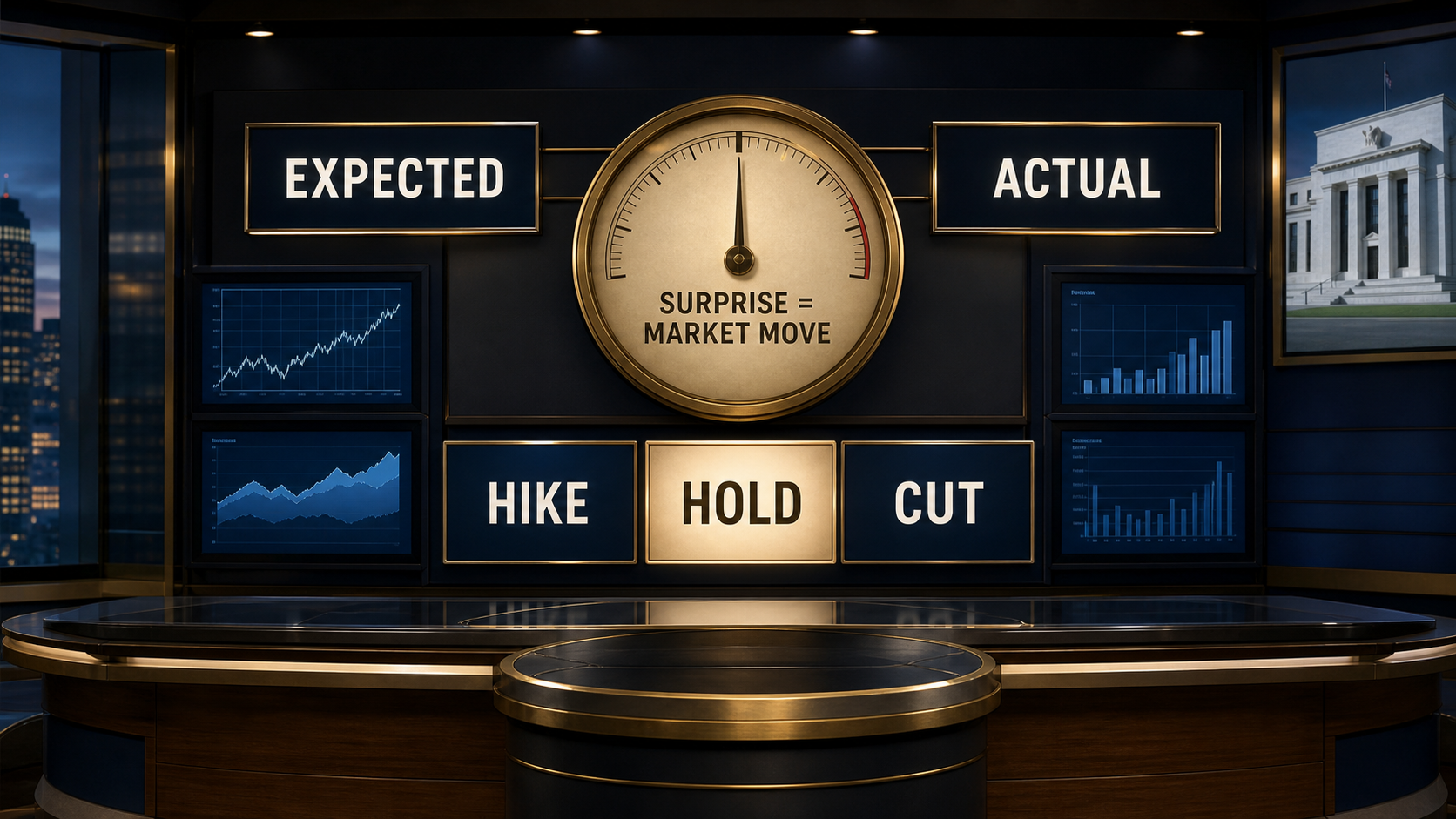
Before a Fed rate decision, professional investors have already spent weeks guessing the result. They study inflation, jobs, growth, Fed speeches, and bond prices. By announcement day, a widely expected cut may already be reflected in stock prices.
Suppose nearly everyone expects the Fed to hold rates. It holds, and nothing else changes. The market may barely react. But if the Fed holds and warns that inflation is still stubborn, investors may suddenly expect rates to stay high for longer. The same word—hold—can produce a very different result.
Why a U.S. Rate Decision Can Move Korean Stocks
This was the part I found hardest to understand. The Fed is in Washington, and the companies are listed in Seoul. Why should one decision reach all the way into my account?
Here is the beginner version. Global money compares possible returns. When U.S. rates or Treasury yields rise unexpectedly, dollar assets can become more attractive relative to riskier assets. Some international investors may reduce exposure elsewhere, hold more dollars, or demand a higher return before owning stocks.
That does not mean every rate hike automatically forces foreigners to sell Korean shares. Growth expectations, company earnings, valuations, geopolitical risk, and Korea’s own economic conditions matter too. Federal Reserve research also finds that emerging-market effects depend on why U.S. rates changed and how vulnerable each economy is.
The exchange rate is another link. A more hawkish Fed message can support the dollar and weaken other currencies, although the relationship is never mechanical. A weaker won can help some Korean exporters when overseas earnings are translated home, but it can also raise the local cost of imported energy, materials, and dollar-denominated obligations.
Then foreign trading begins, the won moves, bond yields react, and large index stocks swing. You open the account and sigh: “All this because of one sentence from the Fed?” Not one sentence alone—but that sentence may have changed expectations across several markets at once.
Where Oil Prices Fit In
Oil adds another layer because South Korea imports much of the energy it uses. Higher oil prices can raise fuel, shipping, and production costs. They can also keep inflation pressure alive, which may make investors expect interest rates to stay high for longer.
So oil can hit the market through two doors: company profits and interest-rate expectations. Still, an oil move does not explain every Korean stock decline. Export demand, semiconductor cycles, earnings, regulation, currencies, and investor positioning can all be moving at the same time.
| What investors hear | Why the market may react differently |
|---|---|
| The Fed holds rates. | Stocks can still fall if the Fed signals that cuts are farther away. |
| The Fed cuts rates. | Stocks can fall if investors think the economy is weakening quickly. |
| The Fed raises rates. | Stocks can rise if the increase was expected and the message sounds less aggressive. |
| The decision matches forecasts. | The press conference or future projections may become the real surprise. |
How to Read Every Fed Rate Decision in 5 Steps
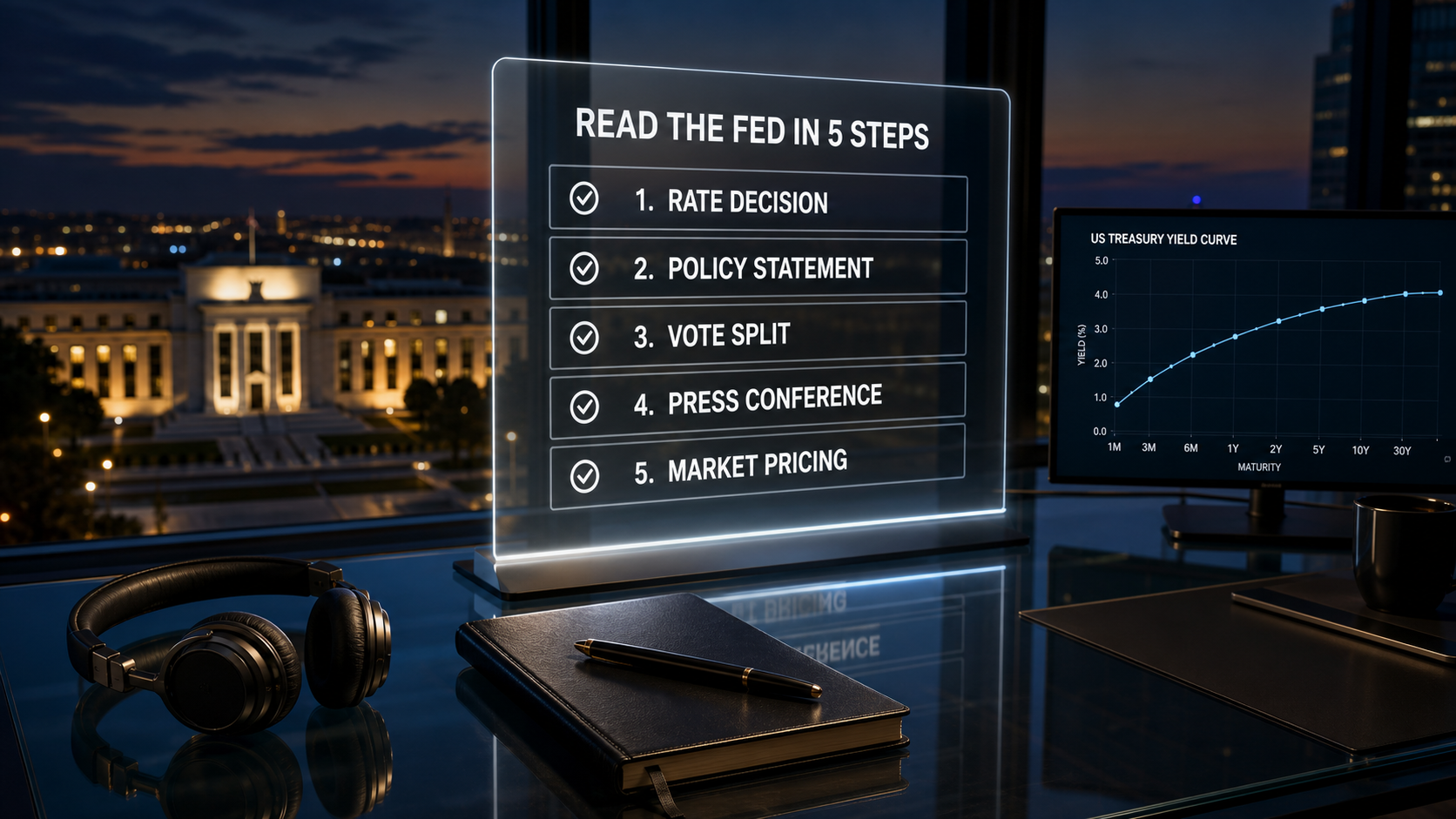
1. Start With the Policy Action
Identify the new target range and any balance-sheet change. Compare the action with the prior setting and the consensus expectation. A headline without the comparison offers little information about the size of the surprise.
2. Compare the Statement Language
Read the current statement beside the previous one. Small changes to descriptions of inflation, employment, growth, uncertainty, and future adjustments can shift expectations. Do not overinterpret one adjective; consider the full paragraph and the data released since the last meeting.
3. Check the Vote
The statement identifies voting members and dissents. A dissent can show that some policymakers preferred a different action, but one vote does not automatically predict the next meeting. Committee membership and evidence can change.
4. Listen to the Press Conference
The Chair explains the committee’s reasoning and answers questions. Markets may reverse their first response when an answer clarifies risks or rejects an interpretation. Prepared remarks matter, but unscripted answers can reveal how policymakers frame uncertainty.
5. Watch Market Pricing
Observe the 2-year Treasury yield, the 10-year yield, the dollar, major stock indexes, and interest-rate futures. The 2-year often reacts strongly to the expected policy path, while the 10-year also reflects growth, inflation, supply, and term premium. Learn the distinction in GSV’s Treasury yields guide.
How a Fed Rate Decision Reaches Markets and Your Money
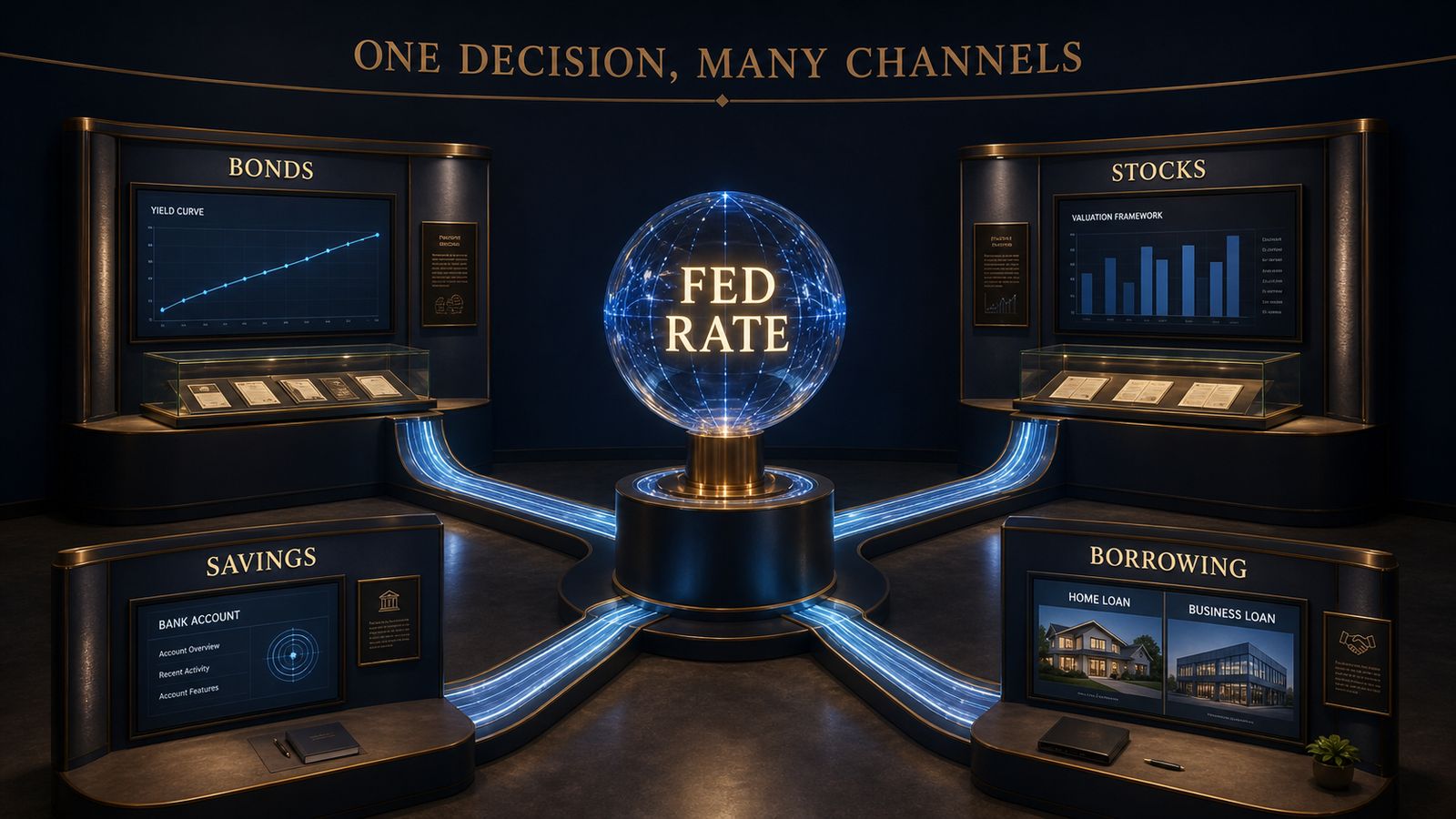
Bonds
Short-term Treasury yields are closely connected to expected overnight rates. Existing bond prices generally fall when comparable yields rise and increase when yields fall. The size of the move depends partly on maturity and cash-flow timing, as explained in GSV’s bond duration guide.
Stocks
After a Fed rate decision, higher expected rates can raise discount rates, increase financing costs, and make safe assets more competitive with equities. Lower expected rates can ease those pressures. Yet the reason for the move matters: an emergency cut associated with a weakening economy may hurt earnings expectations. See Interest Rates and Stocks for the full mechanism.
Savings and Borrowing
Savings yields, Treasury bills, credit cards, and variable-rate loans can respond to short-term rate expectations, although banks and lenders set their own terms. Fixed mortgage rates depend more on longer-term bond yields than on the Fed’s headline rate alone.
The Dollar and Global Markets
A stricter-than-expected message can support the dollar and tighten financial conditions beyond the United States. Dollar moves affect trade, imported costs, international borrowing, and capital flows. That is why investors in Seoul, London, or São Paulo may watch the same press conference as investors in New York.
What Can a Long-Term Investor Actually Do?
You do not have to predict the Fed better than bond traders. I certainly do not. A long-term investor’s job is smaller and more practical: make sure one surprise does not force a panicked decision.
- Keep near-term cash separate. Money needed soon should not depend on what the Fed says next month.
- Check concentration. A portfolio dominated by one volatile sector may react more sharply than the index.
- Watch the reason, not only the rate. A cut caused by weakening growth can worry stocks; a hike caused by strong demand may not be purely bad news.
- Watch the dollar. Currency moves can affect multinational earnings, commodity prices, and global capital flows.
- Review debt and cash yields. Variable borrowing costs and savings returns can respond faster than a long-term stock thesis.
- Rebalance by plan. Do not turn one press conference into an all-or-nothing bet.
Try three simple scenarios: rates stay high, rates fall slowly, or rates fall because the economy weakens sharply. You do not need to guess which one wins. You need a portfolio that can survive more than one of them. GSV’s diversification guide explains how to reduce dependence on a single outcome.
Common Fed Rate Decision Mistakes
- Trading the headline alone. The press conference can reverse the first move.
- Assuming every cut is bullish. A cut can signal economic weakness.
- Assuming every hike is bearish. Strong growth may soften the damage.
- Treating the dot plot as a promise. Projections change with new data.
- Ignoring expectations. Expected news is different from a surprise.
How This Guide Was Verified
- Federal Reserve: What Is the FOMC and When Does It Meet?
- Federal Reserve: Open Market Operations
- Federal Reserve: Selected Interest Rates
- Federal Reserve: U.S. Monetary Tightening and Emerging Markets
Final Thoughts
I used to hear “U.S. rates” and wonder why a Korean stock in my account should care. Now I think of it as a chain rather than a single cause: Fed expectations move U.S. yields and the dollar; those moves can affect currencies, global capital, company costs, and investor confidence.
Does that make every market reaction feel fair? No. It is still maddening when a solid company falls because money is rushing away from risk after a Fed comment. Sigh. But understanding the chain is better than staring at the screen and believing the price moved for no reason.
The next time the Fed cuts rates and stocks fall, ask two questions before reacting: What had the market expected, and why did the Fed make this decision? Those answers usually explain more than the word cut or hold by itself.
Frequently Asked Questions
What time does the Fed announce its rate decision?
For scheduled FOMC meetings, the policy statement is generally released at 2:00 p.m. Eastern Time on the second meeting day. Check the official calendar because schedules can change.
Why do stocks sometimes fall after a rate cut?
The cut may be smaller than expected, accompanied by a restrictive message, or interpreted as evidence that the economy is weakening.
Does the Fed set mortgage rates?
No. The Fed influences financial conditions, but fixed mortgage rates depend heavily on longer-term bond yields, inflation expectations, lender costs, and borrower characteristics.
What should investors watch first?
Start with how the action compares with expectations, then read the statement changes and observe short-term Treasury yields during the press conference.
Continue Learning
Connect monetary policy with the rest of the market.
Educational disclaimer: This article is for general educational purposes only and is not personalized financial, tax, or legal advice. Policy decisions, market expectations, rates, and product terms can change. Consider your objectives, time horizon, liquidity needs, and risk tolerance.