

Tariffs and stocks are connected through a chain that begins at the border and can end in a company’s earnings, consumer demand, interest rates, and valuation. A tariff is collected from the U.S. importer—not directly from the foreign producer—so the first financial question is who ultimately absorbs the added cost.
This question is urgent again after the United States announced new tariffs on imports from dozens of trading partners in July 2026. Yet the useful investing lesson is bigger than one announcement: markets react to expected profits and policy uncertainty before every price increase appears in official inflation data. Understanding the transmission path helps investors separate a dramatic headline from a lasting earnings change.
Key Takeaways
- Tariffs are taxes on imports, initially paid by the importing company to the government.
- The cost may be absorbed by the exporter, importer, retailer, customer, or several parties together.
- Stocks respond differently depending on import dependence, pricing power, competition, retaliation, and valuation.
- Tariff-related inflation can influence interest-rate expectations, creating a second market channel.
- A durable investment decision requires company-level evidence, not a guess about which sector should win.
Why Tariffs and Stocks Move Together
A tariff raises the landed cost of a covered imported product. Suppose a U.S. business imports a component for $100 and faces a 20% tariff. Ignoring other charges, the importer owes $20 when the item enters the country. What happens next depends on bargaining power and competition.
The foreign supplier might reduce its price. The importer might accept a lower profit margin. A retailer might raise the shelf price. Customers might buy fewer units, switch brands, or delay a purchase. In practice, the burden is often shared, changes over time, and varies widely across products.
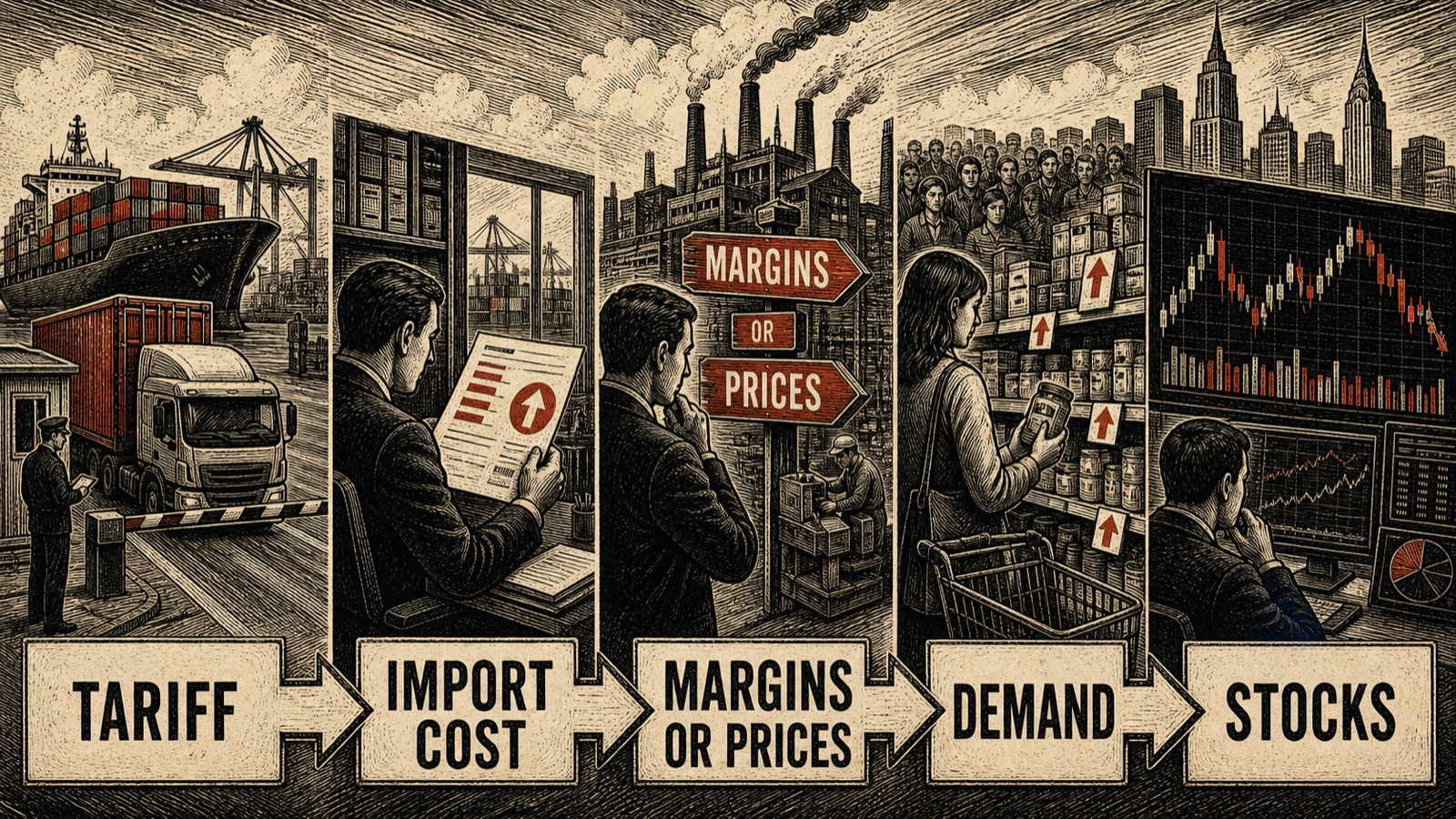
That chain explains why tariffs and stocks can move together without a simple rule that tariffs make all shares fall. A protected domestic producer may gain market share while an importer loses margin. A retailer with a powerful brand may pass through more cost than a commodity seller. The index-level result combines thousands of different exposures.
The Federal Reserve’s 2026 research on the 2025 tariff experience found that retail-price effects developed gradually. A separate Fed study estimated 15%–20% price pass-through in highly exposed household-spending categories relative to less-exposed categories. Those estimates do not apply mechanically to every new tariff, but they show why timing and product mix matter.
The Five Ways Tariffs Affect Stocks
1. Higher Input Costs Can Compress Margins
If a company cannot raise prices, the tariff can reduce gross margin dollar for dollar. Businesses that depend heavily on imported components, have short supplier contracts, or sell undifferentiated products may be especially exposed. Investors should look beyond a company’s headquarters and examine where its inputs actually originate.
Margin pressure matters because a stock represents a claim on future cash flows. Even modest changes in expected profit can move a richly valued stock sharply. The connection between market valuation and changing earnings expectations is often more important than the tariff rate alone.
2. Price Increases Can Weaken Demand
A company may preserve its percentage margin by raising prices, but that does not make the cost disappear. Customers can reduce purchases or choose substitutes. Durable goods such as vehicles, appliances, machinery, and electronics can be sensitive because buyers often have the option to wait.
This is where tariffs and stocks meet the broader economy. If price increases spread while real purchasing power weakens, revenue growth can slow. The outcome resembles one part of the mechanism described in GSV’s guide to stagflation, although tariffs alone do not prove that stagflation will occur.
3. Inflation Can Change the Interest-Rate Path
Tariffs can raise the price level for affected goods, but policymakers must judge whether the effect is temporary or persistent. If inflation expectations rise or repeated tariff rounds broaden price pressure, the Federal Reserve may have less room to reduce rates. If demand weakens sharply, the growth effect may point the other way.
That uncertainty affects interest rates and stocks. Higher expected discount rates generally reduce the present value of distant profits, which can be especially important for high-valuation growth companies. Bond yields, the dollar, and credit conditions can therefore transmit trade policy far beyond importers.
4. Retaliation Can Hurt Exporters
Trading partners may answer U.S. tariffs with duties or restrictions of their own. A company that sources mostly at home can still be vulnerable if it earns substantial revenue abroad. Agricultural producers, manufacturers, logistics firms, and multinational brands can face lower demand or disrupted supply chains.
This is why geographic revenue and input exposure should be evaluated together. GSV’s primer on geopolitical risks explains how policy shocks can move through commodities, currencies, trade routes, and investor sentiment.
5. Uncertainty Can Delay Investment
Sometimes the largest cost is not the tariff itself but the inability to plan. If a rate, exemption, court ruling, or negotiation may change, a company may delay hiring, construction, inventory, or a supplier move. Markets can price that hesitation before it is visible in quarterly revenue.
Uncertainty also raises the value of flexibility. Companies with multiple qualified suppliers, manageable debt, and cash available for redesigns or relocation may adjust more easily. Businesses with one critical foreign source or a fragile balance sheet have fewer options.
Which Companies Are Most Exposed?
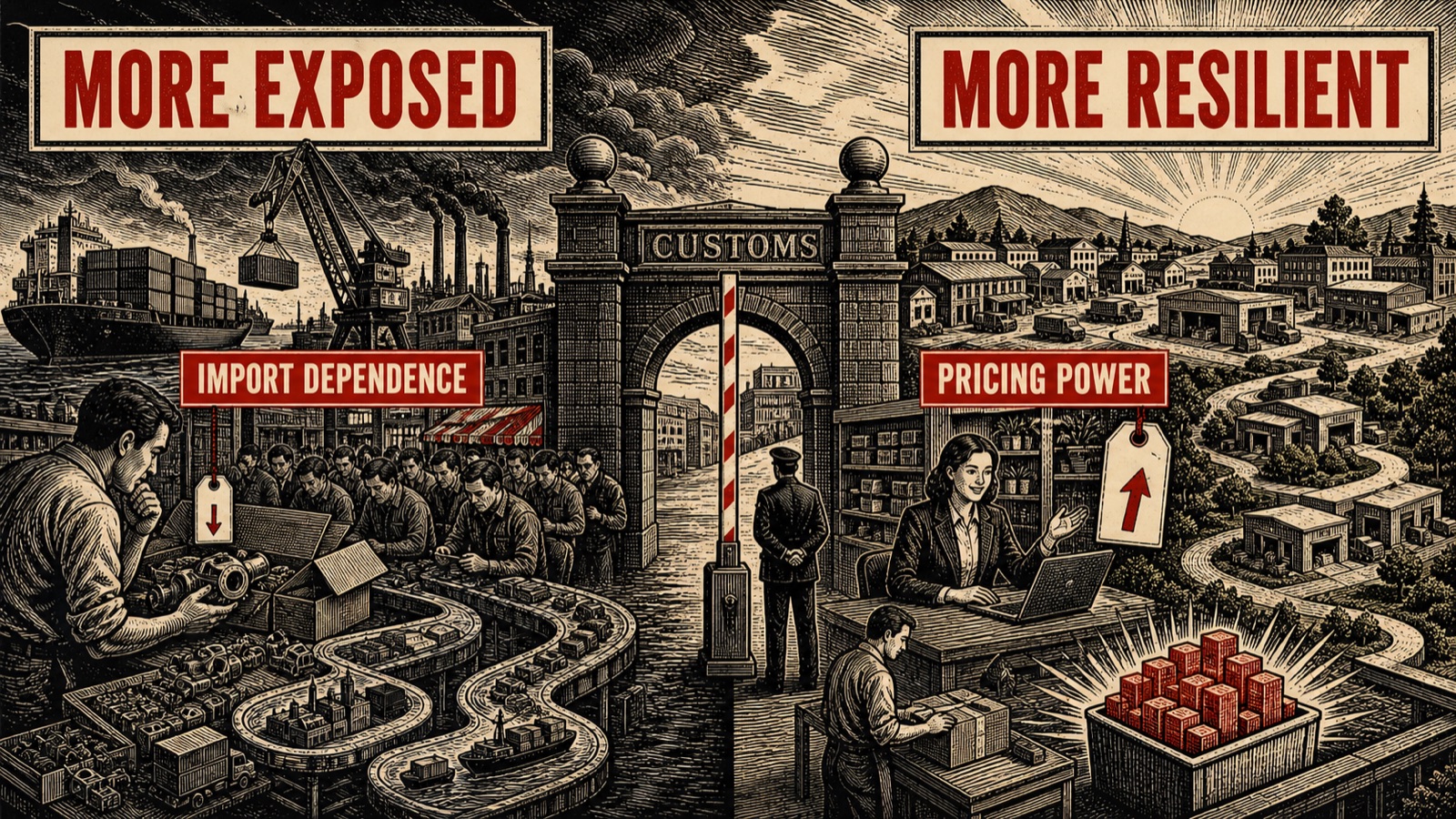
Import dependence is only the beginning. A complete review of tariffs and stocks should ask four questions: How much of the cost base is covered? Can suppliers share the burden? Can the company raise prices without losing customers? Is the risk already reflected in the stock price?
More-exposed businesses often combine imported inputs, low margins, intense competition, limited inventory, and weak bargaining power. Potentially more-resilient businesses may sell domestic services, have several suppliers, command customer loyalty, or operate with enough margin to absorb temporary costs.
Domestic production is not an automatic shield. A factory may use imported machines, metals, chemicals, or electronic parts. Conversely, a multinational importer may have sophisticated hedging, long-term contracts, alternate suppliers, or enough scale to negotiate concessions. Sector labels are shortcuts, not conclusions.
Can Any Stocks Benefit From Tariffs?
Yes, but benefits are conditional. A domestic producer can gain if imported alternatives become more expensive and if it has spare capacity to meet demand. A logistics, automation, construction, or supply-chain company may benefit from efforts to relocate production. Some government contractors or strategic-material suppliers may receive policy support.
However, protection can attract new competition, raise the cost of imported equipment, or invite retaliation. A stock can also become overpriced when investors crowd into an obvious narrative. The correct question is not “Which tariff stocks should I buy?” but “How much durable cash flow can this company earn after costs, competition, and valuation?”
Broad funds can dilute single-company exposure, yet they do not eliminate it. Review the underlying holdings and industry weights, then apply the principles in GSV’s guide to diversification.
How to Analyze Tariffs and Stocks
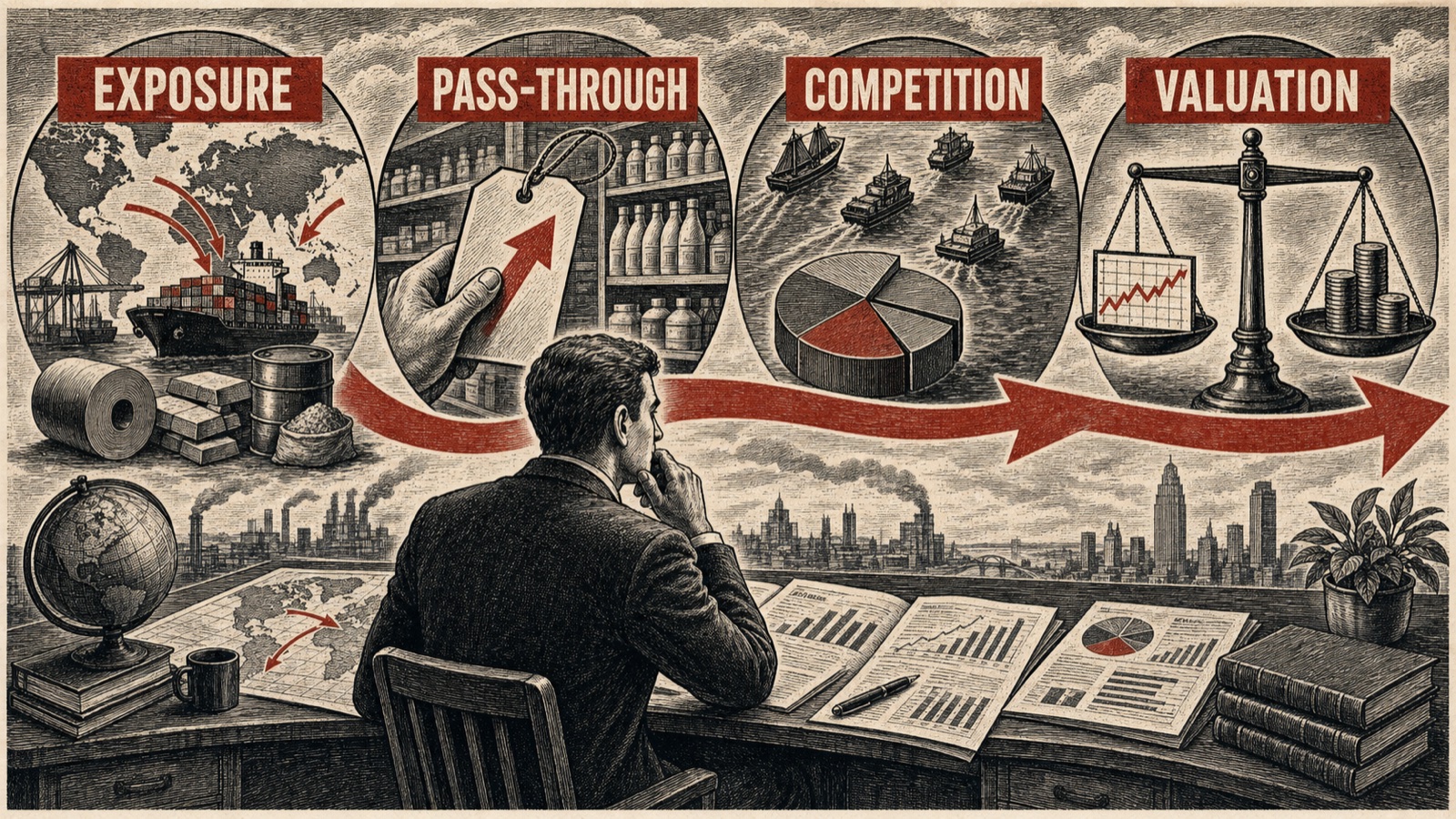
Map the Exposure
Read annual reports, earnings calls, and investor presentations for sourcing, manufacturing, geographic revenue, and customer concentration. Search for tariff, duty, import, supply chain, and pricing. Estimate the portion of cost of goods sold exposed rather than applying the headline tariff to total revenue.
Test Pass-Through
Look for evidence of previous price increases, unit-volume changes, contract terms, brand strength, and substitutes. Pricing power is demonstrated through stable demand and margins—not asserted by management. Compare the company with direct competitors.
Model More Than One Outcome
Use at least a base case, a higher-cost case, and a negotiated or exempted case. Consider the delay between imported inventory arriving, price changes reaching consumers, and financial statements reflecting the effect. The market may react before the accounting numbers do.
Check the Price You Pay
A resilient company can still be a poor investment at an extreme valuation, while a vulnerable company may already trade at a large discount. Compare the possible earnings change with the valuation and your risk tolerance.
What Investors Should Avoid
- Trading every headline. Announcements can change through exemptions, negotiations, litigation, or implementation details.
- Assuming the exporter pays. The legal payment begins with the importer, while the economic burden can be shared.
- Buying a whole sector story. Company supply chains and pricing power vary inside the same industry.
- Ignoring second-order effects. Inflation, rates, currencies, retaliation, and demand can matter more than direct duties.
- Confusing a beneficiary with a bargain. A favorable policy story can already be priced into the stock.
Official and Current Sources
- Office of the U.S. Trade Representative: July 2026 releases
- USTR: July 2026 Section 301 tariff action
- Federal Reserve: How tariffs gradually raised retail prices
- Federal Reserve: Tariffs and household spending
How a Tariff Can Move Through the Economy
| Stage | Possible Effect | What Determines the Burden |
|---|---|---|
| Importer | Pays the tariff when covered goods enter the country | Contract terms, sourcing options, and the tariff rate |
| Company | May absorb cost, switch suppliers, reduce margins, or raise prices | Pricing power, inventory, competition, and supply-chain flexibility |
| Customer | May face a higher price or choose a substitute | Demand, available alternatives, and how much cost is passed through |
| Investor | May see changes in revenue, margins, valuation, or uncertainty | Company exposure and what the stock price already reflects |
The final burden is rarely captured by one headline number. It can be shared across importers, producers, suppliers, workers, customers, and shareholders.
Final Thoughts
Tariffs and stocks connect through costs, prices, demand, retaliation, rates, and valuation. No single market rule captures all those channels. The most useful response is to replace a broad political prediction with a company-level exposure map.
Start with imported inputs and foreign revenue, test pricing power, model several outcomes, and compare the possible earnings change with the stock’s valuation. That process will not remove uncertainty, but it can prevent a temporary headline from becoming a permanent portfolio mistake.
Frequently Asked Questions
Who actually pays a tariff?
The importer pays the tariff to the government at the border. The economic cost may then be shared through lower exporter prices, lower importer margins, higher customer prices, or reduced demand.
Do tariffs always make stocks fall?
No. Effects vary by company and can be offset by protection, pricing power, supplier changes, exemptions, currency moves, or expectations already embedded in prices.
Which stocks are most vulnerable to tariffs?
Businesses with high import dependence, thin margins, weak pricing power, few alternate suppliers, and substantial foreign retaliation risk may be more vulnerable.
Can tariffs cause inflation?
They can raise prices for covered goods, but the size and persistence depend on pass-through, demand, exchange rates, substitutions, and the breadth and duration of the policy.
Continue Learning
Build the next layer of your market-risk framework with these guides.
Educational disclaimer: This article is for general educational purposes only and is not personalized financial, tax, or legal advice. Trade policy and markets can change quickly. Consider your goals, financial situation, time horizon, and risk tolerance before making investment decisions.